
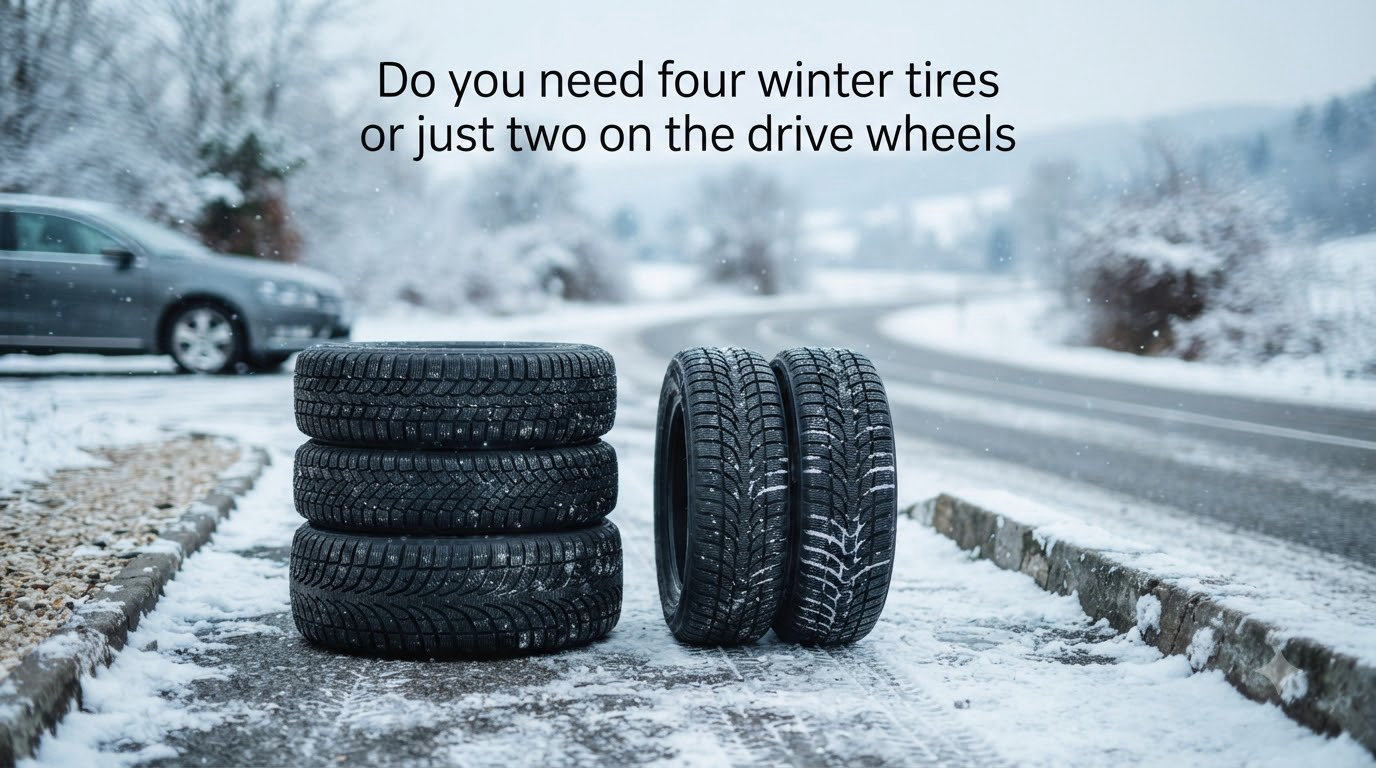
Every winter, drivers walk into our shop asking the same question: do you need four winter tires or just two on the drive wheels? It’s one of the most searched tire questions online, and the answer from every major tire manufacturer is the same. You need four matching winter tires on every wheel position, regardless of whether your car is FWD, RWD, AWD, or 4WD. Installing only two winter tires, whether on the front or the rear axle, creates a dangerous mismatch that modern safety systems were never designed to handle.
In this guide, I’ll break down exactly why four winter tires are non-negotiable, what happens to your car when you mix tire types, and how the answer changes (or doesn’t) based on your drive type. I’ve been around winter tires long enough to know where the misconceptions live, and I’ll address each one head-on.
Table of Contents
Do You Need 2 or 4 Winter Tires?
You need four winter tires, not two. Installing winter tires on only the drive axle, whether front or rear, creates a traction mismatch between the front and rear of your vehicle. The end with more grip can brake, accelerate, and corner differently than the end with less grip, and modern safety systems like ABS and electronic traction control cannot compensate for that imbalance. Every major tire manufacturer recommends a set of four matching winter tires on every wheel position.
What Makes a Winter Tire Different From an All-Season Tire?
A winter tire uses a special cold-weather rubber compound that stays flexible below about 45°F (7°C). Standard all-season rubber hardens in the cold, and once it hardens it loses grip on cold, snowy, or icy pavement.
Beyond the compound, winter tires use a more aggressive tread pattern. Thousands of tiny slits called sipes bite into snow and ice, while deeper tread blocks and channels push slush and water away from the contact patch. The result is shorter stopping distance, better cornering grip, and more confident braking in conditions where all-season tires struggle.
Winter tires also carry the Three-Peak Mountain Snowflake symbol on the sidewall. That symbol means the tire has been tested and certified for severe snow service. All-season tires carrying only the M+S (mud and snow) marking do not meet that standard.
Why Mounting Winter Tires on the Front Only Is Dangerous
Mounting winter tires on the front axle only causes the rear of the car to lose traction before the front. With more grip up front and less grip in back, the rear end can swing wide in a corner, a behavior called oversteer. Drivers describe it as fishtailing, and on snow or ice it can turn a routine turn into a spin.
This risk applies to every drive type, including FWD. A common myth says “put the good tires on the drive wheels so the car can move.” But a FWD car still steers with the front and follows with the rear, and if the rear loses grip first, the car becomes very difficult to control.
Reddit’s r/cars community has a long-running consensus on this: “Always all 4. The rear tires keep you on the road in corners. If the front tires have more traction than the rear tires, the car will enter an oversteer condition.” Mechanics on the same subreddit are equally blunt: never put snow tires only on the front of a FWD.
Why Mounting Winter Tires on the Rear Only Is Also Dangerous
Mounting winter tires on the rear axle only causes the front of the car to lose traction first. The car pushes wide in corners and feels sluggish to steering input, a behavior called understeer. On snow or ice, an understeering car simply plows straight ahead no matter how hard you turn the wheel.
Understeer is the classic failure mode for rear-wheel drive (RWD) cars fitted with winter tires on the rear only. The rear end plants and grips, the front end slides, and the car slides off the road. Drivers often describe the feeling as “the car just wouldn’t turn.”
Several posters in r/cars and r/Cartalk have reported exactly this: a FWD car with two winter tires on the rear pushed straight into a curb in a snowy parking lot. The lesson is the same no matter which axle gets the winter tires: mismatch equals risk.
How Drive Type Changes the Answer
The short answer is that drive type does not change the recommendation. You still need four matching winter tires. But the failure mode differs by drivetrain, so it’s worth walking through each.
Front-Wheel drive (FWD)
On a FWD car, the front wheels both drive and steer. Putting winter tires on the front only gives the car more traction at the drive wheels, which sounds helpful. The problem is the rear, which is now the weak link. Once the rear loses grip in a corner or on slippery pavement, the car snaps into oversteer. The Two new tires should always go on the rear axle, regardless of drive type, which is why tire makers and safety groups all say the same thing: if you only have two winter tires, put them on the rear, and then go buy two more.
Rear-wheel drive (RWD)
On a RWD car, the rear wheels drive and the front wheels steer. Putting winter tires on the rear only gives the drive wheels grip but leaves the steering end of the car with cold, hardened all-seasons. The front loses traction first, the car understeers, and you slide straight. Many RWD owners swear their car is “unusable in snow,” then discover the same BMW, Mercedes, or Crown Victoria becomes a totally different vehicle once all four corners wear matching winter tires. A RWD car on four winter tires outperforms many AWD crossovers on all-seasons.
All-wheel drive (AWD) and four-wheel drive (4WD)
AWD and 4WD help you accelerate. They do almost nothing to help you steer or stop. An AWD Subaru on all-season tires will still slide straight through a snowy intersection because the front tires cannot grip the road. A common misconception is that AWD eliminates the need for winter tires. It doesn’t. Tire Rack testing and AAA studies both confirm that AWD shortens acceleration distance in snow but does not meaningfully improve braking or cornering grip. Four winter tires on an AWD or 4WD vehicle is just as important as on a 2WD vehicle, possibly more so, because drivers of AWD vehicles tend to drive more confidently in conditions that still overwhelm their tires.
If you want a quick visual comparison, here’s what happens when you mount only two winter tires on different drivetrains:
- FWD with 2 winter tires on front: rear loses grip → oversteer / fishtail risk
- FWD with 2 winter tires on rear: front loses grip → understeer / push wide risk
- RWD with 2 winter tires on front: front loses grip → understeer / push wide risk
- RWD with 2 winter tires on rear: rear gains grip but front slides unpredictably
- AWD or 4WD with 2 winter tires on any axle: AWD system cannot balance mismatched grip, behavior becomes unpredictable
In every case, the fix is the same: four matching winter tires on every wheel position.
Can You Save Money by Buying Just 2 Winter Tires?
Drivers ask this question because two tires cost roughly half as much as four. That’s a real saving up front. But the trade-off isn’t really “cost versus safety.” It’s “cost versus bigger cost.” Independent testing consistently shows that four winter tires cut stopping distance on snow by 30-40% compared to all-seasons, often the difference between stopping in time and sliding into the car ahead of you at an intersection.
Some insurance carriers also offer winter tire discounts, and many of those discounts apply only when all four tires are winter tires. Before buying two tires, call your insurer and ask whether the discount requires a full set. You may find that the discount on four tires largely closes the gap.
A used set of four take-off winter tires on dedicated steel wheels is often the most economical route. Mounting the same wheels twice a year is faster and cheaper than remounting rubber on your existing wheels, and it preserves your alloy wheels from road salt corrosion.
When Should You Install and Remove Winter Tires?
The commonly cited rule of thumb is the “7/7 rule”: switch to winter tires when temperatures consistently drop below 7°C (about 45°F), usually around October or November, and switch back to all-seasons in spring when they climb back above 7°C. Don’t wait for the first snowfall. By the time snow is in the forecast, every shop in town is booked and you may not get an appointment for days.
You should also avoid running winter tires year-round. The soft, high-silica compound that grips in the cold wears out quickly on hot summer pavement. You’ll burn through the tread in one season and need new tires sooner, wiping out any savings from skipping the seasonal swap.
Practical Tips for Running Two Sets of Tires
Buy a dedicated winter wheel set. A second set of inexpensive steel wheels with winter tires mounted eliminates twice-yearly mounting fees and protects your alloy wheels from curb rash and salt corrosion. Many shops will store your off-season tires for a small annual fee.
Check your TPMS sensors. Tire Pressure Monitoring System sensors live inside the wheel, so a second wheel set needs its own set of sensors, or your TPMS light will stay on all winter. Most modern vehicles re-learn new sensors automatically after a short drive at highway speed.
Check tread depth before each season. Winter tires should have at least 6/32 inch (about 5 mm) of tread remaining to perform well in deep snow. Anything shallower and the tire has lost most of its snow-biting edges.
Match all four tires. Even within a set of winter tires, mixing brands, models, or tread depths creates the same imbalance problems described above. Replace winter tires in sets of four whenever possible.
Frequently Asked Questions
Do you need 2 or 4 winter tires?
You need four winter tires on every wheel position. Installing only two creates a traction mismatch between the front and rear of the car, and modern safety systems like ABS and electronic traction control cannot correct for that imbalance. Every major tire manufacturer recommends a full set of four matching winter tires.
Do I need 4 winter tires for a FWD car?
Yes. Even on a FWD car, you need four winter tires. The non-driven rear tires still follow the car through corners, and if the rear loses grip before the front, the car will oversteer or fishtail. FWD cars are not exempt from this rule.
Where should you put two new tires on a FWD car?
If you only have two winter tires, put them on the rear axle. The rear tires are what keep the car following the driver’s intended path through corners. Mounting two new tires on the front of a FWD car creates oversteer, which is harder to control than understeer. Then buy two more for the front as soon as you can.
Why is RWD not good for snow?
RWD cars send power to the rear wheels only, and weight shifts backward during acceleration, which lightens the steering end of the car. Without winter tires, the rear easily breaks loose and the front loses steering grip. With four winter tires, a RWD car becomes a confident winter vehicle, often outperforming AWD crossovers on all-seasons.
Do rear wheel drives oversteer or understeer?
RWD cars tend to oversteer when the rear loses grip before the front, which is the more common failure mode in snow. With mismatched tires, behavior can flip between oversteer and understeer unpredictably, depending on throttle and steering input.
Should I replace 4 tires or just 2?
Replace all four at once. Even on the same axle, mixing a new tire with a half-worn tire changes the effective diameter and can trigger ABS or traction control warnings. Across axles, mixing tire types creates the front-to-rear traction imbalance covered above. A full set of four is the safest, longest-lasting option.
What are the disadvantages of 4WD over 2WD?
4WD and AWD systems add weight, complexity, and cost. They improve acceleration in snow but do almost nothing for braking or cornering grip. They also encourage drivers to venture into conditions their tires cannot handle, which can be more dangerous than driving a 2WD car with appropriate caution. Four winter tires on any drivetrain outperform all-seasons on any drivetrain.
The Bottom Line on Winter Tires
So, do you need four winter tires or just two on the drive wheels? You need four, every time, no matter the drivetrain. Two winter tires create a traction mismatch that ABS, traction control, and all-wheel drive cannot fix. The cost saving of buying two instead of four is small compared to the cost of even a minor winter collision, and many insurance carriers offer winter tire discounts that close the gap further.
If you regularly drive in temperatures below 45°F (7°C), deal with snow, ice, or slush, or just want shorter stopping distances in cold weather, four matching winter tires on a dedicated wheel set is the safest and most economical long-term choice. Mount them before the first snowfall, remove them when temperatures climb back into the 50s, and store the off-season set somewhere cool, dry, and out of direct sunlight.
For more guidance on choosing the right winter tire for your vehicle, our team is happy to help you compare options by size, speed rating, and the conditions you actually drive in.