
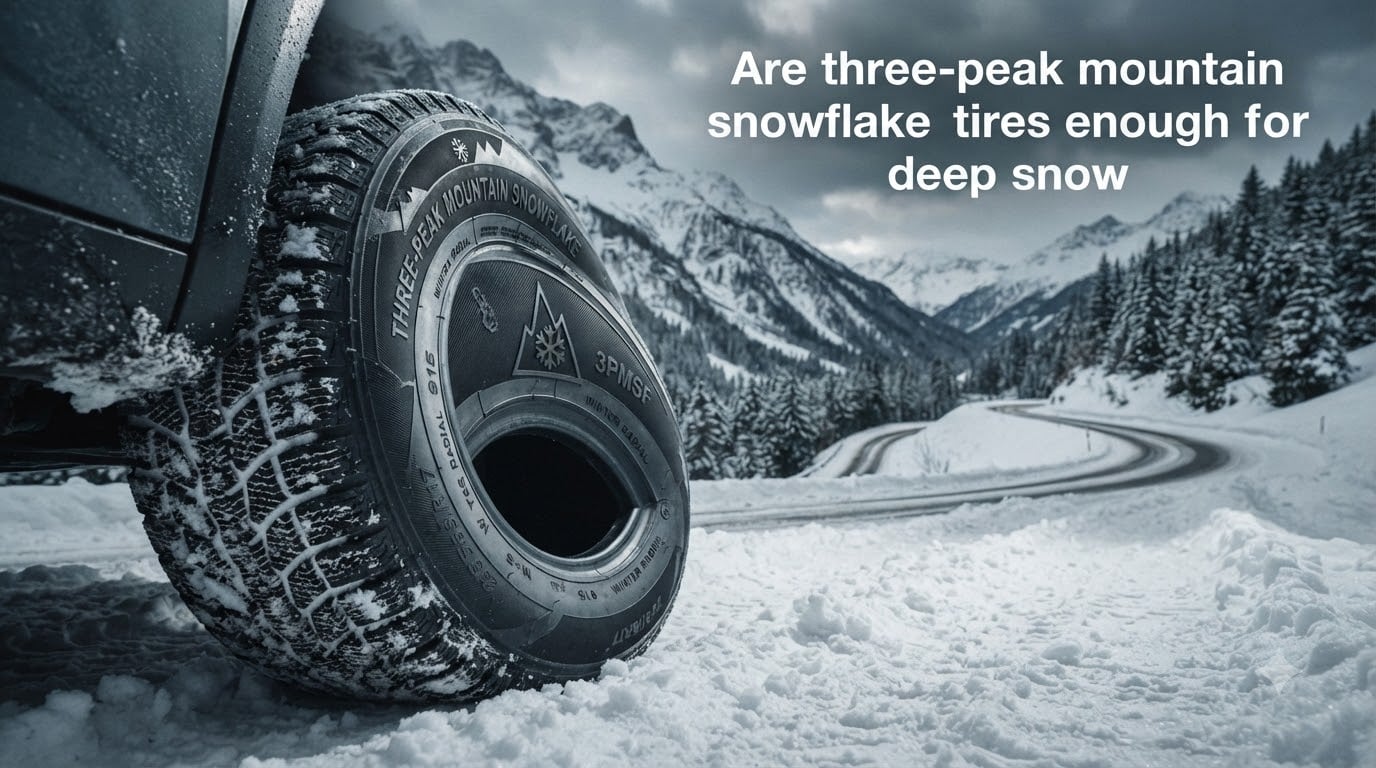
Three-peak mountain snowflake (3PMSF) tires are not enough for deep snow. They pass an industry snow-traction acceleration test (ASTM F2493) but do not test braking, cornering, ice grip, or rubber flexibility below roughly 7°C / 45°F. For unplowed roads, mountain passes, or fresh snow deeper than about 4 inches, dedicated winter tires (the ones that also carry the Alpine / severe snow conditions symbol) are the safer choice.
If you have been asking whether the little mountain logo on your tire’s sidewall really means “good in deep snow,” this guide breaks down exactly what the 3PMSF symbol does, what it leaves out, and the real-world conditions where it falls short. I will also cover the AWD / 4WD misconception, EV-specific behavior in deep snow, and a simple inches-of-snow rule of thumb you can use before your next winter drive.
Table of Contents
The Short Answer
For light winter commutes on plowed roads, 3PMSF all-weather tires are genuinely useful and noticeably better than a basic all-season tire without the marking. For deep, fresh snow on unplowed roads, mountain passes above 4 to 6 inches of accumulation, or extended sub-freezing cold, 3PMSF tires are not enough on their own.
Dedicated winter tires – including studless winter tires and studded winter tires – use a softer rubber compound tuned for cold temperatures and a tread pattern designed to bite into packed snow and ice. That is what 3PMSF all-weathers are not built to do at the limit.
What Is the Three-Peak Mountain Snowflake (3PMSF) Symbol?
The three-peak mountain snowflake symbol is a sidewall marking that means the tire has passed an industry-standard snow traction acceleration test (ASTM F2493). To earn it, a tire must accelerate in packed snow at least 10% better than a reference tire in controlled conditions. The symbol looks like a snowflake nested inside a mountain with three peaks.
The 3PMSF symbol was introduced in the late 1990s so drivers could tell apart a true cold-weather tire from a basic all-season tire that only carries an M+S (mud and snow) marking. M+S is a self-declared designation with no standardized test. 3PMSF is the line that separates marketing from measurable snow performance.
You will most often see 3PMSF on all-weather tires – the newer category that aims to handle both summer and winter in a single tire. It can also appear on some dedicated winter tires and on certain all-season tires built for colder climates, but it is not universal across those categories.
What the 3PMSF Test Actually Measures (and What It Doesn’t)
The ASTM F2493 test is a snow-to-snow acceleration test on a defined, medium-packed snow course. A test tire is run alongside a reference tire, and the test tire must accelerate, on average, at least 10% faster than the reference across multiple runs. That is the entire bar.
Three things the 3PMSF test does not cover:
- Braking on snow or ice. The test is acceleration-only. Stopping distance is a different metric, and dedicated winter tires consistently post shorter braking distances on packed snow and ice than 3PMSF all-weathers.
- Cornering grip on snow or ice. Lateral traction is not part of the test.
- Cold-weather compound performance below roughly 7°C / 45°F. The test is run at moderate cold temperatures. The very property that makes dedicated winter tires work – a compound that stays flexible as temperatures drop well below freezing – is not what 3PMSF certifies.
That last point is the most misunderstood. An all-weather tire with the 3PMSF symbol uses a compound harder than a dedicated winter tire’s. It is more cold-tolerant than a summer or all-season tire without 3PMSF, but it stiffens more than a true winter tire as temperatures drop into the single digits or below zero Fahrenheit.
3PMSF vs the Alpine (Severe Snow Conditions) Symbol
There is a second, less common sidewall symbol that drivers confuse with 3PMSF. The Alpine symbol – sometimes called the “severe snow conditions” symbol – looks like a single mountain with a snowflake inside it. It is the European E-mark certification for use as a dedicated winter tire in countries that require them by law.
The two symbols are not the same, and they are not interchangeable.
| Symbol | Name | What It Certifies | Tire Category |
|---|---|---|---|
| 3PMSF (three peaks + snowflake) | Three-peak mountain snowflake | ASTM F2493 snow traction acceleration, at least 10% better than reference tire | All-weather (most common), some dedicated winter, some all-season |
| Alpine (single peak + snowflake) | Severe snow conditions symbol (3PMS) | UNECE Regulation 117 snow performance on packed snow (braking, traction, cornering) | Dedicated winter tires only |
| M+S | Mud and snow | Self-declared by manufacturer; no standardized test | All-season, all-weather, winter – varies widely |
If you see only the Alpine symbol and not 3PMSF, you are looking at a European-spec dedicated winter tire. If you see only 3PMSF, you are looking at an all-weather or winter-rated tire that passed the North American acceleration test. A tire can carry both. Neither replaces the other.
All-Weather vs All-Season 3PMSF: The Distinction That Matters
This is the area where buyers get misled most often. Not every tire with 3PMSF is the same.
All-weather tires are designed to stay on the vehicle year-round. They carry the 3PMSF symbol, use a cold-tolerant compound, and have an aggressive siping pattern for snow traction. Popular examples include the Michelin CrossClimate 2, Bridgestone WeatherPeak, and the Toyo Celsius II. They trade some dry and warm-weather performance for legitimate winter capability.
All-season tires with 3PMSF are a smaller subset. Some all-season tires now carry 3PMSF and are marketed as cold-climate all-seasons, but they are not the same as all-weather tires. They typically use a harder compound and prioritize treadwear and fuel economy over deep-snow grip.
Basic all-season tires without 3PMSF use a summer-leaning compound that stiffens in cold weather. On a 25°F morning, a basic all-season tire can feel almost plastic. Braking distances on cold, dry pavement and on light snow are noticeably worse than a 3PMSF tire.
When someone tells you they have “3PMSF tires,” ask which category. An all-weather with 3PMSF is meaningfully better in cold weather than an all-season with 3PMSF, and both are meaningfully better than an all-season without it.
How Deep Is Too Deep for 3PMSF Tires? (Decision Rule)
Here is the rule of thumb I use when advising drivers. It is not a laboratory number, but it tracks with what I have seen across thousands of owner reports on forums and what the tire engineers I trust tell me informally.
- 0 to 2 inches of fresh snow on a plowed road: 3PMSF all-weather tires handle this comfortably. You are driving on mostly clean pavement with patches of snow. Almost any 3PMSF tire is fine.
- 2 to 4 inches of fresh snow on lightly plowed roads: 3PMSF all-weathers are still adequate. You will feel the car working a little harder in deeper ruts, but grip is manageable for cautious drivers.
- 4 to 6 inches of fresh snow, unplowed residential or rural roads: This is the gray zone. Drivers with all-weather 3PMSF tires in AWD or 4WD vehicles generally get through, but FWD and RWD drivers start reporting difficulty, especially on any grade.
- 6+ inches of fresh, unplowed snow, or any sustained mountain driving: 3PMSF all-weather tires are not enough. Dedicated winter tires are the safer call.
The threshold drops further when temperatures fall below 0°F. Cold stiffens the rubber compound, and once you are 10 to 20 below zero Fahrenheit, the difference between an all-weather 3PMSF and a dedicated winter tire becomes obvious. Drivers in the Upper Midwest and Interior Alaska consistently report this.
3PMSF Tires vs Dedicated Winter Tires: Honest Comparison
Dedicated winter tires are engineered specifically for sustained cold and snow. They use a softer, more silica-rich rubber compound that remains flexible well below freezing. Their tread blocks are heavily siped – cut with hundreds of tiny slits that grip snow crystals. Many also carry the Alpine symbol.
The trade-off is real: winter tires wear faster on warm, dry pavement, fuel economy drops a bit, and you need a second set of wheels if you want to swap seasonally.
| Factor | 3PMSF All-Weather | Dedicated Winter / Snow Tire |
|---|---|---|
| Best for | Mild to moderate winter, plowed roads, year-round use | Heavy snow, unplowed roads, mountain passes, extended cold |
| Fresh snow acceleration | Good (passes ASTM F2493) | Better, especially above 4 inches |
| Snow braking | Adequate to good | Noticeably shorter distances |
| Ice grip | Moderate | Substantially better; studded versions even more so |
| Cold compound (below 0°F) | Stiffens noticeably | Stays flexible, grip stays consistent |
| Year-round usability | Yes | No – wear accelerated on warm pavement |
| Treadwear | 40,000 to 60,000 mile warranties are common | Lower; designed for seasonal use |
If you live somewhere with light, plowed winters and you do not want to swap tires twice a year, a 3PMSF all-weather tire is a sensible choice. If you face real winter – unplowed roads, mountain commutes, long cold snaps – dedicated winter tires are the better tool for the job.
How Do 3PMSF Tires Perform on Ice?
On clear, glare ice, even the best 3PMSF all-weather tires fall short of dedicated winter tires. The ASTM F2493 test does not measure ice traction at all. Tire makers rely on siping and a softer compound for ice grip, but the rubber formulation of a dedicated winter tire is fundamentally more ice-friendly.
If you regularly drive on icy roads – lake-effect snow belts, shaded mountain curves, freeze-thaw urban streets – the practical difference between a 3PMSF all-weather and a studless winter tire is significant. Studded winter tires go further, with metal studs that physically bite into ice, though they come with road-surface restrictions in many states.
The AWD/4WD Fallacy: Why Drivetrain Doesn’t Replace the Right Tire
This is the single most common misconception I see in winter-tire threads. All-wheel drive and four-wheel drive help a vehicle accelerate. They do almost nothing for braking, and they do nothing at all for cornering grip. A tire is what contacts the road in every one of those directions.
I have read dozens of owner reports from AWD SUV drivers who got stranded in 8+ inches of fresh snow on 3PMSF all-weather tires, often saying they thought AWD would compensate. It does not. AWD got them moving; it could not help them stop, turn, or climb out of a deep rut when the tires packed with snow and lost bite.
If you have an AWD or 4WD vehicle and you face deep snow, the right answer is still dedicated winter tires. AWD plus winter tires is the best combination. AWD plus 3PMSF all-weathers is decent, not great.
Studded Tires vs 3PMSF for Deep Snow
Studded winter tires outperform 3PMSF all-weather tires on hard-packed snow and glare ice. The studs physically penetrate ice, giving you grip no siped rubber can match. For deep, fresh, unconsolidated snow, the gap narrows – both can struggle if the snow is loose and deeper than the tread depth.
The catch is legality. Many U.S. states restrict studded tires by date or road type, and they are louder on bare pavement. For most drivers, a high-quality studless winter tire with the Alpine symbol is the more practical choice unless you regularly drive on icy roads where studs are permitted and noise is not an issue.
EV and Heavy Vehicle Considerations in Deep Snow
Electric vehicles add a wrinkle that tire marketing does not always acknowledge. EVs deliver maximum torque at zero RPM, which is the worst possible moment to ask a tire to find grip. Several EV owners on Tesla and Rivian owner forums report difficulty starting from a stop in deep snow on 3PMSF all-weather tires, even with traction control engaged.
Two practical tips: enable the vehicle’s winter or slip-start mode if it has one, and consider dedicated winter tires if you regularly drive an EV in deep, fresh snow. The instant-torque penalty on a soft, cold-compound winter tire is smaller than on a 3PMSF all-weather.
Heavy vehicles – three-quarter-ton and one-ton trucks and vans – put more weight on each tire, which can help bite into snow but also makes loss of traction at low speeds more abrupt. The same rule applies: dedicated winter tires, and consider lowering tire pressure 2 to 3 PSI below the door-sticker recommendation in extreme cold for a larger contact patch.
How to Verify Your Tire Actually Has the 3PMSF Marking
Look at the sidewall. The 3PMSF symbol is on the tread shoulder, not the center sidewall. It is small and easy to miss. If you only see M+S but no mountain-with-snowflake, the tire does not carry the 3PMSF certification.
You can also confirm by the tire’s full model name. Manufacturers list 3PMSF as a feature in their spec sheets. If a tire is described as “M+S only,” it has not been certified. Some budget all-season tires carry M+S for marketing but skip the more expensive ASTM F2493 testing.
Regional Recommendations by Winter Climate
Where you drive matters as much as which tire you choose.
- Pacific Northwest (Seattle, Portland, Bend): Occasional snow at elevation, mild winters. 3PMSF all-weather tires are usually enough for valley driving. Dedicated winter tires recommended if you regularly drive over mountain passes.
- Mountain West (Denver, Salt Lake City, Boise, Reno): Real winter, with deep snow and sustained cold at elevation. Dedicated winter tires are the right choice, especially above 5,000 feet. Many drivers run two sets.
- Upper Midwest (Minneapolis, Milwaukee, Fargo): Long cold, lots of snow. Dedicated winter tires pay off here more than almost anywhere. 3PMSF all-weathers are a reasonable compromise for drivers who refuse to swap.
- Northeast (Boston, Hartford, Buffalo, Albany): Lake-effect snow belts need dedicated winter tires. Coastal and southern New England drivers on plowed roads can manage with 3PMSF all-weathers.
- Mid-Atlantic and South (DC, Raleigh, Atlanta, Dallas): Light, infrequent winter. 3PMSF all-weather tires are overkill; basic all-seasons are fine unless you regularly drive into snow for ski trips.
Quick Decision Guide: Should You Use 3PMSF or Dedicated Winter Tires?
Answer these four questions honestly:
- Do you regularly drive on roads that are not plowed within 12 hours of a storm?
- Do you face more than 4 to 6 inches of fresh snow in a typical storm?
- Do you regularly see temperatures below 10°F?
- Do you drive mountain passes, rural roads, or steep driveways?
If you answered yes to two or more of those, dedicated winter tires are the safer choice. If you answered no to three or more, a 3PMSF all-weather tire is probably enough for your winters.
Frequently Asked Questions
What does the three-peak mountain snowflake symbol mean?
The three-peak mountain snowflake (3PMSF) symbol is a sidewall marking that means the tire passed the ASTM F2493 snow traction acceleration test. It must accelerate at least 10% faster than a reference tire in standardized snow conditions. It does not certify braking, cornering, or ice performance.
Are 3PMSF tires as good as dedicated winter tires?
No. 3PMSF all-weather tires are useful for mild to moderate winter on plowed roads, but dedicated winter tires use a softer cold-weather compound, more aggressive siping, and shorter braking distances on snow and ice. For deep snow, unplowed roads, or extended cold, winter tires are the safer choice.
What is the difference between 3PMSF and the severe snow conditions (Alpine) symbol?
3PMSF is a North American snow acceleration test. The Alpine symbol (a single peak with a snowflake) is a European UNECE certification that covers snow braking, traction, and cornering. Dedicated winter tires often carry both. The Alpine symbol indicates a true winter tire; 3PMSF does not on its own.
How deep can 3PMSF tires drive in snow?
On plowed roads with up to about 2 inches of fresh snow, 3PMSF all-weathers perform well. Between 2 and 4 inches on lightly plowed roads they remain adequate. Above 4 to 6 inches of fresh, unplowed snow, performance drops sharply and dedicated winter tires become the safer choice. The threshold is lower in extreme cold.
Do 3PMSF tires work on ice?
Moderately. The ASTM F2493 test does not measure ice traction at all. 3PMSF all-weather tires rely on siping and a softer compound for ice grip, but a dedicated studless winter tire grips ice noticeably better. Studded winter tires are best of all on glare ice where they are legal.
Does AWD make 3PMSF tires enough for deep snow?
No. All-wheel drive helps a vehicle accelerate, but it does not improve braking or cornering grip – those depend entirely on the tires. Drivers who got stuck in deep snow with AWD and 3PMSF all-weathers consistently report being surprised that their drivetrain could not compensate. AWD plus winter tires is the strongest combination.
Bottom Line on Three-Peak Mountain Snowflake Tires and Deep Snow
Three-peak mountain snowflake tires are enough for plowed roads and light snow, but they are not enough for deep snow on unplowed roads, mountain passes, or extended sub-freezing cold. If you live where winter is real, dedicated winter tires – ideally studless with the Alpine symbol – remain the safer tool. 3PMSF all-weathers are the right compromise for everyone else.