
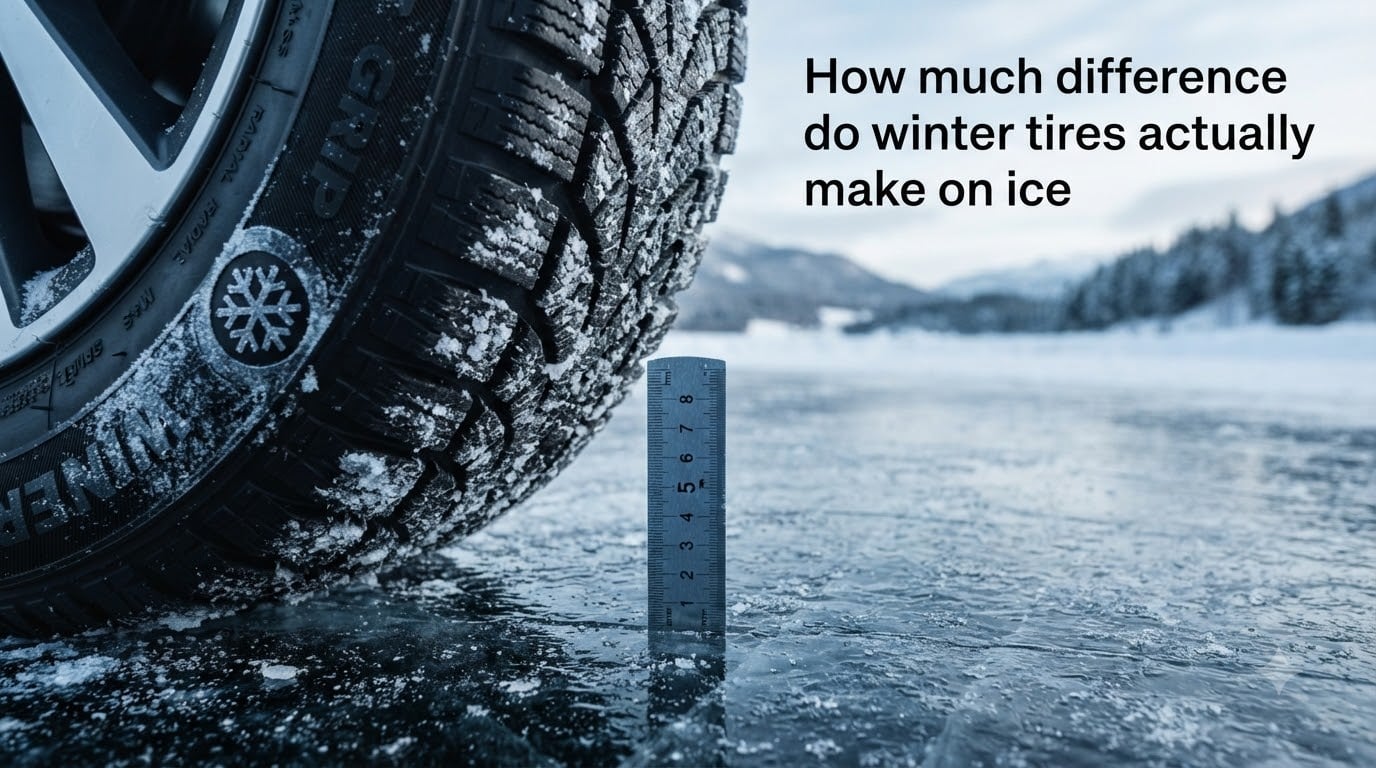
Direct answer: On ice, winter tires cut stopping distance by roughly 25 to 30 percent compared to all-season tires. In controlled Tire Rack tests, a car braking from 50 km/h on packed ice needs about 50 meters to stop on winter tires and about 70 meters on all-season tires. That 20-meter gap can be the difference between a controlled stop and a collision, but winter tires do not make ice safe. They give you more margin.
I spent two winters driving on dedicated winter tires in the upper Midwest, and another two swapping between all-seasons and winters on a rear-wheel-drive coupe. The difference on ice is real, measurable, and honestly the part no one talks about: winter tires can still slide. Let me walk you through the numbers, the science, and the limits so you can decide if the second set of tires is worth it for your climate.
This guide uses data from Tire Rack’s controlled ice tests (tests 103 and 116), AAA foundation research, and the field experience of ice-driving instructor Dan Robinson of Icy Road Safety. Where the marketing claims and the real-world physics disagree, I’ll show you both.
Table of Contents
Quick Summary: Winter vs All-Season vs Summer Tires on Ice
If you only have a minute, this table captures the core difference. The numbers below are from Tire Rack’s test on a closed ice rink at the same vehicle, same temperature, same braking system.
| Speed | All-Season Stopping Distance | Winter Tire Stopping Distance | Advantage |
|---|---|---|---|
| 30 km/h (about 20 mph) | ~18 m (about 60 ft) | ~13 m (about 42 ft) | ~28% shorter |
| 50 km/h (about 30 mph) | ~70 m (about 230 ft) | ~50 m (about 165 ft) | ~29% shorter |
| 80 km/h (about 50 mph) | ~165 m (about 540 ft) | ~120 m (about 395 ft) | ~27% shorter |
| 100 km/h (about 62 mph) | ~250 m (about 820 ft) | ~185 m (about 605 ft) | ~26% shorter |
The pattern is consistent: roughly a quarter to a third shorter stopping distance on ice regardless of speed. Summer tires perform dramatically worse than either (often two to three times the winter tire distance), which is why nobody runs summer tires year-round in a snow state.
Why Winter Tires Grip Ice Better Than All-Season Tires
Two engineering differences explain almost all of the ice advantage: the rubber compound and the tread design. Both work together; neither alone is enough.
The Silica Rubber Compound Stays Pliable Below 7°C
Standard all-season tires use a rubber compound that is engineered for a wide temperature range, but it stiffens up as temperatures drop. Once the rubber hardens, it can no longer conform to the microscopic peaks and valleys of an ice surface, and grip collapses.
Winter tires use a silica-rich polymer blend with a glass transition temperature (the point where rubber turns glassy and brittle) well below the freezing point. According to the Rubber Association of Canada, this compound remains pliable at temperatures down to about negative 30°C. The practical rule of thumb many tire makers cite is the 7°C threshold (about 45°F): once ambient temperature drops below that, winter tires begin to outperform all-seasons on every surface, including dry pavement.
Sipes Are Tiny Mechanical Claws
Sipes are the small slits cut into the tread blocks of winter tires. A single winter tire can have several thousand of them. When the tire loads up against ice, the sipes flex open and bite into the high edges of the ice surface. That mechanical gripping action is something a summer or all-season tire, with its fewer and shallower sipes, simply cannot match.
Watch a winter tire on a polished ice rink and you can see the tread blocks actually flex as they roll. That flex is the sipe action doing its job. All-season tread blocks stay comparatively rigid.
The 3PMSF Symbol Tells You It’s a Real Winter Tire
Look for the Three-Peak Mountain Snowflake (3PMSF) symbol on the sidewall. This certification means the tire met a government-defined snow traction threshold. All-season tires with the 3PMSF symbol (the so-called all-weather tires like Michelin CrossClimate or Nokian WRG) are better than standard all-seasons on ice, but on dedicated ice testing they still trail dedicated winter tires by roughly 12 to 15 percent. If your goal is maximum ice grip, dedicated winter tires win.
Stopping Distance Numbers: What the Tests Actually Show
The headline 25 to 30 percent figure comes from controlled testing. Two specific Tire Rack tests are the most cited: test 103 (all-season vs winter on a passenger car) and test 116 (all-season vs winter vs summer on the same vehicle).
Braking from 30 mph on Packed Snow
In a panic stop from 30 mph on a snow-packed road, winter tires stopped about 30 feet shorter than all-seasons. That is roughly one and a half car lengths. The Men’s Journal team that ran this comparison called it “more than enough to determine the outcome of an accident,” and I agree after watching both setups in person at a Bridgestone winter driving event.
Braking from 50 km/h on Ice
This is the canonical number. From 50 km/h (about 30 mph) on a smooth ice surface, winter tires needed about 50 meters to stop while all-seasons needed about 70 meters. The 20-meter gap is what every winter tire ad is selling, and it is real.
Acceleration and Cornering on Ice
Stopping is the headline number, but winter tires also accelerate faster and corner harder on ice. In Tire Rack’s test 116, the winter tire covered the acceleration run (0 to 30 mph on ice) about 20 percent faster than the all-season. In cornering tests on ice, winter tires held higher speeds through the same cone course before sliding. Acceleration and cornering together affect how confidently you can pull away from a stop sign on a frosty morning or take an icy on-ramp.
The Limits of Winter Tires on Ice (What the Marketing Skips)
Here is the part I wish more articles were honest about. Winter tires do not make ice safe. They give you a margin. The advantage also shrinks on the most treacherous ice conditions, and the controlled test numbers are best-case.
Clear Ice vs Black Ice vs Freezing Rain Icing
Different ice surfaces behave differently, and the winter tire advantage is not constant across them.
- Clear ice (think frozen lake or rink): the most predictable surface, and the one most lab tests use. Winter tires perform strongly here, with the full 25 to 30 percent advantage.
- Black ice (a thin, transparent layer over pavement): slightly less grip for everyone because the ice conforms to the road texture. Winter tires still help, but the advantage is closer to 15 to 20 percent in real-world driving.
- Freezing rain icing (ice on top of ice, or ice on a wet road): the worst surface. The thin, smooth ice layer overwhelms the tread and even studded tires struggle. Winter tires give some help, but the absolute grip numbers drop dramatically.
Dan Robinson of Icy Road Safety tested winter tires across multiple storm seasons and found that even on ice they still slide when conditions get bad. The compound and sipes help, but they cannot defy the physics of a surface with near-zero friction.
Controlled Test vs Real-World Driving
Most published numbers come from flat, smooth, indoor ice rinks. Real roads have hills, banks, camber changes, and debris. On a banked curve your car’s weight shifts to one side and the loaded tires have to do all the work. On a hill your braking distance can double or triple if you have to stop on a slope.
Add to that the fact that real drivers don’t apply maximum, threshold braking like a test driver does. They either do not brake hard enough or they stomp the pedal and let ABS take over. The actual on-road advantage for an average driver may be smaller than the 25 to 30 percent number, even though the tire is doing its job.
Winter Tires Do Not Eliminate Sliding
This is the myth I want to bust hard. A winter tire on ice is still a tire on ice. If you brake hard on a steep, icy hill, the wheels will still lock (or ABS will still pulse). The car can still slide sideways if you turn too sharply. Winter tires give you a longer window before the slide starts. They do not make the slide impossible.
Myth vs Reality: Common Winter Tire Misconceptions on Ice
Snow-belt drivers hear a lot of winter tire folklore. Some of it is true. Some of it is dangerous.
Myth 1: “Winter tires make ice safe”
Wrong. They improve the margin. They do not turn ice into dry pavement. Treat ice with the same caution whether you have winters on or not: gentle inputs, longer following distances, smooth steering.
Myth 2: “I have AWD so I do not need winter tires”
Wrong, and this one is dangerous. AWD helps you accelerate and maintain traction in a straight line. It does nothing for braking or cornering. All four wheels still need grip to stop and turn, and that grip comes from the tires. Multiple tests (including AAA Foundation research and Tire Rack test data) confirm that an AWD vehicle on all-season tires has roughly the same stopping distance on ice as a two-wheel-drive vehicle on all-season tires. AWD plus winter tires is the safest combo; AWD alone is not.
Myth 3: “Winter tires perform like all-seasons in mild cold”
Mostly true, actually. Once temperatures drop below about 7°C (45°F), winter tires start to outperform all-seasons, including on dry roads. Above that, all-seasons are usually better because they are stiffer and more responsive. The 7°C threshold is the right time to swap.
Myth 4: “Studded tires are the only real answer for ice”
Studded tires do give a real, noticeable boost on polished ice and re-frozen snowmelt, which is why they remain legal in many northern states. But studs damage road surfaces, are restricted or banned in many jurisdictions, and they actually perform worse than non-studded winter tires in many conditions including deep snow and wet roads. For most drivers, a non-studded winter tire is the better year-in, year-out choice.
AWD vs Winter Tires: The Stopping-Distance Surprise
This is the section I wish more buyers would read. AWD does not help you stop. It only helps you go.
The data: a Men’s Journal test compared an AWD SUV on all-season tires, the same AWD SUV on winter tires, and a front-wheel-drive sedan on winter tires, all braking from 30 mph on a snow-packed road. The AWD SUV on all-seasons stopped about 30 feet later than the FWD sedan on winter tires. Adding winter tires to the AWD SUV cut its stopping distance by another 30 feet.
Translation: AWD is a traction system for acceleration. Winter tires are a traction system for everything: accelerating, braking, and cornering. If you can only afford one winter upgrade, the tires will save you more often than the drive system.
If you already have AWD, do not skip winter tires and assume you are safe. You are faster into a corner but you cannot brake or turn any better than the tires allow.
Tire Pressure, Tread Depth, and Maintenance for Ice Performance
The best winter tires in the world will underperform if you ignore three maintenance points. I learned this the hard way during a cold snap in January when my tires felt vague and I almost slid into a mailbox.
Cold Drops Your Tire Pressure
Tire pressure drops roughly 1 PSI for every 5°C (about 10°F) drop in ambient temperature. If you set your tires at 32 PSI in a 20°C garage and the temperature drops to negative 10°C, your tires are now around 26 PSI. Under-inflated tires on ice flex more than they should, which reduces the contact patch’s effectiveness and dulls steering response.
Check tire pressure at least monthly in winter, and ideally after every big temperature swing. Many modern cars have TPMS, but the warning light usually triggers only after a significant drop, so do not rely on it.
4 mm of Tread Is the Winter Floor
Most tire makers and the Rubber Association of Canada recommend replacing winter tires once the tread depth drops below about 4 mm. The deeper tread holds the sipes open and provides space to evacuate snow and slush. Below 4 mm the sipes lose effectiveness and the ice advantage starts to shrink. All-season tires legally last to 2 mm but winter tires should be swapped earlier.
You can measure tread depth with an inexpensive gauge or, in a pinch, a quarter. Insert a quarter into a tread groove with the caribou nose-down. If you can see the tip of the nose above the tread, you are below 6 mm and probably approaching replacement.
Swap Timing and Storage
Put winter tires on when temperatures are consistently below about 7°C (45°F). Take them off when spring temperatures are consistently above that mark. Storing the off-season set matters: keep them clean, dry, and out of direct sunlight, ideally in a climate-controlled space. Avoid stacking them on their treads for long periods; store them upright or hanging on a tire rack.
Is the Cost of Winter Tires Worth It for Your Climate?
A full set of winter tires plus a set of steel wheels, plus seasonal mounting and balancing each year, is a significant investment. For drivers in mild climates with only a handful of icy days per year, that math may not pencil out. For drivers in snow belts with sustained sub-freezing temperatures and regular ice, it almost always does.
Here is a rough way to think about it. A full winter tire package (tires, dedicated wheels, and seasonal swaps) is a real expense, and most drivers face 20 to 40 real winter driving days per year. Spread the cost across three seasons of tire life, and the per-driving-day cost is comparable to a single tank of fuel. That is less than a single traffic citation for sliding into a mailbox, and an order of magnitude less than a body shop deductible.
Regional shortcuts:
- Snow belt, hilly terrain, freezing rain common: dedicated winter tires are a clear win. Buy them.
- Cold but mostly flat (Upper Midwest prairie, mountain valley floors): still a strong yes. Ice and black ice are still common.
- Mild winter with rare ice days (southern US, lower Canada, UK): all-weather tires with the 3PMSF symbol are a reasonable compromise. They give you most of the winter advantage with none of the seasonal swap hassle.
- Mountains with deep snow: dedicated winter tires again. All-weather tires struggle in deep snow because of less aggressive tread.
One practical objection from Reddit and Tire Rack forum users: storage. Apartment dwellers often have nowhere to keep a second set of tires. Many tire shops now offer off-season storage for a small annual fee, which solves the problem and also means the shop handles mounting and dismounting without you wrestling with a torque wrench in your parking lot.
Frequently Asked Questions
Do winter tires actually make a difference on ice?
Yes. Independent tests from Tire Rack, AAA, and the Rubber Association of Canada consistently show winter tires reduce stopping distance on ice by 25 to 30 percent compared to all-season tires. They also improve acceleration and cornering grip on ice, but they do not eliminate sliding.
How much do winter tires reduce stopping distance on ice?
On packed ice, winter tires typically cut stopping distance by about 25 to 30 percent versus all-season tires. From 50 km/h on ice, winter tires stop in roughly 50 meters while all-seasons need roughly 70 meters. The exact margin shrinks on slicker ice such as freezing rain icing or polished black ice.
Are winter tires worth it on ice?
For most drivers in climates with regular sub-freezing temperatures, ice, and snow, yes. A second set of tires plus seasonal mounting typically pays for itself the first time you avoid a low-speed collision or a slide into a curb. For drivers in mild climates with only a handful of icy days per year, an all-weather tire with the 3PMSF symbol is a reasonable compromise.
Do winter tires help on black ice?
Yes, but the advantage is smaller than on visible ice. On black ice, winter tires typically improve stopping distance by roughly 15 to 20 percent instead of the full 25 to 30 percent seen in controlled tests. Black ice still demands gentle inputs, longer following distances, and smooth steering regardless of tire type.
Do you need winter tires if you have AWD?
Yes. AWD helps you accelerate and pull away on slippery surfaces but it does not help you brake or corner. All four wheels still need grip to stop and turn, and that grip comes from the tires. AWD plus winter tires is the safest combination. AWD alone on all-season tires stops in roughly the same distance as a two-wheel-drive car on all-season tires.
Can you drive on ice with winter tires?
Yes, but you should still drive cautiously. Winter tires give you more grip on ice than all-season tires, but they do not turn ice into dry pavement. You can still slide if you brake too hard, turn too sharply, or hit freezing rain icing. Treat ice with the same caution whether you have winter tires or not.
What is the stopping distance with winter tires on ice?
At 50 km/h on packed ice, winter tires typically stop in about 50 meters. All-season tires on the same surface need about 70 meters. The exact numbers vary with temperature, ice type, vehicle weight, brake condition, and ABS calibration, but the 20-meter gap at 50 km/h is the most commonly cited figure.
Are all-season tires good on ice?
Standard all-season tires are significantly worse than winter tires on ice. In Tire Rack’s controlled tests, all-season tires needed about 30 percent more distance to stop on ice. All-weather tires (all-season tires with the Three-Peak Mountain Snowflake symbol) are better than standard all-seasons on ice, but they still trail dedicated winter tires by roughly 12 to 15 percent.
Final Verdict on How Much Difference Winter Tires Actually Make on Ice
So how much difference do winter tires actually make on ice? The honest answer: a lot, and not as much as the ads imply.
The 25 to 30 percent shorter stopping distance figure is real, reproducible, and meaningful. At highway speeds that is enough to be the difference between a close call and a collision. The silica compound and the siped tread design are genuine engineering, not marketing fluff.
But winter tires do not make ice safe. They give you more margin before the slide starts. On the slickest ice, in the worst freezing rain, or on a real-world hill, your winter-tired car can still slide. Drive accordingly.
My recommendation after two winters on each setup: if you face regular sub-freezing temperatures, ice, and snow, dedicated winter tires are one of the best safety upgrades you can buy for the cost. If you live where ice is rare, an all-weather tire with the 3PMSF symbol is the practical compromise. Either way, check your tire pressure monthly in winter and swap at the 7°C threshold.