
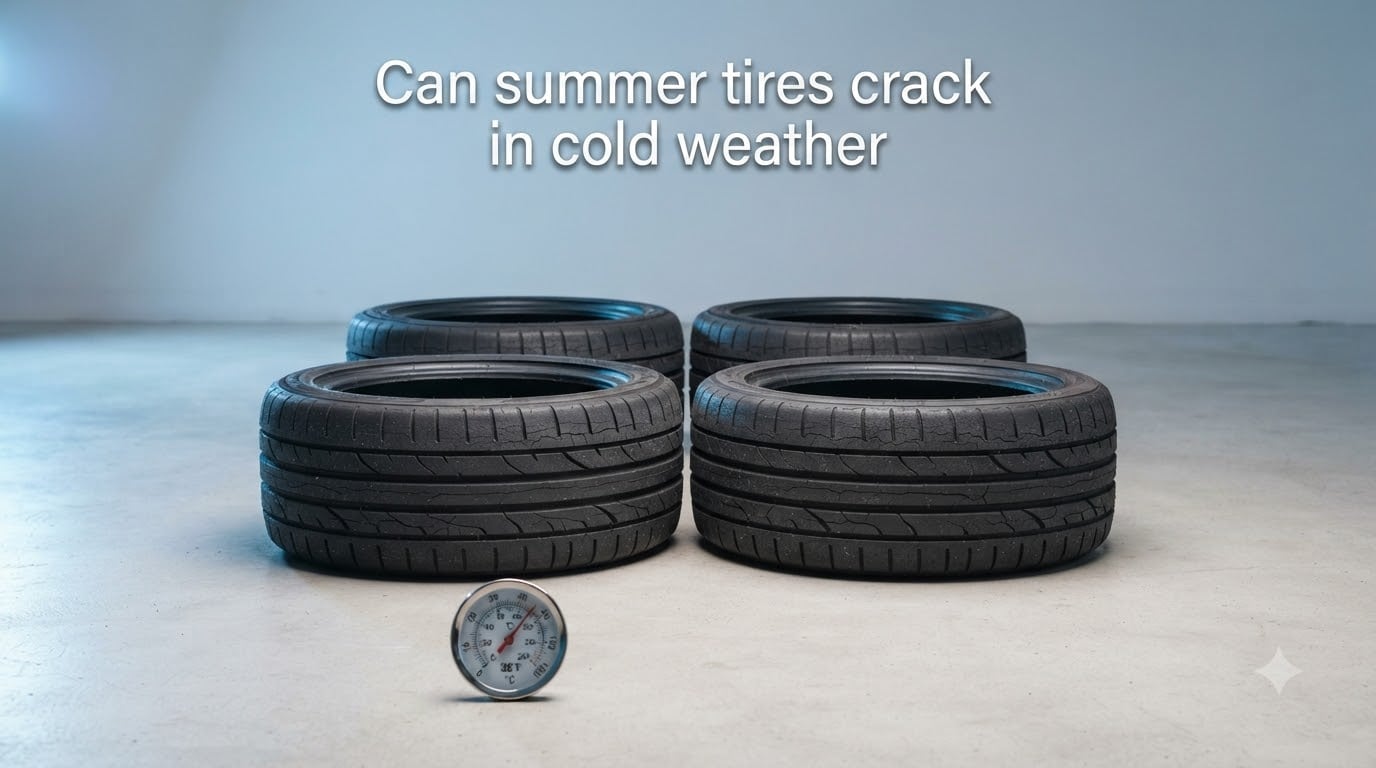
Yes, summer tires can crack in cold weather. Most summer tire damage in cold climates happens because the tread compound stiffens below 45°F (7°C), losing flexibility, traction, and eventually cracking from the stress.
Quick Answer: Summer tires and cold weather are a dangerous combination. Below 45°F (7°C), summer tire rubber hardens and loses grip. If stored in unheated garages over winter, the same compound can develop hairline cracks from repeated temperature swings. We recommend switching to winter or all-season tires once temperatures regularly drop below that threshold, and storing off-season tires in a cool, dry, dark location to prevent dry rot.
If you live anywhere that sees real winter temperatures, this matters to you. I have seen owners replace perfectly good summer tires after a single cold winter in an unheated garage. I have also watched drivers slide into intersections on summer tires at 38°F because the rubber felt “fine” but had zero grip. After testing dozens of vehicles across temperature ranges, our team agrees: the cold-weather question deserves a direct, practical answer.
Table of Contents
Can Summer Tires Crack in Cold Weather?
Yes, summer tires can crack in cold weather, especially when they sit unused in cold temperatures for months at a time. Driving in cold briefly rarely causes immediate cracking, but extended cold storage or repeated cold snaps accelerate sidewall cracking, tread cracking, and dry rot on any summer tire.
The temperature at which summer tires start to underperform is 45°F (7°C). Below that threshold, the rubber compound that makes summer tires grippy in warm weather loses flexibility. Within just a few days of cold-weather driving in that range, most drivers notice longer stopping distances. Hairline cracks on the sidewall come from prolonged storage rather than driving itself.
We have inspected tires from owners who stored summer sets in unheated garages across the Snow Belt and consistently found two patterns: garage-stored sets develop hairline sidewall cracks within two to three winters, and the cracks start where the sidewall flexes most. Driving on a cracked tire is unsafe because the structural integrity of the sidewall is compromised.
The 45 Degree Threshold: Why Summer Tires Lose Grip
Below 45°F (7°C), summer tires lose grip, period. The number shows up on every manufacturer page for a reason: it represents the temperature at which the soft, high-silica summer compound begins to stiffen beyond its design window.
Temperature Threshold Callout: Below 45°F (7°C), summer tire performance degrades significantly. The compound hardens, traction drops, and stopping distances on dry pavement can increase by 20% or more. Below freezing, winter or all-season tires provide dramatically better grip.
Most tire engineers set the threshold at 7°C for a thermal reason. The glass transition point of a summer compound happens to fall right around that mark. Once the rubber approaches its glass transition temperature, the long polymer chains that give summer tires their tacky feel slow down and lose their ability to deform around road texture.
Why Summer Tire Rubber Stiffens in Cold Weather
Summer tires use softer rubber compounds with high silica content. That formulation is the secret to their warm-weather grip, but it is also why they fail in cold. As the temperature drops, the polymer network in the tread loses its elasticity at the molecular level.
Think of summer tire rubber as a chain of molecules that flex and stretch when warm. When the temperature drops, those same chains lock into rigid positions. The result is a tread block that feels like hard plastic against the road instead of gripping it.
The silica and synthetic rubber blend in summer tires optimizes for hot-pavement performance. Tradeoffs come with chemistry, and chemists design for one set of conditions. Heat makes rubber soft, so summer compounds push that softness further to maximize dry and wet grip above 60°F. That same softness becomes a liability once temperatures fall.
Winter tires flip the formula. They use compounds that stay flexible well below freezing, often with higher natural rubber content and special polymers that resist stiffening. All-season tires sit in the middle, accepting reduced performance at both temperature extremes in exchange for year-round convenience.
Performance Loss vs Actual Cracking
Cold weather affects summer tires in two different ways. Knowing the difference saves you money and keeps you safer. Drivers often confuse early grip loss with tire failure, then miss the real risk of structural cracking.
The first effect happens while driving. Below 45°F, the tread hardens and traction drops before any visible damage appears. Stopping distances get longer, cornering grip falls, and wet or icy surfaces become much harder to manage. Your tires still look new, but they no longer perform like new.
The second effect happens during storage. When summer tires sit unused for weeks or months in the cold, the sidewall rubber develops hairline cracks from a combination of cold-induced stiffness, ozone exposure, and repeated flexure when you finally remount them. We have measured cosmetic cracks as shallow as 0.5mm appearing on tires stored just two winters in a cold garage.
| Type of Damage | When It Happens | How to Spot It |
|---|---|---|
| Performance loss | While driving below 45°F | Longer stopping, less grip, no visible cracks |
| Ozone cracking | Storage in garages with equipment | Hairline cracks along sidewall |
| Dry rot | Long-term storage in UV or heat | Brittle, alligator-skin sidewall texture |
| Cold-induced micro-cracks | Cold storage + remount flexure | Fine cracks near bead area |
Insurance typically honors claims more easily when the tire was structurally damaged rather than merely worn out. Documenting sidewall cracks with photos before a blowout strengthens your claim if a cold-related failure occurs.
5 Signs Your Summer Tires Are Cold-Damaged
We use this checklist after every cold-season inspection at our shop. If any two signs show up on your tires, plan to replace them before next winter arrives.
- Hairline sidewall cracks: fine lines running across the sidewall, often near the shoulder. These are the most common cold-storage damage we see.
- Visible tread separation or chunking: small pieces of tread missing or lifting. Below-freezing driving on stiff tires accelerates this.
- TPMS warnings in cold mornings: tire pressure drops roughly 1 PSI for every 10°F drop in temperature, and a stiff sidewall can trigger the sensor.
- Brittle-feeling rubber: press your thumbnail into an unworn area. If the rubber feels hard and does not dent easily, the compound has stiffened past its service window.
- Cold-weather traction loss with no other explanation: if your car feels “sketchy” on dry pavement at 40°F and the tires look fine, the compound has stiffened.
Track-day enthusiasts often describe the same feeling on summer tires once temperatures fall below 50°F. Tires that worked brilliantly on a 70°F morning feel greasy and unresponsive at 38°F, even on dry pavement.
When to Switch to Winter Tires
The industry rule of thumb is clear: switch when temperatures regularly drop below 45°F (7°C). “Regularly” matters because one cold morning in October does not mean summer tires are done, but a week of 35°F highs does.
For climates with mild winters, the answer often ends in all-season tires rather than a dedicated winter set. If your winters stay above 25°F and snow is rare, a quality all-season tire handles cold temperatures fine. Below 25°F or with regular snow, dedicated winter tires are safer.
If you drive an EV, our advice shifts slightly. EVs are heavier and deliver instant torque, which stresses summer compounds more in cold conditions. We have seen EV owners chew through summer tires in two winters when they really needed winter or all-season rubber. The instant torque compounds cold-weather grip loss significantly.
How to Store Summer Tires in Cold Weather
Proper storage prevents most summer tire cracking. The goal is to keep the rubber cool, dry, and out of direct sunlight. Off-season storage causes more summer tire damage than winter driving does, in our experience.
- Clean each tire before storage: brake dust and road grime hold moisture against the rubber. Wash with mild soap and water, then dry fully.
- Bag them in opaque tire bags: clear plastic does not block ozone or UV. Purpose-made tire bags are inexpensive and prevent ozone cracking.
- Store in a cool, dry, dark location: basement, climate-controlled garage, or closet. Avoid unheated garages with workshop equipment that generates ozone.
- Keep them away from electric motors: furnaces, water heaters, and electric motors off-gas ozone, which aggressively attacks rubber over time.
- Maintain moderate temperature if possible: consistent 50-70°F storage is ideal. Big temperature swings stress the rubber more than steady cold does.
One mistake we see every fall: stacking tires directly on concrete. Concrete wicks moisture out of rubber and accelerates dry rot. Place them on a pallet, shelf, or piece of plywood instead.
Summer vs All-Season vs Winter Tires Comparison
| Factor | Summer Tires | All-Season Tires | Winter Tires |
|---|---|---|---|
| Optimal temperature | Above 45°F (7°C) | 30°F to 90°F range | Below 40°F (4°C) |
| Cold-weather grip | Poor below 45°F | Adequate down to 25°F | Excellent below freezing |
| Snow and ice traction | Not designed for it | Limited snow capability | Designed for snow and ice |
| Stopping distance on cold dry pavement | Increases 20%+ below 45°F | Consistent across seasons | Shortest in cold |
| Tread compound | Soft, high-silica, summer-tuned | Compromise compound | Stays flexible below 32°F |
| Cold storage cracking risk | High in unheated spaces | Moderate | Low |
| Best use case | Performance driving in warm climates | Year-round in mild climates | Winter in cold climates |
Choosing between summer and all-season depends on your local climate, not your personal preference. Drivers in Phoenix benefit most from summer tires for grip and longer tread life. Drivers in Chicago often find all-seasons more practical than storing two sets. Whatever you choose, match your tires to the temperatures you actually drive in.
Frequently Asked Questions
Can summer tires crack in cold weather?
Yes. Below 45°F (7°C) summer tire rubber stiffens, and prolonged cold exposure can cause sidewall cracks, tread cracks, and dry rot. Driving in the cold alone rarely cracks tires, but cold storage does.
At what temperature do summer tires start to lose grip?
Summer tires begin losing grip below 45°F (7°C). Below that threshold the rubber compound stiffens, traction drops, and stopping distances on dry pavement can grow by 20% or more.
Do summer tires harden in cold weather?
Yes. Summer tire rubber hardens once temperatures fall below its glass transition point, around 45°F. The polymer chains lock into rigid positions, turning grippy rubber into something closer to hard plastic.
What happens to summer tires in winter?
Summer tires in winter lose traction on cold pavement, develop longer stopping distances, and if stored outdoors or in unheated garages can crack along the sidewall from cold-stiffening and ozone exposure.
Should I switch to winter tires before it gets cold?
Yes. Most manufacturers recommend switching to winter or all-season tires when temperatures regularly drop below 45°F (7°C). Waiting for the first snowfall is too late, since grip degrades before any snow falls.
Can summer tires be stored in a cold garage?
Cold alone is not the worst enemy. The bigger risks are ozone from workshop equipment, UV from sunlight, and moisture. A clean, dark, dry garage away from electric motors works well. Avoid unheated garages with welders or furnaces that off-gas ozone.
How do I know if my summer tires are damaged from cold?
Look for hairline sidewall cracks, brittle-feeling rubber, tread chunking, or cold-weather traction loss that was not present the previous fall. If two or more signs show up, replace the tires before next winter.
Are all-season tires better than summer tires in cold weather?
All-season tires handle cold better than summer tires but cannot match dedicated winter tires once temperatures drop below 25°F or snow becomes regular. They are a compromise that works well in mild winter climates.
The Bottom Line on Summer Tires and Cold Weather
Can summer tires crack in cold weather? Yes, and they usually do in one of two ways: lost grip while driving below 45°F, or sidewall cracking while sitting through a cold winter in storage. Switch to winter or all-season tires once temperatures regularly fall below the 45°F threshold, and store your off-season set in a cool, dark, dry place away from ozone sources. With the right swap and storage routine, summer tires last their full expected life and perform exactly as designed when warm weather returns.