
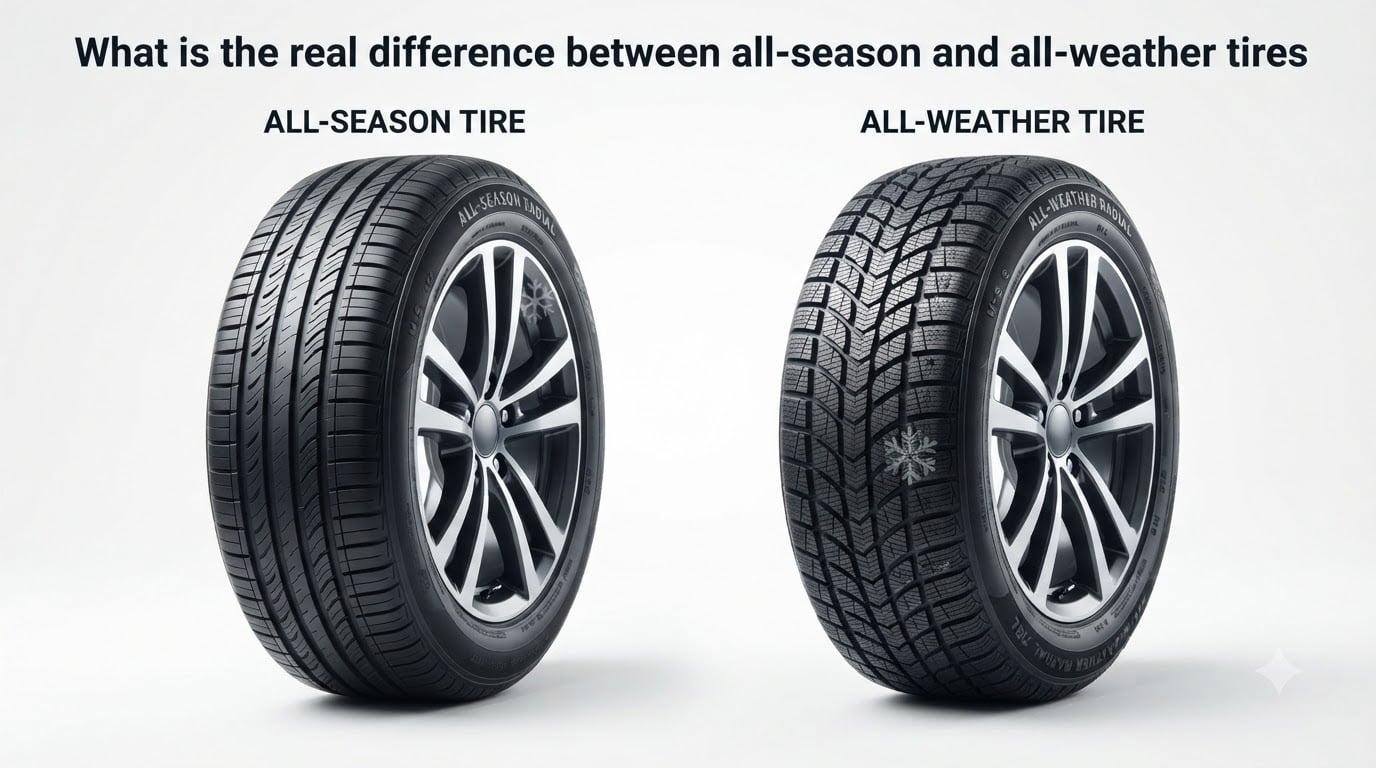
If you’ve ever stood in a tire shop wondering whether to spend more on all-weather tires or stick with the all-seasons you’ve always run, you’re not alone. I get this question from drivers every week, and the confusion makes sense: the names sound interchangeable. They are not.
The real difference between all-season and all-weather tires comes down to two things: the rubber compound and the certification on the sidewall. All-season tires are built for mild, year-round conditions and stiffen up once temperatures drop below about 45°F (7°C). All-weather tires use a softer compound that stays pliable in freezing cold and carry the Three-Peak Mountain Snowflake (3PMSF) symbol, which means they’ve passed an industry-standard snow traction test.
That distinction can be the difference between stopping safely on a cold morning and sliding through an intersection. In this guide, I’ll walk you through exactly how these two tire types differ, what the markings on your sidewall actually mean, and how to pick the right one based on where you live and how you drive.
Table of Contents
What Are All-Season Tires?
All-season tires are the default choice for most passenger vehicles sold in North America. They are designed as a compromise: a single set of tires that handles dry summer roads, light rain, and the occasional cool morning without needing seasonal swaps.
The “all-season” label has been around since the late 1970s, and the original promise was simple: one tire, year-round, in places that don’t see harsh winters. That promise holds up well in places like southern California, Florida, or the Texas Hill Country, where winter means a few 40°F nights and no real snow.
Modern all-season tires use a harder rubber compound optimized for warm temperatures and long tread life. The tread pattern balances dry grip with water evacuation through circumferential grooves and lateral sipes, but the siping is typically less aggressive than what you’d find on a true winter tire. Most all-season tires carry the M+S (mud and snow) marking on the sidewall, but that marking is self-declared by the manufacturer and doesn’t require any third-party testing.
Here’s the catch most drivers never learn until it’s too late: as temperatures drop, the rubber compound in all-season tires begins to stiffen. Below that 45°F (7°C) threshold, the tread becomes noticeably less flexible, grip drops, and stopping distances increase. On cold, dry pavement this might only add a few feet to your braking distance. On cold, wet, or snowy pavement, the loss of grip can be dramatic.
What Are All-Weather Tires?
All-weather tires are a relatively newer category that first hit the North American market seriously in the early-to-mid 2010s, with models like the Michelin CrossClimate and Nokian WRG3 paving the way. The category exists to solve a specific problem: drivers who deal with real winter conditions but don’t want the hassle (or cost) of owning two separate sets of tires.
An all-weather tire is built to perform in summer heat, heavy rain, light snow, and freezing temperatures, all on a single set of rubber. To do that, manufacturers use a more advanced rubber compound that stays flexible well below 45°F (7°C), often incorporating higher silica content and specialized polymers that resist the stiffening effect of cold.
The tread pattern on an all-weather tire is more aggressive than a typical all-season. You’ll see deeper circumferential grooves for hydroplaning resistance, more numerous sipes (the tiny slits in the tread blocks) for snow and ice bite, and often a directional or asymmetric pattern designed to handle both wet and wintry conditions.
The defining feature of a true all-weather tire is the Three-Peak Mountain Snowflake (3PMSF) symbol on the sidewall. This certification means the tire has passed a standardized ASTM snow traction test, delivering at least 110% of the grip of a reference winter tire in medium-packed snow. That requirement is what separates all-weather tires from all-season tires that simply carry the older M+S marking.
The 3PMSF Certification: The Mark That Actually Means Something
If you take one thing away from this article, make it this: the 3PMSF symbol is the single most important marking to look for when comparing all-season vs all-weather tires for any climate that sees real winter.
The Three-Peak Mountain Snowflake (3PMSF) certification was introduced by the U.S. Tire Manufacturers Association (USTMA) and the Rubber Association of Canada. The symbol itself is a stylized snowflake inside a mountain with three peaks. To earn it, a tire must demonstrate it provides at least 110% of the traction of a reference standard tire (the ASTM F1805 test) in snow conditions that simulate medium-packed snow on a passenger vehicle.
What makes this certification meaningful is that it’s not self-reported. The manufacturer has to submit the tire for standardized testing and prove the performance. Compare that to the M+S (mud and snow) marking, which any manufacturer can stamp on a tire simply by claiming the tread pattern is designed for those conditions. There is no performance threshold for M+S.
When you see 3PMSF on a tire sidewall, you know it has passed an objective test for snow traction. When you see only M+S, you’re taking the manufacturer’s word for it. This is why all-weather tires carry 3PMSF while most all-season tires do not.
Rubber Compound Differences and the 45°F Threshold
The 45°F (7°C) number comes up constantly in tire discussions, and for good reason: it represents the point at which the rubber compounds in summer and all-season tires begin to lose meaningful grip.
Here’s what’s happening at the molecular level. Tire rubber is a polymer blend, and its flexibility depends heavily on temperature. As the rubber cools, the polymer chains become less mobile, the compound stiffens, and the tire’s ability to conform to small surface irregularities on the road (which is what creates grip) drops off. On a 50°F morning, your all-season tires might feel fine. On a 30°F morning, the same tires will feel wooden and unresponsive, especially under braking or cornering loads.
All-weather tires address this by using advanced silica-rich compounds that maintain flexibility at much lower temperatures. Some premium all-weather compounds stay pliable down to single digits or below. The trade-off is tread life: a softer compound typically wears faster than a harder one. We’ll dig into that more in a minute.
If you want a quick gut-check for your own driving, look at your average winter temperatures. If your region regularly sees mornings below 45°F, an all-weather tire will outperform an all-season tire in nearly every cold-weather metric, including wet grip, snow traction, and braking distance.
Tread Design and Siping Patterns
Beyond the rubber compound, tread design is where all-season and all-weather tires diverge most visibly.
All-season tires typically feature a symmetric or lightly asymmetric tread pattern with moderate siping. The sipes are the tiny slits cut into the tread blocks that give the tire extra biting edges. All-season siping is designed primarily for wet traction, helping the tire cut through thin layers of water on the road surface.
All-weather tires carry significantly more siping, and the sipes are often deeper and more complex in shape. Many all-weather tires use 3D sipe technology, where the sipes interlock under load to maintain block stiffness while still providing biting edges. This is critical for snow performance: snow-to-snow contact inside the sipe creates the grip mechanism that pulls a tire through packed snow.
The tread blocks themselves are also typically more aggressive on all-weather tires, with sharper edges and sometimes a directional V-shaped pattern that helps evacuate slush and water. The shoulder blocks, the outer edges of the tread, are often larger and more heavily supported on all-weather tires for better cornering grip in slippery conditions.
None of this makes all-weather tires a substitute for a dedicated winter tire in extreme conditions. If you live in a mountain town that sees months of sub-freezing temperatures and feet of snow, dedicated winter tires still outperform all-weathers. But for the 90% of drivers who deal with occasional to moderate winter weather, all-weather tread designs offer a meaningful upgrade over all-season.
Tire Sidewall Markings Explained: M+S vs 3PMSF
Reading your tire sidewall doesn’t require a degree in rubber chemistry, but a few key markings will tell you almost everything you need to know about winter capability.
M+S (Mud and Snow): This is the older marking, and you’ll find it on the majority of all-season tires. It indicates the manufacturer designed the tread pattern with features intended for mud and snow conditions. There is no performance test behind it. Any tire with reasonable siping can carry this marking.
3PMSF (Three-Peak Mountain Snowflake): This is the snowflake-and-mountain symbol you may have spotted on certain tires. It means the tire has passed the ASTM F1805 standardized snow traction test. Look for this if you care about real winter performance.
Severe Snow Use: Some dedicated winter tires carry a Severe Snow Use designation, which is even more stringent than 3PMSF. You typically won’t see this on all-season or all-weather tires.
Other useful markings include the tire size, load index, speed rating, and the DOT date code that tells you when your tire was manufactured. Tires older than about 6 years from the manufacture date should be replaced regardless of tread depth, as the rubber compounds degrade over time.
Snow and Ice Performance
This is where the rubber meets the road, literally, and where all-weather tires earn their premium.
In independent testing from organizations like Tire Rack, the performance gap between all-season and all-weather tires in snow is substantial. On medium-packed snow, all-weather tires typically deliver 30-50% better traction than all-season tires. In braking tests from 30 mph on snowy surfaces, all-weather tires often stop 15-25 feet shorter than comparable all-seasons.
The story on ice is more nuanced. Neither all-season nor all-weather tires are ideal for serious ice conditions. Dedicated winter tires with their softer compounds and studdable designs remain the gold standard for ice traction. But all-weather tires still outperform all-season tires on ice by a smaller margin, typically 10-20% in braking traction tests.
For daily commuting through regions that see occasional snow events, ice storms, and freezing rain, all-weather tires offer a meaningful safety margin. For drivers who see only occasional flurries on otherwise mild winters, all-season tires remain adequate.
Wet and Dry Road Performance
The trade-off question always comes up: do all-weather tires sacrifice summer performance for winter capability? The answer is: a little, but less than you’d think.
On dry pavement, the gap between modern all-season and all-weather tires is small. In Tire Rack’s dry braking tests, premium all-weather tires like the Michelin CrossClimate2 stop within a few feet of comparable all-season tires. The difference is often within the margin of error for real-world driving.
On wet pavement, all-weather tires can actually outperform some all-season tires. The more aggressive tread patterns and additional siping help evacuate water and resist hydroplaning. This is one area where the all-weather design’s “compromise” actually pays dividends year-round.
Where you do see a trade-off is in extreme summer heat. All-weather compounds optimized for cold flexibility can feel slightly softer in 100°F+ temperatures, leading to marginally faster wear and slightly less crisp steering response. For most drivers in temperate climates, this difference is barely noticeable.
Tread Life and Durability
Tread life is the most common concern drivers raise when considering all-weather tires. The shorter answer: yes, all-weather tires typically wear faster than all-season tires, but the gap is narrower than you might expect.
Most premium all-weather tires carry treadwear warranties in the 50,000-70,000 mile range. Comparable all-season tires often come with 60,000-80,000 mile warranties. The 10,000-15,000 mile difference is real but manageable, especially when you factor in the safety benefits.
Several factors influence actual tread life, including driving style, vehicle alignment, road conditions, and climate. Aggressive acceleration and braking wear tires faster regardless of type. Living in a hot climate accelerates tread wear for both categories. Properly maintained all-weather tires on a typical commuter vehicle will easily deliver 50,000+ miles of service.
If you currently run two sets of tires (winter + summer), the cost equation shifts. Owning one set of all-weathers eliminates seasonal swap fees, storage costs, and the hassle of scheduling appointments twice a year.
Which Tire Is Right for You? A Climate-Based Decision
Choosing between all-season and all-weather tires comes down to answering a few honest questions about where you live and how you drive.
Choose all-season tires if you live in a mild climate that rarely sees temperatures below 45°F and gets snow once every few years. This covers most of the Sun Belt, coastal California, the desert Southwest, and similar regions. The performance trade-off for winter capability is minimal, and you’ll benefit from longer tread life.
Choose all-weather tires if you live in a four-season climate with regular winter weather. This includes most of the Northeast, Midwest, Mountain West, Pacific Northwest, and Canada. If you deal with several months of freezing temperatures, regular snow, and icy commutes, all-weather tires provide year-round confidence without seasonal swaps.
Consider dedicated winter tires (in addition to summer or all-season tires) if you live in a true snow belt with months of sub-freezing temperatures, deep snow, and mountainous terrain. Examples include mountain towns in Colorado, Utah, Wyoming, Vermont, and similar regions. For these drivers, the safety benefits of dedicated winters from November through March outweigh the inconvenience.
Ask yourself these key questions: Does your area see regular sub-freezing temperatures from December through February? Do you regularly drive on roads that may be snow-covered or icy? Do you commute in early morning hours when roads are coldest? If you answered yes to two or more, all-weather tires are likely worth the investment.
The Real Cost Comparison: All-Weather vs Two Sets
The sticker price on all-weather tires is higher than comparable all-season tires, but the full cost picture is more interesting.
A set of four premium all-weather tires typically runs more than a comparable set of all-season tires. A set of four dedicated winter tires adds another full set to the budget. Over a typical 5-7 year ownership period, the costs work out roughly like this.
Running all-season tires year-round in a four-season climate means lower upfront cost but potentially dangerous winter driving. Running two dedicated sets (winter + summer) means buying two complete sets plus paying for seasonal swaps and storage. Running all-weather tires year-round means one purchase, one set of mounting/balancing, and no swap fees.
For many drivers, the total cost of ownership over five years is actually lower with all-weather tires than with two dedicated sets, once you account for swap fees, storage costs, and the inconvenience factor. The math tips in favor of all-weather tires if you currently own winter tires and a second set of wheels.
Legal Requirements by Region
In some regions, tire selection isn’t just a matter of preference: it’s the law.
Several states and provinces have winter traction requirements that affect tire choice. Quebec requires dedicated winter tires on passenger vehicles from December 1 through March 15. British Columbia requires winter tires or chains on certain mountain passes from October to April. In the United States, Colorado has traction laws on Interstate 70 during winter months that require either 3PMSF tires, M+S tires with adequate tread, or chains.
For drivers in regions with active traction laws, all-weather tires with the 3PMSF marking typically satisfy the requirements. This is another practical benefit: the 3PMSF symbol is legally recognized as meeting winter tire standards in most jurisdictions.
If you regularly travel through multiple states or provinces with different requirements, carrying all-weather tires with 3PMSF certification can save you from the hassle of dealing with chain requirements or facing fines. Always check the specific regulations for your route before winter travel.
Frequently Asked Questions
Are all-weather tires really better than all-season in snow?
Yes, by a meaningful margin. All-weather tires with the 3PMSF certification typically deliver 30-50 percent better traction in medium-packed snow than all-season tires, and they often stop 15-25 feet shorter from 30 mph in braking tests. The difference comes from softer rubber compounds that stay flexible in cold temperatures and more aggressive tread designs with deeper sipes.
What does 3PMSF mean on a tire?
3PMSF stands for Three-Peak Mountain Snowflake, a certification mark on the tire sidewall that indicates the tire has passed a standardized ASTM snow traction test. The tire must demonstrate at least 110 percent of the traction of a reference winter tire in medium-packed snow conditions. This is a meaningful performance certification, unlike the older M+S marking which is self-declared by manufacturers.
Do all-weather tires wear out faster than all-season?
Generally yes, but less than many drivers expect. Most premium all-weather tires carry 50,000-70,000 mile treadwear warranties compared to 60,000-80,000 miles for comparable all-seasons. The 10,000-15,000 mile difference is real but modest, especially when you factor in the safety benefits in winter conditions.
Can I use all-weather tires year-round?
Yes, all-weather tires are specifically designed for year-round use, including summer. They perform well in hot weather, though their compounds optimized for cold flexibility may wear slightly faster in extreme summer heat. For drivers who want to avoid seasonal tire swaps, all-weather tires are an excellent single-set solution.
Are all-weather tires required by law anywhere?
All-weather tires with 3PMSF certification satisfy winter tire requirements in most jurisdictions that have traction laws. Quebec requires dedicated winter tires, but British Columbia, Colorado’s I-70 corridor, and similar regions accept 3PMSF all-weather tires as meeting their winter traction requirements. Always check specific regulations for your region before traveling.
Are all-weather tires worth the extra cost?
For drivers in four-season climates with regular winter weather, all-weather tires are typically worth the premium. The higher upfront cost is often offset by eliminating seasonal swap fees and storage costs associated with owning two sets of tires. More importantly, the safety benefits in cold, wet, and snowy conditions can be substantial.
The Bottom Line on All-Season vs All-Weather Tires
The real difference between all-season and all-weather tires isn’t marketing. It’s rubber compound, tread design, and certification. All-season tires work well in mild climates but stiffen and lose grip below 45°F. All-weather tires use advanced compounds that stay flexible in cold and carry the 3PMSF certification that proves real snow performance.
If you live somewhere that sees regular winter weather, all-weather tires offer meaningful safety benefits without the hassle of seasonal swaps. If you’re in a mild climate that rarely freezes, all-season tires remain a sensible choice with longer tread life. For drivers in snow-belt regions with months of harsh winter, dedicated winter tires paired with summer tires still deliver the best performance.
The 3PMSF symbol is the clearest marker to look for. When that snowflake-and-mountain logo is on your sidewall, you know the tire has been tested and certified for genuine winter traction. That single marking tells you more than any salesperson’s pitch or marketing claim.