
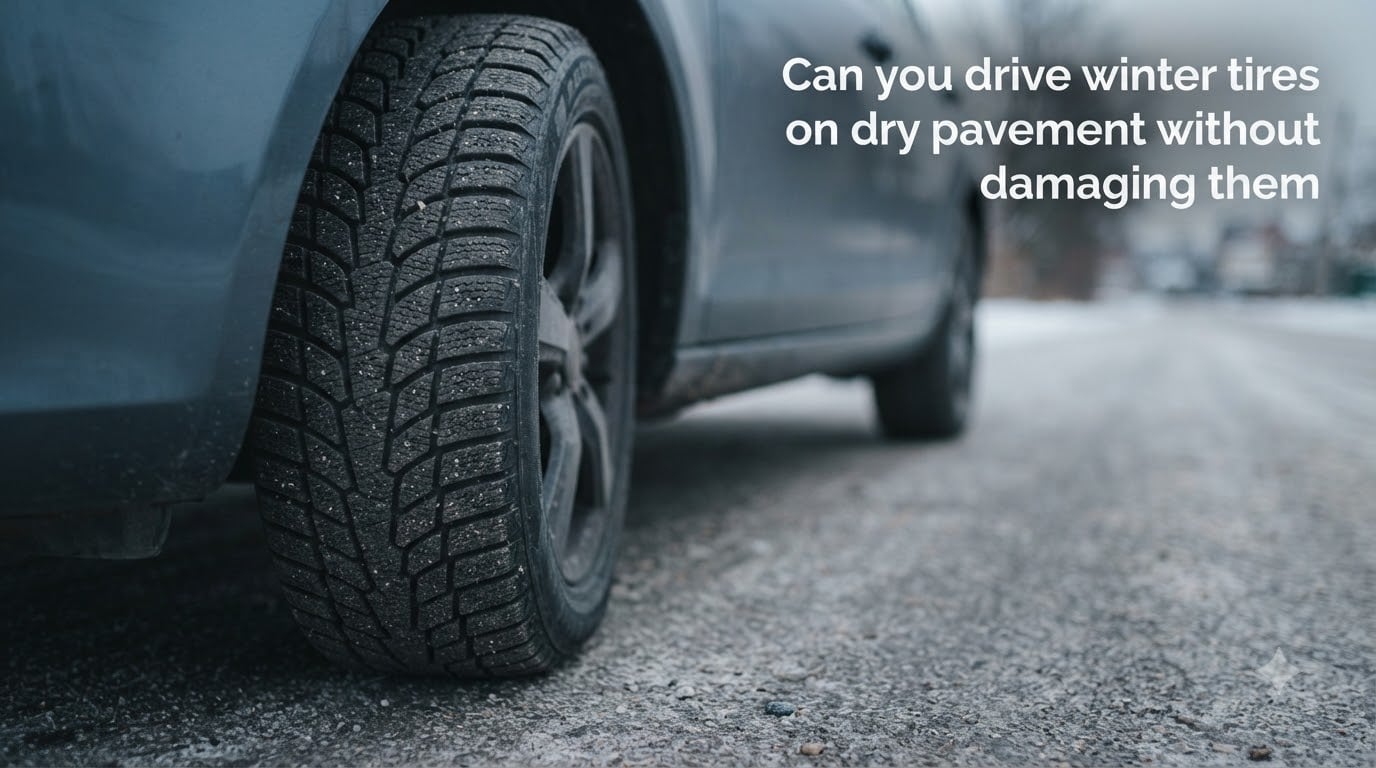
If you’re asking can you drive winter tires on dry pavement without damaging them, the short answer is yes — with one important condition. Winter tires are perfectly safe on dry roads when temperatures stay below about 50 degrees F, and they will not suffer meaningful damage from typical dry-pavement driving in cold weather. Once temperatures climb above that 50 degree threshold, however, the same soft compound that gives winter tires their cold-weather grip starts wearing out fast, getting vague through corners, and hurting fuel economy.
I help drivers in cold-winter regions decide every spring whether to swap their winter tires off, and the same question comes up year after year. In this guide I’ll walk you through what winter tires are made of, why they behave the way they do on dry pavement, the exact temperature thresholds tire manufacturers use, and the small habits that keep your set from wearing out before its time.
Table of Contents
Quick Verdict: Yes, But Only Below About 50 Degrees F
You can drive winter tires on dry pavement safely and without damage as long as the road temperature stays below roughly 50 degrees F. Above that, expect accelerated tread wear, softer steering response, and longer stopping distances. Below 45 degrees F, winter tires are actually grippier than all-season tires on dry pavement.
- Below 45 degrees F: Winter tires outperform all-seasons on dry pavement and wear normally.
- 45 to 50 degrees F: A safe gray zone — winter tires still work, but wear starts to climb.
- Above 50 degrees F: Switch to all-season or summer tires as soon as practical to prevent rapid dry-pavement wear.
What Makes Winter Tires Different From All-Season Tires
Winter tires are not just all-season tires with deeper tread. They’re built from a different rubber compound, with a different tread pattern, and with features designed specifically to grip cold, wet, and snowy surfaces. Understanding those differences is the key to understanding why dry pavement behaves differently depending on the temperature.
The rubber compound. Winter tires use a softer, more flexible rubber that stays pliable in cold weather. Most all-season tires start to harden up once temperatures drop into the 30s and 40s, which is why they feel slippery on a cold morning. The winter compound stays grippy down to well below freezing. The trade-off is that this same softness turns into a weakness once the pavement warms up.
Sipes and biting edges. If you look closely at a winter tire tread block, you’ll see hundreds of tiny slits — those are sipes. They act like extra edges that bite into snow and ice. On dry pavement, sipes don’t add much grip, but they don’t take it away either. They’re one of the main reasons winter tires look more “aggressive” than all-seasons.
Deeper tread and wider tread blocks. Winter tires carry more void space between tread blocks to evacuate snow and slush. On dry pavement that extra void space means slightly less rubber contacting the road, which is part of why winter tires feel a touch less precise in steering than a summer tire.
The glass transition. Every rubber compound has a glass transition temperature — the point at which it stops being flexible and starts behaving more like hard plastic. For winter tire compounds that transition typically happens near 50 degrees F. Below it, the rubber stays soft and grippy. Above it, the compound softens further than designed, which is what drives the wear and vague feel drivers complain about.
Winter Tires on Cold Dry Pavement (Below 45 Degrees F)
On cold dry roads, winter tires are genuinely excellent. The soft compound stays flexible, the contact patch conforms to small bumps and texture in the asphalt, and you usually get shorter stopping distances than the same car on all-season tires.
This is the scenario winter tires were designed for, even when no snow is on the ground. A dry 30-degree morning in February is exactly when you want winter tires on the car.
Drivers sometimes report a slightly vague or “squishy” feel through the steering wheel on cold dry pavement, especially during maximum-effort braking. That’s a real phenomenon, not just perception — the softer compound and more flexible sidewalls deform a bit more under hard loading than a summer tire would. Forum users on BobIsTheOilGuy have described the feeling as “mushy” and noted reduced friction under threshold braking, even though the same tires grip well in normal driving.
The honest takeaway: on cold dry pavement, winter tires are safe and predictable. The vague feel is something you’ll notice only if you’re pushing the car hard. For daily commuting, school runs, and highway driving in 20 to 40 degree weather, winter tires are a non-issue on dry roads.
Winter Tires on Warm Dry Pavement (Above 50 Degrees F)
Once the thermometer climbs above 50 degrees F, the picture changes. The same soft compound that worked so well in January now becomes too soft. The tread blocks squirm under load, the tire wears faster, and the steering loses precision.
Faster wear. A winter tire driven regularly on warm dry pavement can wear out two to three times faster than the same tire on cold dry pavement. Some drivers see the tread depth drop by a third in a single warm season if they forget to swap.
Vague steering. The flexible sidewalls that helped on snow now flex too much on dry pavement during cornering and lane changes. The car feels less precise, and quick inputs at highway speed can feel loose.
Longer stopping distances. As the rubber softens past its design range, dry braking distances can stretch compared to an all-season or summer tire in the same conditions.
Higher rolling resistance. The softer compound deforms more with every rotation, which costs you a few percent in fuel economy.
This is also the temperature range where drivers notice the biggest jump in road noise. Winter tire tread patterns are designed to evacuate snow, not to be quiet on asphalt, and a warm day seems to amplify the hum.
How Winter Tires Wear on Dry Pavement: The Mechanics
Why does the same tire behave so differently at 40 versus 70 degrees? It’s mostly about rubber chemistry.
Above the glass transition temperature, the long polymer chains in the rubber can move more freely. The tread blocks deform more easily under load, and each tiny bit of that deformation rubs against the road surface. On a cold day the rubber is stiffer, so it springs back faster and skids less. On a warm day it skids a little more, which means friction — which means heat — which means even more deformation. That cycle is what wears the tire down so much faster.
Two factors make dry-pavement wear even worse for winter tires specifically:
- Larger tread blocks and more void space. Less rubber on the road means higher contact pressure on each block, which speeds wear.
- Soft sidewalls. The same flexibility that helps on snow means the tire flexes more under cornering loads, generating extra heat in the shoulders — exactly where wear shows up first.
The pattern you’ll typically see is faster shoulder wear on warm dry pavement, with the center of the tread holding up better. That’s the opposite of an over-inflated all-season tire, which wears in the center first.
Winter Tires vs All-Season vs Summer vs Studded on Dry Pavement
| Tire Type | Dry Grip (Cold) | Dry Grip (Warm) | Wear Rate on Dry | Noise | Fuel Economy |
|---|---|---|---|---|---|
| Winter (non-studded) | Excellent | Reduced | Fast in warm weather | Moderate to high | Slightly reduced |
| All-Season | Good | Good | Slow | Low to moderate | Good |
| Summer / Performance | Excellent | Excellent | Slow | Low | Best |
| Studded Winter | Good (metal studs) | Reduced | Fast — studs damage dry pavement | Loud on dry roads | Reduced |
Studded Winter Tires on Dry Roads
Studded tires deserve a separate note because they’re a special case. The metal studs that grip ice also dig into dry asphalt, which is why many jurisdictions restrict studded tire use by season. On dry pavement, studded tires wear faster than non-studded winter tires, are noticeably louder, and can leave visible scuff marks on the road. If you have studded tires, the 50 degree threshold for switching off is even more important.
Safe-Driving Checklist for Winter Tires on Dry Roads
If you have to drive winter tires on dry pavement — whether because of an early-spring warm spell or a late-fall cold snap — a few habits will protect the tires and keep you safe.
- Check cold tire pressure monthly. Cold dry mornings give the most accurate reading; pressure drops about 1 PSI for every 10 degree F drop in temperature.
- Avoid hard acceleration on dry pavement above 50 degrees F. Smooth throttle inputs cut shoulder wear dramatically.
- Increase following distance. Give yourself an extra car length or two in case dry braking distances are longer than usual on warm days.
- Rotate every 5,000 to 7,000 miles. Even wear on dry pavement means longer tire life, especially on a front-wheel-drive car.
- Watch for vibration. Vibration at speed often means a tire is out of balance or the alignment has shifted — both accelerate wear on dry roads.
- Avoid curbs and potholes. The softer sidewalls of winter tires dent and bulge more easily than all-seasons.
- Park in the shade when possible. Direct sun on warm pavement is the worst case for accelerated wear.
How to Maintain Winter Tires and Extend Their Life
Most winter tire sets are warrantied for four to six seasons of cold-weather use. A few maintenance habits make a real difference in whether you reach that lifespan or wear them out in two.
Tire pressure. Check pressure once a month during the season. Under-inflation is the single biggest cause of premature winter tire wear on dry roads. The correct PSI for your tires is on the door jamb sticker, not the maximum number on the sidewall.
Rotation pattern. For non-directional winter tires, rotate front-to-rear every 5,000 to 7,000 miles. For directional tires (which can only roll one way), swap front-to-rear on the same side. Directional winter tires are common because their tread pattern evacuates slush in one direction.
Wheel alignment. If you notice the car pulling to one side, the steering wheel sitting off-center, or uneven shoulder wear, get an alignment check. Misalignment is invisible day to day but eats tires fast on dry pavement.
Tread depth. Winter tires are considered worn out at about 6/32 inch of remaining tread — deeper than the 2/32 inch legal minimum for all-seasons. Most winter tires have a winter-specific tread wear indicator (a small icon in the tread grooves) that shows when the tire has lost its snow capability. Above that threshold, dry-pavement traction stays reasonable.
Storage. Off-season storage matters more than most drivers think. Keep the mounted tires in a cool, dry place away from direct sunlight. Avoid stacking them standing on the tread if they’re unmounted — store them upright or hung on a tire rack.
When to Switch Back to All-Season or Summer Tires
The simplest rule is to swap when the forecast shows a full week of daytime highs consistently above 50 degrees F. Waiting for the first 70 degree day is too late — the wear damage on warm dry pavement is already happening by then.
A few additional signals tell you it’s time:
- Tread depth below 6/32 inch. The tire has lost most of its snow capability and won’t grip much better than an all-season anyway.
- Visible dry-rot or sidewall cracking. Older winter tires that have seen too many hot seasons dry out and lose grip.
- Three or more winters on the tires. Most winter tires are made from compounds that age out before they wear out.
- Stud damage. If studs are missing or the tire has been driven extensively on dry pavement, the stud holes can oval out.
In cold-winter regions like the northern US, Canada, and mountain states, the typical pattern is winter tires on from late October through early April, then all-seasons or summer tires for the rest of the year. That’s roughly six months of winter tires, with maybe two months at each end where temperatures hover near the 50 degree threshold and dry-pavement wear is a real concern.
Frequently Asked Questions
Do winter tires perform well on dry pavement?
Yes, winter tires perform well on dry pavement when temperatures stay below about 45 degrees F. Below that threshold the soft compound stays flexible and grips better than all-season tires. Above 50 degrees F the same softness hurts dry-pavement handling, increases stopping distance, and accelerates wear.
Can winter tires wear out quickly on dry pavement?
Winter tires wear out two to three times faster on warm dry pavement (above 50 degrees F) than on cold dry pavement. The soft rubber compound deforms more under load, generating heat and friction that strips tread from the shoulders first. Keeping tires below the 50 degree threshold protects their lifespan.
Can you drive winter tires on dry pavement?
Yes, you can drive winter tires on dry pavement as long as road temperatures stay below roughly 50 degrees F. Cold dry pavement is exactly the condition winter tires are designed for. Above 50 degrees F, switch to all-season or summer tires to prevent accelerated dry-pavement wear.
What temperature is too hot for winter tires?
Above 50 degrees F is too hot for winter tires for sustained driving. The rubber compound passes its glass transition temperature near 50 degrees, after which the tire becomes too soft, wears rapidly, and loses steering precision on dry pavement. Below 45 degrees F winter tires are actually grippier than all-seasons on dry roads.
Can you drive studded tires on dry roads?
Studded tires can be driven on dry roads but wear faster, are noticeably louder, and may damage pavement compared to non-studded winter tires. Many jurisdictions restrict studded tire use by season for this reason. If you run studded tires, the case for switching off at 50 degrees F is even stronger than with non-studded winter tires.
Can you drive snow and winter tires year round?
Driving winter tires year round is technically possible but expensive. Tread life drops dramatically during warm months, fuel economy suffers, dry-road handling feels vague, and the tires age out faster because the compound is not formulated for sustained warm-weather use. Most tire manufacturers recommend seasonal swaps.
The Bottom Line on Driving Winter Tires on Dry Pavement
To wrap up the question can you drive winter tires on dry pavement without damaging them: yes, as long as the temperature stays below about 50 degrees F. Cold dry roads are exactly where winter tires shine, and there’s no meaningful damage from daily driving in those conditions. The moment the forecast shows a sustained warm stretch above that threshold, swap to all-season or summer tires to protect your winter set and keep dry-road handling crisp.
If you want a simple seasonal rule, follow the 45-on / 50-off guideline most tire manufacturers publish: install winter tires when temperatures consistently drop below 45 degrees F in fall, and swap them off once a full week of daytime highs above 50 degrees F arrives in spring. That single habit is the best thing you can do to keep both your winter and non-winter tires wearing evenly and lasting their full service life.