
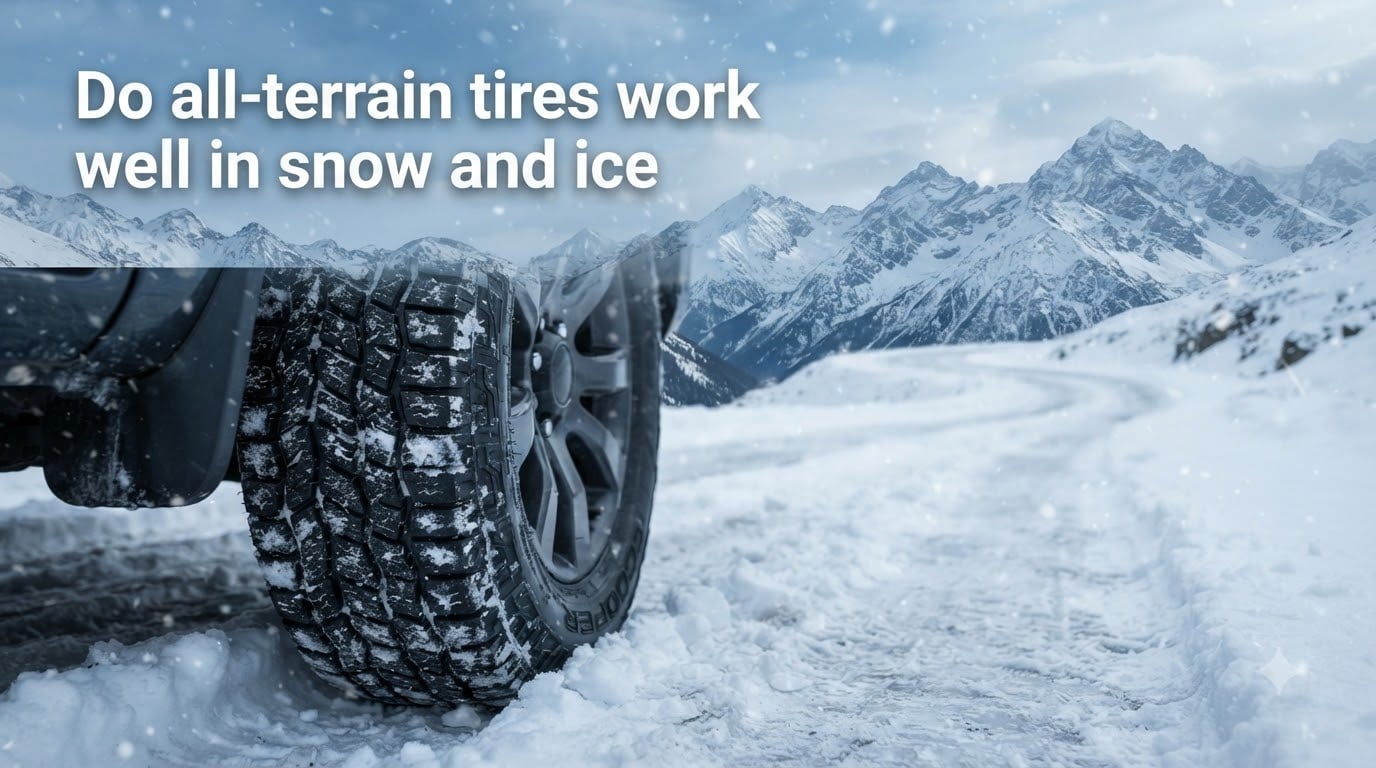
All-terrain tires in snow and ice can handle light to moderate winter conditions, especially those stamped with the 3PMSF (Three-Peak Mountain Snowflake) symbol. But once you hit packed snow, polished ice, or temperatures that stay below 20°F for weeks, they fall well short of dedicated winter tires. If you live where ice, deep snow, or long cold stretches are part of every winter, a true winter tire is still the safer, shorter-stopping choice.
That short answer is what we want to back up for the rest of this guide. Our team works with all-terrain, all-season, all-weather, and winter tires every day. We’ve watched truck and SUV owners make confident A/T choices, and we’ve also seen the same trucks slide past an intersection the first time real winter shows up. This article breaks down exactly when all-terrain tires in snow and ice are good enough, when they aren’t, and what you can do to close the gap.
Table of Contents
What Are All-Terrain Tires, Exactly?
All-terrain (A/T) tires are a compromise between highway tires and mud-terrain tires. They are built so a pickup or SUV can drive to a job site on Monday, park on a gravel driveway, run through a muddy trail on Saturday, and still feel reasonably quiet on the commute home.
To do all of that, an A/T tire leans on four design ingredients:
- An aggressive tread pattern with larger, blocky tread elements spaced apart.
- Deeper grooves between the blocks to channel mud, slush, and loose snow.
- Reinforced sidewalls and tougher rubber in the carcass for off-road impacts.
- A compound that is harder than a winter tire but softer than a pure summer tire.
The catch: the same features that make A/T tires handle rocks and ruts also limit how well they grip slick winter surfaces. The harder compound that resists punctures on a back road is the same compound that starts to stiffen the moment your tire drops below freezing.
What Do the 3PMSF and M+S Markings Mean?
Before we talk about snow and ice performance, you need to read the sidewall of your tire. Two small symbols tell you almost everything about winter capability.
The M+S (Mud + Snow) Marking
The M+S marking is a self-declared designation from the manufacturer. It just means the tread pattern is open enough, with enough void and edge effect, to handle mud and loose snow. It is not a performance test and it has no legal meaning in terms of severe-snow traction. A lot of all-season tires carry M+S.
The 3PMSF (Three-Peak Mountain Snowflake) Symbol
The 3PMSF symbol is the one that actually matters for winter. A tire earns the 3PMSF marking by meeting a specific industry test: it has to provide at least 10 percent better traction than a standard reference tire in a standardized snow braking test. That test is hard to pass, which is why many A/T tires do not have the symbol.
How to tell them apart at a glance:
- M+S alone = “we think this tread will be okay in mud and light snow.”
- 3PMSF = “this tire passed a real severe snow traction test.”
If you live where it snows and you want to stick with all-terrains, a 3PMSF-rated A/T is the only A/T worth considering. Even that has limits, which we will get to.
All-Terrain Tires in Snow: Light vs Deep
Snow is not one thing. Powder, wet slush, packed snow, and ice behave very differently under a tire, and the same A/T tire can feel confident in one and useless in the next.
Light and Fluffy Snow
This is where all-terrain tires do well. Fresh powder sits loosely on the road, and the deep, blocky tread of an A/T tire bites into it like a snowshoe. Drivers with a 3PMSF-rated A/T report little trouble with everyday commutes on light snow days. As long as traffic hasn’t packed the snow down, even an M+S-only A/T will get you through.
Moderate Snow and Slush
Slush is part snow, part water, and it punishes tires that cannot evacuate water quickly. A/T tires are designed to pump slush out through the deep channels between tread blocks, so they manage reasonably well here, especially on a truck or SUV with some weight over the drive axle. Your stopping distance will be longer than on dry pavement, but it should still feel predictable.
Deep Snow
Deep snow is where the picture starts to change. Once the snow is deeper than the height of your tread blocks, the tire can ride up on top of the snow instead of cutting through it. The aggressiveness that helps off-road works against you here: a more open, void-heavy tread loses mechanical grip in deep, soft snow because each block loses contact with the surface.
Dedicated winter tires use a finer tread pattern with hundreds of biting edges. That high sipe density is what lets them continue to find grip as the snow gets deeper. A typical A/T tire has far fewer sipes and that becomes a real limitation once snow piles up on unplowed roads.
Packed Snow on Plowed Roads
Packed snow that other cars have hardened into a half-inch ice-snow layer is the daily reality for many winter commuters. Most drivers actually do fine here with a good 3PMSF A/T tire, but only if they drive to the conditions: ease off the throttle before an intersection, brake earlier than you think you need to, and avoid sharp steering inputs.
All-Terrain Tires on Ice: The Honest Truth
Ice is where A/T tires in snow and ice stop being a compromise and start being a real limitation. There are two reasons.
First, ice has almost no texture for a tread block to grip. The only thing that grips ice well is a tread design that uses hundreds of fine sipes to “wipe” across the surface and a soft rubber compound that stays flexible in extreme cold. A/T tires are built with harder, more cut-resistant compounds, and their sipes are larger and fewer than what you find on a winter tire.
Second, A/T tires often have large, blocky tread elements that rely on the edge of the block to bite into something. On a clean, polished ice surface, those edges have nothing to bite into, so the tire slides.
Real-world numbers make this concrete. Independent winter tire testing on glare ice has shown dedicated studless winter tires can stop roughly 30 to 50 percent shorter than a typical all-season or all-terrain tire at the same temperature. On a vehicle traveling at 30 mph, that can be the difference between a controlled stop and sliding into an intersection.
If you regularly drive on hard-packed ice (think shaded intersections, ski area access roads, or unheated parking lots), we strongly encourage a different tire, studded tires where they are legal, or a backup set of chains.
How Cold Temperatures Change the Rubber
Tires are made of rubber, and rubber changes with temperature. As a general rule, rubber that gets colder gets stiffer, and stiffer rubber grips worse.
Winter tires are formulated with special polymers that stay flexible down to roughly -30°F. That flexibility is what lets the tread conform to microscopic texture in the road and clear ice off its surface.
Most all-terrain tires are formulated closer to an all-season compound. They work okay in the 20°F to 40°F range, but as the temperature sinks into single digits or below zero, the tread hardens noticeably. The tire doesn’t look different, but it feels different, and that is when A/T drivers start noticing reduced grip on braking and cornering.
So if your winters are mostly in the 25°F to 40°F range with a few cold snaps, a 3PMSF A/T can be acceptable. If your winters include long stretches below 10°F, the compound factor alone is going to push you toward a winter tire.
All-Terrain vs Winter vs All-Season vs All-Weather Tires
One quick comparison can save a lot of confusion. Each tire category is built for a different mix of conditions.
All-Season tires are designed around warm-weather performance with light winter capability. They carry M+S but almost never 3PMSF. They are the most common “do everything okay” tire in the U.S.
All-Terrain tires are a step more aggressive than all-seasons. They have deeper tread, larger blocks, and tougher sidewalls. Some have 3PMSF, many do not. They trade some on-road comfort and winter grip for off-road capability.
All-Weather tires are a less common hybrid designed to meet 3PMSF severe-snow standards while still functioning as a year-round tire. They use winter-optimized compounds. They can be a good choice for drivers who never go off-road but want year-round winter certification in one tire.
Winter tires are purpose-built for snow, ice, and cold. They have the softest compounds, the densest sipe patterns, and aggressive tread voids for slush evacuation. They are not meant to be run year-round, especially in summer or on hot dry pavement.
A quick rule of thumb: if a tire does not have the 3PMSF symbol, treat it as a fair-weather winter tire. You can drive it in a flurry, but do not expect dependable grip in a real storm.
The 4WD and AWD Myth on Ice
If you ask our team one question more than any other, it is some version of this: “I have four-wheel drive, so my all-terrain tires are fine in snow, right?”
Four-wheel drive and all-wheel drive help you accelerate in low-traction conditions. They do almost nothing for the other half of driving: stopping and turning. Stopping and turning come down to the tire, not the drivetrain. On glare ice, a heavy 4WD truck with A/T tires will start moving from a stop just fine, but it will also keep going right through the same intersection it would have if it were a sedan. The extra weight and momentum actually make things worse.
This is the single most dangerous myth in winter driving. 4WD and AWD do not replace winter tires on ice. Period.
Real-World Stopping Distance: Why Numbers Matter
Drivers tend to underestimate how much stopping distance changes between tires because the difference does not show up until you need it most.
Independent braking tests on snow-packed surfaces consistently show a stopping-distance gap of 20 to 40 percent between all-terrain tires and dedicated winter tires at 25°F. That gap widens as the temperature drops and as the surface becomes icier.
To translate that into something you can feel: at 40 mph on packed snow, a winter tire may need around 150 feet to stop where an A/T tire needs closer to 200. Ten or fifteen feet often separates a “close call” from a collision.
If you live somewhere with moderate winters, those numbers are still uncomfortable but workable. If you live somewhere with regular icy storms or steep hills, they are the difference between a vehicle you can drive and a vehicle that ends up in a ditch.
Tire Pressure and Tread Depth in Cold Weather
Two simple maintenance habits can recover a lot of A/T tire performance once the temperature drops.
Cold Weather Tire Pressure
Tire pressure drops roughly 1 psi for every 10°F drop in air temperature. By the time winter arrives, your A/T tires may be 5 to 8 psi under what they were in October. Under-inflated tires flex more, wear unevenly, and grip worse, especially in the cold. Check tire pressure monthly through winter and inflate to the door-jamb recommendation, not the number on the tire’s sidewall.
Tread Depth and Snow Safety
Tread depth below roughly 6/32 inch starts to seriously compromise snow traction. New all-terrain tires usually ship with about 12 to 16/32 inch of tread. Once they wear past 8/32 inch, you will feel a noticeable change in snow performance. Once they wear past 6/32 inch, plan to retire them before the next winter.
A simple coin test works: stick a quarter into the tread with George Washington’s head facing down. If you can see the top of his hair above the tread, you are at or below 6/32 and should not be relying on that tire in snow.
Driving Tips to Get the Most From AT Tires in Winter
If you are going to run all-terrain tires through another winter, drive like the tires matter, because they do.
- Slow down. Add a third more following distance than you would in summer.
- Brake earlier and with lighter pressure. Pulse the pedal if your vehicle does not have ABS.
- Avoid cruise control on snowy or icy roads. You want full manual control.
- Steer smoothly. No sudden lane changes, no jerky inputs.
- Approach intersections and ramps gently, especially the shaded side where ice lingers.
- Keep the fuel tank at least half full. A heavier vehicle has slightly more grip on packed snow.
- Carry a winter safety kit: blanket, flashlight, shovel, sand or cat litter, jumper cables.
None of these tips turn an A/T tire into a winter tire. They do help you reach the same level of safety with a less-capable tire by giving the tire more time to do its job.
Regional and Climate Recommendations
The right answer depends heavily on where you actually drive. A driver’s idea of “winter” in Atlanta is very different from a driver’s winter in Bozeman.
If your winters are mostly cool with an occasional 1 to 3 inch snowfall that melts within a day, a 3PMSF-rated all-terrain tire will handle it fine. The ice and freezing-rain days will be your worst moments but they will also be brief.
If your winters include regular snow that stays on the ground for weeks, frequent freezing rain, or unplowed rural roads, you have moved out of all-terrain territory. A dedicated winter tire, or at least chains for the worst days, is the safer call.
If your winters include deep mountain snow that lingers for months and you regularly drive into serious backcountry conditions, dedicated winter tires plus chains for the ski area approach are not optional. They are the baseline.
When All-Terrain Tires Are Not Enough
There are a few specific situations where we recommend parking the A/T-only setup, even if you have 4WD.
If you regularly commute on roads that stay icy all day, like rural roads that rarely see salt, consider a second set of studded or studless winter tires on a second set of wheels. Many drivers find this cheaper than they expect because winter tires are smaller, have less rolling resistance, and last 4 to 6 seasons.
If you are towing or hauling in winter, your A/T tires are doing even more work than usual. A heavier vehicle loads the contact patch with more weight, which can help grip in soft snow but hurts on ice. For towing through real winter weather, dedicated winter tires are strongly recommended.
If you only need a few extra days of grip a year, tire chains or cable chains are a cheap backup. They are legal in most states where winter conditions are routine, and they turn even an M+S all-season tire into a snow-capable setup for the worst days.
Quick Decision Checklist Before Winter
Run through this short list to decide whether to keep your all-terrains, swap them, or supplement them.
- Does your tire have the 3PMSF symbol? If not, do not expect serious snow performance.
- How cold does your area actually get for how long? Below 20°F for weeks means compound matters.
- How often do you see ice rather than just snow? Ice is the A/T weak spot.
- Are your typical roads plowed and salted, or do they see bare snow? Bare snow is harder.
- What is your tread depth? Below 6/32 inch means retire before the season.
- Do you regularly need to tow or haul? Adds weight, raises the stakes.
If most of those answers point in the wrong direction, a dedicated winter tire or a set of chains will pay for itself the first time you avoid an incident.
Frequently Asked Questions
Are all-terrain tires good in snow?
Yes, all-terrain tires with a 3PMSF rating handle light to moderate snow well. Without 3PMSF, performance drops quickly in heavier or wetter snow. For deep packed snow or ice, a true winter tire is significantly better.
Do all-terrain tires work on ice?
Not reliably. Hard compounds and large, blocky tread elements grip ice poorly. Studless winter tires can stop 30 to 50 percent shorter than all-terrain tires on glare ice. If you face regular ice, use winter tires or chains.
What is the difference between all-terrain and winter tires?
Winter tires use softer, cold-resistant compounds and far more sipes. All-terrain tires use harder compounds for off-road durability and larger blocks for traction on rocks and dirt, which costs them grip on ice and packed snow.
Can I use all-terrain tires year round in a snowy region?
In mild, low-snow regions a 3PMSF all-terrain tire can work year round. In regions with prolonged ice, deep snow, or weeks below 20°F, a dedicated winter tire for the cold months is safer and gives shorter stopping distances.
How do I know when my all-terrain tires are no longer safe for snow?
Once the tread is below about 6/32 inch, snow performance falls off sharply. A simple quarter test with the head facing down tells you whether the top of Washington’s hair is above the tread. Replace the tire before another winter if it fails.
Are studded or studless winter tires better than all-terrain tires?
Both dedicated winter options outperform all-terrain tires on ice and packed snow. Studded tires grip best on clear ice but can damage pavement and are restricted in some states. Studless winter tires use high sipe density and soft compounds for strong grip on cold, dry, and wet roads as well.
What pressure should I run in all-terrain tires during winter?
Follow the door-jamb placard, not the tire sidewall. Cold weather drops pressure roughly 1 psi per 10°F, so check monthly and inflate to the vehicle’s recommended cold pressure. Avoid mixing winter and all-terrain tires on the same vehicle.
Final Verdict on All-Terrain Tires in Snow and Ice
All-terrain tires in snow and ice are a real compromise. In light snow, mild climates, and short cold snaps, a 3PMSF-rated A/T can carry a truck or SUV through winter comfortably. The moment conditions turn to long stretches of ice, deep unplowed snow, or weeks of single-digit temperatures, the compromise starts costing you real stopping distance and real safety.
If you live somewhere with mild winters, keep an eye on tread depth, stay current on cold-weather tire pressure, and drive to the conditions. If you live somewhere with real winters, plan on either a dedicated set of winter tires on a second set of wheels or a set of chains you trust, because no all-terrain tire will replace a true winter tire when conditions get serious.