
Table of Contents
Cheap Winter Tires vs Good All-Seasons in Snow: Quick Answer
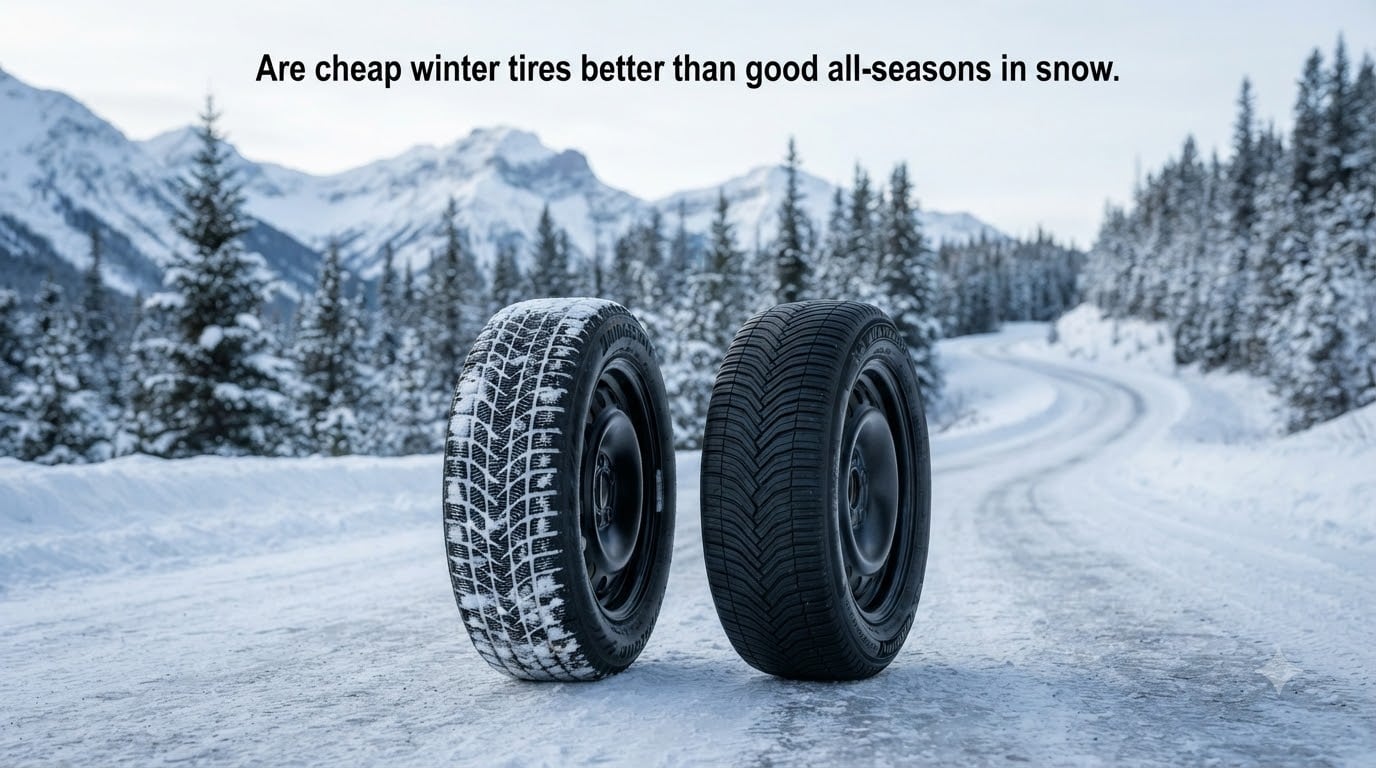
Yes — even cheap winter tires significantly outperform good all-season tires in snow and ice. The difference comes down to rubber compound, tread design, and certification. Here is the short version:
Compound flexibility: Winter tire rubber stays soft below 45°F (7°C), while all-season rubber hardens and loses grip.
Sipe density: Budget winter tires carry 1,500–2,000 sipes per tread block versus 800–1,200 on premium all-seasons — that means roughly twice the biting edges on ice.
Stopping distance: On ice at just 12 mph, winter tires stopped 23 feet shorter than all-seasons in Tire Rack testing — a gap that scales dangerously at highway speeds.
Certification: Cheap winter tires still carry the Three-Peak Mountain Snowflake (3PMSF) symbol, meaning they meet a defined snow-traction standard. Most all-seasons carry only the M+S (Mud and Snow) marking, which has no cold-weather testing requirement.
The compound advantage alone is enough. Even a budget winter tire from Falken, General, or Westlake uses cold-optimized rubber that a premium Michelin or Bridgestone all-season simply cannot match below freezing.
If you drive regularly in temperatures below 45°F or on snowy roads, cheap winter tires are a better investment than premium all-seasons for winter safety. If you live in a mild climate with occasional flurries, a quality all-season with the 3PMSF symbol may suffice.
In this guide, we break down the engineering behind each tire type, the real-world performance data, the cost-of-ownership math, and the scenarios where each option makes sense. If you are deciding whether to buy a set of budget winter tires or rely on your current all-seasons, you will find a clear answer here.
How Winter Tires Are Engineered for Snow
Winter tires are not just “all-season tires with deeper treads.” They are purpose-built from the compound up to work in cold, snow, and ice. The engineering differences are significant and measurable.
The 45°F Threshold: Where Winter Tires Start Winning
The single most important fact in the winter-versus-all-season debate is the 45°F (7°C) threshold. Below this temperature, standard all-season rubber compounds begin to stiffen and harden — a process driven by polymer crystallization in the rubber. The tire loses contact patch flexibility, and grip drops sharply.
Winter tire compounds are formulated with higher silica content and specialized polymer blends that keep the rubber pliable well below freezing. On a Shore A durometer scale (used to measure rubber hardness), winter tires measure around 55–65 at low temperatures, while all-seasons climb to 65–75. That difference translates directly into more contact with the road and shorter stopping distances.
You do not need snow on the ground for winter tires to help. Any time the thermometer reads below 45°F, a winter compound outperforms an all-season compound on bare, cold pavement.
Tread Design: Biting Edges, Sipes, and Void Ratio
Winter tires use three key tread features that all-seasons cannot fully replicate:
Sipes: These are the thin slits cut into tread blocks. A typical winter tire carries 1,500–2,000 sipes per tread block, creating thousands of “biting edges” that grip ice and packed snow. Premium all-seasons usually carry 800–1,200 sipes.
Void ratio: Winter tires have a void ratio of roughly 35–45%, meaning the tread blocks are separated by wider channels. This allows snow and slush to evacuate quickly rather than packing into the tread and reducing grip. All-seasons typically have a void ratio of 25–35%.
Tread depth: New winter tires start at deeper tread depths (10/32″–12/32″) compared to most all-seasons (8/32″–10/32″). Deeper tread channels more snow and water away from the contact patch.
Budget winter tires from brands like Falken, General, Westlake, and Ironman use the same sipe and channel architecture as premium winter tires. The savings come from simpler tread compounds and lower warranty mileage ratings — not from skipping the features that matter in snow.
How All-Season Tires Handle Cold and Snow
All-season tires are designed to be a compromise. They aim for acceptable performance across a wide range of conditions — dry roads, wet roads, light snow, warm pavement — without excelling at any single one. Think of them as the tennis shoes of tires: versatile, but not built for any specific surface.
Their rubber compound is formulated to stay stable at moderate-to-hot temperatures, which means it starts stiffening earlier than winter compounds as the mercury drops. In light snow or slush, their shallower tread depth and fewer sipes mean less mechanical grip. On cold, dry pavement — even without precipitation — the hardened compound simply does not conform to the road surface as well as winter rubber does.
That said, premium all-season tires from brands like Michelin, Continental, and Bridgestone are genuinely competent in light winter conditions. They handle wet roads well, and their tread patterns are optimized for hydroplaning resistance and long tread life. For drivers who rarely see temperatures below 40°F or snow accumulation above an inch, quality all-seasons remain a reasonable choice.
3PMSF vs M+S: What Those Sidewall Symbols Actually Mean
The two symbols you will see on tire sidewalls — M+S and the Three-Peak Mountain Snowflake (3PMSF) — tell you very different things about winter capability.
M+S (Mud and Snow): This is a self-declared manufacturer marking with no standardized cold-weather test. It simply indicates a tread pattern that is designed to handle mud and snow — but says nothing about rubber compound performance in freezing conditions. Most all-season tires carry this symbol.
Three-Peak Mountain Snowflake (3PMSF): This symbol is earned through an actual ASTM traction test on medium-packed snow. The tire must meet a defined snow-traction index to qualify. All dedicated winter tires carry this symbol, and a growing number of all-season and all-weather tires now qualify as well.
If you are choosing tires for winter driving, look for the 3PMSF symbol on the sidewall. It is the only reliable indicator of tested snow performance. M+S alone does not guarantee cold-weather capability.
Why Cheap Winter Tires Beat Good All-Seasons in Snow
The performance gap between a budget winter tire and a premium all-season tire in snow and ice is not marginal — it is dramatic and measurable. The reasons are structural, not marginal tweaks to an already capable design.
Snow and Ice Stopping-Distance Data
Stopping distance is where the difference between winter and all-season tires becomes most visible — and most dangerous. Consider the following real-world test results:
Tire Rack ice test (12 mph): Winter tires stopped 23 feet shorter than all-season tires on the same vehicle, on the same surface, at the same speed. At 30 mph, that gap would scale to roughly 58 feet — more than four car lengths.
Snow traction tests: Independent testing consistently shows winter tires stopping 30–40% shorter than comparable all-season tires on packed snow from highway speeds.
Cornering grip: MotorTrend reported that a Toyota RAV4 on all-season tires “plowed straight ahead” during a snow cornering test, while the same vehicle on winter tires tracked the intended line without drama. Stability-control systems intervened constantly on the all-seasons and rarely on the winters.
These are not small differences. In a real emergency stop on a snowy highway, the gap between 180 feet and 260 feet can mean the difference between a close call and a collision. Even cheap winter tires close this gap substantially because the compound does the heavy lifting — the rubber stays soft and the sipes keep biting, regardless of whether the tire costs $90 or $150.
Cheap Winter Tires vs Premium Winter Tires — How Close?
If budget winter tires beat premium all-seasons in snow, how do they compare to premium winter tires? Closer than you might expect.
The compound chemistry in a $100 Falken winter tire and a $160 Michelin X-Ice is not identical, but both are silica-rich and cold-flexible. Both carry the 3PMSF certification. Both use dense siping and aggressive tread channels. The main differences show up in:
Treadwear: Premium winter tires typically last 4–5 seasons of winter-only use, while budget sets often run 2–3 seasons before the sipes wear down and compound hardens. Reviewers report this as a common trade-off.
Noise and ride quality: Budget tires tend to be louder and ride slightly firmer due to simpler internal construction and less noise-dampening technology.
Wet-road refinement: Premium winter tires tend to maintain better wet-road manners at the end of their tread life, while budget tires can get noisy and hydroplane-prone as they wear.
But in the core mission — stopping and steering on snow and ice — the performance gap between a budget and premium winter tire is far smaller than the gap between any winter tire and any all-season tire. Drivers who have switched to even the cheapest 3PMSF-certified winter tire consistently report that it “completely changed how their car felt in the first storm.” That real-world feedback is consistent across forums and review platforms.
When Good All-Seasons Are Enough: A Climate Decision Framework
Winter tires are not always the right answer. Your local climate, driving patterns, and risk tolerance should determine whether the investment makes sense. Here is a practical framework to help you decide.
Winter tires make sense if:
You regularly drive in temperatures below 45°F for more than a few weeks per year.
Your area sees more than a handful of snow events per season — even a few inches at a time adds up.
You commute on highways or mountain roads where stopping distance matters.
You have rear-wheel drive (RWD) — RWD vehicles benefit disproportionately from winter tires because they have less inherent traction than FWD or AWD.
Quality all-seasons with 3PMSF can work if:
You live in a mild-winter climate (Pacific Northwest lowlands, parts of the Mid-Atlantic, southern states) where temperatures rarely drop below 40°F.
Snow events are infrequent and light — one or two storms per winter that melt quickly.
You can stay home or use public transit on the handful of days roads are icy.
You drive primarily in urban areas where roads are quickly plowed and salted.
Neither option is ideal in these situations:
You live in a transitional zone (parts of the Southeast, coastal Northeast) where ice storms and freezing rain are more common than heavy snow. Studded tires or tire chains may be more practical for occasional severe events.
The key question is frequency. If you are dealing with snow and below-freezing temperatures more than 20–30 days per year, winter tires are a safety investment, not a luxury.
The AWD Winter-Tire Myth — Does All-Wheel Drive Eliminate the Need?
One of the most persistent misconceptions in the tire world is that AWD eliminates the need for winter tires. It does not. AWD helps with acceleration — getting the car moving from a standstill on slippery surfaces. It does nothing to help with braking or steering, which are the maneuvers that keep you out of an accident.
An AWD vehicle on all-season tires will accelerate well in snow, which creates a false sense of security. But when the driver needs to stop or turn, all four tires are still riding on hard, cold-optimized rubber with limited siping. The stopping distance is the same as a FWD or RWD vehicle on the same tires — and that distance is 30–40% longer than a vehicle on winter tires.
AWD owners consistently report the same experience: “My AWD felt great until I tried to stop.” The system that distributes power to all four wheels cannot create grip where the compound does not provide it. Winter tires give AWD vehicles their full capability. Without them, you have a car that can go but cannot stop or steer reliably in winter conditions.
Trade-Offs of Cheap Winter Tires You Should Know About
Cheap winter tires are not a free lunch. The performance gains in snow and ice come with real trade-offs that you should factor into your decision.
Dry-road handling: The soft compound that makes winter tires brilliant in snow makes them vague and imprecise on dry pavement in warm weather. You will notice more body roll, longer dry stopping distances, and less steering feedback. That is why winter tires should come off when temperatures consistently stay above 45°F.
Faster treadwear: Budget winter tires typically last 2–3 seasons of winter-only use before the sipes wear thin and the compound hardens. Premium winter tires last 4–5 seasons. All-season tires, used year-round, often last 50,000–70,000 miles — far longer than a winter tire’s tread life.
Noise and ride: The aggressive tread patterns and soft compound of winter tires generate more road noise, especially on dry highway pavement. Budget tires tend to amplify this because they use simpler internal construction and less sound-absorbing technology.
Warm-weather damage: Driving on winter tires in temperatures above 50°F accelerates tread wear dramatically and can permanently alter the compound, reducing its effectiveness the following winter. Swap timing matters.
The critical point is that these trade-offs do not erase the safety advantage in snow. A cheap winter tire that rides noisily on a dry highway is still the tire that stops 40% shorter on ice. The trade-offs are real, but they are trade-offs you make during the months you are not driving in winter conditions.
The Real Cost of Running Two Sets of Tires
The most common objection to winter tires is cost — specifically, the cost of buying and maintaining a second set. Let us break it down with real numbers.
Upfront costs for a set of four cheap winter tires: A set of budget winter tires (Falken, General, Westlake) typically costs $360–$560 for a standard sedan. If you want a separate set of steel wheels to avoid remounting twice a year, add $200–$400 for the wheels. Total upfront: roughly $560–$960.
Ongoing annual costs:
Seasonal swap (mounting and balancing): $60–$100 per swap, twice a year = $120–$200 annually if you do not have a second set of wheels.
With a second set of wheels, the swap drops to a simple bolt-on — often $40–$60 total per swap, or free if you do it yourself.
Tire storage: If you lack garage space, tire storage services run $50–$150 per season in most metro areas.
Five-year cost comparison:
Single all-season set: $500–$800 for a quality set, replaced every 50,000–60,000 miles (roughly 4–5 years of average driving). No swap costs. No storage costs.
All-seasons + cheap winter set: $500–$800 for all-seasons + $360–$560 for winters + $200–$400 for wheels (one-time) + $80–$300/year for swaps and storage. Over 5 years, the total is roughly $1,460–$2,860. But both sets last longer because each is used only half the year.
The real math favors winter tires when you factor in safety. A single accident — even a minor fender-bender on ice — easily costs $1,000–$5,000 in repairs and insurance premium increases. Winter tires are cheap insurance against that risk.
A note on insurance: In some Canadian provinces and a few US states, insurance companies offer discounts for vehicles equipped with winter tires. Check with your provider — the savings can offset a portion of the seasonal swap cost.
All-Weather Tires: A Middle-Ground Option?
All-weather tires sit between all-season and winter tires. They carry the 3PMSF snowflake symbol — meaning they are tested and certified for snow traction — but they are designed to stay on the vehicle year-round without seasonal swaps.
The trade-off is that all-weather tires are a compromise in both directions. They do not match a dedicated winter tire’s ice and deep-snow performance because their compound is engineered to survive warm-weather driving as well. And they do not match a premium all-season tire’s dry-road handling and tread life for the same reason.
All-weather tires make sense for drivers who:
Live in moderate winter climates with occasional snow but long shoulder seasons.
Do not want the hassle or cost of seasonal tire swaps and second sets of wheels.
Prioritize convenience over maximum winter safety.
If you live in a true snow-belt climate, all-weather tires are a better option than plain all-seasons but still fall short of a dedicated winter tire. They are the “good enough” compromise for mild winters — not the best answer for serious snow.
Frequently Asked Questions
Are cheap winter tires actually better than all-season tires in snow?
Yes. Even budget winter tires from brands like Falken, General, and Westlake use cold-flexible rubber compounds and dense siping that outperform premium all-season tires in snow and ice. The compound stays pliable below 45°F, providing 30-40% shorter stopping distances on snow and significantly better cornering grip. The 3PMSF certification ensures a minimum snow-traction standard that most all-season tires do not meet.
Do winter tires really make a difference in snow?
Yes, and the data is clear. Tire Rack testing showed winter tires stopping 23 feet shorter than all-season tires on ice at just 12 mph — a gap that scales to over 50 feet at highway speeds. On packed snow, winter tires consistently stop 30-40% shorter. The difference is dramatic enough that drivers report feeling it immediately in the first storm.
What temperature do winter tires work better than all-season tires?
Winter tires outperform all-season tires below 45°F (7°C). At this threshold, standard all-season rubber begins to stiffen and lose contact patch flexibility, while winter compound remains pliable. You do not need snow on the ground — cold pavement alone is enough for winter tires to provide better grip.
How much shorter is the stopping distance with winter tires on snow?
On ice at 12 mph, Tire Rack and MotorTrend testing measured a 23-foot stopping-distance gap between winter and all-season tires. At 30 mph, that gap scales to roughly 58 feet. On packed snow from highway speeds, winter tires consistently stop 30-40% shorter than comparable all-season tires.
Can I use all-season tires in light snow?
Quality all-season tires with the 3PMSF symbol can handle light, occasional snow in mild winter climates. However, standard all-season tires with only M+S markings have no cold-weather testing requirement and may lose grip quickly once temperatures drop below 45°F or snow accumulates beyond an inch or two.
Is it worth putting winter tires on an AWD vehicle?
Yes. AWD helps with acceleration but does nothing for braking or steering on slippery surfaces. An AWD vehicle on all-season tires will still have the same stopping distance as a FWD vehicle on the same tires — 30-40% longer than a vehicle on winter tires. AWD plus winter tires is the safest combination for winter driving.
Are all-weather tires a good compromise between winter and all-season tires?
All-weather tires carry the 3PMSF certification and can stay on year-round, making them a convenient middle-ground option. They outperform standard all-seasons in snow but do not match dedicated winter tires for ice and deep-snow performance. They work well in moderate winter climates where dedicated winters are overkill.
Do budget winter tires perform as well as premium ones?
In snow and ice, budget and premium winter tires are closer than most people expect. Both use cold-flexible compounds and dense siping with 3PMSF certification. The main differences are treadwear (2-3 seasons for budget vs 4-5 for premium), road noise, and wet-road refinement. For pure snow safety, budget winter tires deliver 80-90% of premium performance at 50-60% of the cost.
How long do cheap winter tires last compared to all-season tires?
Cheap winter tires typically last 2-3 seasons of winter-only use before sipes wear thin. Premium winter tires last 4-5 seasons. All-season tires used year-round often reach 50,000-70,000 miles. However, when you run two sets and alternate seasonally, both sets last longer because each is only used half the year.
Should I buy a second set of wheels for winter tires?
A second set of steel wheels costs $200-$400 upfront but saves money long-term. Without a second set, you pay $120-$200 per year for mounting and balancing during seasonal swaps. With a second set, the swap is a simple bolt-on you can do yourself or pay $40-$60 for. Over 3-4 years, the wheels pay for themselves and reduce wear on your original rims.
Conclusion
So, are cheap winter tires better than good all-seasons in snow? The answer is a clear yes. A budget winter tire with 3PMSF certification uses cold-flexible rubber compound and dense siping that no premium all-season can match once temperatures drop below 45°F. The stopping-distance data — 23 feet on ice at 12 mph, scaling to 30–40% shorter stops on snow from highway speeds — makes the case without room for debate.
The trade-offs are real: faster treadwear, more road noise, and the hassle of seasonal swaps. But for drivers who regularly face snow and freezing temperatures, those trade-offs are a small price for a meaningful safety upgrade. If you are asking whether cheap winter tires are worth the investment over relying on quality all-seasons in winter conditions, the engineering, the data, and the experience of millions of winter drivers all point the same direction.