
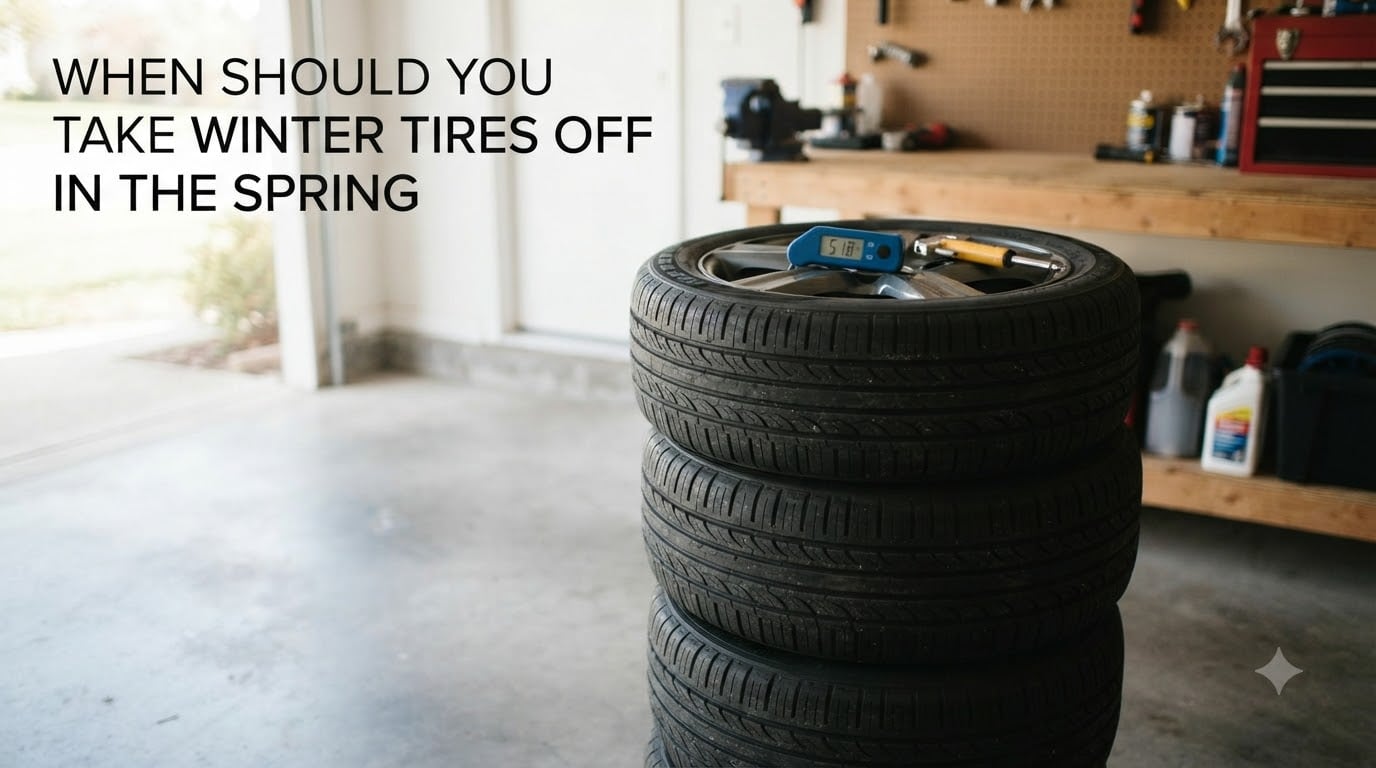
You should take winter tires off in the spring once daily high temperatures stay consistently above 45°F (7°C) for one to two weeks. That single temperature threshold is the rule our team follows, and it is what tire manufacturers like Michelin and Bridgestone recommend in their own owner literature. Below 45°F, the soft rubber compounds in winter tires stay flexible and grip cold pavement. Above it, the same compounds turn gummy, wear out faster, and push your braking distance out by measurable margins.
This guide walks through exactly when to swap, how to read your local weather, what to inspect before you store your winter set, and the regional timing windows that match how drivers actually use their cars across the U.S. We pulled together manufacturer specs, NHTSA tread depth minimums, Transport Canada braking data, and a few cold-hard forum threads from drivers who learned the hard way. If you only take one thing from this article, take the 45°F rule and the patience to wait a week past it.
Table of Contents
Understanding the 45°F (7°C) Temperature Rule
The 45°F (7°C) rule is the cleanest answer to the question of when to take winter tires off in the spring. Once your daytime highs stop dipping below 45°F for a stretch of seven to fourteen days, the rubber in your winter tires has stopped doing the job it was built for and is now wearing itself out on warm pavement.
Winter tires use a softer, more pliable rubber compound than all-season or summer tires. That flexibility is exactly what gives them bite on ice and snow below 45°F. As soon as the ambient temperature climbs above that line, the compound becomes too soft for dry and wet roads. It grips, but it grips in the wrong way — like a pencil eraser dragged across paper — which shortens braking distance on warm dry roads and inflates it on warm wet roads.
The “consistently” part matters as much as the number. A single 50°F day in early March followed by three more freezing nights does not justify a swap. The pavement, the tire carcass, and the air inside the tire all need to settle into a warm-weather steady state. That is why most tire technicians, including the OK Tire shop owner quoted by Reader’s Digest, tell drivers to wait one to two weeks of sustained warmth before pulling the trigger.
Two temperature signals to watch together:
- Daily high above 45°F (7°C) for 7 to 14 consecutive days
- Overnight low reliably above freezing, 32°F (0°C)
When both of those line up in your area, you have crossed the threshold. If you live somewhere that bounces between warm afternoons and frosty mornings for another month (think Denver in April or Boston in mid-March), hold off. A surprise refreeze can turn an all-season tire into a hockey puck on a cold morning commute.
Why Winter Tires Wear Faster and Perform Worse in Warm Weather
Winter tires wear roughly twice as fast on warm pavement as they do in the cold conditions they were designed for. That figure comes up consistently in tire-industry testing, and it shows up in the shop receipt the first time you forget to swap on time.
There are three concrete reasons winter tires underperform once temperatures rise, and each one affects a different part of your driving experience:
- Soft rubber compounds turn gummy above 45°F. The tread blocks squirm instead of biting, which lengthens braking distance. Reader’s Digest cited testing showing up to a 26% increase in stopping distance on warm dry pavement compared to all-season tires.
- Aggressive siping and high void-to-rubber ratio reduce contact patch on dry roads. Those tiny slits and channels that evacuate snow and slush become dead space once the road is dry, which hurts cornering and steering response.
- Rough tread surfaces generate more rolling resistance. That extra drag burns more fuel and shows up as a small but noticeable drop in mpg over a full summer of driving.
The hydroplaning risk is the one most drivers underestimate. Spring rain plus 60°F pavement plus a winter tire’s softer compound is a tricky combination. The tire can hold water for a beat longer than an all-season or summer tire before channeling it through the tread, and in that beat your steering goes light. We see this come up every spring in driver forums, where people swap early and then wonder why their car feels vague in a sudden April downpour.
None of this means winter tires are unsafe above 45°F. It means they are no longer the best tool for the job, and continuing to run them costs you money in tread life and fuel while costing you a small amount of grip in conditions you actually have to drive through.
US Regional Timing Windows for Spring Tire Changes
Regional timing is where most generic guides fall down. A driver in Maine and a driver in North Carolina should not be running the same swap calendar. Below is the regional timing window we built from NOAA climate normals and Forum threads on regional swap habits. Adjust it for your specific microclimate (mountains, valleys, lakefront) by adding two to three weeks of conservatism if you live above 2,000 feet or anywhere lake-effect snow lingers.
| U.S. Region | Typical Window | Average Daily Highs in Window | Notes |
|---|---|---|---|
| Northern New England (ME, NH, VT, northern NY) | Late April to mid-May | 48°F to 62°F | Watch overnight lows; refreeze risk through early May. |
| Mid-Atlantic and Great Lakes (PA, NY, OH, MI, WI) | Mid-March to mid-April | 45°F to 58°F | Lake-effect regions: wait an extra two weeks. |
| Pacific Northwest (WA, OR, northern CA coast) | Mid-March to early April | 48°F to 60°F | Wet conditions persist; check tread for wear from winter rain. |
| Mountain West (CO, UT, WY, MT) | Late April to late May | 45°F to 60°F at altitude | Above 7,000 ft, often into June. Snow tires mandatory through May for many mountain passes. |
| Northern Plains and Midwest (MN, IA, IL, IN, MO) | Early April to early May | 48°F to 62°F | Wide swings common; wait for two solid warm weeks. |
| Southeast and Gulf (NC, SC, GA, FL, AL, MS, LA, TX) | Late February to mid-March | 55°F to 70°F | Many drivers here run all-seasons year-round. |
| Southwest and Southern California (AZ, NM, SoCal) | January to mid-February | 60°F to 75°F | Winter tire use is rare; only mountain and high-desert drivers need them. |
The key is that these windows describe typical years. A warm spring lets you swap earlier; a cold snap in May in the Rockies can push your swap into June. The temperature rule still rules, but these windows are how you plan your appointment.
Best Time to Switch to Summer or All-Season Tires
The best time to switch from winter tires to summer or all-season tires is the first sustained warm stretch after your regional window opens, not the first warm day. Watch a 10-day forecast instead of the calendar, and look for two specific signals before you book the appointment.
First, look for a forecast where every day is above 45°F, including the overnights. One cold night is not a disaster, but if your forecast keeps dipping into the 30s, your winter tires are still earning their keep on the morning commute.
Second, look at the longer-range trend. NOAA’s 6-to-10-day outlook and 8-to-14-day outlook give you a sense of whether a warm week is the start of a pattern or a fluke. If the longer range still shows cold air masses nearby, hold off. We treat any forecast that calls for snow within two weeks of our swap as a reason to delay.
If your area is prone to surprise late-spring snow (think Front Range Colorado, lake-effect snow belts, or mountain valleys above 5,000 feet), have a contingency plan. Some drivers keep a single set of all-weather tires on a second vehicle for the tail end of winter. Others simply wait until mid-May to swap, accepting a few weeks of accelerated winter-tire wear in exchange for not getting caught in a May snowstorm with summer tires.
For most drivers in the lower 48 outside the mountain west, swapping by the second week of your regional window is the right balance. You get the warm-weather grip and fuel savings soon enough to matter, and you avoid the worst of the spring snow risk.
Inspecting Tread Depth and Tire Condition Before Storage
Before you swap your winter tires off, spend ten minutes on inspection. You will be storing them for six months, and what you learn now tells you whether they are worth keeping or whether this is the year you replace the set.
The legal tread depth minimum in most U.S. states is 2/32 of an inch, which is roughly 1.6 mm. For winter tires specifically, most tire manufacturers and Transport Canada both recommend replacing them once the tread reaches 4/32 of an inch (about 3.2 mm). Below 4/32, the sipes and tread blocks that give winter tires their snow and ice bite are too shallow to do their job. If your winter tires are at or below 4/32 going into storage, plan on replacing them before next winter.
Three quick checks before the tires come off the car:
- Tread depth with a gauge. Use a dedicated tread depth gauge (a few dollars at any auto parts store) rather than the penny test, which is too imprecise for winter tire decisions. Measure at the center, inside, and outside of each tire.
- Even wear patterns. Look across the tread face. If the inside edge is significantly more worn than the outside, you have an alignment issue that needs to be fixed before the new set goes on.
- Sidewall damage. Cracks, bulges, or embedded debris on the sidewall are a hard “do not store” signal. Sidewall damage does not heal in storage, and a stored tire with a sidewall bulge can fail catastrophically when reinstalled.
If everything checks out, note the position where each tire was mounted (front left, front right, etc.). When you put them back on next fall, rotating to the opposite axle position evens out wear that happened during the season you just finished.
AWD and 4WD Vehicles: Why Matching Tire Sets Matter
If you drive an AWD or 4WD vehicle, swap all four tires at the same time and keep the sets as close in tread depth as you can. This is the single piece of advice that most general tire guides skip, and it is the one that matters most for owners of Subaru, Audi Quattro, BMW xDrive, and similar systems.
AWD and 4WD systems continuously compare the rotational speed of each wheel. The center differential, transfer case, or electronic clutch pack uses those comparisons to send power where it is needed. When one set of tires has noticeably more tread than the other, the system sees a phantom speed difference and reacts to it, often by binding up the drivetrain or sending power to the wrong wheels.
Three rules we share with every AWD owner who asks:
- All four tires swap together. Do not run two winter tires and two all-season tires on an AWD vehicle. The mismatch can damage the center differential, and the cost of that repair dwarfs the cost of a second set of tires.
- Keep tread depth within 2/32 of an inch across all four tires when the swap happens. If your winter set is at 7/32 and your all-season set is at 5/32, the difference is enough to cause drivetrain stress over time.
- Check the owner’s manual. Some manufacturers, including Subaru and certain Audi models, require identical tires on all four corners for the AWD system to operate within warranty terms.
If you are at the end of your winter tire’s life and your all-season set is also getting thin, replace all eight tires at once. AWD systems reward symmetry, and chasing tread depth by replacing tires one at a time is the most expensive way to maintain them.
Step-by-Step Spring Tire Swap Plan
A spring tire swap is straightforward enough that most drivers can do it in a driveway with a jack, a lug wrench, and a torque wrench. Here is the six-step process we use, and the steps that DIYers tend to skip that the pros insist on.
- Check the weather. Confirm a 10-day forecast of daily highs above 45°F before you start. Do not swap with a cold snap in the forecast.
- Gather your tools. Floor jack, jack stands, lug wrench, torque wrench, gloves, and a marker for marking tire position.
- Loosen lug nuts a quarter turn while the car is on the ground. Do not remove them yet. This breaks torque and prevents wheel spin in the next step.
- Jack the car, place jack stands, then remove the wheels. Mount your all-season or summer wheels and hand-tighten the lugs in a star pattern.
- Torque to spec. This is the step DIYers skip. Use your manufacturer’s torque spec (usually 80 to 100 lb-ft for most cars, 100 to 120 lb-ft for many light trucks) and a star pattern. Hand-tightening leaves lugs under- or over-torqued.
- Reset the TPMS. Most direct TPMS systems relearn automatically after a few miles of driving above 15 mph. Some vehicles require a manual reset through the infotainment menu or a relearn tool. Check your owner’s manual.
Two practical details. First, mark each winter tire’s position with a piece of chalk or a tire marker before you stack them. Front tires wear differently than rear tires, and rotating positions at next fall’s install extends the life of the set. Second, check the tire pressure on the new set after 24 hours of driving. Cold inflation pressure on the freshly installed tires should match the door-jamb sticker, not the number molded on the tire sidewall.
If you prefer to have a shop do it, expect a charge in the range most national chains quote for a seasonal swap. Many shops that store your tires offer the swap free as part of a storage package. Either way, ask them to torque the lugs properly. Hand-tight wheels are the single most common mistake we see from shops that rush seasonal swaps.
How to Store Winter Tires Over Summer
How you store winter tires over the summer determines whether they are still usable when you pull them back out in November. Six months in a hot garage can age a tire faster than six months of daily driving, especially if the garage sees direct sun or swings in temperature.
The four rules for storing winter tires are simple:
- Clean before storage. Wash the tires with soap and water and dry them completely. Brake dust and road grime hold moisture against the rubber and accelerate sidewall dry rot.
- Bag them. Use breathable tire storage bags (a few dollars for a four-pack) or large garbage bags with a few small holes punched for airflow. Bags keep ozone, which is emitted by electric motors and household chemicals, off the rubber surface.
- Store cool, dry, and dark. A climate-controlled basement or closet is ideal. A garage is fine if it does not see direct sunlight and stays under 80°F. Avoid storing next to a furnace, water heater, or ozone-generating equipment like air purifiers or older electric motors.
- Stack or hang. If your tires are mounted on wheels, stack them upright or hang them on a wall-mounted tire rack. If they are unmounted, store them standing upright (like wine bottles) to prevent flat-spotting. Never store unmounted tires hanging from the center hole; the weight distorts the carcass over time.
If you do not have the space at home, most tire shops and big-box automotive retailers offer seasonal tire storage for a small annual fee. The fee is worth it if the alternative is a hot attic or a sun-soaked garage. A properly stored set of winter tires can last six seasons before the tread wears out. A poorly stored set can be unusable in three.
What Happens If You Leave Winter Tires On Too Long
Leaving winter tires on past the right window costs you money, grip, and potentially the tires themselves. We hear from drivers every year who thought they would “just leave them on through May” and then discovered the consequences in June.
Four things happen, in order of how quickly they show up:
- Rapid tread wear. The soft compound sheds rubber on warm dry pavement at roughly twice the cold-weather rate. A normal winter season’s worth of wear can show up in two months of summer driving.
- Longer braking distances on warm dry and warm wet roads. The squirmy compound delays the tire’s transition from rolling to braking. The 26% figure that shows up in tire testing comes from this exact scenario.
- Higher rolling resistance, which costs you real money at the pump. A set of winter tires can cost a small car about a 3% to 5% fuel economy penalty in summer driving, which adds up over a full season.
- Shortened total tire life. A set of winter tires that should last six seasons might be worn out in three or four if you leave them on year-round. The cost of two extra sets of tires over the life of the car pays for itself.
The hidden risk is the one nobody talks about: hydroplaning in summer rain. Winter tires evacuate water through the same channels that evacuate snow, but the softer compound holds water in contact with the road a beat longer. In a heavy summer thunderstorm, that extra beat can be the difference between a controlled stop and a slide. If you drive into July with your winter tires still mounted, you are gambling on the weather.
Common Mistakes to Avoid When Removing Winter Tires
Most of the winter tire problems we hear about in our shop come from a handful of predictable mistakes. Avoid these, and your swap will go smoothly.
- Swapping by calendar date instead of temperature. March 21 is the spring equinox, not a tire changeover date. Drivers in Atlanta can swap in late February; drivers in Caribou, Maine should not swap until May.
- Ignoring the overnight low. A daytime high of 55°F does not help you on the 28°F morning commute. Wait until overnight lows stay reliably above freezing too.
- Skipping the tread depth check. Storing a worn-out set is just paying storage fees for a set you will have to replace before next winter anyway. Measure first, store second.
- Storing tires in the sun or in a hot attic. UV and heat destroy rubber compound. A set stored badly in June can be visibly cracked by November.
- Mismatching tires on an AWD vehicle. Two winter tires and two all-season tires on an AWD car damages the drivetrain. Swap all four at once, every time.
- Forgetting the TPMS relearn. A lit tire pressure light after a swap is not always a low tire; sometimes it is just a TPMS sensor that needs to be paired again. Check the owner’s manual before assuming you have a puncture.
- Over-torquing lug nuts. A lug wrench and an impact gun are not torque wrenches. A wheel that is too tight is almost as dangerous as one that is too loose, because it stretches the studs and the next swap becomes a problem.
The first mistake on this list is the one we see the most. Drivers swap by the calendar because it is easy, and then either end up with a May blizzard on summer tires or a June heatwave on winter tires. Watching the temperature costs you nothing and saves you a season of bad decisions.
Frequently Asked Questions
What temperature is too cold for all-season tires?
All-season tires start to lose grip below about 45°F (7°C). Below that threshold, the rubber hardens, sipes stiffen, and braking distance lengthens on cold pavement. If your area sees extended cold, dedicated winter tires are a safer choice.
Can I switch tires too early?
Yes. If you swap to summer or all-season tires before overnight lows reliably stay above freezing, you risk hitting a cold snap with the wrong rubber. Wait until daily highs stay above 45°F (7°C) for one to two weeks and overnight lows stay above freezing before you swap.
What is the 45 degree rule for winter tires?
The 45 degree rule says you should remove winter tires once daily high temperatures stay consistently above 45°F (7°C) for one to two weeks. Below that temperature, the soft compound stays flexible and grips cold pavement. Above it, the compound turns gummy and wears out fast on warm roads.
Is it bad to drive on winter tires in summer?
It is not safe to keep winter tires on year-round. The soft compound wears twice as fast on warm pavement, lengthens braking distance by up to 26%, and increases hydroplaning risk in summer rain. Most drivers replace winter tires that were left on through summer a season or two early.
How long do winter tires last?
Winter tires typically last four to six seasons when used only in cold months and stored properly. Replace them once the tread wears down to 4/32 of an inch (about 3.2 mm), even if the legal minimum in your state is lower. Proper storage in a cool, dark, dry place extends tire life.
How often should you change seasonal tires?
Most drivers swap seasonal tires twice a year, in the fall and spring. Each swap happens when temperatures cross the 45°F (7°C) threshold in the appropriate direction. Drivers in mild climates who run all-season tires year-round do not need to swap at all.
The Bottom Line on Spring Tire Changeover
The cleanest answer to when should you take winter tires off in the spring is the 45°F rule: once your daily highs stay above 45°F (7°C) for a solid stretch and your overnight lows stay above freezing, it is time to swap. For most of the U.S., that window opens between late February and mid-May depending on your region, and closes again in the fall when temperatures cross back the other way.
Do your inspection before you store the set, mark tire positions for the fall reinstall, and put your winter tires somewhere cool, dark, and dry. If you drive an AWD or 4WD vehicle, keep your tire sets matched in tread depth and swap all four corners together. Done right, a spring swap takes an hour and saves you tread life, fuel, and grip across the warm months ahead.
Our team uses this same checklist every March through May, and it is the one we trust. Bookmark it for next fall, when you are asking the mirror question of when to put winter tires back on. Until then, watch the forecast, watch the thermometer, and enjoy the warm pavement.