
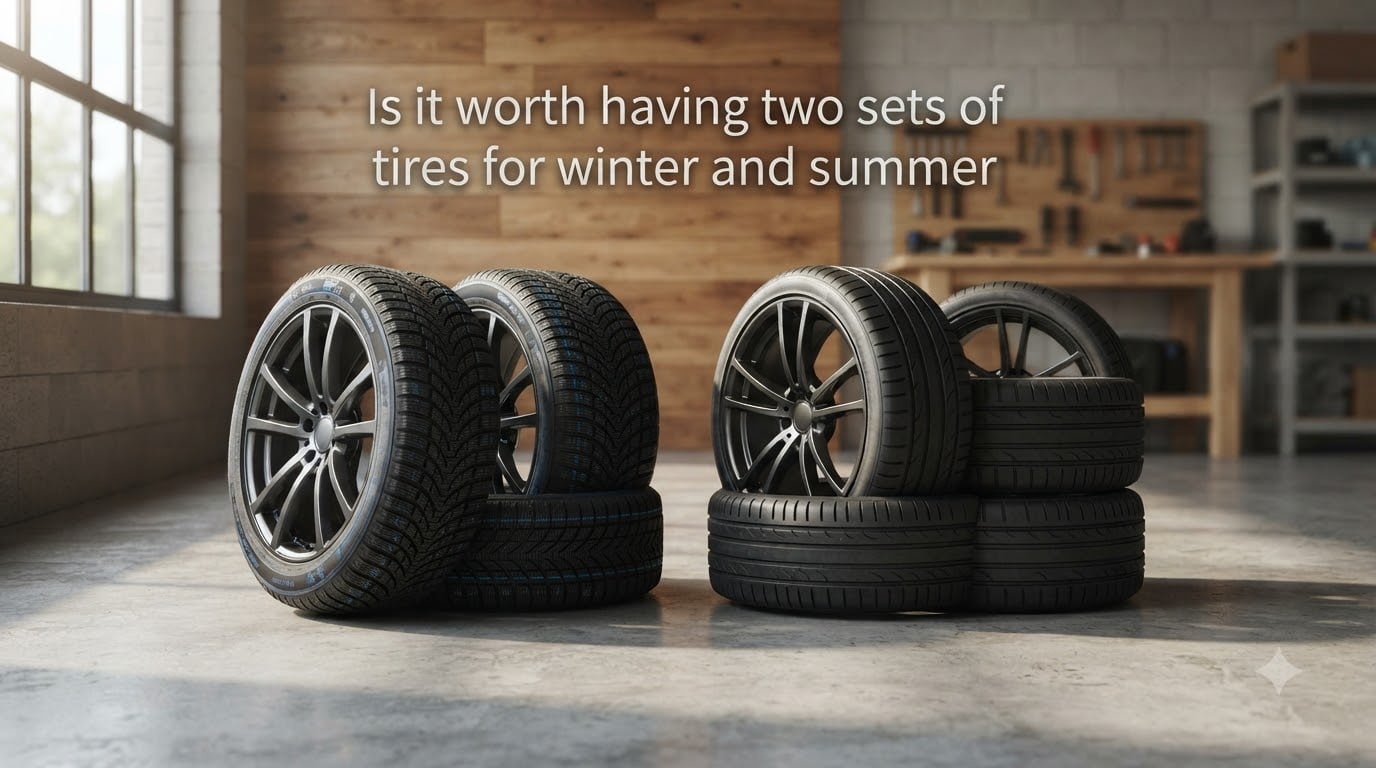
Two sets of tires are worth it if you regularly drive in temperatures below 7°C (45°F), deal with snow or ice, and put on enough annual miles to break even on the upfront cost. If you live in a mild climate, drive few miles, and have no place to store a second set, quality all-season tires will honestly get you through most winters. The rest of this guide walks through exactly how I make that call for our team of readers.
I’ve spent the last several winters helping drivers figure out the right setup for their climate, vehicle, and budget. Most of the questions that land in my inbox come down to the same five things: how cold does it really get, how much stopping distance winter tires actually buy you, what the second set costs in total, where you put the off-season set, and whether AWD removes the need entirely. I’ll answer each one with real numbers and an honest yes/no for the borderline cases.
Table of Contents
What Changes Between Winter and Summer Tires
Winter tires and summer tires are not the same tire tuned differently. They are engineered from the ground up for opposite ends of the temperature spectrum, and the differences show up in three places: rubber compound, tread pattern, and siping.
Winter tires use a softer rubber compound loaded with silica and natural rubber. That compound stays flexible when temperatures drop, so the tread can actually conform to the road surface and bite into snow. Summer tires use a stiffer, heat-resistant compound optimized for warm pavement; they deliver crisp dry handling and resist the squirmy feel winter rubber produces on a hot highway.
The tread patterns diverge just as much. Winter tread blocks have thousands of tiny slits called sipes. Those sipes act like tiny claws that grab snow and wick away the thin water film that forms on ice. Summer tread patterns have larger, stiffer blocks and wider circumferential grooves designed to evacuate heavy summer rain and resist hydroplaning at highway speeds.
All-season tires try to split the difference. They use a medium-hardness compound and a tread pattern that handles both light snow and summer storms. They work well in climates that hover near the threshold, but they are a compromise in both directions. That compromise is the entire reason the two-set conversation exists.
The 7°C / 45°F Temperature Threshold
The single most important number in this whole article is 7°C, or 45°F. Below that temperature, the rubber compound in all-season and summer tires begins to stiffen, and the tire’s grip on the road drops sharply. Michelin, Tire Rack, and every major manufacturer publish this threshold because it is the inflection point where winter tires start outperforming all-seasons on a dry cold road, before a single flake of snow has fallen.
Cold rubber does not bend as easily, so the tread cannot wrap around small road textures. The tire still rolls and steers, but braking distance and cornering grip both suffer. Winter compounds stay pliable well below freezing, which is why a winter tire on a cold dry road can out-brake an all-season on the same road.
If your region spends three or more months below 7°C, you are firmly in winter-tire territory. If your winters barely brush that mark, an all-season tire may genuinely be enough. The threshold is your first filter for the whole decision.
Do Winter Tires Really Make a Difference? (Braking Data)
The honest answer is yes, and the gap is large enough to matter in a crash. AAA’s 2024 winter-tire testing compared dedicated winter tires against all-season tires on the same vehicle across snow, ice, and cold wet pavement. The winter tires stopped the car about 30% shorter on snow and roughly 50% shorter on ice than the all-seasons.
Translated into real distance: on packed snow from 30 mph, an all-season typically needs around 100 feet to stop. A dedicated winter tire on the same surface stops in roughly 70 feet. That 30-foot gap is the difference between hitting a curb and stopping short of it. On ice the gap is even more dramatic, because winter siping is the only thing giving the tire any mechanical grip at all.
Cold wet pavement is the one most people forget. Even with no snow on the ground, a road near freezing is slicker than a warm wet road, and winter tires outperform all-seasons there too. If you commute on cold mornings, that data point alone justifies the swap for many drivers.
Winter vs All-Season vs Summer: Comparison Table
This is the table I wish someone had handed me on day one. It compares the three tire categories across traction, temperature range, tread life, and approximate cost per set.
Traction: Winter tires win on snow and ice. Summer tires win on dry and wet roads above 7°C. All-season tires sit in the middle on every surface.
Temperature range: Winter tires perform best below 7°C and wear quickly above that. Summer tires perform best above 7°C and harden dangerously below. All-seasons work across roughly -10°C to 30°C but never excel at either end.
Tread life: Winter tires typically last 4 to 6 seasons when used seasonally. Summer tires last 4 to 6 seasons of warm-weather use. All-seasons last 5 to 8 seasons total, because they are on the car year-round.
Cost per set: Budget all-seasons are the cheapest single-set option. A dedicated winter set usually runs more than a summer set of the same size, because the compound and siping cost more to produce. Buying both dedicated sets plus a second set of rims is the most expensive option, but also the most convenient.
Dry handling: Summer tires deliver the best dry handling and shortest warm-weather braking. Winter tires feel soft and vague above 10°C. All-seasons are acceptable but never class-leading.
Wet braking: Summer tires outperform all-seasons in summer rain. Winter tires outperform all-seasons in cold rain below 7°C. All-seasons are a year-round compromise.
Snow and ice grip: Winter tires are the only category worth the name on packed snow or ice. All-seasons handle light snow at low speeds and nothing more. Summer tires are genuinely dangerous in those conditions.
How Much Does a Second Set Cost?
There are three ways to set up a two-set system, and the cost varies widely depending on which one you pick. The cheapest is buying tires only and paying for a remount and balance twice a year. The most expensive is buying a complete second wheel-and-tire package so the swap is a 30-minute job in your driveway.
Tires only: A set of four dedicated winter tires for a typical sedan usually runs in the mid-hundreds, with premium winter tires climbing higher. You pay for mounting and balancing twice a year, typically a few tens of dollars per swap at a shop.
Tires plus a second set of rims: Steel rims are the budget-friendly route and add a few hundred dollars for four. Alloy rims look better and shed a little weight, which slightly improves winter fuel economy and braking. Mounted on their own rims, the swap becomes a quick bolt-on job you can do at home with a torque wrench and a jack.
Storage: Off-season tires stored at home in a cool dry garage cost nothing. Tires stored at the retailer or a tire-storage facility usually run a modest yearly fee per set. Climate-controlled storage costs more and is worth it mainly if you live somewhere with extreme humidity or temperature swings.
For a typical sedan owner, the realistic total for a full two-set system (winter tires, steel rims, two changeovers, and home storage) lands in the low-to-mid four figures over the first year. After that, your annual outlay is essentially the changeover cost, which is small.
Break-Even Math: When Does the Second Set Pay for Itself?
Most competitor articles skip this part, and I think that’s a mistake, because the break-even calculation is what makes the decision feel less like a leap of faith. Here is the simple version.
Two effects work in your favor when you run dedicated seasonal sets. First, each set only wears during the season it is designed for, so both sets last longer than a single all-season set wearing year-round. Second, you reduce the risk of cold-weather accidents, which carries an insurance-deductible and hassle cost that is hard to put a number on but very real.
A practical example: suppose your current all-season tires last about 50,000 miles. With two seasonal sets, each one might last 60,000 to 70,000 miles because neither is ever run outside its design temperature. That extra life partially offsets the upfront cost of the second set.
Add in an insurance discount (some carriers offer up to 5% off the collision or comprehensive portion of the premium when you carry a dedicated winter set, with proof of purchase), and the effective cost drops further. If you drive 12,000 to 15,000 miles a year and live in a region with five or more cold months, a dedicated two-set system usually pays for itself within three to five winters, and after that it is essentially free tire mileage.
If you drive fewer than 7,000 miles a year, the math gets much weaker. The tires simply do not wear enough for the longevity benefit to matter, and the upfront cost takes a decade or more to amortize.
AWD vs Winter Tires: Do You Still Need Them?
This is the myth that needs to die, because the answer is clearly yes. All-wheel drive helps your car accelerate in snow. It does almost nothing for braking or cornering, which are the two things that put you into a ditch or a telephone pole.
An AWD SUV on all-season tires will get going up an icy hill faster than a two-wheel-drive sedan on winter tires. The same AWD SUV will slide straight through a stop sign on a cold morning because all four of its tires are made of rock-hard rubber. I have read forum threads on r/SubaruForester and r/WRX where owners confirm exactly this after a winter-tire swap. The handling difference, not the traction difference, is what shocks people.
If you own an AWD or 4WD vehicle, winter tires are even more important, not less. You have already invested in the drivetrain. Pair it with the right tires and you have a genuinely capable winter vehicle. Pair it with all-seasons and you have a fast AWD car that cannot stop.
Where to Store Off-Season Tires
Storage sounds like a small thing, but it is one of the top reasons people skip the second set. Here are your three realistic options.
Home garage or basement: Free, convenient, and perfectly fine if you have the space. Stack them upright (not hanging) or lay them flat. Keep them out of direct sunlight and away from electric motors or ozone-producing equipment, both of which degrade rubber over time. A heavy-duty trash bag or a purpose-built tire bag keeps them clean.
Retailer storage: Many tire shops will store your off-season set for a modest yearly fee. The set comes back to you already swapped at changeover time, which removes the hassle of transporting four tires in your trunk. The fee is usually modest per set per season.
Climate-controlled self-storage: Worth it if you live somewhere with extreme temperature swings, high humidity, or no garage space. The unit keeps the tires in stable conditions, which marginally extends rubber life. Skip it if your garage stays dry and shaded.
The two things that actually damage stored tires are sunlight, ozone, and standing water. If you avoid those, almost any clean indoor spot will do.
Climate-Based Recommendation: Snow Belt vs Mild vs Sun Belt
Geography is the single biggest input into this decision. Here is how I break it down.
Snow Belt (upper Midwest, Northeast, mountain West, most of Canada): Dedicated winter tires are strongly recommended. You see sustained temperatures below 7°C for four to six months, regular snow, and ice. All-seasons are a compromise you should not accept if you can afford the second set.
Mild winter (Pacific Northwest lowlands, Mid-Atlantic, lower Midwest, Mid-South): Quality all-seasons are a defensible choice for most drivers here. You get a handful of cold mornings and maybe a few snow events per winter. If you can work from home on the two or three bad days a year, all-seasons are honest and adequate. If you commute on snow days, a dedicated winter set earns its keep.
Sun Belt (Florida, southern Texas, southern California, southern Arizona): Dedicated winter tires are unnecessary. All-seasons are fine year-round. The temperature threshold is the giveaway: if your winters stay above 7°C, winter tires never enter their design window.
Mountain West with deep snow: Studless winter tires are the standard recommendation. If you regularly drive on packed snow or hard-packed ice at altitude, the siping-only design pays off. Studded tires are still an option in some states, especially on rural roads, but they are louder on pavement and not legal everywhere.
When a Second Set Is NOT Worth It
Honesty time. There are real scenarios where a second set is wasted money, and I want to name them so you can trust the rest of this guide.
You live in a mild climate. If your region spends less than two months below 7°C and you see less than a handful of snow days a year, all-seasons are genuinely enough. The winter tire never enters its design window, so you are paying for capability you cannot use.
You drive very few miles. Below 7,000 miles a year, the longevity argument disappears because the tires simply do not wear enough for the dual-set benefit to show up. The upfront cost stretches across a decade or more, and the math stops working.
You have no storage and no shop nearby. If you cannot safely store four tires and have no retailer offering storage, the logistics cost (transporting tires, finding a shop twice a year) erodes the value.
You replace your car every two to three years. If you rotate vehicles quickly, you may never wear out either set, and the upfront cost becomes pure expense.
In any of these cases, a premium all-season tire is the honest recommendation. There is no shame in that. A good all-season outperforms a cheap winter tire on every surface.
EV-Specific and Studded vs Studless Notes
Two short notes worth their own section.
Electric vehicles: Cold weather drops EV range meaningfully, partly because of battery chemistry and partly because of rolling resistance. Winter tires with low rolling resistance can claw back a few percentage points of range. Regenerative braking also behaves differently on cold rubber, because the traction limit is lower. If you drive an EV in a cold climate, winter tires are worth it for the same reasons as any other vehicle, plus the small efficiency bonus.
Studded vs studless: Studded winter tires use small metal studs to bite into ice. They are the gold standard on hard-packed ice but louder on bare pavement, slightly worse on dry roads, and restricted or banned in some states. Studless winter tires rely on compound softness and dense siping for grip. They are quieter, legal everywhere, and nearly as good on ice as studded in most real-world conditions. For most drivers in the lower 48, studless is the right default.
Frequently Asked Questions
Is it worth getting two sets of tires?
Two sets of tires are worth it if you regularly drive in temperatures below 7°C (45°F), see snow or ice, and put on enough annual miles to break even on the upfront cost. Drivers in mild climates with low annual mileage are usually better off with a premium all-season tire.
Is it worth having winter tires and summer tires?
Yes, if you live where winters stay below 7°C (45°F) for three or more months. Dedicated winter tires stop a car roughly 30 percent shorter on snow and 50 percent shorter on ice than all-seasons, per AAA testing, which is a meaningful safety gain. If your winters barely touch that threshold, a quality all-season tire is the more honest choice.
How much does it cost to have two sets of tires?
A complete two-set system for a typical sedan, including winter tires, steel rims, two changeovers, and home storage, typically lands in the low-to-mid four figures the first year. After that, the only recurring cost is the changeover, which is usually a few tens of dollars per swap at a shop.
Do winter tires really make a difference?
Yes. AAA testing shows dedicated winter tires stop a car about 30 percent shorter on snow and roughly 50 percent shorter on ice than all-season tires on the same vehicle. The gap shows up even on cold dry pavement, because winter rubber stays flexible below 7°C while all-season rubber hardens.
How long do winter tires last?
A dedicated winter tire used only in the cold season typically lasts 4 to 6 seasons, or roughly 40,000 to 60,000 miles. Running them in warm weather shortens life dramatically and is not recommended.
Where should I store my off-season tires?
A cool, dry, dark indoor space is best. Stack them upright in heavy-duty tire bags, away from direct sunlight and ozone sources like electric motors. Retailer storage runs a modest yearly fee, and climate-controlled self-storage is worth it mainly in extreme humidity or temperature swing regions.
Do I need winter tires if I have all-wheel drive?
Yes. AWD helps a car accelerate in snow but does almost nothing for braking or cornering. An AWD vehicle on all-season tires will out-accelerate a two-wheel-drive car on winter tires but still slide through a stop sign on a cold morning. Winter tires improve the two things that matter in a crash: stopping and turning.
Are winter tires worth it in mild climates?
Usually not. If your region spends less than two months below 7°C (45°F) and sees only a few snow days per winter, a premium all-season tire is the more honest choice. The winter tire never enters its design window, so you are paying for capability you cannot use.
Final Verdict
Whether it is worth having two sets of tires for winter and summer comes down to three honest questions. Do you live where it stays below 7°C for three or more months? Do you drive enough miles per year for the dual-set system to amortize? And do you have a clean, dry place to store the off-season set?
If the answer to all three is yes, two sets are a smart investment that pays for itself in safety, tire life, and the small recurring cost of a twice-yearly changeover. If the answer to any of the three is no, a premium all-season tire will honestly serve you well, and the second set is money better spent elsewhere. Either way, the decision is yours once you know the threshold, the braking data, and the break-even math.