
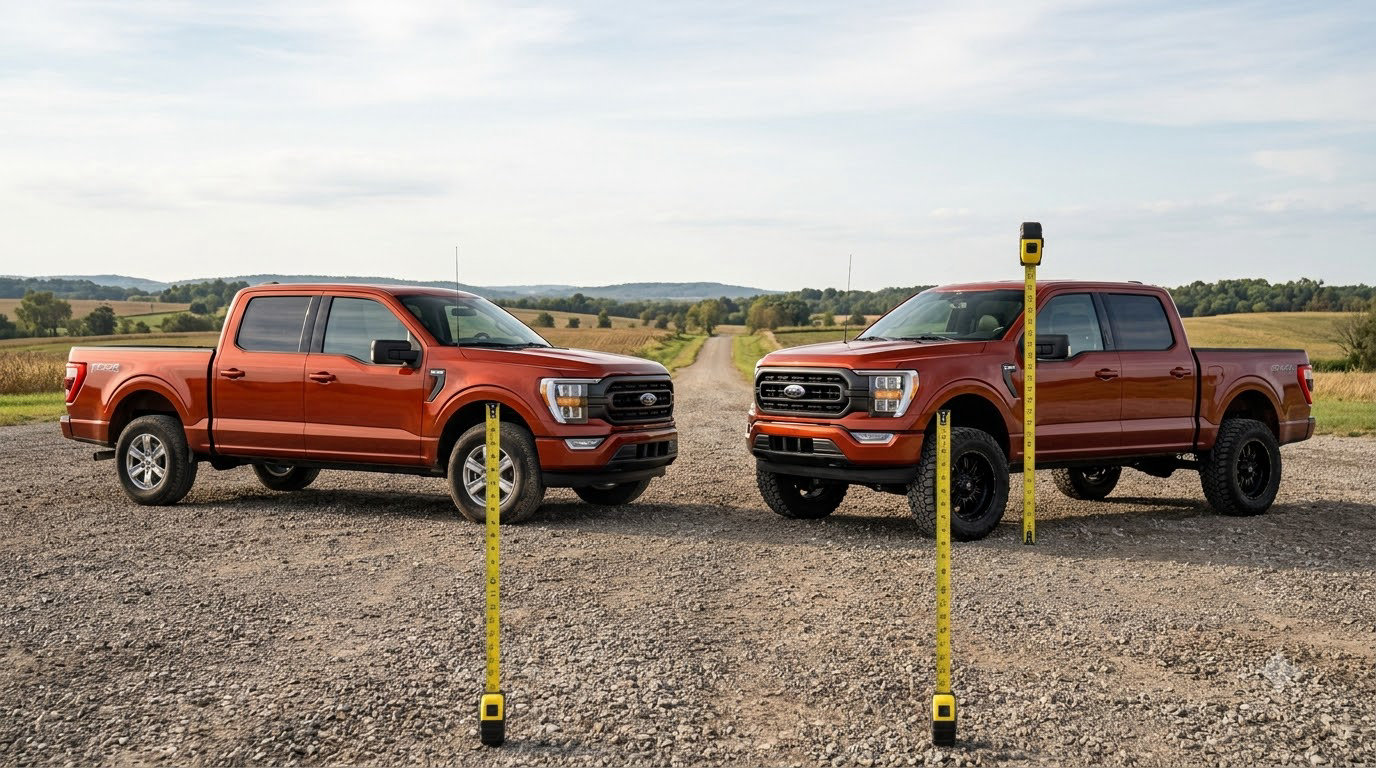
Putting bigger tires on a half-ton pickup is the first mod most owners make, and it is the one they regret most when they pick the wrong size. Going from the factory tire to a one-to-three-inch taller or wider tire changes how the truck accelerates, stops, shifts, records mileage, and even how the ABS and traction control behave. This guide walks through what “bigger” actually means, what changes when you upsize, and when the trade-offs are worth it.
A half-ton pickup is a light-duty truck like the Ford F-150, Chevy Silverado 1500, Ram 1500, Toyota Tundra, GMC Sierra 1500, or Nissan Titan. These trucks share a similar chassis and a similar tolerance for tire size, which is why the same rules apply across the segment.
Table of Contents
What Counts as “Bigger”? The 3% Plus-Sizing Rule
Upsizing means fitting a tire with a larger overall diameter than the factory tire, usually by lowering the sidewall aspect ratio or moving to a taller sidewall. The industry rule of thumb is the plus-sizing rule: stay within 3% of the stock overall diameter, or 2% if you want to keep speedometer error below 1 mph.
Here is the calculator math. Tire diameter in inches equals sidewall height times 2 plus wheel diameter. For a 265/70R17 stock tire: sidewall is 265 mm times 0.70 equals 185.5 mm, which converts to about 7.3 inches. Doubled and added to the 17-inch wheel gives an overall diameter of roughly 31.6 inches. A 285/70R17 tire, a common +1 swap, comes out to about 33 inches, a 4.4% jump and just outside the 3% rule. A 275/65R18, a popular mild upsize on newer half-tons, lands within 1-2% of the factory diameter.
Going more than 3% bigger starts a chain reaction. Speedometer error climbs, effective gear ratio changes, and the transmission shifts at the wrong RPM. That is why every tire size calculator on the market flags anything beyond plus-three as “regear recommended.”
Performance Impact: Acceleration and Braking
Upsized tires weigh more per corner and have a larger diameter, so they add rotational mass the engine has to spin up every time you hit the gas. In Outside Online’s nine-month test comparing stock 275/65R18 tires with 35-inch BFG KO2s, stopping distance from 60 mph increased by roughly 80%. That is the difference between stopping in a parking lot and stopping in the next county.
Acceleration suffers too. A half-ton truck like the F-150 with the 5.0L V8 or Silverado with the 5.3L already feels slower with 35-inch tires because the engine is effectively geared shorter. Owners on r/Silverado and f150forum.com routinely report losing 1-2 seconds in the 0-60 mph sprint after moving from a 32-inch to a 35-inch tire.
The braking change is the part that surprises people most. ABS and traction control are calibrated for the factory tire diameter. Bigger tires change the wheel speed sensor input, which can extend or shorten intervention timing. That is why some owners report the ABS activating earlier on rough roads after an upsize.
Fuel Economy: How Much MPG Do Bigger Tires Cost?
Bigger tires cost fuel economy in three ways: extra weight, larger contact patch, and taller gearing. A 35-inch all-terrain tire can weigh 10-15 lbs more per corner than a stock highway tire, and the aggressive tread blocks add rolling resistance.
Real-world data from the Outside Online long-term test showed about a 100-mile drop in total range on a full tank after moving to 35s. For a truck that normally gets 20 mpg combined, that works out to roughly 1-2 mpg lost. On a Ram 1500 with the eTorque mild hybrid or a Tundra with the hybrid powertrain, the loss can be even more noticeable because the system is tuned to recover energy from the factory tire weight.
Speedometer and Odometer Recalibration
This is the one mod that lies to you. If you put 35-inch tires on a truck that was built for 32-inch tires, your speedometer will read low by about 8-10%. That means when your speedo says 60 mph, you are actually doing closer to 65 mph.
Worked example: stock tire is 31.6 inches in diameter, new tire is 33.0 inches. The error is (33.0 minus 31.6) divided by 31.6, which equals 4.4%. At an indicated 60 mph, your true speed is 60 times 1.044, or about 62.6 mph. That is enough to matter in a school zone or when the highway patrol is clocking you.
Odometer error follows the same math. A truck that reads 100,000 miles on 35s has actually traveled about 104,400 real miles. That hurts resale value and skews your service intervals. The fix is an aftermarket programmer, like a SuperChips or DiabLew tune, or a handheld flash that recalibrates the PCM for the new tire size. Most tuners charge for this service or include it with a custom tune.
Drivetrain, Transmission, and Suspension Strain
Every drive in the truck sees the tire change first. The differential ring and pinion, the transmission torque converter, and the driveshaft all react to the new effective gear ratio. A taller tire acts like a numerically higher axle gear, which makes the engine feel lazier off the line but reduces engine RPM at highway speed.
For towing, that gearing change is usually a downgrade. A half-ton truck is often geared for max tow rating at factory tire size. Upsizing effectively shortens the gear, which raises transmission temperatures and makes the torque converter hunt for the right gear on hills. r/Diesel owners running 37s on stock wheels routinely report a multi-thousand-dollar unplanned regear cost.
Suspension wear is the slower-burn issue. Bigger, heavier tires put more stress on ball joints, wheel bearings, and control arm bushings, especially on a leveled or lifted truck that has already altered the factory geometry. Tire rotation intervals may need to shorten.
Cost Comparison: Tires and Supporting Mods
The tire itself is the easy line item. A set of four quality 35-inch all-terrains runs meaningfully more than a set of stock-size highway tires. Add in the supporting mods and the math gets heavier. A re-gear runs several thousand dollars installed for a half-ton, a leveling kit adds several hundred, and a quality aftermarket wheel for a 35-inch tire pushes the total up again.
When we ran the numbers for a typical F-150 build, the all-in cost to step from 32-inch stock to 35-inch all-terrains with regear and tune landed in the multi-thousand-dollar range. That is a real sum, and it is why f150forum.com consensus is to stay near stock diameter with E-rated tires if towing efficiency matters.
Handling, Stability, and Tire Rub
A taller tire raises the center of gravity, which reduces cornering stability. For a half-ton pickup used as a daily driver or family hauler, the difference is mild but real. Steering feel also changes because the larger contact patch adds scrub torque in the steering rack.
Tire rub is the more visible problem. Upsized tires can contact the wheel well liner, the upper control arm, or the sway bar at full steering lock, especially on a stock suspension. The classic test is to turn the wheel full lock both ways at parking lot speed and listen for rubbing. If you hear it, you need either a leveling kit, a small spacer, or a wheel with less offset.
When Bigger Tires Actually Make Sense
Bigger tires are not a bad decision by default. They make sense when the use case matches the trade-off. Off-roaders benefit from the added ground clearance and the deeper sidewall protection against rocks. Towing and payload haulers sometimes benefit from a heavier Load Range E tire that can carry more air pressure, even at stock diameter. Styling is a valid reason too, as long as the owner knows what they are paying in fuel and braking.
The 35-inch tire has become the de facto sweet spot for half-tons because it gives meaningful ground clearance without forcing a major regear. Owners going past 35 inches, into 37-inch territory, are usually committed to the build with a lift, regear, and programmer already in the plan.
Stock vs +1 Inch vs +2 Inch vs +3 Inch Comparison
Here is how the common upsize steps compare on a typical half-ton. Numbers are approximate and depend on stock tire size, but the pattern holds across the segment.
- Stock size (32-inch equivalent): Factory gearing, 0% speedometer error, baseline fuel economy, no tire rub. The reference point.
- +1 inch (33-inch equivalent, like 285/70R17): Roughly 3% diameter gain, 1-2% speedometer error, 0.5-1 mpg loss, minor tire rub risk on stock wheels.
- +2 inch (34-inch equivalent): Roughly 6% diameter gain, 3-4% speedometer error, 1-2 mpg loss, leveling kit often required.
- +3 inch (35-inch equivalent): Roughly 9% diameter gain, 6-8% speedometer error, 1-2 mpg loss, regear commonly recommended, lift or level needed for clearance.
The +1 step is the easy win for most half-tons. The +3 step is the build-defining mod that requires budgeting for regear, tune, and possibly suspension work.
Common Fitment Mistakes to Avoid
Three mistakes show up on every half-ton forum. First, stretching a smaller tire over a wider wheel for a flush look. That weakens the sidewall and risks a blowout under load. Second, fitting 35s on a stock suspension without checking for tire rub at full lock. Third, ignoring the load index sticker on the door jamb. The factory load index is there for a reason, and going below it on a half-ton reduces payload capacity.
Another mistake is mixing tire diameters across axles on a 4×4. Even a 1/4-inch difference between front and rear can trigger ABS and traction control lights on some trucks. Always run four matching tires on a half-ton.
Frequently Asked Questions
What happens if you put slightly bigger tires on a truck?
Slightly bigger tires, within the 3% plus-sizing rule, cause a small drop in fuel economy, a small speedometer error under 1 mph, and minimal braking impact. Going beyond 3% accelerates every trade-off: longer stopping distance, more rotational mass on the drivetrain, and the need for a speedometer recalibration or regear.
What is the 3% rule for tire size?
The 3% rule says the new tire’s overall diameter should stay within 3% of the factory tire’s overall diameter to avoid noticeable speedometer error, transmission shift issues, and braking changes. Staying within 2% keeps the speedometer within 1 mph of true speed. For a 31.6-inch stock tire, the 3% ceiling is about 32.5 inches of new tire diameter.
Will 35 inch tires make my truck higher?
Yes. Moving from a typical 32-inch stock tire to a 35-inch tire adds roughly 1.5 inches of standing height, plus another inch or so if a leveling kit is added. Ground clearance at the frame goes up by the same amount, which is the main reason off-roaders pick 35s over 33s.
What are the pros and cons of putting bigger tires on a truck?
Pros include more ground clearance, better off-road protection from the taller sidewall, more aggressive looks, and a heavier Load Range E option for towing. Cons include worse fuel economy, longer stopping distance, speedometer and odometer error, added stress on the drivetrain, and the cost of supporting mods like a regear or leveling kit.
What is the biggest tire I can fit on a stock half-ton?
Most stock half-tons like the F-150, Silverado 1500, Ram 1500, and Tundra fit a 33-inch tire with no modifications. A 35-inch tire usually requires a leveling kit and possibly a small spacer or wheel-offset change to clear the upper control arm and wheel well liner at full steering lock.
Conclusion: Bigger Tires vs Stock Size on a Half-Ton Pickup
The bigger tires vs stock size decision comes down to math and use case. Within the 3% plus-sizing rule, the trade-offs are minor and the gains in ground clearance and looks are real. Beyond 3%, every system on the truck pays for the upgrade: braking gets worse, fuel economy drops, the speedometer lies, and the drivetrain works harder unless you regear and tune.
For a daily-driven half-ton used for commuting and light towing, staying within a +1 swap is the sweet spot. For a dedicated off-road or work build, going to 35s makes sense as long as the regear, lift, and tune are in the budget from day one. The worst outcome is the surprise mod, where the owner discovers the speedometer error, the MPG drop, and the regear invoice after the bigger tires are already mounted. Plan the build before you buy the tires, and the bigger tires vs stock size decision becomes a clear call.