
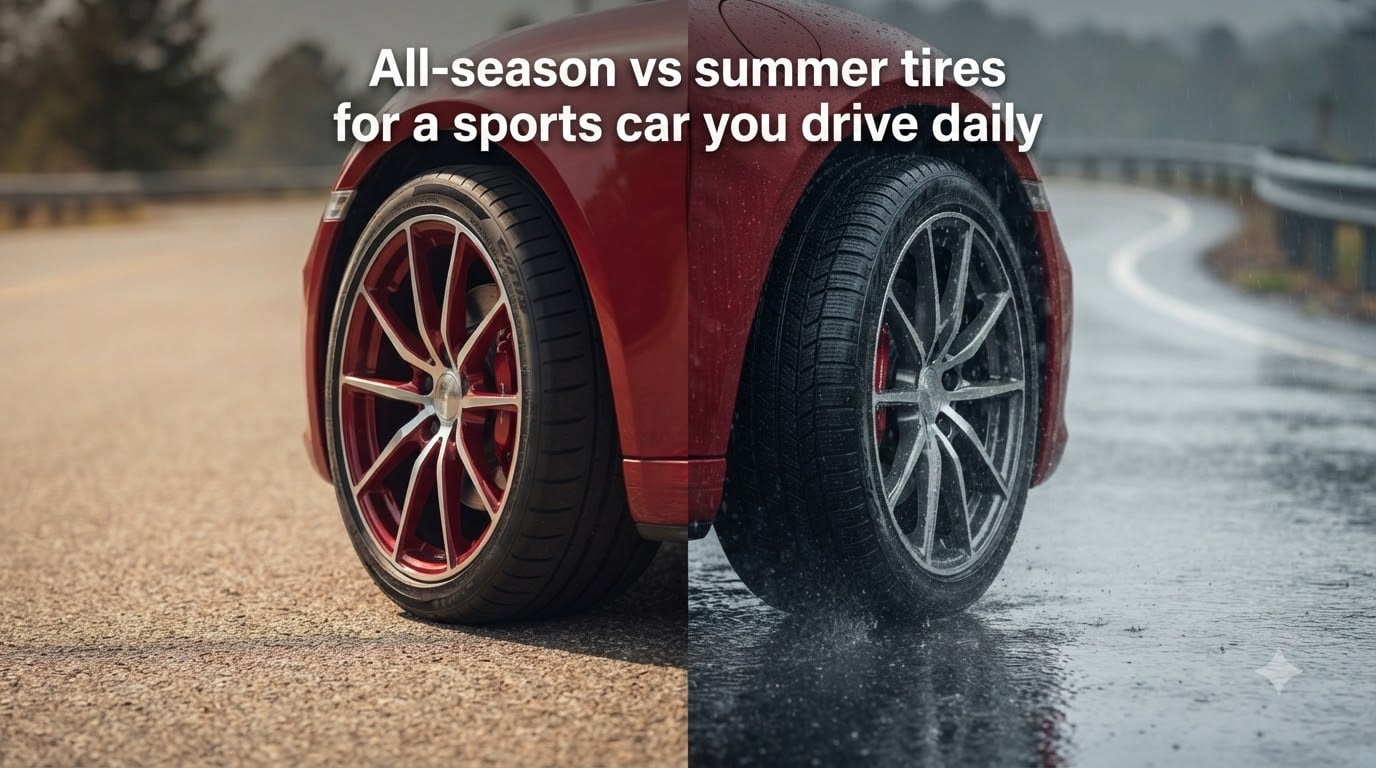
Summer tires prioritize maximum grip and precision in warm conditions; all-season tires sacrifice peak grip for year-round versatility, longer tread life, and cold-weather confidence. If you own a sports car you drive daily, this trade-off matters more than it does for someone in a standard commuter. The right tire choice affects your braking distance, cornering feel, road noise, ride comfort, and how many miles you get before a replacement set.
I’ve spent years testing both tire types on everything from a daily-driven Porsche Cayman to a track-day Corvette and a year-round BMW M2. Here’s what I’ve learned about all-season vs summer tires for a sports car you drive daily.
Table of Contents
What Are Summer Tires?
Summer tires are engineered with a softer rubber compound and a tread pattern optimized for warm, wet, and dry pavement. They typically operate best above 45°F (7°C). The compound stays pliable in heat, giving you maximum grip, shorter braking distances, and sharper steering response.
The trade-off is that this same compound hardens in cold temperatures. Once the mercury drops, summer tires lose their performance advantage and can become genuinely dangerous on cold, wet roads. Most summer tires also wear faster than all-season alternatives, with tread life often in the 20,000 to 30,000 mile range for a daily-driven sports car.
Within the summer category there are sub-types: extreme performance (track-focused), max performance (dual street/track), ultra high performance (spirited street driving), and grand touring summer (comfort-oriented). If you’re daily driving a sports car, you’re likely looking at max performance or ultra high performance summer tires.
What Are All-Season Tires?
All-season tires use a harder rubber compound and a more versatile tread pattern designed to perform across a wide temperature range. They carry M+S (Mud and Snow) markings and balance dry grip, wet grip, and light-snow traction year-round.
The compromise is clear: you give up some warm-weather grip for cold-weather capability and longer tread life. Most all-season tires deliver 40,000 to 60,000 miles of tread life, roughly double what a summer tire offers on the same car.
For sports car owners, the sub-types that matter most are ultra high performance all-season (UHP AS) and grand touring all-season. UHP all-seasons like the Michelin Pilot Sport All-Season 4 deliver surprisingly sharp handling for a year-round tire, while grand touring options prioritize ride comfort and noise reduction.
Summer Tires vs All-Season Tires: Head-to-Head Comparison
Here’s how these two categories stack up across the performance metrics that matter most to a sports car daily driver.
Dry Grip
Summer tires dominate dry grip. The softer compound generates more mechanical grip during hard cornering, acceleration, and braking. On a warm, dry backroad, a good max performance summer tire will outperform even the best UHP all-season by 5 to 10 percent in lateral grip testing. For a high-horsepower rear-wheel-drive sports car, that difference translates directly into how hard you can push before the rear end steps out.
Wet Grip
Summer tires also win in wet conditions, but the margin is smaller than most people expect. Modern UHP all-seasons like the Continental ExtremeContact DWS 06 Plus close the gap significantly in the rain. The deeper circumferential grooves on all-season tires actually help with hydroplaning resistance at highway speeds. Independent tests from Tire Rack and Tyre Reviews show wet braking distances between UHP all-seasons and entry-level summer tires are often within a car length or two.
Cold-Weather Grip
All-season tires are the clear winner once temperatures drop below 45°F (7°C). Summer tire compounds harden in cold weather, reducing the contact patch’s ability to conform to the road surface. On a 35°F morning with wet pavement, summer tires can lose 20 to 30 percent of their braking grip compared to their warm-weather performance. All-season tires maintain consistent grip well below freezing, making them the safe choice for four-season climates.
Treadwear and Tread Life
All-season tires last significantly longer. A daily-driven sports car wearing summer tires can expect 15,000 to 25,000 miles from a set, depending on driving style and alignment. The same car on all-season tires typically gets 35,000 to 55,000 miles. That’s a real cost difference when you’re buying tires for a car that takes 245/35R19 or wider rubber.
Ride Comfort and Road Noise
All-season tires are generally quieter and more comfortable. Summer tires use stiffer sidewalls and softer compounds that transmit more road texture into the cabin. On a daily commute with rough pavement, potholes, and expansion joints, the difference in ride quality between a set of extreme performance summer tires and grand touring all-seasons is immediately noticeable. Forum users on r/cars and r/tires consistently cite road noise as one of the biggest daily-driver downsides of summer tires.
The 45°F Rule: When Summer Tires Stop Working
The 45°F (7°C) threshold is the single most important number in this entire debate. Below this temperature, summer tire compounds begin to harden significantly. The rubber loses its ability to conform to microscopic imperfections in the road surface, and grip drops off a cliff.
This isn’t a gradual decline. Tire Rack’s cold-weather testing shows summer tires can lose 30 to 50 percent of their wet braking grip when the temperature drops from 70°F to 35°F. On dry pavement the loss is smaller, but on a cold, wet morning the difference can be the length of a car or more in an emergency stop.
If you live somewhere temperatures regularly dip below 45°F for more than a few weeks, summer tires become a liability on a daily driver. This is the threshold where all-season tires start earning their keep.
Why a Sports Car Daily Driver Changes the Equation
Driving a sports car every day amplifies every trade-off between these tire types. Here’s what changes when your weekend toy is also your Monday morning commuter.
More Power Means More Grip Demand
A 300+ horsepower rear-wheel-drive sports car puts significantly more stress on tires than a standard sedan. Launching from a stoplight, merging onto a highway, or powering out of a corner all demand maximum traction. Summer tires provide that grip, but they also wear faster under the additional load. A Corvette or Supra owner will chew through summer tires noticeably quicker than someone driving a Civic Si on the same tires.
Low-Profile Sidewalls and Pothole Risk
Sports cars run lower-profile tires, often 30- or 35-series sidewalls. That shorter sidewall gives you sharper steering response and better cornering stability, but it also means less cushion between your wheel and the road. Potholes that a standard sedan absorbs can crack a wheel or pinch a low-profile tire’s sidewall. Summer tires with their softer compounds are more vulnerable to this kind of damage than all-seasons with their slightly more resilient rubber.
Ride Harshness and Road Noise
The combination of a stiff sports car suspension and aggressive summer tires creates a noticeably harsher ride on rough pavement. On a 30-mile highway commute, that translates into more fatigue and more road noise in the cabin. Grand touring all-seasons soften the blow without completely neutering the car’s handling character. Multiple forum users on r/WRX report that switching from summer to all-season tires made their daily commute significantly more pleasant.
Tire Wear on a Daily Driver
If you’re driving 12,000 to 15,000 miles a year, a set of summer tires might only last 12 to 18 months. All-season tires on the same car could stretch to three years. Over a five-year ownership period, that cost difference adds up fast, especially when you factor in the higher purchase price of max performance summer tires.
Which Should You Choose for Your Sports Car?
The right answer depends on where you live, how you drive, and how many sets of tires you’re willing to own. Here’s a decision framework based on real-world scenarios.
Choose summer tires if you live in a warm climate where temperatures stay above 45°F most of the year, you drive your sports car for spirited weekend runs more than daily commuting, and you can tolerate faster wear and more road noise.
Choose all-season tires if you live in a four-season climate with cold winters, you daily-drive your sports car year-round, you want one set of tires with no seasonal swap, and you prioritize comfort and longevity over maximum grip.
Consider the climate-zone approach:
- Sun Belt (Phoenix, Miami, Houston): Summer tires make sense year-round. The rare cold snap rarely justifies all-season compromises.
- Four-Season (Atlanta, Nashville, Raleigh): Ultra high performance all-seasons are the sweet spot. You get most of the performance with cold-weather safety.
- Snow Belt (Chicago, Boston, Denver): You either run summer tires and accept seasonal swapping, or go all-season and accept winter limitations. Dedicated winter tires are the real answer here.
The Two-Set Strategy: Summer Plus All-Season or Winter
Enthusiasts with the budget and storage space often run two sets of tires: summer tires for warm months and either all-season or dedicated winter tires for cold months. This gives you maximum performance year-round without compromise.
The cost is real though. A second set of wheels plus tires can run well into four figures, plus you need storage space and either a tire shop visit twice a year or the tools and knowledge to swap them yourself. Budget roughly two to three hours per swap if you’re doing it at home, or $60 to $100 per swap at a shop.
For many sports car daily drivers, a single set of ultra high performance all-season tires is the practical answer. You sacrifice some peak warm-weather grip, but you gain year-round convenience, longer tread life, and cold-weather safety.
Frequently Asked Questions
What are the downsides of using summer tires?
Summer tires wear faster (15,000 to 25,000 miles on a daily driver), produce more road noise, lose significant grip below 45°F, and require seasonal swapping in four-season climates. On a sports car with low-profile sidewalls, they’re also more vulnerable to pothole damage.
Is it better to have all-season tires or summer tires?
It depends on your climate and driving habits. Summer tires deliver superior warm-weather grip and cornering precision. All-season tires offer year-round versatility, longer tread life, and cold-weather safety. For a sports car you drive daily in a four-season climate, ultra high performance all-seasons are usually the better compromise.
Are summer tires ok in the rain?
Yes, summer tires perform well in rain at warm temperatures. Their softer compound and tread design provide excellent wet grip above 45°F. However, all-season tires with deeper circumferential grooves can match or beat summer tires in hydroplaning resistance at highway speeds.
Do summer tires last longer than all-season tires?
No. Summer tires typically last 15,000 to 25,000 miles on a daily-driven sports car, while all-season tires deliver 35,000 to 55,000 miles. The softer compound that gives summer tires their grip advantage wears significantly faster under daily driving conditions.
What temperature is too cold for summer tires?
Summer tires begin losing significant grip below 45°F (7°C). The rubber compound hardens, reducing the contact patch’s ability to conform to the road. Below 35°F, summer tires can lose 30 to 50 percent of their wet braking grip compared to warm-weather performance.
Can I run summer tires in the front and all-season in the rear?
This is not recommended. Mixing tire types creates unpredictable handling, especially in wet or cold conditions. The different grip levels between front and rear can cause oversteer or understeer in emergency maneuvers. Always run a matched set of the same tire type on all four corners.
Final Verdict
The all-season vs summer tires debate for a sports car you drive daily comes down to climate, convenience, and compromise. Summer tires deliver the grip and precision your sports car was built for, but they demand warm weather, faster wear cycles, and a willingness to swap sets when temperatures drop. Ultra high performance all-season tires offer a remarkably capable year-round alternative that keeps your sports car fun to drive while protecting you when the mercury falls. For most daily-driven sports cars in four-season climates, all-season tires are the smarter choice.