
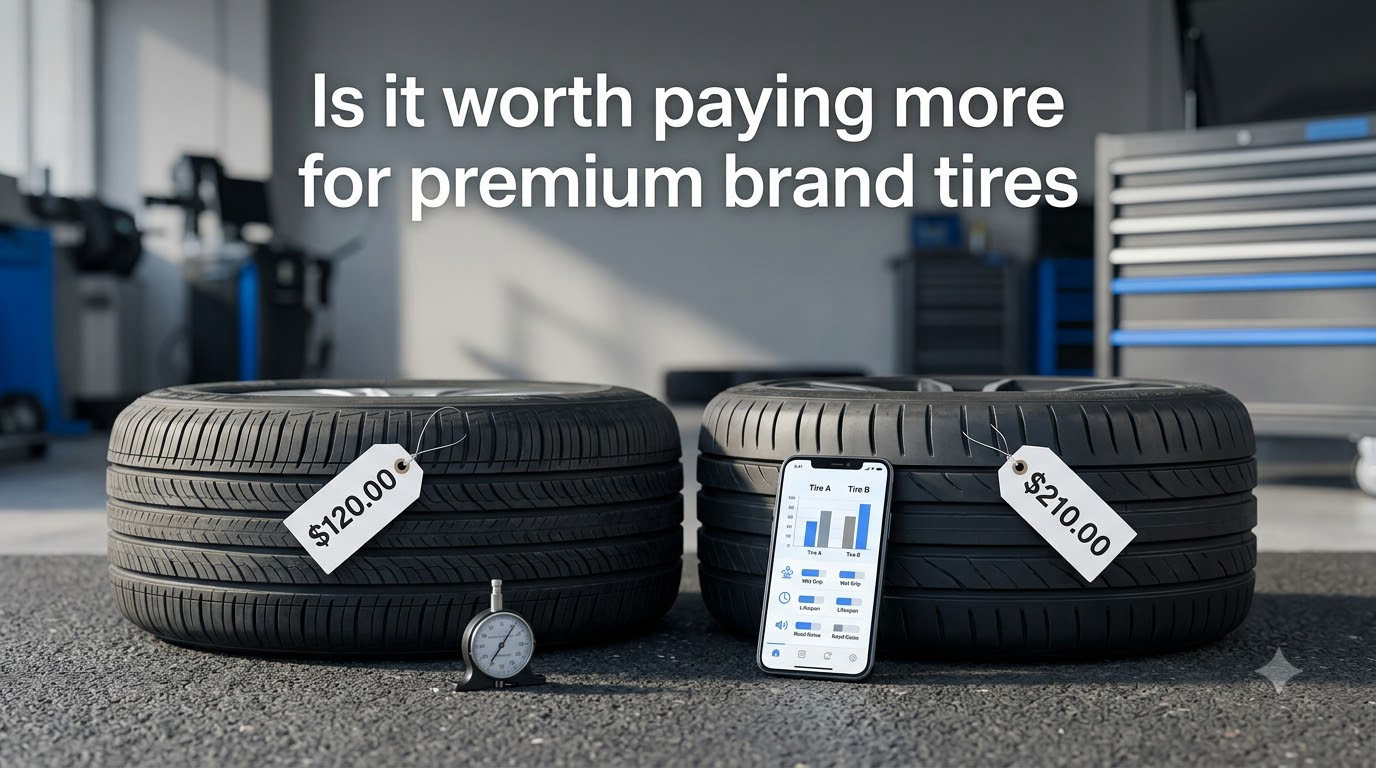
Are premium brand tires worth the extra money? For most drivers who log more than 10,000 miles a year and care about wet-weather safety, yes. Premium tires from brands like Michelin, Continental, and Bridgestone consistently outperform budget options in braking distance, tread life, and ride quality. The catch is that the price premium often disappears when you calculate cost per mile over the tire’s full lifespan.
The answer changes depending on how you drive, how long you keep your vehicle, and where you live. A commuter covering 15,000 miles annually in a rainy climate gets a very different value proposition than someone driving a leased sedan 4,000 miles a year in the desert. This guide breaks down exactly when paying more for tires makes financial sense and when it doesn’t.
Table of Contents
What Makes a Tire Premium?
A premium tire is built by a top-tier manufacturer using advanced rubber compounds, multi-layer internal construction, and engineered tread patterns that budget tires simply don’t match. Think of brands like Michelin, Continental, Goodyear, Bridgestone, and Pirelli. These companies invest hundreds of millions in R&D every year, and that investment shows up in every mile you drive.
The differences come down to materials and engineering. Premium tires use higher-grade silica-enriched rubber compounds that stay flexible in cold temperatures and resist hardening in heat. They feature reinforced steel belts, stronger sidewall construction, and tread patterns computer-optimized for water evacuation, noise reduction, and even wear.
Budget tires, by contrast, use cheaper compounds that degrade faster and simpler construction that doesn’t hold up as well under stress. Some import brands cut corners on quality control, meaning you might get a tire that was fine when it left the factory but has been sitting in a warehouse for three years. Always check the DOT date code on any tire you buy. A code ending in “2524” means the tire was manufactured in the 25th week of 2024.
Braking Distance and Safety: Where Premium Tires Shine
The single biggest reason to pay more for tires is stopping distance. Independent testing consistently shows premium tires stop 20 to 30 feet shorter than budget tires in wet conditions from highway speeds. At 60 mph, that difference can mean the gap between a close call and a collision.
A Consumer Reports survey of over 47,000 members found that 74% of tire buyers rank wet grip as their top priority. The data backs that instinct. Premium tires use advanced tread compounds with higher silica content that maintains grip on slick surfaces. Their tread patterns feature more sipes (tiny slits) and wider circumferential grooves that channel water away from the contact patch more efficiently.
Forum discussions across Reddit’s r/MechanicAdvice and r/tires communities repeatedly confirm this finding. Drivers who switched from budget to premium tires describe the wet-weather improvement as the most noticeable real-world difference. One common refrain: “I didn’t realize how much my old tires were slipping until I put good ones on.”
Dry braking improves too, though the gap is smaller. Premium tires typically stop 5 to 10 feet shorter on dry pavement. Where they really separate themselves is in emergency maneuvers, where the sidewall stiffness and compound grip of a premium tire provide more predictable handling.
Treadwear and the Cost-Per-Mile Calculation
This is where the “expensive tires cost more” assumption falls apart. A premium all-season tire from Michelin or Continental might carry a 70,000-mile treadwear warranty. A budget tire might last 30,000 to 40,000 miles before the tread wears down to the wear bars.
Run the math and the picture shifts. If a premium tire costs roughly 50% more than a budget tire but lasts twice as long, your cost per mile is actually lower with the premium option. Here’s a simplified example using typical pricing:
A budget tire at 30,000 miles of tread life gives you about 3.3 cents per mile. A premium tire at 70,000 miles of tread life comes in around 2.9 cents per mile. Over a set of four tires covering 70,000 miles, you’d go through two full sets of budget tires versus one set of premiums. The savings add up to over a hundred dollars for a full set, plus you skip the hassle and installation cost of a second tire purchase.
Consumer Reports data supports this. Their survey found that Michelin owners report the highest satisfaction across all four tire categories, largely because the tires deliver on their treadwear promises. When a tire actually lasts as long as the warranty says, your long-term cost drops.
The cost-per-mile advantage grows even more with trucks and SUVs. Forum users on Forest River Forums note that heavier vehicles chew through budget tires faster, making the premium option an even clearer financial win over time.
Ride Comfort, Road Noise, and Fuel Economy
Premium tires are noticeably quieter and smoother. The difference comes from two engineering choices: optimized tread pitch patterns and stronger sidewall construction. Premium manufacturers use computer-modeled tread block arrangements that cancel out road noise frequencies. Budget tires tend to produce a droning hum at highway speeds that becomes tiring on long drives.
Ride comfort improves because premium tires absorb road imperfections more effectively. Their sidewalls flex in a controlled way rather than transmitting every bump and crack directly to the cabin. You feel this most on rough highways and city streets with potholes.
Fuel economy is the third benefit. Premium tires generally have lower rolling resistance, meaning your engine works less to keep the car moving. The difference is small, typically 1 to 3 percent improvement in fuel economy, but over 50,000 miles it adds up to several full tanks of gas saved. For drivers covering 15,000 miles a year, that can offset a meaningful chunk of the tire price difference.
When Premium Tires Are Worth the Money
Premium tires deliver the clearest value for specific types of drivers. If you fit any of these profiles, paying more upfront is almost always the smarter long-term move.
High-mileage commuters. If you drive more than 12,000 miles a year, the longer tread life alone can justify the cost. The per-mile savings compound over every year you own the tires.
Wet-climate drivers. Rain is where the safety gap between premium and budget tires is widest. If you live somewhere with frequent rain, snow, or mixed conditions, the improved wet traction is worth the investment for the braking distance advantage alone.
Long-term owners. If you plan to keep your vehicle for five or more years, premium tires pay for themselves through fewer replacements and better sustained performance.
Families and safety-conscious drivers. If you regularly carry passengers, especially children, the improved braking and handling predictability of premium tires provides peace of mind that’s hard to put a price on.
Truck and SUV owners. Heavier vehicles put more stress on tires. Budget tires wear faster on trucks, while premium options hold up better under the extra weight and towing demands.
When You Can Skip Premium Tires
There are legitimate scenarios where budget or mid-tier tires make more sense. Understanding these situations saves you from overspending.
Low-mileage drivers. If you drive fewer than 6,000 miles a year, a set of tires might age out before the tread wears down. Rubber degrades over time regardless of miles driven. In this case, a mid-tier tire that’s replaced based on age rather than tread wear gives you adequate safety without the premium price.
Leased vehicles. If you’re returning the car in two to three years, you likely won’t drive enough miles to realize the tread-life advantage of premium tires. A solid mid-tier option covers the lease period comfortably.
Low-power economy cars. A lightweight subcompact with modest horsepower doesn’t generate the cornering forces or braking demands that expose a premium tire’s advantages. Budget tires handle the performance envelope of most economy cars just fine.
Short ownership plans. If you’re selling the vehicle within a year or two, the long-term cost-per-mile math doesn’t favor premium tires. You won’t be around to collect the longevity benefits.
The one exception: even in these scenarios, avoid the cheapest no-name tires. The DOT date code risk and inconsistent quality control of ultra-budget imports make them a poor choice regardless of your driving profile. A recognized mid-tier brand like Cooper, General Tire, Hankook, or Falken gives you quality assurance without the premium-tier price tag.
A Quick Decision Matrix
Here’s a simple framework to help you decide whether premium tires are worth it for your situation:
Choose premium if: You drive more than 10,000 miles per year. You live in a wet or snowy climate. You plan to keep your vehicle for four or more years. You carry passengers regularly. You drive a truck, SUV, or performance vehicle.
Choose mid-tier if: You drive 6,000 to 10,000 miles per year. You want reliable safety without the top-tier price. You live in a moderate climate with occasional rain. You own a standard sedan or compact crossover.
Choose budget (with caution) if: You drive fewer than 6,000 miles per year. You’re in a dry climate with minimal wet driving. You’re returning a leased vehicle soon. You’re selling the car within a year.
Regardless of which tier you choose, proper maintenance is the equalizer. Rotate your tires every 5,000 to 7,500 miles, keep them inflated to the manufacturer’s recommended pressure, and get an alignment check once a year. These habits extend the life of any tire, premium or budget.
Frequently Asked Questions
Is it worth it to buy premium tires?
Yes, for most drivers who put on significant mileage. Premium tires from brands like Michelin, Continental, and Bridgestone deliver shorter braking distances, longer tread life, and better wet traction. When you calculate cost per mile over the tire’s full lifespan, premium tires often cost less per mile than budget alternatives.
What is the 3 percent rule for tires?
The 3 percent rule suggests that the cost difference between budget and premium tires is roughly 3 percent of your vehicle’s total ownership cost over five years. Since tires affect safety, fuel economy, and ride quality, this small percentage delivers outsized value relative to its cost.
Are more expensive tires actually worth it?
Expensive tires are worth it when you consider long-term cost per mile, safety improvements in wet braking, and reduced replacement frequency. A premium tire that costs 50 percent more upfront but lasts twice as long actually saves money over the life of the tires.
What brand of tires should I stay away from?
Avoid ultra-cheap imported tires with no recognizable brand name or warranty backing. Some no-name imports have inconsistent quality control and may be old stock with degraded rubber. Always check the DOT manufacturing date code and stick with recognized brands, even if you choose a mid-tier option like Cooper, General Tire, or Falken.
How long do premium tires last compared to budget tires?
Premium all-season tires typically last 60,000 to 80,000 miles, while budget tires often last 25,000 to 40,000 miles. This means a single set of premium tires can outlast two sets of budget tires, making them more cost-effective over time despite the higher upfront price.
Do premium tires improve gas mileage?
Yes, premium tires generally have lower rolling resistance, which can improve fuel economy by 1 to 3 percent. Over 50,000 miles, this translates to several full tanks of gas saved. The fuel economy benefit adds to the overall value proposition of premium tires for high-mileage drivers.
The Bottom Line
Are premium brand tires worth the extra money? For the majority of drivers, the answer is yes. The combination of shorter braking distances, longer tread life, better wet-weather grip, and lower cost per mile makes a compelling case. When you factor in the safety benefits, especially in rain and mixed conditions, paying more for tires from Michelin, Continental, Bridgestone, Goodyear, or Pirelli is one of the smartest investments you can make in your vehicle.
The exceptions are real but narrow. Low-mileage drivers, leased-vehicle owners, and those selling their cars soon can confidently choose a mid-tier brand without sacrificing safety. Just stay away from the absolute cheapest options with no warranty or brand recognition. Whatever you decide, proper tire maintenance is what keeps you safe and extends the life of every tire you buy.