
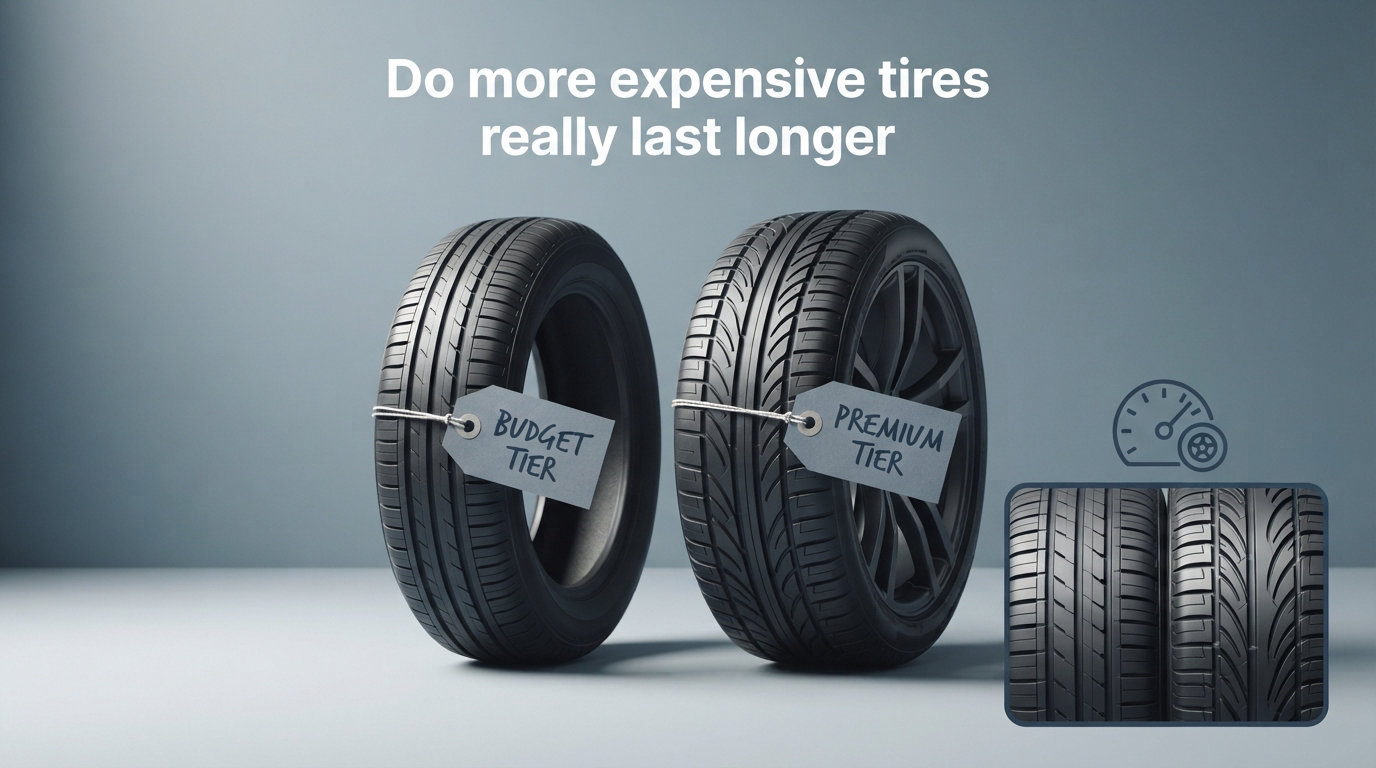
You stand in the tire shop, looking at a budget tire next to a premium tire of the exact same size. Same vehicle. Same fitment. Same store. The only difference is the price, and the question burns in the back of your mind: do more expensive tires really last longer, or am I just paying for a logo?
After comparing treadwear data, independent test results, and cost-per-mile calculations from dozens of tire models, our team can give you a straight answer. Yes, more expensive tires do last longer. Premium touring tires typically deliver 60,000 to 85,000 miles, while budget tires often wear out at 20,000 to 30,000 miles. But lifespan is only part of the story. The smarter question is whether the longer life, better safety, and fuel savings make premium tires worth it for your specific driving situation.
In this guide, we break down the construction differences that justify the price, show you the real mileage numbers from each price tier, walk through the cost-per-mile math that flips the value argument on its head, and lay out exactly when premium tires pay off (and when budget tires are perfectly fine). Whether you’re driving a daily commuter, a high-mileage highway cruiser, or an older vehicle nearing end of life, you’ll know which tires deserve your money.
Table of Contents
Quick Answer: Do More Expensive Tires Really Last Longer?
Yes, more expensive tires last longer, on average 2 to 3 times longer than budget tires. Here’s the short version drivers keep asking about:
- Premium tires last 60,000 to 85,000 miles on average for touring models from Michelin, Continental, and Goodyear.
- Budget tires last 20,000 to 30,000 miles before reaching the legal tread depth limit, based on consumer data and TyreSafe reports.
- Mid-range tires fall in between at roughly 40,000 to 60,000 miles, offering a balance of cost and longevity.
- Premium tires cost less per mile driven despite the higher upfront price, because they last so much longer.
- The reason is engineering: better rubber compounds, silica additives, reinforced internal construction, and tread patterns designed for even wear.
That bullet list is the bottom line. The rest of this article shows you why those numbers are real, what affects them, and how to decide which tier fits your driving.
What You’re Paying For: Construction, Materials, and Tread Design
The price gap between a budget tire and a premium tire comes from three places: the rubber compounds, the internal construction, and the tread design. All three directly affect how long the tire lasts.
Premium Rubber Compounds and Silica Additives
Budget tires use older, harder natural and synthetic rubber blends chosen to keep manufacturing costs down. Those compounds resist tearing but wear down faster and lose grip faster as the tread thins.
Premium tires use advanced polymer blends with silica-rich compounds. Silica increases flexibility without sacrificing wear resistance, so the tread grips better in wet conditions and still lasts longer. Continental, Michelin, and Goodyear spend hundreds of millions of dollars annually on R&D to refine these compounds, and the result is a tire that wears slower across its entire life.
This is the single biggest factor in tread life. A harder rubber lasts roughly the same distance regardless of conditions. A softer, silica-rich compound wears slower than you’d expect because it’s engineered to flex without breaking down under heat cycles.
Reinforced Internal Construction
Inside every tire are steel belts, polyester or nylon plies, and bead bundles that hold the tire on the wheel. Premium tires use more layers, stronger steel, and tighter tolerances.
That extra reinforcement does two things. First, it distributes road forces evenly, which prevents the uneven wear patterns that kill budget tires early. Second, it holds the tread flat against the road for the tire’s full life. A budget tire starts cupping or feathering after 15,000 miles. A premium tire resists that for 40,000 miles or more.
Tread Pattern Engineering
Premium tire tread blocks are designed using computer modeling to balance three competing goals: grip in the wet, low noise, and even wear. The block shapes, siping patterns, and groove angles are optimized to flex evenly as the tire rolls.
Budget tires use simpler, symmetrical patterns. They work fine when new, but they don’t distribute stress evenly. So you get the classic budget tire wear pattern: the edges bald out while the center still has tread, and you’re shopping for replacements at 25,000 miles.
Premium tread patterns also include features like variable-pitch blocks (to reduce noise) and full-depth sipes (to maintain wet grip as the tread wears down). Both contribute to a tire that performs consistently from mile 1 to mile 70,000.
Treadwear Lifespan: Real Numbers (Budget vs Premium Mileage)
Numbers matter here. Forum users debate whether premium tires really last 3x longer than budget, but the data is fairly consistent across independent tests and consumer reports.
Mileage Ranges by Price Tier
- Budget (entry tier): 20,000 to 30,000 miles. Typical use case: older vehicle, low mileage, short-term replacement.
- Mid-Range (mid tier): 40,000 to 60,000 miles. Typical use case: daily commuter, balanced priorities.
- Premium Touring (premium tier): 60,000 to 85,000 miles. Typical use case: highway commuter, family vehicle, long-term ownership.
- Premium Performance (premium tier with soft compound): 20,000 to 40,000 miles. Typical use case: sport sedan, performance car, enthusiast driver.
Notice the last row. Premium performance tires from Michelin Pilot Sport, Continental ExtremeContact, or Goodyear Eagle F1 lines are expensive but wear out faster than mid-range touring tires. The softer, grippier compounds prioritize handling over longevity. This is a critical distinction most articles miss.
If your goal is maximum lifespan, you want a premium touring tire (Michelin Defender, Continental PureContact, Goodyear Assurance), not a premium performance tire.
What the UTQG Number Tells You
Every tire sold in the US carries a UTQG (Uniform Tire Quality Grade) rating. The treadwear number is the key figure: a tire rated 400 should last roughly twice as long as a tire rated 200, under standardized testing.
Budget tires typically have UTQG treadwear ratings of 200 to 400. Premium touring tires sit at 600 to 800+. The higher number correlates strongly with real-world mileage.
One caveat: UTQG is a relative number from lab testing, not a mileage guarantee. A premium 800-treadwear tire won’t necessarily deliver 800,000 miles, but it will deliver more mileage than a budget 300-treadwear tire in the same vehicle on the same commute.
Factors That Impact Tire Longevity
Premium tires last longer on average, but no tire lasts its rated life if you ignore maintenance. Our team has seen premium touring tires wear out in 30,000 miles and budget tires survive 40,000 miles. The difference is almost always maintenance.
Tire Rotation
Rotating tires every 5,000 to 7,000 miles distributes wear across all four positions. Front tires wear faster because they carry more weight (in front-wheel-drive vehicles) and handle steering. Without rotation, front tires bald out long before rear tires.
Premium tires don’t need rotation more or less often than budget tires, but they respond more visibly. Rotate a set of Michelin Defenders every 6,000 miles and they wear close to evenly across all four corners. Skip rotation and you can shave 15,000 miles off total lifespan.
Wheel Alignment
Misalignment is the silent tire killer. Even a small misalignment (2 to 3 degrees) causes the tire to scrub sideways with every rotation, generating heat and uneven wear. The classic symptom is feathering on the tread edges, where one side wears faster than the other.
If you’ve hit a curb, replaced a strut, or notice your car pulling to one side, get an alignment before installing new tires. A four-wheel alignment costs far less than a premature replacement set and can extend tire life by 20,000 miles or more. Skipping it can ruin premium tires in half their expected life.
Tire Pressure
Under-inflated tires flex more, generate more heat, and wear faster on the shoulders. Over-inflated tires wear out the center tread faster. Both shorten tire life.
Check pressure monthly. The number on the sidewall is the maximum pressure, not the recommended pressure. Your vehicle’s door jamb sticker (or owner’s manual) shows the correct cold inflation pressure, usually 32 to 35 PSI for sedans and 35 to 42 PSI for light trucks.
TPMS (Tire Pressure Monitoring System) helps but isn’t perfect. TPMS sensors typically trigger at 25% below recommended pressure, which is too low to prevent accelerated wear. Check pressure with a quality gauge, not just the dashboard light.
Driving Habits
Hard acceleration, late braking, and cornering at speed all shorten tire life. Aggressive driving can cut tire life by 30% to 50% regardless of price tier. Highway driving at steady speeds is the easiest on tires. City driving with frequent stops is the hardest.
If you drive mostly highway miles at moderate speeds, even budget tires can exceed their rated life. If you drive stop-and-go city traffic with hard acceleration, even premium tires will wear faster than expected.
Load and Towing
Overloading your vehicle or towing at max capacity generates heat that breaks down rubber compounds faster. Check your tire’s load rating (the “LR” or “XL” marking on the sidewall) and stay within it. For towing vehicles, look for tires with the “LT” (light truck) designation and an “E” load range rating.
Cost Per Mile: Why Premium Tires Can Actually Save You Money
This is the math that flips the value argument. Yes, premium tires cost more upfront. But because they last so much longer, they often cost less per mile driven.
The Worked Example
Let’s compare a typical budget tire rated for 25,000 miles against a typical premium touring tire rated for 75,000 miles:
- Budget tire cost per mile: typical budget price divided by 25,000 miles = roughly 0.48 cents per mile.
- Premium tire cost per mile: typical premium price divided by 75,000 miles = roughly 0.32 cents per mile.
The premium tire is roughly twice as expensive upfront but costs about 33% less per mile. Drive 15,000 miles a year and you’ll replace the budget tire twice before you replace the premium tire once. Over six years, you spend noticeably more on two sets of budget tires than on one set of premium tires.
That’s several hundred dollars in savings on tires alone, before counting the time and hassle of two extra replacement cycles.
Add in Fuel Savings
Premium tires typically have lower rolling resistance, which means your engine doesn’t work as hard to keep the car moving. The US Department of Energy estimates that low rolling resistance tires can improve fuel economy by 1% to 3%, depending on the vehicle and driving conditions.
On a vehicle averaging 28 MPG and driving 15,000 miles a year, a 2% fuel economy improvement saves roughly 11 gallons of gas per year. Over six years, that’s around 65 gallons saved.
Add that to the tire savings and the premium tire wins by a wide margin over its lifetime. The math gets even better for higher-mileage drivers.
When Budget Tires Win the Math
Budget tires win when you won’t keep the car long enough to use the premium tire’s full lifespan. If you’re selling the car in two years and it needs tires now, paying premium prices for 75,000-mile tires doesn’t pay off. You’ll never drive those miles.
Budget tires also win for vehicles with low residual value. Putting a full set of premium tires on a 12-year-old sedan with 180,000 miles is hard to justify. A budget tire set gets you safely through the next 30,000 miles at a fraction of the cost.
When Premium Tires Are Worth It
Premium tires earn their higher price in specific situations. If any of these match your driving, premium is the smart buy.
You Drive 12,000+ Miles Per Year
High-mileage drivers wear out tires fast. Replacing budget tires every 18 months gets old quickly. Premium touring tires let you drive 4 to 5 years between replacements, with better safety and comfort the entire time.
You Commute in Heavy Traffic
Stop-and-go driving, frequent braking, and pothole exposure all punish tires. Premium tires with stronger sidewalls and better heat resistance handle these conditions without falling apart prematurely.
You Drive in Wet or Snowy Climates
Premium all-season and winter tires deliver measurably shorter wet braking distances. Independent testing has shown premium tires can stop 10 to 15 feet shorter than budget tires on wet roads at highway speeds. That’s the difference between a close call and a collision.
You Own a Performance Vehicle
BMW, Mercedes, Audi, and sports cars need tires rated for their speed and handling capabilities. Budget tires can’t transmit the chassis performance these vehicles were engineered for, and they wear out even faster under the stress.
You Tow or Carry Heavy Loads
Towing generates heat and stress that destroys budget tires. Premium LT-rated tires with higher load ranges handle towing and hauling without overheating or failing under load.
You Plan to Keep the Vehicle 5+ Years
Long-term ownership is the strongest case for premium tires. The cost-per-mile advantage compounds over time, and you avoid the hassle of multiple replacement cycles during your ownership.
When Budget Tires Are Acceptable
Budget tires aren’t always a compromise. In the right situation, they make perfect sense.
You Drive Under 8,000 Miles Per Year
Low-mileage drivers take 4+ years to wear out tires. A budget tire rated for 25,000 miles might last 6 to 8 years in low-mileage use. By then, the rubber has aged out anyway, and you’re replacing them due to age, not wear.
You’re Replacing Tires on a Vehicle You’re Selling
If the car is leaving your driveway in the next few months, you need safe tires for the test drive and the buyer’s first weeks of ownership. Budget tires deliver that without over-investing in a car you’ll never see again.
The Vehicle Has Low Resale Value
An older car with high mileage doesn’t justify premium tires from a financial standpoint. The buyer isn’t going to give you more money because you put Michelin Defenders on a 15-year-old Civic. Budget tires that get you safely through the next 30,000 miles are the rational choice.
You’re Driving Short-Term or Backup Use
Backup vehicles, beater cars, and seasonal-use vehicles don’t need premium tires. Budget tires meet the safety standard, and the longevity advantage of premium tires is wasted on vehicles that barely move.
Frequently Asked Questions
Are more expensive tires actually better?
Yes. More expensive tires use advanced rubber compounds with silica additives, reinforced internal construction with more steel belts, and computer-engineered tread patterns. These improvements deliver 2 to 3 times longer tread life, shorter wet braking distances (10 to 15 feet shorter in independent tests), lower rolling resistance for better fuel economy, and more consistent performance as the tire wears down.
What is the 3% rule for tires?
The 3% rule for tires refers to replacing tires in matched sets or keeping tread depths within 3% of each other across the same axle. When new tires are paired with significantly worn tires (more than 3% tread depth difference), the tread depth mismatch affects handling, braking, and ABS performance, especially in wet conditions. Many all-wheel-drive vehicles require all four tires to have tread depths within 3% to prevent damage to the drivetrain.
Is 40,000 miles a lot on tires?
40,000 miles is moderate mileage, neither high nor low for most tires. Premium touring tires typically last 60,000 to 85,000 miles, so a tire at 40,000 miles still has substantial life remaining. Budget tires rated for 20,000 to 30,000 miles would be at or past replacement at 40,000 miles. If your tires have 40,000 miles and still have 6/32 inch or more tread depth remaining, you likely have plenty of life left.
Is it worth it to buy premium tires?
Premium tires are worth it for high-mileage drivers (12,000+ miles per year), owners keeping vehicles 5+ years, drivers in wet or snowy climates, performance vehicle owners, and anyone who tows or hauls regularly. For these drivers, premium tires cost less per mile driven, last 2 to 3 times longer, and provide measurably better safety in adverse conditions. Premium tires are not worth it for low-mileage drivers, vehicles being sold soon, or older cars with low resale value.
How long do premium tires last?
Premium touring tires from Michelin, Continental, and Goodyear typically last 60,000 to 85,000 miles under normal driving conditions with proper maintenance. Premium performance tires (Michelin Pilot Sport, Continental ExtremeContact, Goodyear Eagle F1) last 20,000 to 40,000 miles because softer compounds prioritize grip over longevity. Real-world lifespan depends heavily on rotation intervals, alignment, tire pressure, driving habits, and climate.
Final Verdict
So, do more expensive tires really last longer? The data is unambiguous: yes, premium touring tires last 2 to 3 times longer than budget tires in the same vehicle under the same conditions. The price gap reflects real engineering differences in rubber compounds, internal reinforcement, and tread design.
But premium tires aren’t automatically the right choice for every driver. The cost-per-mile math favors premium for high-mileage drivers, long-term owners, and anyone who values wet-weather safety and fuel economy. The math favors budget for low-mileage drivers, vehicles being sold soon, and older cars with limited resale value.
Our recommendation: match the tire to your driving, not to your hopes. If you drive 12,000+ miles a year and plan to keep your vehicle for the next 5+ years, buy a premium touring tire from Michelin, Continental, or Goodyear. You’ll pay more upfront and save money in the long run while driving on safer, longer-lasting tires. If you’re a low-mileage driver or replacing tires on a vehicle you’re selling, save the money and buy a quality budget tire. Either way, rotate every 6,000 miles, check pressure monthly, and get an alignment every other year. No tire lasts its rated life without proper maintenance, regardless of how much you paid for it.