
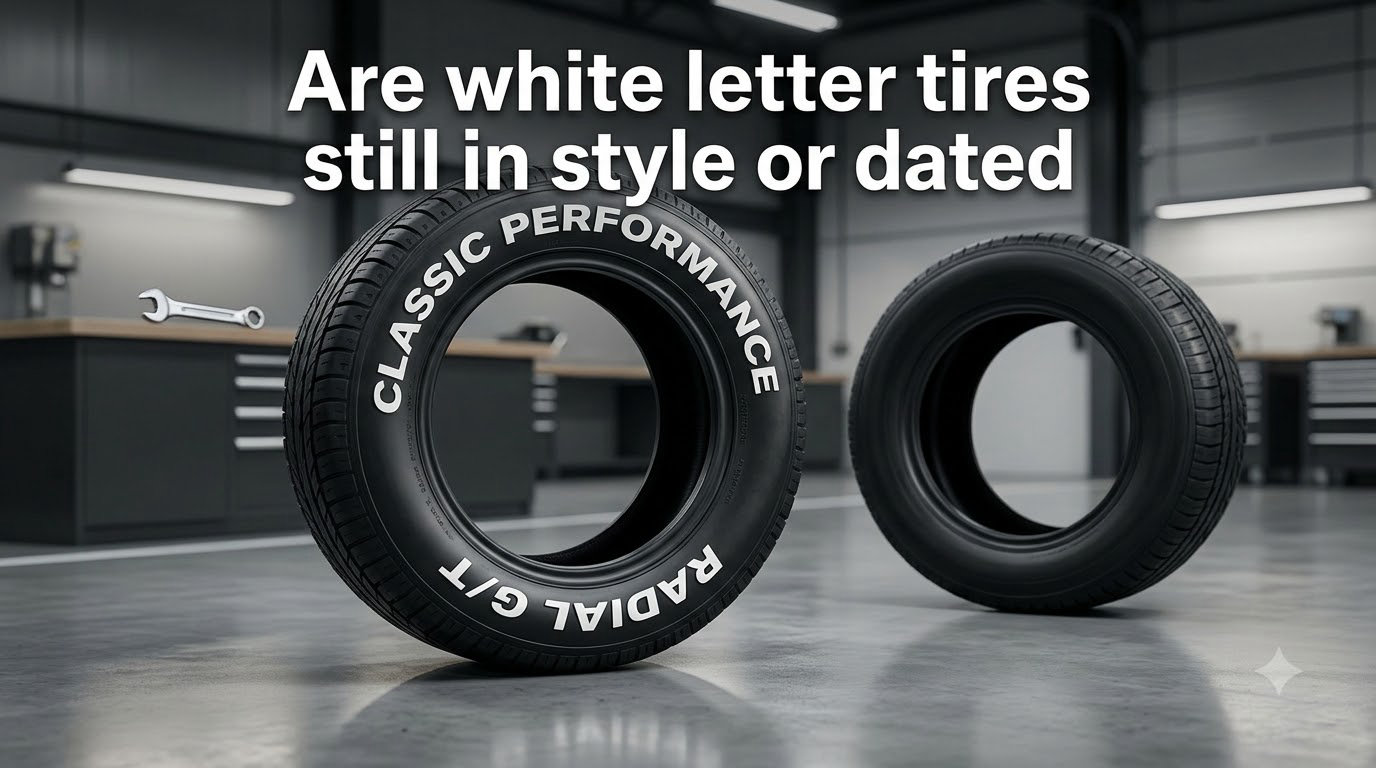
White letter tires sit in a weird spot in 2026. They’re not dead, not mainstream, and definitely not universally cool. After digging through forum threads on r/tires, r/cars, r/Ram1500, and r/ToyotaTacoma, and lining that up against what tire brands are actually making, our team lands on a split verdict: white letter tires are still stylish in the right niches and quietly dated everywhere else.
This guide gives you the direct answer first, then the context that explains it. You’ll get the 2026 trend state, the difference between raised white letter (RWL) and outline white letter (OWL) tires, which vehicles pull the look off, and where it falls flat. Whether you’re restoring a Chevelle, shopping for your Tacoma, or wondering whether to flip the white letters out on your new commuter car, we have you covered.
Direct answer for 2026: White letter tires are niche stylish, not mainstream. They still look great on classic muscle cars, restomods, trucks, and off-road builds. They look dated on most modern sedans, EVs, and daily drivers. Context (vehicle type, wheel size, intent) decides everything.
Table of Contents
Quick Answer: Are White Letter Tires Still in Style?
Yes for muscle cars, classic restorations, trucks, and off-road rigs. No for modern sedans, EVs, crossovers, and most daily drivers. The answer is genuinely context-dependent, and any article that tells you a flat “yes” or “no” is oversimplifying it.
Raised white letter (RWL) tires are tires where the brand name and model are molded as raised letters on the sidewall and tinted white instead of the standard black. The look exploded in the late 1960s and early 1970s when American muscle cars dominated showroom floors and drag strips. By the mid-1980s, the look had faded from passenger cars but never disappeared from truck and off-road circles. In 2026, the style is alive and well in enthusiast spaces and essentially absent from new sedans.
The short version: if you drive a classic or a truck, white letters still work. If you drive anything else, you’re fighting the current aesthetic, and the tradeoffs (cleaning, UV yellowing, scuff sensitivity) often aren’t worth it.
The History of White Letter Tires
To understand whether white letter tires are still in style, you need to know where they came from and why they faded the first time. The story runs from the 1900s through three distinct fashion cycles.
Early 1900s: White Tires Were the Norm
Here’s the twist most people miss. Early tires were naturally white because zinc oxide was the primary compounding ingredient. They looked like modern whitewalls, just without the contrast band. When rubber chemistry shifted to carbon black in the 1910s and 1920s, tires turned the deep black we know today, and that black sidewall became the default for the next half century.
Carbon black wasn’t just a fashion choice. It dramatically improved tire durability, abrasion resistance, and UV protection. The black sidewall stayed because it worked, not because it looked cool. White lettering, when it arrived decades later, was a deliberate visual choice layered on top of performance rubber.
1960s-1970s: The Muscle Car Heyday
Raised white letter tires became a signature muscle car look in the late 1960s. Brands like Goodyear Polyglas, Firestone Wide Oval, and eventually BF Goodrich Radial T/A defined the era. The white letters sat against the blackwall and created high-contrast sidewall lettering that signaled performance and American muscle.
This was also the golden age of motorsports visibility. SCCA Trans-Am racing, NASCAR, and drag strips all featured cars with prominent white letter tires. Consumers saw the look winning races and copied it. The BF Goodrich Radial T/A in particular became so iconic that it’s still being manufactured today, essentially unchanged.
1980s-1990s: The First Decline and the OWL Era
The raised white letter trend peaked around 1970 and started fading by the mid-1970s as fuel economy and low-profile tire technology took over. By the 1980s, RWL was considered dated. Outline white letter (OWL) tires took over as a softer alternative, with thin painted rings around black lettering rather than the chunky raised white characters of the muscle era.
OWL tires had a strong run through the 1980s and into the 1990s, especially on sport compacts, import tuners, and early Honda and Nissan performance cars. By the late 1990s, even OWL began to look dated, and the blackwall returned as the dominant default.
2000s-Today: Niche but Persistent
In 2026, white letter tires occupy the same niche as chrome bumpers and vinyl tops: technically available, culturally loaded, and very specific about which cars they look right on. The brands that still make them (BF Goodrich, Coker, Firestone, Cooper) cater to the restoration, hot rod, and truck markets. Mainstream passenger car buyers overwhelmingly choose black sidewalls, and tire manufacturers have followed the money.
What Do the White Letters on Tires Signify?
The white letters on tires were originally branding made visible. Tire manufacturers molded their name and model into the sidewall so anyone standing next to the car could read it. Coloring those letters white turned the sidewall into a billboard, and that visibility became a status symbol in the performance scene.
Beyond branding, the letters came to signify several things at once. They said the owner cared enough about tire choice to pick a specific brand. They referenced a performance heritage tied to muscle cars and drag racing. And they signaled a period-correct or vintage-conscious approach to vehicle styling.
On a 1969 Mustang fastback or a 1970 Chevelle SS, white letters are authenticity markers. On a 2024 commuter car, the same letters read as an attempt to look retro, sometimes cool, often confused. The signal changes based on the canvas.
Types of White Letter Tires: RWL vs OWL vs Stickers
Not all white letter tires are the same. There are three distinct categories, and the differences matter if you’re trying to decide whether the look works for your vehicle.
Raised White Letter (RWL) Tires
RWL tires have the brand and model name molded as raised three-dimensional letters on the sidewall, with the rubber itself tinted white. This is the original muscle car style. The letters protrude from the sidewall and have a sculpted, dimensional look. Examples include the BF Goodrich Radial T/A and Firestone Wide Oval reproductions.
Outline White Letter (OWL) Tires
OWL tires have the letters molded in but painted with an outline rather than filled in solid white. The look is more subtle and modern. OWL tires were the dominant white letter style through the 1980s and 1990s and remain available on some truck and passenger lines.
Tire Stickers and DIY Options
Tire stickers are vinyl lettering you apply over a standard blackwall tire to mimic either RWL or OWL. Companies like Tire Stickers make pre-cut kits for popular tire models. You can also buy white tire paint pens and paint your own lettering. This is the cheapest way to test the look without buying specialty tires.
Here’s a comparison to help you choose:
| Type | Look | Cost | Best For |
|---|---|---|---|
| RWL (Raised White Letter) | Bold, 3D, classic muscle | Highest (specialty tire) | Restored muscle cars, restomods |
| OWL (Outline White Letter) | Subtle, painted, modern-retro | Moderate | Trucks, sport compacts, mild retro |
| Tire Stickers | Variable, DIY | Lowest | Testing the look, budget builds |
Where White Letter Tires Are Still Stylish
White letter tires haven’t disappeared. They’ve concentrated into a few specific niches where the look is either period-correct or culturally alive.
Muscle Cars and Classic American Performance
This is the home turf. If you’re driving a Camaro, Mustang, Chevelle, Charger, GTO, or any factory muscle car from 1964 to 1973, white letter tires are essentially mandatory for a correct look. The BF Goodrich Radial T/A on a set of Magnum 500s is the default muscle car wheel-and-tire package for a reason.
Restorers care about period correctness because show judges do. Even modified muscle cars (restomods) often run white letters because the visual signature is so tied to the era that dropping it feels wrong.
Trucks and SUVs
Pickup trucks and body-on-frame SUVs are the second stronghold. Many factory truck tires still ship with outline white letters as original equipment, and the look reads as rugged and masculine rather than dated. On a Tacoma, Tundra, F-150, Silverado, or Ram, white letters fit the truck aesthetic without question.
Forum sentiment on r/Ram1500 and r/ToyotaTacoma is generally positive toward white letters when they’re factory or tastefully added. The complaints come when white letters look out of place on a small wheel or appear scuffed and yellow.
Off-Road and All-Terrain Builds
Off-road tire brands like BF Goodrich (All-Terrain T/A KO2), Goodyear (Wrangler), and Toyo (Open Country) frequently offer white letter or outline white letter options for their all-terrain and mud-terrain lines. On a lifted 4Runner, Wrangler, Bronco, or F-250, white letters pair naturally with the rugged, go-anywhere intent.
Hot Rods, Customs, and Show Cars
Hot rodders and custom car builders have kept white letters alive as a deliberate throwback style. On a street rod, a pro-touring build, or a show car, white letter tires are a known visual choice that signals intent. This is a small but persistent market that supports ongoing production.
Where White Letter Tires Look Dated
Here’s the flip side, and it’s where most modern tire buyers will land. White letter tires can read as dated or out of place in several common scenarios.
Modern Sedans and Compact Cars
On a 2020s sedan or compact car (think Civic, Corolla, Camry, Accord), white letters look anachronistic. The wheel sizes are typically 16-19 inches, the styling is clean and aero-conscious, and the sidewall proportions are short. White letters on a short sidewall look cramped and visually noisy.
This is the dominant sentiment on r/cars and r/tires. When asked about white letters on daily drivers, the prevailing opinion is that they make the car look like it’s trying too hard to look retro.
Electric Vehicles and Modern Crossovers
EVs and modern crossovers (Model 3, Model Y, Mach-E, ID.4, RAV4, CR-V) lean toward flush aerodynamic designs with large diameter wheels and minimal sidewall. White letters fight the entire aesthetic. They also signal combustion-era performance culture, which clashes with the EV ethos.
Luxury Vehicles
Luxury cars emphasize understated elegance. White letters are loud, contrasty, and brand-forward. On a Lexus, Genesis, BMW, or Mercedes, white letters read as gaudy and out of place. The luxury buyer overwhelmingly chooses black sidewalls.
The Big Wheel Problem
White letters scale poorly as wheel diameters grow. On a 15-inch muscle car wheel, white letters are a substantial visual element that fits the proportions. On a 20-inch or 22-inch modern wheel with a short sidewall, the same letters look squished and disproportionate. Many new car buyers with large wheels flip the white letters inward to show a clean black sidewall, which is a tell that the style has shifted.
Pros and Cons of White Letter Tires
An honest list, with Reddit sentiment included where it adds context.
The Pros
Period-correct for classics. If you own a muscle car, white letters are the most authentic choice. Show judges and other enthusiasts notice when they’re missing.
Strong visual identity. White letters make a tire choice visible. On a truck or off-road rig, that bold sidewall signals intent. As one r/Ram1500 user put it, “raised white letters give it a racing look.”
Widely available for niche markets. BF Goodrich, Firestone, Cooper, Toyo, and Coker all produce white letter options. You’re not hunting for unobtainium.
DIY alternatives exist. Tire stickers and white paint pens let you test the look without buying specialty tires.
The Cons
Maintenance burden. White letters show every bit of brake dust, road grime, and curb scuff. They need regular cleaning with a tire brush and proper dressing to look good. Reviewers consistently flag this as the biggest practical drawback.
UV yellowing and fading. The white compound yellows over time with sun exposure. Even well-maintained tires eventually look dingy. This hits cars in sunny climates hardest.
Curb rash sensitivity. A scuffed white letter is immediately visible. On a black sidewall, the same scuff blends in. Parking-lot damage is more obvious on white letters.
Dated perception outside niches. As multiple r/tires commenters have noted, “the trend faded in the 1980s and never returned” for daily drivers. That perception is hard to shake.
Limited modern fitments. White letter tires are concentrated in muscle car, classic, and truck sizes. If you want a 19-inch or 20-inch white letter tire for a modern car, options are scarce.
Iconic Brands Still Making White Letter Tires
Several major brands continue to produce raised and outline white letter tires, mostly for the restoration and truck markets.
BF Goodrich Radial T/A is the most iconic modern RWL tire. Originally launched in 1970, it’s still produced today in muscle car sizes and remains the default choice for restored American muscle.
Firestone Wide Oval reproductions are available through Coker Tire and Firestone’s classic line. These replicate the original muscle car fitments with modern rubber compounds.
Coker Tire specializes in classic and vintage tires, offering multiple white letter options including reproduction Firestone, Goodyear, and BF Goodrich patterns in original sizes.
Cooper Cobra offers raised white letters in sizes that fit classic muscle and modern truck applications.
Toyo, Goodyear, and Bridgestone offer white letter or outline white letter options in their truck and all-terrain lines, particularly for popular pickups and SUVs.
DIY Alternatives: Tire Stickers and Paint Pens
Don’t want to commit to specialty tires? Two DIY routes let you test the white letter look at low cost.
Tire stickers are pre-cut vinyl lettering kits. You clean the sidewall, peel and stick, and let them set. Quality kits from Tire Stickers or similar companies last a year or two before needing replacement. Cost is typically much lower than a full set of specialty tires.
White tire paint pens are the cheapest option. You trace over the existing molded letters with a paint pen designed for rubber. Results vary, and the paint needs reapplication every few months, but for under twenty dollars you can find out whether you like the look on your daily driver.
Both options are reversible. If you decide white letters aren’t for you, you can peel stickers off or simply flip your tires so the letters face inward.
The 2026 Verdict on White Letter Tires
Here’s where the rubber meets the road, literally. In 2026, white letter tires are stylish in their home niches and outdated outside them.
If you drive a classic muscle car, a restomod, a hot rod, a truck, or a lifted off-road rig, white letter tires are still in style and probably always will be. The look is anchored to those vehicles by decades of culture, and the manufacturers are still producing for that market.
If you drive a modern sedan, a compact car, an EV, a crossover, or a luxury vehicle, white letter tires are dated. The aesthetic doesn’t fit the proportions, the wheel sizes, or the design language of the car. You’d be fighting a strong headwind, and even with careful maintenance, the look would still read as anachronistic to most observers.
For everyone in between, the answer depends on how much you value standing out versus blending in. White letters are a loud visual choice. On the right car, that is the appeal. On the wrong car, it is a problem you have to clean every weekend.
Frequently Asked Questions
Do they still make raised white letter tires?
Yes. BF Goodrich still produces the Radial T/A in raised white letter (RWL) versions for muscle cars. Coker Tire manufactures reproduction Firestone Wide Oval and Goodyear Polyglas RWL tires in original sizes. Cooper Cobra and several truck tire lines from Toyo and Goodyear also offer RWL or outline white letter (OWL) options.
What do the white letters on tires signify?
The white letters on tires were originally branding made visible. Tire manufacturers molded their name and model into the sidewall and tinted the letters white so anyone could read them. Over time, the look became a symbol of American muscle car culture, motorsports heritage, and period-correct restoration. Today, white letters signal performance intent or vintage authenticity depending on the vehicle.
Why don’t tires have white letters anymore?
Tire manufacturers followed consumer demand. As low-profile tires, large-diameter wheels, and modern aerodynamic designs became dominant in the 1980s and 1990s, white letters looked out of proportion and dated. Mainstream passenger car buyers shifted to black sidewalls. Manufacturers concentrated white letter production into the niche markets that still wanted them: classic muscle cars, trucks, and off-road vehicles.
Why did white wall tires go out of style?
Whitewall tires faded for several reasons. Carbon black became standard in tire compounding for durability, making black sidewalls the default. Whitewalls visually aged poorly, scuffed easily, and required constant cleaning to look good. As American cars moved toward lower-profile tires and larger wheels in the 1980s and 1990s, whitewalls looked disproportionate and disappeared from new car showrooms.
Are white letter tires out of style?
White letter tires are out of style for modern sedans, EVs, crossovers, and luxury vehicles. They are still in style for classic muscle cars, trucks, off-road builds, and restomods. The look is context-dependent rather than universally dated.
Are white letter tires worth it?
White letter tires are worth it if you own a classic muscle car, truck, or off-road vehicle where the look is period-correct. They are not worth it for most modern daily drivers due to maintenance burden, UV yellowing, and dated perception. DIY tire stickers offer a low-cost way to test the look before committing to specialty tires.
Final Verdict on White Letter Tires
So, are white letter tires still in style or dated in 2026? The honest answer is both, depending on what you drive.
White letter tires are still stylish for muscle cars, classic restorations, trucks, SUVs, and off-road builds. In those niches, white letters are timeless rather than trendy, anchored by decades of enthusiast culture and active manufacturer support.
White letter tires are dated for modern sedans, EVs, crossovers, luxury cars, and most daily drivers. The proportions don’t fit, the wheel sizes fight the look, and the general perception has moved on.
If you’re in the first group, buy with confidence. The BF Goodrich Radial T/A and similar offerings remain excellent tires with iconic looks. If you’re in the second group, save your money, flip the white letters inward if your tires came that way, or test the look with cheap tire stickers before committing. Either way, you now have the context to make the call.