
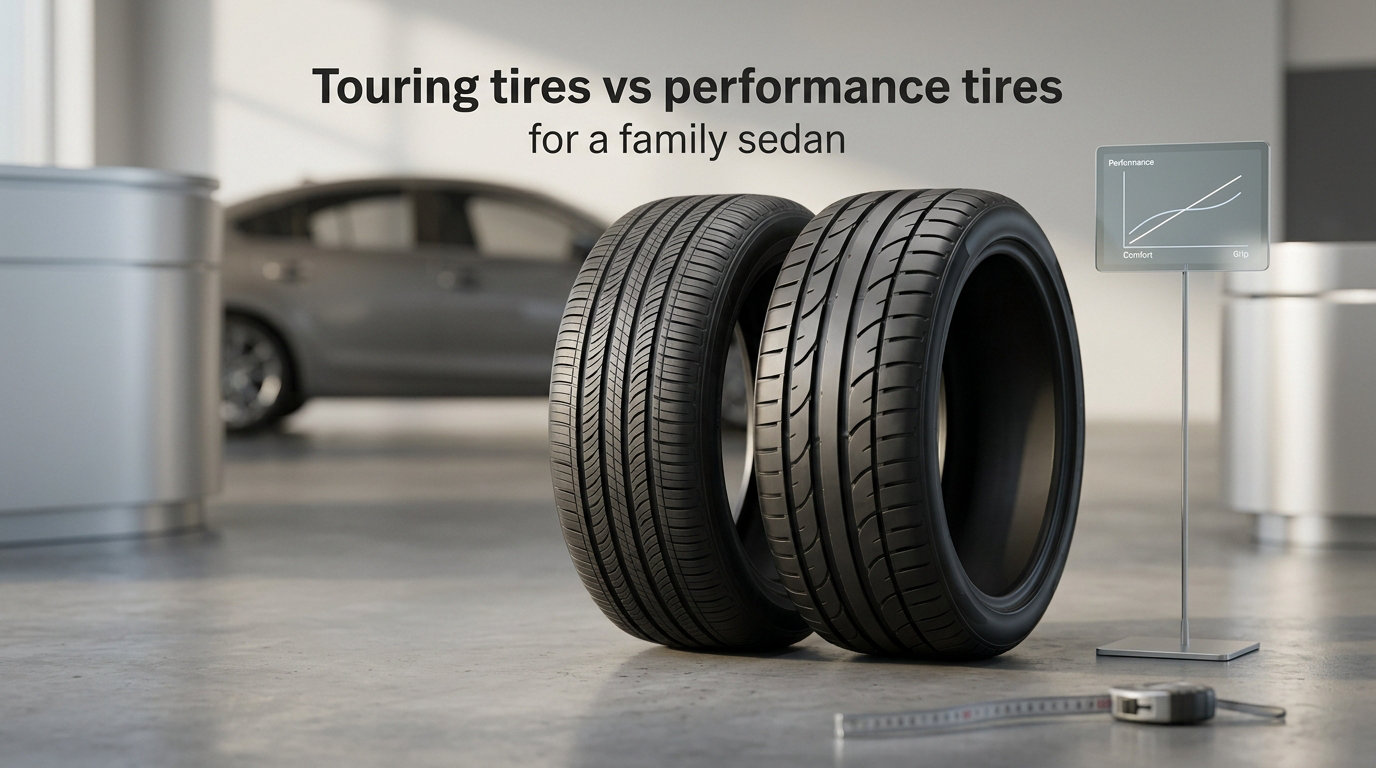
Choosing between touring tires vs performance tires for a family sedan comes down to one question: do you want a smoother, longer-lasting ride, or sharper handling that wears out faster? For most family sedan owners who commute, shuttle kids, and take road trips, touring tires are the smarter pick. Performance tires shine when the driver actually pushes the car through corners, which is rare in daily family life.
We’ve worked through this choice with hundreds of sedan owners over the years, and the same pattern shows up again and again. Drivers who switched to performance tires expecting more fun usually came back to touring tires within one tread cycle because the noise, ride harshness, and replacement cost outweighed the occasional extra grip. This guide walks you through every difference that matters, then gives you a clear framework for picking the right tire for your specific sedan.
Table of Contents
What Are Touring Tires?
Touring tires are comfort-oriented all-season tires designed for smooth rides, long tread life, and quiet operation on the road. They use a harder tread compound, taller sidewalls, and tread patterns that prioritize low noise over maximum grip. The whole design goal is to keep you comfortable mile after mile without making you think about your tires at all.
You’ll find touring tires on most new family sedans straight from the dealership. Brands like Michelin, Continental, Bridgestone, and Goodyear build their flagship touring lines specifically for cars like the Toyota Camry, Honda Accord, Honda Civic, and Nissan Altima. These tires are usually 50 to 65 aspect ratio, meaning the sidewall height is 50 to 65 percent of the tire’s width.
Core Features of Touring Tires
- Harder tread compound for longer mileage (typically 60,000 to 80,000 miles)
- Taller sidewalls that absorb bumps and rough pavement
- Symmetrical tread designs with multiple circumferential grooves for water evacuation
- Larger tread blocks that reduce impact noise
- Lower rolling resistance for better fuel efficiency
- All-season versatility for light winter conditions
Who Touring Tires Are Best For
Touring tires work best for daily commuters, highway drivers, families running errands around town, and anyone who values a quiet cabin over sharp cornering feel. If your sedan spends 90 percent of its life driving straight and turning gently into parking lots, touring tires match your reality.
What Are Performance Tires?
Performance tires prioritize handling, grip, and responsiveness for sportier driving. They use softer, stickier tread compounds, shorter and stiffer sidewalls, and aggressive tread patterns that bite into the road surface. The design goal is to keep the tire glued to the pavement when you brake hard, corner hard, or accelerate hard.
You’ll see performance tires factory-installed on sport trims of sedans like the Honda Accord Sport, Toyota Camry TRD, Mazda6, and Acura TLX. These tires usually come in lower aspect ratios (30 to 45) with larger wheel diameters (18 to 20 inch). That profile looks great but transmits every bump directly into the cabin.
Core Features of Performance Tires
- Soft, high-grip tread compound for maximum traction
- Stiffer sidewalls for responsive steering and cornering stability
- Directional or asymmetric tread patterns tuned for grip
- Larger tread blocks on the outer shoulder for cornering force
- Shorter braking distances on dry pavement
- Quicker steering response and sharper turn-in feel
Who Performance Tires Are Best For
Performance tires work best for enthusiasts who actually drive their sedans hard on winding roads, drivers who attend track days, and owners of sporty trim sedans who want the handling the car was engineered to deliver. If you never explore the cornering limits of your car, performance tires add cost without benefit.
Key Differences Between Touring and Performance Tires
The head-to-head comparison below breaks down the eight attributes that matter most when you drive a family sedan every day. We pulled the data from manufacturer specs, third-party tire tests, and feedback from real drivers on Reddit’s r/tires and r/cars forums.
Tread Life and Longevity
Touring tires typically last 60,000 to 80,000 miles. Performance tires usually last 25,000 to 40,000 miles because the softer compound that gives them grip wears down much faster. For most family drivers covering 12,000 to 15,000 miles a year, that means replacing performance tires every two to three years versus five to seven years for touring tires. Multiple forum users on r/tires report going through two sets of performance tires in the time it took their touring tires to wear down to the wear bars.
Ride Comfort
Touring tires absorb bumps, potholes, and rough pavement through taller, more flexible sidewalls and a cushioned tread design. Performance tires transmit road imperfections directly through the steering wheel and seat because the stiffer sidewalls and lower profile have nowhere to flex. On broken city streets, the difference feels like driving on a cloud versus driving on a hard floor.
Road Noise
Touring tires are noticeably quieter, typically registering 68 to 71 dB at highway speed. Performance tires usually run 72 to 76 dB because the larger tread blocks and stiffer construction create more impact noise. Over a long highway drive, that extra 4 to 5 dB translates to measurable fatigue for everyone in the cabin, especially kids trying to nap.
Handling and Cornering Grip
Performance tires deliver sharper turn-in, less body roll, and higher cornering grip on dry pavement. A skilled driver can feel the difference immediately when pushing through a sweeper or hard corner. Touring tires feel softer and less precise at the limit, but for everyday maneuvers like highway on-ramps and shopping center turns, that limit rarely matters.
Wet and Dry Traction
Performance tires win on dry pavement braking distance by roughly 10 to 15 feet from 60 mph compared to touring tires. On wet pavement, the gap narrows considerably, and touring tires with modern tread designs and siping often match or exceed older performance tires. For family sedans that see more rain than racetracks, touring tires handle wet conditions confidently.
Fuel Efficiency
Touring tires have lower rolling resistance, which can improve fuel economy by 1 to 3 percent compared to performance tires. Over a year of driving, that adds up to noticeable savings at the pump, especially on a daily commute. Drivers on r/cars frequently mention the MPG drop they noticed after switching to performance tires.
Snow and Winter Performance
Neither touring nor performance tires are dedicated winter tires. Touring tires with the three-peak mountain snowflake symbol handle light snow competently. Performance tires with summer-biased compounds become dangerously hard below 45 degrees Fahrenheit and offer almost no grip in snow. If you live where winters are real, dedicated winter tires outperform both options.
Cost Over Time
Touring tires for a family sedan typically cost more per tire up front but spread that cost over far more miles. Performance tires sometimes cost less per tire but need replacement two to three times as often. Over five years, the total cost of ownership for performance tires frequently exceeds touring tires, which we cover in detail in the cost analysis section below.
Quick Comparison: Touring vs Performance Tires
| Attribute | Touring Tires | Performance Tires |
|---|---|---|
| Typical tread life | 60,000 to 80,000 miles | 25,000 to 40,000 miles |
| Ride comfort | Smooth, absorbs bumps | Firm, transmits road feel |
| Road noise | Quieter (68 to 71 dB) | Louder (72 to 76 dB) |
| Cornering grip | Good for daily use | Excellent at the limit |
| Dry braking | Good | 10 to 15 ft shorter from 60 mph |
| Wet traction | Good with modern siping | Good but wears quickly |
| Fuel efficiency | 1 to 3 percent better MPG | Lower due to higher rolling resistance |
| Light snow capability | Capable with 3PMSF symbol | Poor below 45 degrees F |
| Typical cost per tire | Mid to upper range | Mid to upper range |
| Replacement frequency | Every 5 to 7 years | Every 2 to 3 years |
Touring vs Grand Touring Tires: The Middle Ground
Grand touring tires sit between standard touring tires and ultra-high-performance tires. They blend longer tread life and comfort with a step up in handling and grip compared to standard touring tires. Think of them as touring tires that took a performance course.
For family sedan owners who want a little more responsive feel without sacrificing comfort or tread life, grand touring tires are often the sweet spot. Popular options include the Michelin Premier A/S, Continental PureContact, and Bridgestone Turanza QuietTrack. These tires typically deliver 50,000 to 65,000 miles of life with noticeably better cornering than standard touring tires. If you’re stuck between the two extremes, grand touring deserves a serious look before you commit.
Touring vs Performance Tires: Pros and Cons
Here’s a clear breakdown of what you gain and give up with each tire type. We pulled these pros and cons from manufacturer claims, independent tire tests, and thousands of owner reviews across tire forums.
Touring Tires: Pros and Cons
Pros:
- Long tread life reduces replacement frequency and total ownership cost
- Quieter cabin at highway speed for more comfortable long drives
- Smoother ride over rough pavement and potholes
- Better fuel efficiency from lower rolling resistance
- Strong wet traction with modern tread designs and siping
- All-season versatility for light winter conditions
Cons:
- Less responsive steering feel compared to performance tires
- Longer dry braking distances by 10 to 15 feet from 60 mph
- More body roll during aggressive cornering
- Lower ultimate grip on a racetrack
Performance Tires: Pros and Cons
Pros:
- Sharper turn-in and more precise steering response
- Shorter braking distances on dry pavement
- Higher cornering grip for spirited driving
- Sportier visual appearance with lower profile
- More confident handling in emergency maneuvers at the limit
Cons:
- Tread life of only 25,000 to 40,000 miles means frequent replacement
- Louder cabin at highway speed
- Firmer ride that transmits bumps into the cabin
- Lower fuel economy from higher rolling resistance
- Poor cold-weather and snow grip once temperatures drop
- Higher total cost of ownership over five years
Family Sedan Tire Size Guide: What to Buy for Camry, Accord, Civic, and Altima
One thing that frustrates family sedan owners is figuring out the exact tire size for their specific car. Most competitors skip this entirely, but the right size matters because the wrong size affects speedometer accuracy, fuel economy, and ride quality. Here are the factory sizes for the most popular family sedans on the road today.
Common Tire Sizes by Sedan Model
| Sedan Model | Common Factory Sizes | Notes |
|---|---|---|
| Toyota Camry (2018+) | 205/65R16, 215/55R17, 235/45R18 | Touring tires fit all trims; performance tires best on SE/XSE |
| Honda Accord (2018+) | 225/50R17, 235/40R19 | 19 inch wheels strongly favor touring for comfort |
| Honda Civic (2016+) | 215/55R16, 215/50R17, 235/40R18 | Si and Type R come with summer performance tires |
| Nissan Altima (2019+) | 215/55R17, 235/40R19 | SR and Platinum trims often use performance tires |
| Mazda 6 (2014-2021) | 225/55R17, 225/45R19 | Grand Touring trim typically uses 19 inch wheels |
| Hyundai Sonata (2020+) | 205/65R16, 215/55R17, 235/45R18 | N Line uses 235/40R19 performance tires |
| Toyota Corolla (2019+) | 205/55R16, 225/40R18 | SE and XSE trims use lower-profile sizes |
| Subaru Legacy (2020+) | 225/50R18, 235/45R18 | AWD system works well with touring tires |
Notice that even sporty trims of family sedans often come from the factory with sizes that work fine with touring tires. The Camry SE and Accord Sport, for example, both fit standard touring replacements without any modification. You only need performance tires if you specifically bought a tire size that demands low-profile sidewalls.
Cost-Per-Mile Analysis: Which Tire Saves Money Over Time?
The cheapest tire on the shelf isn’t always the cheapest tire over its life. Total ownership cost depends on the price per tire, how many miles it lasts, and how often you replace it. For a family sedan covering 12,000 miles per year, the math over five years looks like this.
A set of four touring tires at the mid-to-upper price range typically lasts 70,000 miles, which works out to roughly seven to ten cents per mile over the tire’s life. A set of four performance tires at a similar price per tire but lasting only 35,000 miles works out to roughly 14 to 20 cents per mile. Even when the upfront price of performance tires is the same, the higher replacement frequency roughly doubles your cost per mile.
For drivers covering more than 15,000 miles a year, the gap widens further. Touring tires can sometimes outlast the warranty period entirely, while performance tires may need two full replacements in the same window. Forum users on r/tires consistently report the same pattern: touring tires win on long-term value every time.
Safety and Stopping Distance Considerations for Families
For families with children, stopping distance matters more than cornering grip. A typical 60 to 0 mph dry braking test shows performance tires stopping 10 to 15 feet shorter than touring tires. That sounds significant, but on a real family sedan driven at sensible speeds, the difference rarely determines outcomes because drivers rarely brake from 60 mph in everyday situations.
What matters more for family safety is consistent wet traction, predictable behavior in emergency maneuvers, and tread life that doesn’t leave you stranded with bald tires in a rainstorm. Touring tires excel at all three. Their modern siping and water-channeling tread patterns grip wet pavement confidently, and their longer tread life means you’re not gambling on worn-down rubber during a sudden downpour.
If you carry small children, a touring tire’s softer sidewall also cushions the cabin over rough roads, reducing fatigue on long trips. Drivers on family-focused forums consistently say they trust their touring tires in everyday family use, including wet highways and emergency stops.
Decision Framework: How to Choose the Right Tire for Your Family Sedan
Use this simple framework to decide between touring and performance tires for your specific driving reality. Answer each question honestly, and the answer usually becomes obvious.
Question 1: Do you push your sedan through corners at more than 7/10ths of its limit?
If yes, performance tires deliver real value. If no, you’re paying for grip you’ll never use. Most family drivers answer no here.
Question 2: Do you drive more than 15,000 miles per year?
If yes, touring tires win on cost per mile. If no, both options are reasonable, but touring still edges ahead on comfort.
Question 3: Do you frequently drive on rough or potholed roads?
If yes, touring tires absorb the punishment. Performance tires will beat you up and show curb damage quickly.
Question 4: Is fuel efficiency important to your household budget?
If yes, touring tires save 1 to 3 percent on fuel compared to performance tires, which adds up over years.
Question 5: Do you carry passengers who notice road noise?
If yes, touring tires deliver a quieter cabin for everyone, especially on long highway drives.
If you answered “no, yes, yes, yes, yes” like most family sedan owners, touring tires are the right choice. If you answered “yes, no, no, no, no” like a weekend canyon-carver, performance tires are worth considering. Anyone in between should look at grand touring tires as the compromise that doesn’t really compromise.
Frequently Asked Questions
What is the difference between performance and touring tires?
Touring tires prioritize comfort, long tread life, low noise, and fuel efficiency using harder compounds and taller sidewalls. Performance tires prioritize grip, sharp handling, and braking using softer compounds and stiffer sidewalls, which leads to faster wear and a firmer ride. For family sedans used daily, touring tires usually deliver more useful benefits.
Are touring tires good for highway driving?
Yes, touring tires are excellent for highway driving. They deliver low road noise, smooth ride quality over expansion joints, strong straight-line stability, and 60,000 to 80,000 miles of tread life. Many family sedan owners specifically choose touring tires because of how comfortable long highway trips become.
Are performance tires good for everyday driving?
Performance tires work for everyday driving if you can accept shorter tread life, more road noise, and a firmer ride. For most family sedan owners who never explore the cornering limits of their car, the extra grip is wasted while the downsides cost real money. Touring tires are usually the smarter everyday choice.
What is the best tire for a sedan?
The best tire for a family sedan is a touring tire with a strong reputation for tread life, wet traction, and low noise. Top picks include the Michelin Primacy Tour A/S, Continental PureContact, and Bridgestone Turanza QuietTrack. If you want sharper handling without giving up comfort, look at grand touring tires as the middle option.
Do performance tires wear out faster?
Yes, performance tires wear out significantly faster than touring tires because the softer, stickier tread compound that gives them grip is the same compound that wears down quickly. Most performance tires last 25,000 to 40,000 miles, while touring tires last 60,000 to 80,000 miles. That means replacing performance tires two to three times as often.
Which tires offer the best comfort and quietness?
Touring tires deliver the best comfort and quietness for family sedans. Their harder tread compound, taller sidewalls, and tread patterns designed to reduce impact noise produce a noticeably quieter and smoother ride than performance tires. Grand touring tires come close while adding a bit more handling capability.
Final Verdict: Which Tire Type Wins for a Family Sedan?
Touring tires win for the vast majority of family sedan owners. They last longer, ride smoother, run quieter, save fuel, handle wet roads confidently, and cost less per mile over their lifetime. Performance tires only make sense if you actively push your sedan to its cornering limits, which most family drivers don’t.
If you’re somewhere in between, grand touring tires give you the best of both worlds: nearly all the comfort and tread life of standard touring tires with noticeably better handling. For your Camry, Accord, Civic, or Altima, start with a top-rated touring tire, and only consider performance if you genuinely enjoy driving hard. Your wallet, your passengers, and your fuel economy will all thank you for choosing touring tires.