
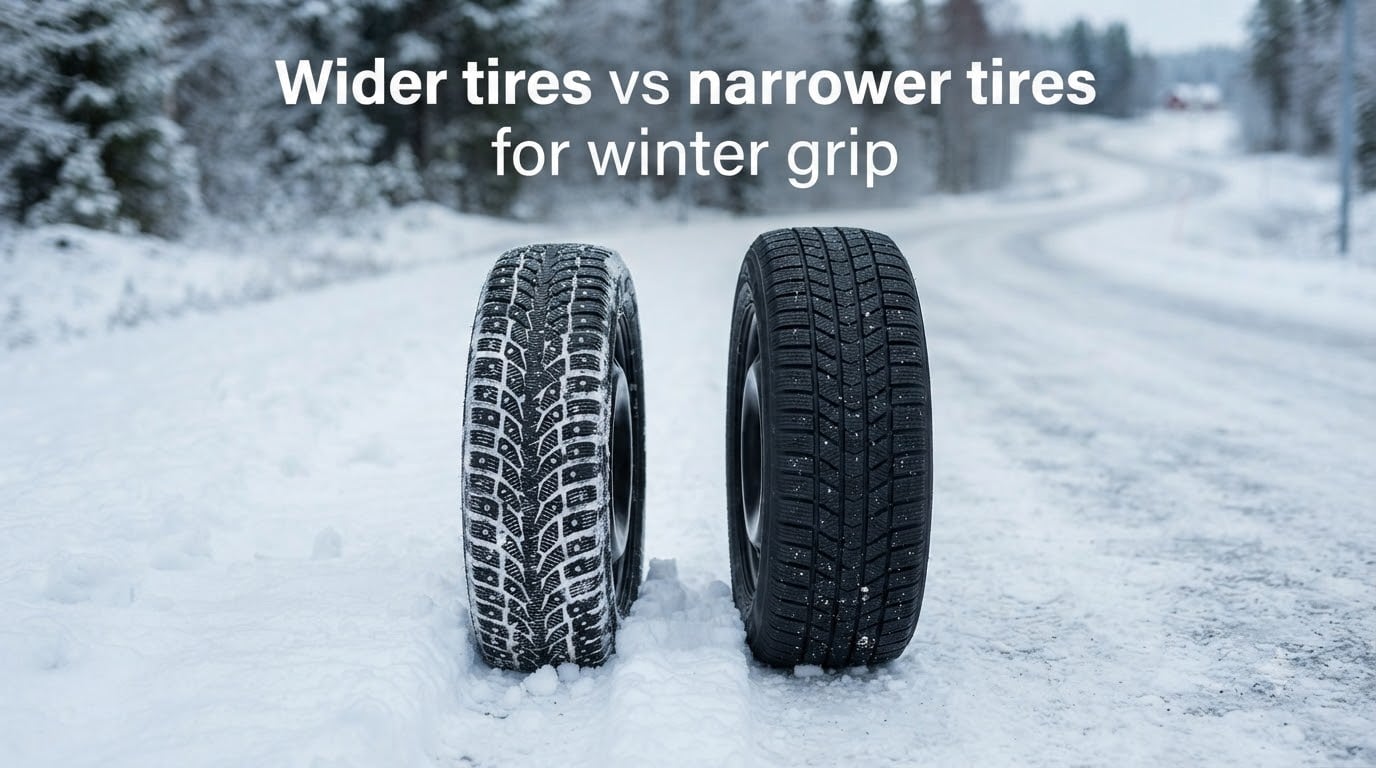
Narrower tires win on loose snow and slush because they concentrate the vehicle’s weight into a smaller contact patch, cutting through the snow rather than plowing it. Wider tires win on dry pavement, packed snow, and hardpack ice because they put more rubber on the road. For most winter drivers, going one size narrower than the factory summer tire is the right call — but the rubber compound matters more than the width.
If you have ever read manufacturer advice saying “narrower winter tires are better” and then wondered how that squares with the obvious fact that a wider tire has more rubber touching the road, you are not alone. This guide breaks down the physics, the real-world tests, and the practical sizing steps so you can pick the right tire width for your car and your winters.
Table of Contents
How Tire Width Affects Winter Grip: The Contact Patch
The whole “wider tires vs narrower tires for winter grip” debate boils down to one thing: contact patch physics. The contact patch is the small footprint of rubber that actually touches the road at any given moment. For a typical passenger car tire, that patch is roughly the size of a sheet of paper — and how wide, long, and pressurized it is determines how much grip you have.
Two competing forces are at play:
- Contact patch area — the total square inches of rubber on the road. More area generally means more grip on dry surfaces.
- Contact patch pressure (PSI) — the vehicle’s weight divided across that area. Higher pressure per square inch can help the tire bite into soft surfaces like snow.
Here is the part most people miss: a wider tire does have a larger contact patch, but it also distributes the same vehicle weight across that larger area. The result is lower PSI per square inch. A narrower tire has a smaller contact patch but squeezes the same weight into less space, raising the PSI. In deep, loose snow, that higher pressure is what lets the tire slice down to a firmer layer instead of floating on top.
You can see this with the basic pressure formula: PSI equals load (pounds) divided by contact area (square inches). If your car weighs 4,000 pounds and each tire carries 1,000 pounds, a wide 255 mm tire might have a contact patch of about 12 square inches, giving roughly 83 PSI at the patch. A narrow 205 mm tire might have a contact patch closer to 9 square inches, pushing the patch pressure over 110 PSI. That extra pressure is exactly what helps cut through snow.
This is also why a person in snowshoes sinks less than a person in sneakers — spreading weight across a larger area lowers the pressure per square inch and lets you float on top of soft snow. Flip that logic and you get the case for narrower winter tires.
Pros of Narrower Tires for Winter Driving
Narrower tires have earned their reputation for good reason. Here is what they do well.
- Cut through loose and unpacked snow — higher PSI at the contact patch pushes the tire down into the snow instead of letting it ride on top.
- Better slush and wet-snow performance — the narrower tread can evacuate slush through the grooves instead of building it up in front of the tire.
- Lower rolling resistance — less rubber on the road and typically less weight means a small but real fuel economy gain.
- Improved steering response in snow — many drivers report a more “connected” feel because the front tires bite into the surface rather than skating across it.
- Cheaper than ultra-wide performance tires — narrower sizes in winter compounds are widely available and often less expensive per tire.
Ice racing professionals, who run some of the most extreme winter conditions on the planet, have historically used narrower-than-stock tires on purpose. The higher contact patch pressure helps the tire’s rubber compound grip the slick surface.
Cons of Narrower Tires for Winter Driving
Narrower is not a free lunch. There are real trade-offs.
- Weaker grip on dry and wet pavement — less rubber on the road means shorter braking distances and less cornering grip when the surface is clear.
- Higher risk of aquaplaning in standing water — a narrower tire has to displace less water per revolution, which sounds good, but the smaller footprint can lose contact with the road more suddenly in heavy rain.
- Reduced cornering stability — wider tires resist leaning in corners better, especially in heavier vehicles or performance applications.
- Potential fitment limitations — going very narrow on a wide factory wheel can create fitment issues with the sidewall.
For most drivers who split time between snowy and dry conditions, the dry and wet grip loss is the main reason not to go too narrow. A 215-section tire on a car that came with 245s is usually a sweet spot. Going all the way down to 195 is rarely worth the trade.
Pros of Wider Tires for Winter Driving
Wider tires still have a real role to play in winter, especially on certain surfaces and vehicles.
- More grip on packed snow and ice hardpack — once the snow is driven flat and frozen, more rubber on the road wins.
- Better dry and wet braking — wider contact patches mean shorter stopping distances on clear roads.
- Improved cornering and stability — wider tires resist lateral loads better, which helps heavier vehicles and SUVs.
- Better steering feel and precision — many drivers prefer the more direct response of a wider front tire.
- Higher load capacity — wider sizes often come with higher load indexes, useful for trucks and three-row SUVs.
If you live in a region where “winter” means mostly cold rain, occasional black ice, and very little loose snow, a wider tire can absolutely be the right choice. The contact patch advantage on hard surfaces is real.
Cons of Wider Tires for Winter Driving
The downsides of wider winter tires are not just theoretical — they show up in everyday driving.
- Plowing effect in deep snow — the wider tread rides up on loose snow instead of cutting through, which can leave you stuck or sliding.
- Lower contact patch pressure — same load, larger area, less bite per square inch in soft surfaces.
- Slush buildup in the tread — wider grooves can fill with wet snow faster, reducing traction until the tires spin clean.
- Reduced fuel economy — more rolling resistance and usually more weight.
- Higher cost — wide winter tires, especially in low-profile sizes, can run significantly more per set.
Are 275 tires too wide for snow? In many cases, yes — especially if your vehicle’s stock summer fitment is 225 or 235. Stepping up to 275 for winter almost guarantees a plowing effect in anything deeper than an inch of fresh snow.
Conditions Matrix: When Each Tire Width Wins
This is the table most other guides skip, and it is the one that actually answers the question. Winter is not one condition — it is at least five.
| Condition | Narrower Tire | Wider Tire | Why |
|---|---|---|---|
| Deep, loose snow (4+ inches) | Wins | Loses | Higher PSI slices down to firmer layers instead of plowing |
| Packed snow / hardpack | Loses slightly | Wins slightly | More rubber on a firm surface gives more grip |
| Black ice | Tied | Tied | Compound and siping matter far more than width |
| Slush / wet snow | Wins | Loses | Narrower tread evacuates slush before it builds up |
| Cold dry pavement | Loses | Wins | More contact patch = more grip on dry roads |
| Cold wet pavement | Loses slightly | Wins slightly | Wider tire has more rubber to displace water |
| Dry handling / spirited driving | Loses | Wins | Cornering grip scales with contact patch on hard surfaces |
The takeaway: if your winter is mostly deep fresh snow, lean narrow. If your winter is mostly cold rain and clear pavement, lean wide. Most drivers fall somewhere in between, which is why a modest downsize (one width step) is the safe answer.
The Real-World Test: Tyre Reviews Hankook Study
Physics gives you the theory, but controlled tests give you the numbers. The Tyre Reviews YouTube channel ran a winter test on identical Hankook Winter i*cept compounds in four sizes: 205, 225, 255, and 275 mm. All four tires were the same model, so the only variable was width.
The results were surprisingly close. Across acceleration, braking, and lap-time testing in snow, all four sizes finished within roughly 1 to 2 percent of each other. The widest tire won braking tests. The narrowest tire won acceleration tests. A middle size won the lap times.
This is the data behind the Motor1.com counter-narrative that “it doesn’t really matter.” Within a single tire model and compound, width differences are smaller than most drivers expect. The differences between a good winter tire and a worn all-season tire in the same width are far larger than the differences between a 215 and a 255 in the same winter tire.
That said, the test was on a prepared snow surface. In real-world deep, unpacked snow where the plowing effect kicks in, the narrow tire still has a clear advantage. Physics and the test agree on hardpack; only physics predicts the deep-snow gap.
Tire Size Markings Explained (215/55R17 94V XL)
Before you can choose a winter tire size, you need to read the markings on the sidewall. Every modern tire carries a code like this one:
- 215 — section width in millimeters. This is the wider part of the tire, measured from sidewall to sidewall.
- 55 — aspect ratio. The sidewall height is 55 percent of the section width. A 215/55 has a sidewall of about 118 mm.
- R — radial construction. Almost all modern tires are radial.
- 17 — wheel (rim) diameter in inches. This is the wheel the tire mounts on.
- 94 — load index. Each number corresponds to a maximum load in kilograms. 94 equals 670 kg per tire.
- V — speed rating. V means the tire is rated to 149 mph (240 km/h). Winter tires often carry a lower H rating.
- XL — extra load. A reinforced sidewall carrying more weight at higher pressure.
So a 215/55R17 94V XL tire is 215 mm wide, has a sidewall height of 55 percent of that width, fits a 17-inch wheel, can carry up to 670 kg per tire, and is rated for speeds up to 149 mph.
For winter, pay close attention to the load index and speed rating. Many winter-specific compounds carry a lower speed rating (often Q or T) because softer rubber optimized for cold temperatures is not as stable at high speeds. That is normal and expected.
Wheel Diameter and Minus Sizing
Which size wheels are better for snow tires, 18 inch or 20 inch? The shorter answer: smaller wheels with taller sidewalls are better for winter.
This is the principle behind minus sizing. If your summer setup is a 245/40R19 on a 19-inch wheel, your winter setup might be a 215/55R17 on a 17-inch wheel. The overall diameter of the tire stays roughly the same so your speedometer stays accurate, but the sidewall is taller and the wheel is smaller.
Why does this matter? Two reasons:
- Taller sidewalls flex more, which lets the tire absorb impacts from potholes, frozen ruts, and curbs hidden under snow. A 19-inch wheel with a 40-series sidewall has very little give.
- Smaller wheels mean less expensive winter tires. The 17-inch tire and wheel package is usually significantly cheaper than the 19-inch version.
Many manufacturers and Tire Rack specifically recommend a winter wheel and tire package that is one to two inches smaller in diameter than the summer setup. The rule of thumb is to keep overall diameter within about 3 percent of stock to avoid speedometer and ABS issues.
When to Switch: The 7-7 Rule for Winter Tires
The 7-7 rule is a simple guideline for seasonal changeover. The idea is that when temperatures consistently drop below 7 degrees Celsius (about 45 degrees Fahrenheit) for a week or more, it is time to put the winter tires on. The “second 7” can also mean October through April, depending on which version of the rule you follow.
The science behind the rule is that all-season rubber compounds start to harden below about 7 degrees Celsius. Hard rubber does not grip cold, icy, or snowy surfaces as well as winter-specific compounds engineered to stay flexible in those temperatures.
Winter compounds use different silica and polymer mixes that stay pliable well below freezing. That flexibility is what gives winter tires their grip on cold pavement, regardless of whether there is snow on the ground. If your winters are cold but mostly dry, winter tires still outperform all-seasons purely on cold-weather grip.
For most drivers in the northern US, Canada, and northern Europe, the 7-7 rule translates to swapping tires in late October and back to summer or all-season tires in April.
AWD, ABS, and Speedometer: System Impacts of Changing Tire Width
If you drive an AWD or 4WD vehicle, switching tire width comes with extra considerations. Different tire circumferences between the front and rear axles can confuse AWD systems, which assume all four tires are rotating at similar speeds. The general rule is to keep all four tires within about 3 percent of the same overall diameter, and ideally use the same width on both axles.
ABS and electronic stability control systems use wheel speed sensors to determine if a wheel is locking up or sliding. Changing tire diameter affects those readings. If you go up or down in size, the system will recalibrate automatically within a few miles of driving, but a large diameter change can trigger temporary warning lights or a slightly different ABS feel until the system adapts.
Speedometer accuracy depends on tire diameter, not just width. A taller tire means more revolutions per mile, which means your speedometer reads slower than your actual speed. Going wider without changing the sidewall height usually does not affect the speedometer much, but going to a smaller wheel with a taller sidewall can. Most modern vehicles are forgiving within a 3 percent diameter change, but check your owner’s manual before making a large jump.
Does AWD change the tire width recommendation? A little. Because AWD vehicles need all four tires to match closely, you are usually better off picking one width and sticking with it across the whole vehicle. For an AWD car or SUV, that usually means choosing a width that works in both deep snow and on dry pavement — a modest downsize rather than an extreme one.
How to Choose Your Winter Tire Size: 5 Steps
Here is the practical workflow our team uses when helping drivers pick a winter tire size. It combines the physics, the regulatory reality, and the real-world test data into a single decision process.
Step 1: Find your approved tire sizes. Check your driver’s side door jamb for the tire placard, or look up the specifications in your owner’s manual. The placard lists every tire size and wheel size the manufacturer has tested and approved for your vehicle. For European cars, these are homologated sizes and straying outside them can affect insurance and warranties.
Step 2: Identify your typical winter conditions. If your area gets regular deep snow, lean narrower. If your area is mostly cold and wet with occasional ice, lean wider. If you see both, pick the middle option.
Step 3: Pick a width one to two steps narrower than summer. Most drivers do well going from a 245 summer tire to a 225 or 215 winter tire. That keeps the difference noticeable without being extreme.
Step 4: Downsize the wheel by one inch. Pair the narrower winter tire with a wheel one inch smaller than your summer wheel. This gives you a taller sidewall, more impact protection, and usually a lower price.
Step 5: Prioritize compound and tread design over width. A premium winter tire in a slightly wider size will outperform a budget winter tire in the theoretically ideal narrow size. When in doubt, buy the better tire.
Common Winter Tire Width Myths Debunked
A few misconceptions keep showing up in forums and Reddit threads. Let me address the ones that come up most.
Myth: Narrower tires float on snow like a ski. No. Skis float because of their length, not their narrowness. A narrower tire does not float on snow; it sinks into snow because of its higher contact patch pressure. That is exactly the behavior you want on loose snow.
Myth: Wider tires always have more grip because they have more rubber on the road. Only true on hard surfaces. On loose snow, the pressure effect dominates, and the wider tire’s lower PSI actually reduces grip.
Myth: Going as narrow as possible is always the winter move. No. Going too narrow hurts dry and wet braking, increases aquaplaning risk in heavy rain, and can cause fitment issues. A modest downsize is the sweet spot.
Myth: AWD means tire width does not matter. Not quite. AWD helps you accelerate and keep moving, but it does not help you stop or turn. Tire width affects braking and cornering grip the same way in an AWD as in a two-wheel-drive car.
Myth: The wider the tire, the worse the fuel economy. Usually true, but the difference is small. Most drivers will see less than a 2 mpg change between a 215 and a 245 winter tire. Compound and rolling resistance matter more than width for fuel economy.
Frequently Asked Questions
Are narrower tires better in winter snow?
Yes, in deep and loose snow, narrower tires concentrate the vehicle’s weight into a smaller contact patch, raising PSI per square inch so the tire can slice down to a firmer layer instead of plowing on top. On packed snow or ice hardpack, the difference shrinks and other factors like compound and tread design matter more.
Are wider or narrower tires better for snow traction?
It depends on the snow. Narrower tires win in deep, loose, or slushy snow. Wider tires win on packed snow, dry pavement, and ice hardpack. A modest downsize from your summer tire width is the safe compromise for most drivers.
What is the 7-7 rule for winter tires?
The 7-7 rule says you should switch to winter tires when temperatures stay below 7 degrees Celsius (about 45 degrees Fahrenheit) for a week, or in October through April for most regions. Below about 7C, all-season rubber hardens and loses grip, while winter compounds stay flexible.
Are 275 tires too wide for snow?
For most cars that came with 225 or 235 section tires, 275 is too wide for serious winter use. The plowing effect in deep snow becomes significant, and the lower contact patch pressure hurts grip on soft surfaces. 275 can work on heavy SUVs with appropriate winter compounds, but a narrower size is usually safer.
What tire size is best for snow?
The best winter tire size is typically one to two widths narrower than your factory summer tire, mounted on a wheel one inch smaller in diameter. For a car with 245/45R18 summers, a 215/55R17 winter setup is a common recommendation. Always check your door placard and owner’s manual for approved sizes.
Which size wheels are better for snow tires, 18 inch or 20 inch?
Smaller wheels are better for winter. An 18-inch wheel paired with a taller sidewall gives more impact protection over potholes and frozen ruts, costs less, and weighs less. Many winter packages step down one wheel size from the summer setup while keeping overall tire diameter similar.
Do bigger tires work better in snow?
No, bigger tires do not work better in snow. Wider or larger-diameter tires have a plowing effect in deep snow and lower contact patch pressure, both of which reduce grip. Going modestly narrower and downsizing the wheel diameter is the proven winter move.
Final Verdict on Wider vs Narrower Tires for Winter Grip
The wider tires vs narrower tires for winter grip debate does not have one winner — it has a context. Narrower tires concentrate pressure and cut through deep snow. Wider tires spread contact and grip harder surfaces. For most drivers, the right move is to go one to two widths narrower than your summer tire, mount them on a one-inch-smaller wheel, and prioritize a quality winter compound over absolute width.
Start by checking your door jamb tire placard for approved sizes, then narrow by one or two steps and downsize the wheel by an inch. Buy the best winter compound you can afford, run them from October through April under the 7-7 rule, and you will have more grip in every condition winter throws at you. If you want to dig deeper into winter tire compounds or studded versus studless choices, our team has tested both in detail.