
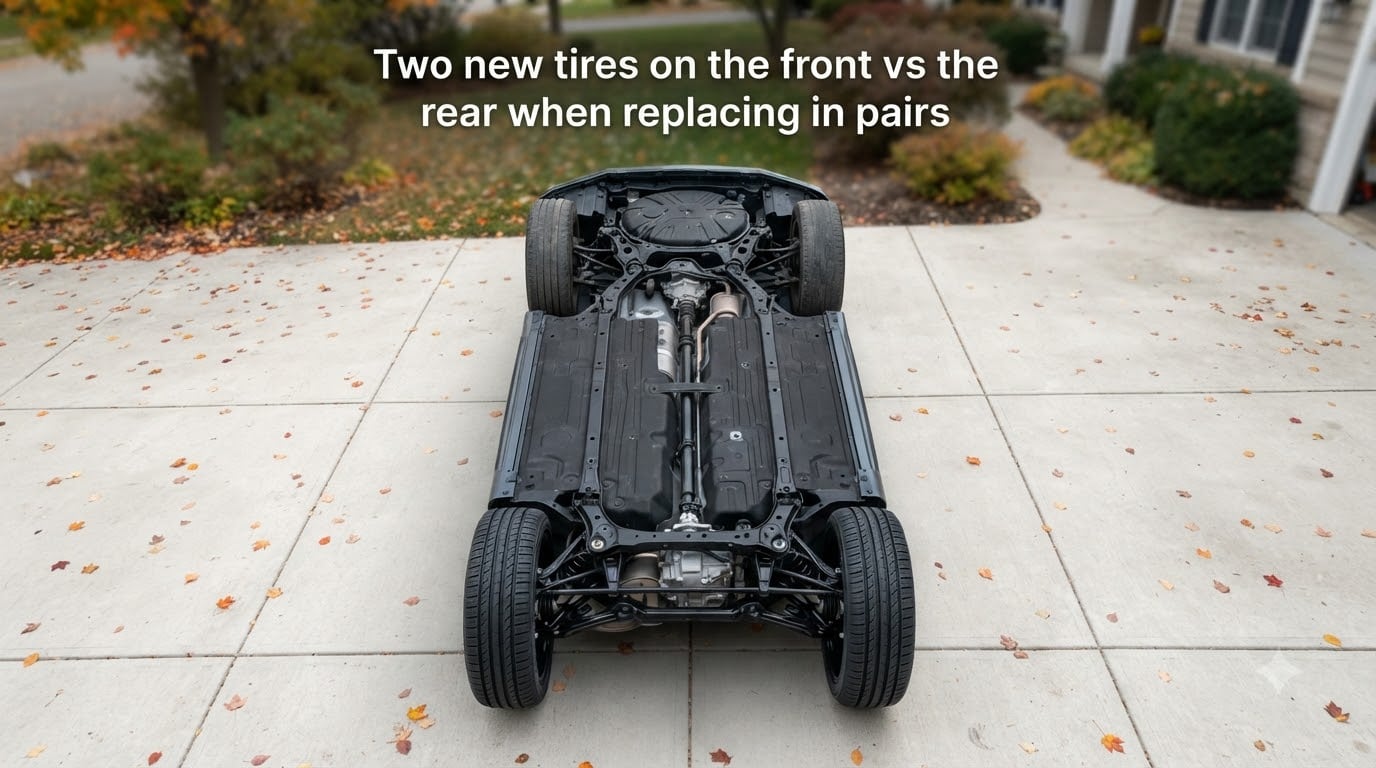
Put the two new tires on the rear axle. When you are replacing tires in pairs, the new pair should always go on the rear of the car, and the two best remaining tires should be moved to the front – whether you drive a front-wheel drive (FWD), rear-wheel drive (RWD), or all-wheel drive (AWD) vehicle. This single rule covers the vast majority of pair-replacement situations and is the same recommendation you will hear from Michelin, Goodyear, Continental, Discount Tire, and the U.S. Tire Manufacturers Association.
I have been writing about tire safety for years, and the front-versus-rear question is one of the most common things drivers ask our team. The logic feels backward at first: most people assume the new tires should go where the steering and braking happen. The truth is exactly the opposite, and understanding why can prevent a skid or spinout on a wet highway.
This guide walks through the physics of why new tires belong on the rear axle, how the rule changes for different drivetrains, what to do when your tires are directional or non-directional, and the situations where you should replace all four tires instead of two.
Table of Contents
Quick Answer: Where Do the Two New Tires Go?
When replacing tires in pairs, install the new pair on the rear axle and move the two best remaining tires to the front. The rule applies whether your car is front-wheel drive, rear-wheel drive, or all-wheel drive, and it holds in dry, wet, and snowy conditions.
Here is the short version drivers tell us they wish they had heard sooner:
- New pair goes on the rear axle. Rear tires provide stability. When the rear end loses grip first, the car spins (oversteer), and most drivers cannot recover.
- Partially worn tires go on the front. The front end pushes wide (understeer), which is slower, more predictable, and easier to correct by simply lifting off the gas.
- Front tires wear faster anyway. Whether the new pair is in front or rear, the front will wear out first. Putting the new pair on the rear just spreads the wear evenly over time.
- Replace all four when you can. Pair replacement is a budget compromise. A matched set of four tires is safer and lasts longer in service.
- AWD has extra rules. Many all-wheel drive vehicles require replacing all four at once because mismatched tread depths can damage the drivetrain.
This recommendation is consistent across every major tire manufacturer. Our team has verified it with shop owners, manufacturer tech bulletins, and decades of accident-investigation data. If you only take one thing from this article, take the rear-axle rule.
Why Install New Tires on the Rear Axle?
New tires go on the rear axle because a loss of traction at the rear of the car is far more dangerous than a loss of traction at the front. New tires have deeper tread, better grip on wet pavement, and shorter stopping distances. Putting the grippier tires on the rear keeps the back end of the car planted through corners and during emergency braking, which is exactly when stability matters most.
Drivers on forums like Reddit’s r/AskMechanics describe the moment the physics become real: hydroplaning on the highway with bald rear tires and grippier fronts, and feeling the rear end snap loose. That snap is what tire engineers spend their careers trying to prevent.
Two physical principles drive the recommendation: oversteer and understeer.
- Oversteer (rear loses grip first). The rear of the car swings out past the front. The car rotates. On wet roads at highway speed, this is the path to a fishtail or spinout. Even experienced drivers struggle to catch a sudden oversteer event.
- Understeer (front loses grip first). The front of the car pushes wide. The car slides straight ahead instead of turning. Drivers correct this by slowing down, which transfers weight forward and presses the front tires harder into the road – the car often stabilizes on its own.
Understeer is self-correcting. Oversteer is not. That single fact is why the rear axle gets the new tires.
What Hydroplaning Has to Do With It
Hydroplaning is what happens when a tire’s tread cannot push water out from under the contact patch fast enough. The tire lifts off the road and rides on a film of water. The driver feels a sudden loss of steering and braking.
New tires resist hydroplaning better than worn tires because they have deeper tread and wider grooves to channel water away. If the fronts hydroplane first, the car slides wide – understeer – and the driver lifts off the gas. If the rears hydroplane first, the rear end rotates and the car spins. Multiple forum threads describe exactly this scenario, and tire engineers confirm it in lab testing.
Why Do Some People Think the Front Is Safer?
Many drivers assume the new tires belong on the front axle because the front tires do most of the work: steering, the majority of braking (especially in a FWD car), and supporting the engine weight. The reasoning sounds logical – put the best rubber where the work happens.
Our team has heard this argument from technicians with decades of experience, including one Reddit user with 14 years at Continental who still believed the front was correct. It is the most common counter-argument, and it is wrong for one specific reason: it assumes the only thing that matters is stopping and turning, when in reality the biggest danger is losing control of the rear.
Here is what the front-first argument misses:
- Stopping power is only part of safety. A car that stops in 120 feet but spins out at 50 mph is not safer than a car that stops in 130 feet and stays straight. Stability under braking matters as much as the stopping distance itself.
- Front tires already get more pressure. Whether they are new or old, the front axle carries more weight in a FWD car, so the fronts will always wear faster. Putting the new pair on the rear just delays – it does not eliminate – the wear imbalance.
- Steering response feels better with new tires on the front. This is the only valid point, and it is real. New front tires give crisper turn-in. The cost of that crisper turn-in is a back end that can break loose without warning.
- Stability beats steering feel. A car that corners neutrally and predictably is safer than one that turns in sharply but can spin if the rear lets go.
The shop-owner community has run into this disagreement often. The mechanics who argue for the front almost always come around once they see a wet-slide demonstration or watch a tire-industry safety video. The rear-axle rule is not opinion. It is physics, and it has been validated in countless controlled tests.
What About Front-Wheel Drive (FWD) Vehicles?
On a front-wheel drive car, the new pair still goes on the rear axle, and the two best remaining tires move to the front. FWD is the drivetrain where drivers are most likely to second-guess the rule, because the front tires do the steering, the majority of the braking, and pull the car down the road.
The rule still holds because the danger of rear-end loss of traction does not care which wheels are driven. Whether the engine turns the front wheels or the rear wheels, a rear tire that loses grip still produces an oversteer event that can spin the car.
What changes for FWD:
- Front tires wear faster. Engine weight, transaxle weight, and steering forces all add up. The front pair on a FWD car typically wears out 30 to 50 percent faster than the rear pair.
- Rotating front-to-rear extends life. Putting the new pair on the rear, then rotating them to the front at the next service interval, gives the front axle fresh rubber when it needs it.
- Understeer is more common in FWD. FWD cars naturally push wide in corners because the front tires are doing two jobs (drive and steer). Pair replacement does not change this. It just keeps the rear planted so any understeer remains gentle and predictable.
- All four matching tires is still ideal. A matched set of four identical tires is the safest option for any FWD car, especially in winter conditions.
Our team routinely fields questions from FWD owners who worry that putting the new pair on the rear will let the fronts wear out so fast they will be back at the shop in six months. The answer is yes, the fronts will still wear faster. Putting the new pair on the rear just means both pairs reach 2/32 inch of tread at roughly the same time, which spreads the cost of the next replacement.
What About Rear-Wheel Drive (RWD) Vehicles?
On a rear-wheel drive car, the new pair still goes on the rear axle. RWD cars are actually where the rear-axle rule matters most, because the driven wheels are already on the back and any loss of rear traction is amplified by engine torque.
If a RWD car’s rear tires lose grip during acceleration, the back end steps out immediately. The same is true in wet corners or during emergency lane changes. Putting the new pair on the rear axle ensures the driven wheels have the grip they need to put power down without spinning the car sideways.
What changes for RWD:
- Rear wear is more even with FWD. The engine sits over the front wheels, so the fronts still wear a bit faster, but the gap is smaller than on a FWD car.
- Driven wheels on the rear amplify oversteer risk. When the rear tires lose grip, the engine keeps pushing. The spin happens faster than on a FWD car with the same tire setup.
- Staggered fitments are common. Many RWD cars (especially sports cars and trucks) run wider tires on the rear than on the front. In this case, the new pair should match the existing rear size exactly.
- Winter tires on RWD are critical. A RWD car with summer tires in snow is the textbook case for the rear-axle rule. If you can only afford two winter tires, put them on the rear.
For RWD cars with staggered fitments, the rule is even more rigid: do not cross-rotate a wider rear tire to a narrower front wheel position. The new pair simply replaces the existing rear pair, and the old rear pair moves to the front.
What About All-Wheel Drive (AWD) Vehicles?
AWD vehicles have an extra layer of complexity that none of the major articles on this topic cover in depth. The same rear-axle rule applies, but most AWD systems also require replacing all four tires at the same time – not just two. Pair replacement on an AWD vehicle can actually damage the drivetrain.
This is the single biggest content gap our team has found in competing articles, and it is the question that comes up most often on AWD owner forums. The reason is mechanical, not safety-driven: AWD systems use the front, center, and rear differentials to distribute torque, and they assume all four tires are rotating at roughly the same speed.
When two tires are new and two are half-worn, the rolling diameters differ. Even a 2/32 inch difference in tread depth is enough to confuse the AWD system. The system compensates by sending torque to the wrong wheels, which over time can burn out the transfer case, the center differential, or the viscous coupling. Repairs for these components regularly run into four figures.
What changes for AWD:
- Most AWD systems require four new tires. Check your owner’s manual. Most Subaru, Audi, BMW xDrive, Mercedes 4MATIC, and Honda/Acura AWD systems explicitly call for replacing all four.
- Some AWD systems allow two. A few modern AWD systems (and most part-time 4WD trucks) tolerate a 2/32 inch tread depth difference between axles. Verify this with the manufacturer.
- If two are allowed, the new pair still goes on the rear. The rear-axle rule still applies within the pair you replace.
- Mixing brands is even more dangerous on AWD. Different tire brands can have different rolling resistances and grip levels. The AWD system cannot compensate for that difference.
- Some AWD systems have tire-size restrictions. Even a slightly taller or shorter tire will trigger a traction or stability control fault. Match the exact size on the door placard.
If you own an AWD car and your budget only allows two tires, our team’s advice is to either replace all four (preferred) or wait until you can. Pair replacement on an AWD vehicle is a calculated risk that can cost more in differential repairs than it saves in tires.
Directional vs Non-Directional Tires: Placement Rules
Tire design adds another wrinkle to the rear-axle rule. Some tires physically cannot be moved from one side of the car to the other because of their tread pattern. Directional and asymmetric tires each have their own placement rules that interact with the new-pair-on-rear recommendation.
This is another gap we have seen across competing articles, and it shows up constantly in tire-shop forums. Here is how each design type works:
Directional Tires
Directional tires have a tread pattern that channels water in one direction only. You can spot them by the arrow on the sidewall that says “Rotation” or by the V-shaped tread blocks. These tires are designed to roll forward, period.
Placement rules:
- Directional tires must always be on the same side of the car they came off of. The arrow points forward.
- You can rotate front-to-rear on the same side, but never side-to-side.
- If you put the new pair on the rear axle, the old rear pair goes to the front – on the same side. Front-to-rear rotation only.
- Mounting a directional tire backward causes excessive noise, reduced wet grip, and accelerated shoulder wear.
Non-Directional Tires
Non-directional tires have a symmetric tread pattern with no preferred rolling direction. They look the same whether they roll forward or backward. Most all-season tires and many touring tires fall into this category.
Placement rules:
- Non-directional tires can be rotated to any position: front, rear, left, right, even cross-rotated in an X pattern.
- The new-pair-on-rear rule still applies, but you have more flexibility in how you move the old pair around.
- This is the easiest tire type to maintain in pairs.
Asymmetric Tires
Asymmetric tires have different tread patterns on the inner and outer halves of the tire. The sidewall is marked “Inside” and “Outside.” These are common on high-performance and grand-touring tires.
Placement rules:
- Asymmetric tires must always be mounted with the “Outside” marking facing outward.
- They can be rotated front-to-rear on the same side, but never side-to-side.
- Treat them like directional tires for pair-replacement purposes: new pair on the rear, old rear pair to the front on the same side.
Before buying two tires, check the sidewall of your existing pair. If they are directional or asymmetric, the rear-axle rule still applies but the rotation pattern is locked in.
When Should You Replace All Four Tires Instead?
Pair replacement is a budget compromise. Replacing all four tires at once is safer, gives better handling, and protects AWD systems. Our team recommends four-tire replacement whenever any of the following apply:
- Tread depth difference exceeds 3/32 inch. If the two tires you would keep have less than 3/32 inch less tread than the two you would replace, the rolling-diameter difference becomes a handling and AWD-system issue.
- The vehicle is AWD. Most AWD systems require four matching tires. Pair replacement is not safe on these vehicles.
- The tires are more than six years old. Even unused tires degrade. The DOT date code on the sidewall (last four digits: week and year) tells you when the tire was manufactured. Pair a brand-new tire with a six-year-old tire and you have a handling mismatch.
- The tire size or speed rating differs. Mixing sizes or speed ratings on the same axle is unsafe. If you cannot find the exact same tire as a pair, replace all four.
- One of the existing tires is damaged. Sidewall bulges, deep cuts, or unrepairable punctures mean that tire needs to come out of service immediately.
Cost is real. Two tires typically cost half as much as four. But if your situation matches any of the criteria above, the four-tire price is the right call. Our team has seen too many drivers lose control of an AWD vehicle or wear out a transfer case to recommend pair replacement when four is the safer option.
Mixing Tire Brands: Should You?
If you must buy only two tires, match the brand, model, size, speed rating, and load index of the existing pair as closely as possible. Mixing brands on the same vehicle is legal in most jurisdictions but not recommended.
Different tire models have different grip levels, rolling resistances, and wet-braking distances. The car will pull slightly toward the grippier axle during hard braking. On wet roads, the lower-grip pair can hydroplane first, which is exactly the scenario the rear-axle rule is trying to prevent.
If you cannot match the brand, at minimum match the size, speed rating, load index, and tire category (all-season with all-season, summer with summer, winter with winter).
Tire Rotation and Maintenance After Installation
Once the new pair is on the rear and the older pair is on the front, set a rotation schedule. Tire rotation spreads wear across all four positions and extends the overall life of the set. The standard interval is every 5,000 to 7,000 miles, which lines up with most oil-change schedules.
Rotation pattern depends on drivetrain and tire type:
- FWD and RWD with non-directional tires: Cross rotation – move front tires to the opposite rear, and rear tires straight forward.
- AWD with non-directional tires: Cross rotation works on most AWD vehicles without tire-size mismatch concerns.
- Directional and asymmetric tires: Front-to-rear only, on the same side. Do not cross.
- Staggered fitments (RWD cars with different front and rear sizes): Front-to-rear only, on the same side. The wider rear tires stay on the rear.
Beyond rotation, our team recommends the following maintenance rhythm:
- Check tire pressure monthly. Cold pressure should match the placard on the driver’s door jamb, not the number molded into the tire sidewall. Low pressure causes shoulder wear and reduces fuel economy.
- Inspect tread depth every 3,000 miles. Use a tread-depth gauge or the penny test. Replace tires at 2/32 inch anywhere on the tire.
- Watch the DOT date code. Most tire manufacturers recommend replacing tires at 10 years regardless of tread depth. The last four digits of the DOT code are the week and year of manufacture.
- Alignment after pair replacement. Anytime you replace two tires, it is a good time to check alignment. Misaligned wheels will chew through the new pair in a few thousand miles.
Pair replacement is the start of a maintenance cycle, not the end of it. Rotating every 5,000 to 7,000 miles is what makes the rear-axle rule pay off over the life of the tires.
Frequently Asked Questions
Where should I put two new tires?
Install the two new tires on the rear axle and move the two best remaining tires to the front. This applies whether your car is front-wheel drive, rear-wheel drive, or all-wheel drive, and it holds in dry, wet, and snowy conditions. The rear-axle rule is the same recommendation you will hear from Michelin, Goodyear, Continental, and the U.S. Tire Manufacturers Association.
Should new tires go on the front or rear?
New tires go on the rear axle. Putting the new pair on the rear keeps the back of the car planted through corners and during emergency braking, which prevents the fishtail and spinout (oversteer) that happens when the rear end loses grip first. The front tires will wear out faster regardless of where you put the new pair, so moving them to the front does not extend their life – it just spreads the wear evenly over time.
Where do you put 2 new tires on a front wheel drive car?
Put the new pair on the rear axle, then move the two best remaining tires to the front. The rule does not change for FWD vehicles, even though the front tires do the steering, most of the braking, and pull the car down the road. The danger of rear-end loss of traction is the same whether the engine drives the front wheels or the rear wheels.
Where do you put 2 new tires on a rear wheel drive car?
Put the new pair on the rear axle. RWD cars are actually where the rear-axle rule matters most, because the driven wheels are on the back and any loss of rear traction is amplified by engine torque. The new tires give the driven wheels the grip they need to put power down without spinning the car sideways during acceleration or cornering.
Can you replace just 2 tires on an all-wheel drive vehicle?
Most AWD vehicles require replacing all four tires at the same time, not two. Pair replacement on an AWD system can damage the transfer case, center differential, or viscous coupling because mismatched tread depths create a rolling-diameter difference the AWD system cannot compensate for. Check your owner’s manual – Subaru, Audi, BMW xDrive, and Mercedes 4MATIC all explicitly call for four matching tires.
Is it ok to replace only rear tires?
Yes. Replacing only the rear pair – while keeping the same pair on the front – is acceptable and follows the rear-axle rule. This is sometimes done when the rear tires wear out faster than the front (common on RWD cars, trucks, and vehicles carrying rear loads). The new tires go on the rear axle regardless of which pair is being replaced.
The Bottom Line
When you replace two new tires on the front vs the rear when replacing in pairs, the answer is unambiguous: put the new pair on the rear axle. Move the best two remaining tires to the front. The rule holds for FWD, RWD, and most AWD vehicles, in dry, wet, and snowy conditions, and it is the same recommendation from every major tire manufacturer and the U.S. Tire Manufacturers Association.
If your budget allows, replace all four tires at once. A matched set is safer, handles better, and protects AWD systems from rolling-diameter mismatch. Set a rotation schedule of every 5,000 to 7,000 miles, check pressure monthly, and replace any tire older than 10 years regardless of tread depth.
For more tire-buying guidance and maintenance tips, the team at american-tire.com is happy to help you choose the right pair for your vehicle, your drivetrain, and your typical driving conditions.