
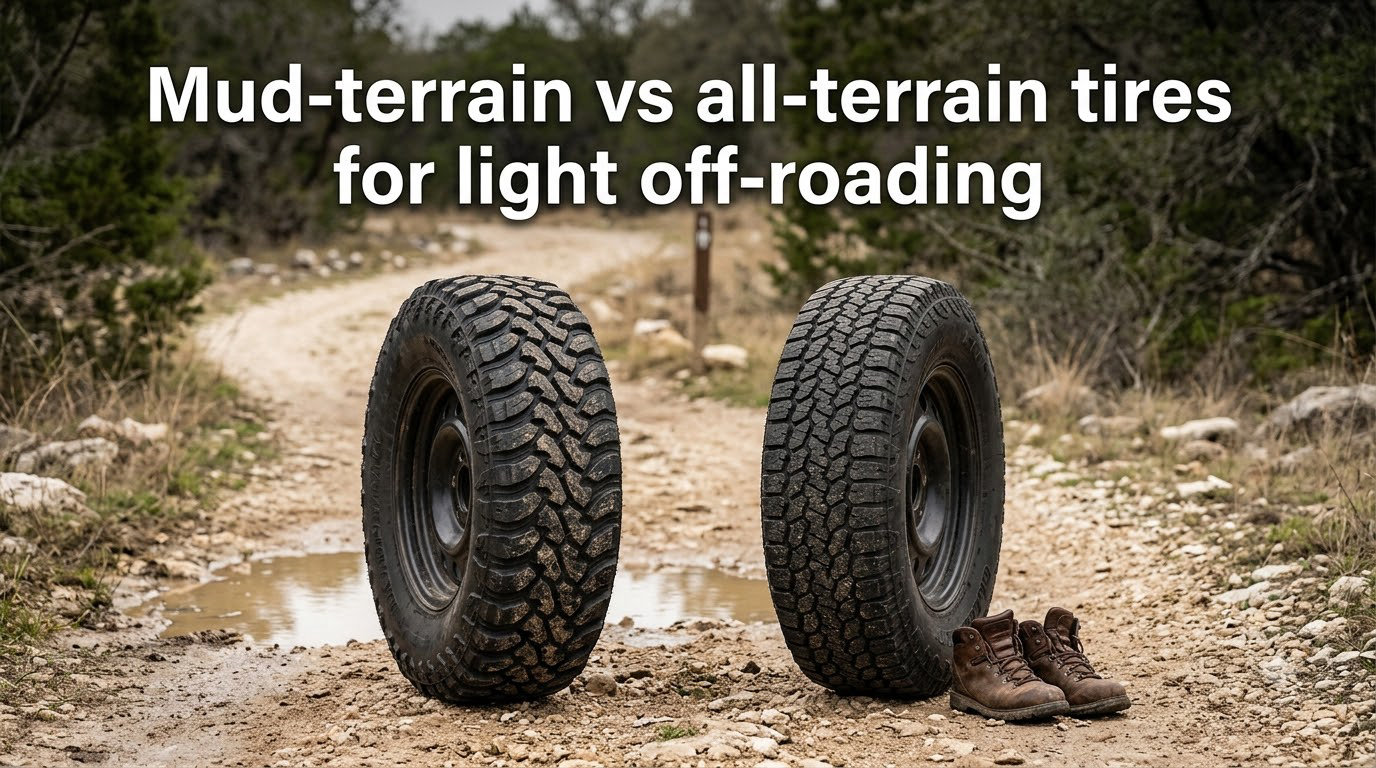
For most drivers, all-terrain tires are the smarter pick for light off-roading — they last longer, run quieter, sip less fuel, and still pull confidently through fire roads, gravel, and mild trails. Mud-terrain tires win only if you regularly drive through deep mud, soft sand, or technical rock obstacles. Our team compared the two categories across noise, MPG, tread life, wet grip, snow performance, and off-road capability to help you decide.
This guide focuses specifically on light off-roading — the use case most truck and SUV owners actually face on weekends. We will define what that means, then walk through the real trade-offs between M/T and A/T tires so you can pick with confidence.
Table of Contents
What Counts as Light Off-Roading?
Light off-roading means unpaved but well-maintained surfaces. It is the weekend territory that most daily-driven trucks and SUVs actually see — not the deep mud bogs or rock gardens reserved for built rigs.
Common examples of light off-roading include:
- Fire roads and forest service roads — graded dirt or gravel tracks maintained for access.
- Gravel and ranch roads — loose surfaces that get dusty in summer and muddy after rain.
- Campground and trailhead access — short unpaved spurs leading to recreation sites.
- Dry creek beds and desert washes — sandy or rocky paths that are dry most of the year.
- Mild two-track trails — dirt paths with minor ruts, roots, or rocks under 6 inches.
- Snow-covered paved roads in winter — a side case some light off-roaders face.
If your weekend driving stays within these conditions — and the rest of the week is highway and city miles — you fall into the light off-roading bucket. The wrong tire choice is more expensive here than people realize: M/T tires wear out fast on pavement, while A/T tires rarely leave you stranded in these conditions.
What Are All-Terrain (A/T) Tires?
All-terrain tires are the middle ground between a dedicated street tire and a mud-terrain tire. They are engineered to deliver acceptable grip on a wide range of surfaces without giving up too much on the road. That balance is why they are the default choice for most light trucks and SUVs.
Design and Construction
A/T tires use a tread pattern with smaller, tightly packed blocks compared to M/T tires. The blocks are connected by stabilizing ribs along the center, which keeps the tire quiet on pavement and helps it track straight at highway speed. Siping — tiny slits cut into the tread blocks — adds biting edges for wet and light snow traction.
Sidewalls are reinforced but not as thick as a true mud-terrain tire. Most A/T tires carry load ranges C, D, or E for light trucks and SUVs, with many featuring a Three-Peak Mountain Snowflake (3PMSF) rating for severe winter use.
Who All-Terrain Tires Are For
All-terrain tires are designed for the daily-driven truck or SUV that hits dirt on weekends. If your truck is also your commuter, grocery-getter, and road-trip vehicle, an A/T tire will make you happier the vast majority of the time. They are also a strong fit for overlanders, contractors, and rural drivers who see more gravel than asphalt.
Strengths of All-Terrain Tires
- Quieter on the highway — closer to a street tire than a mud-terrain.
- Better fuel economy — lower rolling resistance than M/T tires.
- Longer tread life — typically 50,000 to 65,000 miles.
- Better wet and snow traction — siping and 3PMSF ratings help.
- Smoother ride on pavement — less vibration and sharper cornering response.
Where All-Terrain Tires Fall Short
A/T tires do not self-clean as well as M/T tires. In deep, sticky mud or loose sand, the smaller voids can pack up and the tire loses bite. They also lack the puncture resistance of a thicker M/T sidewall on sharp desert brush or jagged rocks.
What Are Mud-Terrain (M/T) Tires?
Mud-terrain tires are purpose-built for the worst unpaved conditions — deep mud, soft sand, loose rock, and technical trails. They prioritize traction in loose terrain over almost everything else.
Design and Construction
M/T tires use large, widely spaced tread blocks. The voids between blocks are wide enough to scoop mud and eject rocks as the tire rotates — a feature called self-cleaning tread. Sidewalls are thicker and often feature extra reinforcement (sometimes called ply-on-ply or 3-ply sidewalls) to resist punctures from sharp rocks and desert brush.
The trade-off comes on pavement. Large voids make the tire noisy, and the softer, grippier compound that helps off-road usually wears faster on asphalt.
Who Mud-Terrain Tires Are For
M/T tires suit drivers who regularly tackle deep mud, sand dunes, rock crawling, or technical trails — and whose vehicle is set up specifically for that use. Many owners of dedicated trail rigs, rock buggies, and weekend-only off-roaders choose mud-terrains for the predictable bite they deliver in the gnarly stuff.
Strengths of Mud-Terrain Tires
- Best-in-class off-road grip in mud, sand, loose rock, and ruts.
- Self-cleaning tread sheds mud and debris instead of packing up.
- Thick, reinforced sidewalls resist punctures from rocks and brush.
- Aggressive look — a styling point for many truck owners.
The Downsides of Mud-Terrain Tires
For light off-roaders, the downsides usually outweigh the benefits:
- Road noise — a steady hum or growl that gets tiring on long highway drives. This is the most common complaint among owners.
- Shorter tread life — typically 20,000 to 40,000 miles on pavement, often less if you commute.
- Lower fuel economy — heavier construction and aggressive tread add rolling resistance, usually costing 1 to 2 MPG.
- Wet-pavement traction drops — large voids hydroplane more easily on standing water.
- Reduced cornering grip on pavement — softer compound flexes more in turns.
- Snow performance is mixed — without siping or a 3PMSF rating, many M/T tires perform worse in winter than a snow-rated A/T.
What About Rugged-Terrain (R/T) Hybrid Tires?
Rugged-terrain tires sit between A/T and M/T on the aggression scale. They borrow the look and sidewall toughness of a mud-terrain but use a tighter tread pattern that delivers quieter, longer-lasting on-road manners. R/T tires are a strong middle-ground choice if you want more off-road bite than an A/T without paying the full M/T price in noise and tread life.
Several related searches now surface R/T as a third option, and they are worth considering if your use case falls between light off-roading and more serious weekend work.
Mud-Terrain vs All-Terrain: Head-to-Head Comparison
Here is how the two categories stack up against each other on the metrics that matter most to daily-driven trucks and SUVs.
| Feature | All-Terrain (A/T) | Mud-Terrain (M/T) |
|---|---|---|
| Road noise | Low — close to a street tire | High — noticeable hum or growl |
| Fuel economy (MPG) | Baseline; minimal hit | 1 to 2 MPG loss typical |
| Tread life (miles) | 50,000 to 65,000 | 20,000 to 40,000 |
| Wet pavement traction | Strong — siping helps | Weaker — voids hydroplane |
| Snow performance | Strong (especially 3PMSF-rated) | Mixed — needs studs or chains for serious snow |
| Off-road grip (mud/sand) | Adequate for light off-roading | Best in class |
| Sidewall puncture resistance | Moderate | High — thicker, often 3-ply |
| Daily driving comfort | High | Lower — firm, noisy |
| Best for | Daily-driven trucks and SUVs | Dedicated off-road builds |
Noise and Comfort
All-terrain tires ride noticeably better than mud-terrains. The connected center ribs and smaller blocks reduce the hum that comes from large voids slapping the pavement. On a 200-mile highway drive, the difference is dramatic — A/T tires feel like a street tire, while M/T tires deliver a steady drone.
Fuel Economy
Switching from A/T to M/T typically costs 1 to 2 MPG. That may not sound like much, but over 15,000 annual miles it adds up at the pump. The heavier construction and aggressive tread both add rolling resistance.
Tread Life
Tread life is the biggest cost difference. A/T tires routinely reach 50,000 to 65,000 miles. M/T tires often wear out between 20,000 and 40,000 miles, especially on a daily-driven vehicle. Two sets of mud-terrains can outpace the total cost of one set of all-terrains over the same mileage.
Wet and Snow Performance
On wet pavement, mud-terrains are noticeably worse — large voids channel water less efficiently, and the soft compound can break traction earlier in a turn. In winter, a snow-rated A/T with the Three-Peak Mountain Snowflake symbol often outperforms a non-rated M/T tire.
Why Tire Pressure Matters More Than Tread Choice
Here is something most buyers overlook: airing down your tires off-road dramatically closes the traction gap between A/T and M/T. Lower pressure lets the tire flatten out, increasing the contact patch and letting the tread conform to rocks and roots.
How to Air Down Before a Trail
- Start with the manufacturer’s recommended cold pressure — usually 30 to 35 PSI for light trucks.
- Drop to 20 to 25 PSI for mild dirt and gravel runs.
- Drop to 15 to 18 PSI for technical trails with rocks or sand.
- Re-inflate to road pressure before driving back on the highway — low pressure at highway speed is dangerous.
Airing down works on any tire type, but it makes the biggest difference on A/T tires because their smaller tread blocks were already designed to flex. Run any tire below 12 PSI and you risk popping the bead off the wheel.
How to Decide in 60 Seconds
Use this framework to settle the mud-terrain vs all-terrain question for your situation:
- 80%+ paved miles and weekend fire roads? Pick an all-terrain. You will save fuel, last longer, and stay comfortable.
- 50/50 paved and off-road, including deep mud? A rugged-terrain (R/T) hybrid gives you the middle path without the full M/T compromise.
- Daily driver with rare light trails? Stay on a quality all-terrain or even a touring all-season — M/T will only frustrate you.
- Dedicated off-road build or weekend-only trail rig? Mud-terrain tires make sense. Pick a model with a 3PMSF rating if you also face snow.
- Snow-heavy climate? Choose a snow-rated A/T with the 3PMSF symbol. Mud-terrains are not snow tires.
For the vast majority of light off-roaders — daily-driven trucks and SUVs that see fire roads, gravel, camp access, and mild trails — all-terrain tires are the right call. Mud-terrains are reserved for drivers whose weekends regularly include deep mud or technical terrain.
Frequently Asked Questions
Should I get mud tires or all-terrain tires for light off-roading?
Pick all-terrain tires. For light off-roading — fire roads, gravel, mild trails, and camp access — A/T tires deliver the traction you need while keeping noise low, tread life long, and fuel economy close to a street tire. Save mud-terrains for drivers who regularly tackle deep mud, sand, or technical rock.
What counts as light off-roading?
Light off-roading means unpaved but well-maintained surfaces: fire roads, forest service roads, gravel tracks, dry creek beds, campground access roads, mild two-track trails, and short dirt spurs to trailheads. It does not include deep mud bogs, rock gardens, or technical obstacle work.
What are the downsides of using mud-terrain tires?
Mud-terrain tires are noisy on the highway, wear out faster on pavement (20,000 to 40,000 miles), reduce fuel economy by 1 to 2 MPG, lose wet-pavement traction more easily, and often perform worse in snow than a snow-rated A/T. The aggressive look attracts buyers, but the daily-driving trade-offs frustrate many of them.
Do all-terrain tires ride better than mud tires?
Yes. All-terrain tires use connected center ribs and smaller, tightly packed tread blocks that stay quiet and stable on pavement. Mud-terrains have large, widely spaced blocks that hum at highway speed and flex more in corners. The difference is noticeable on any drive longer than 30 minutes.
How much MPG do you lose with mud-terrain tires?
Most drivers lose 1 to 2 MPG when switching from all-terrain to mud-terrain tires. The exact hit depends on the specific tire, your vehicle, driving style, and how much of your drive is at highway speed. Over 15,000 annual miles, that gap adds up to meaningful fuel costs.
Can all-terrain tires be used in mud?
Yes, with limits. A quality all-terrain tire handles damp dirt, muddy ruts, and shallow puddles without trouble. In deep, sticky mud where mud-terrains shine, an A/T can pack up and lose bite. Airing down to 15 to 20 PSI helps any A/T perform better in marginal mud.
The Bottom Line
The mud-terrain vs all-terrain tires for light off-roading decision comes down to how much pavement you actually drive. If your truck or SUV is your daily driver and you hit fire roads, gravel, and mild trails on weekends, all-terrain tires give you the right balance of grip, comfort, tread life, and fuel economy. Mud-terrain tires earn their keep only when deep mud, soft sand, or technical rock is a regular part of your driving — not a once-a-year camping trip.
Pick the all-terrain, air down when you hit the trail, and save the mud-terrains for the dedicated off-road build.