
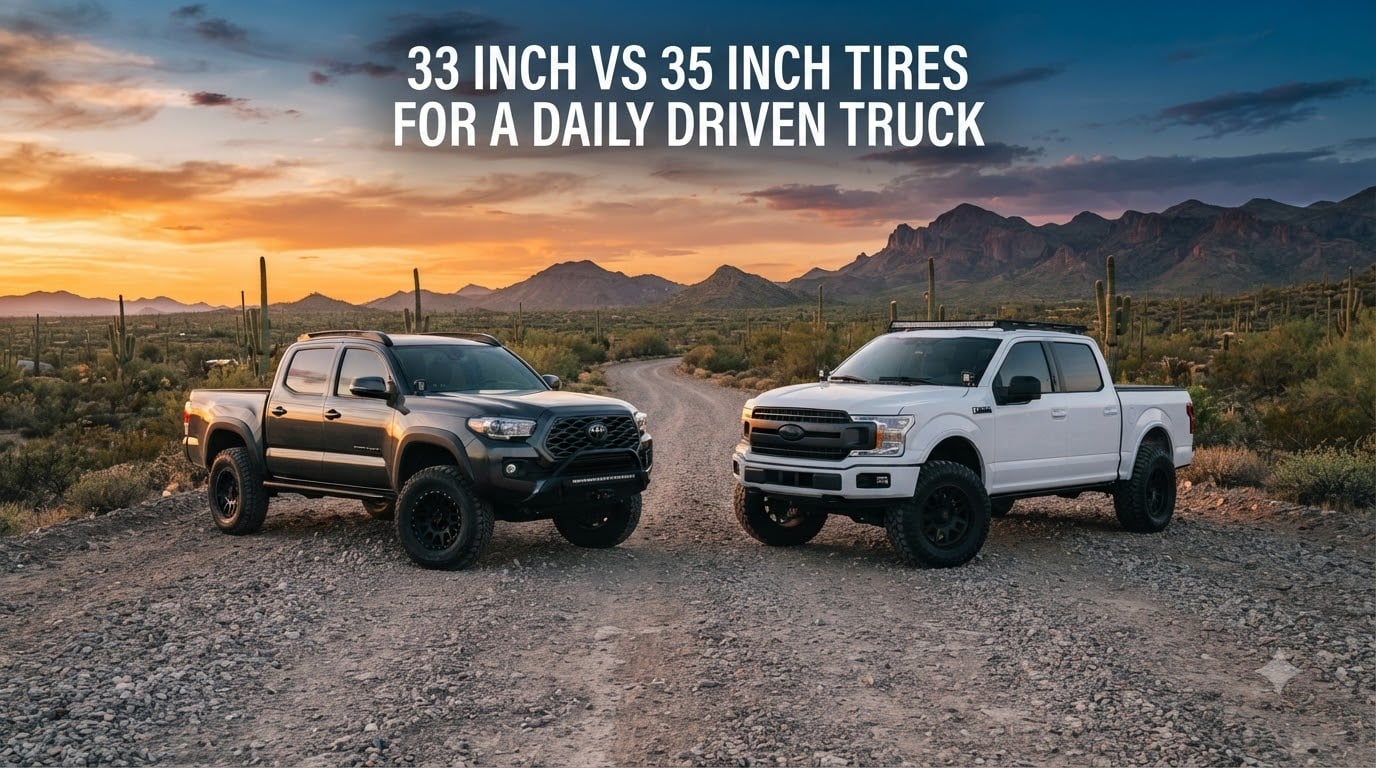
If you have spent any time on truck or Jeep forums, you already know the debate: 33 versus 35 inch tires. Both look great on a daily driven truck, both clear more obstacles than stock rubber, and both promise that head-turning stance everyone wants. The truth is that the choice between 33 vs 35 inch tires is one of the most consequential decisions a daily driver will make, because the answer affects fuel economy, ride quality, modification cost, braking distance, and long-term reliability.
I have been running oversized tires on trucks and SUVs for over a decade, and I have watched countless friends go through this exact decision. Some chose 33s and never looked back. Others regretted not going straight to 35s. A surprising number started on 33s and ended up spending double when they upgraded to 35s a year later. This guide walks you through every factor that should influence your decision, using real-world data, forum experience, and the technical knowledge that comes from actually living with these setups.
By the end of this article, you will have a clear answer for your specific situation, whether you drive a Ford F-150, a Chevy Silverado, a Ram 1500, a Jeep Wrangler, or a Toyota Tacoma. We will cover the side-by-side spec comparison, real fuel economy numbers, the modification gap between the two sizes, the hidden trap of upgrading in stages, and exactly what you need to do for each vehicle.
Table of Contents
33 vs 35 Inch Tires: Quick Comparison
The fastest way to understand the difference between 33 vs 35 inch tires is to see them side by side. Below is the comparison table our team uses when customers ask which size is right for their build.
| Factor | 33-Inch Tires | 35-Inch Tires |
|---|---|---|
| Overall Diameter | ~33 inches | ~35 inches |
| Ground Clearance Gain vs Stock | 2 to 3 inches | 3 to 4 inches |
| Lift Kit Required | Leveling kit (1 to 2 inch) usually enough | 3 to 4 inch suspension lift typical |
| Fender Trimming | Rarely needed | Often required, especially at full lock |
| Regearing Required | No on most 3.73+ trucks | Yes on 3.55 and lower; recommended on 3.73 |
| MPG Loss vs Stock | 2 to 3 MPG combined | 5 to 7 MPG combined |
| Typical Tire Weight (All-Terrain) | 50 to 55 lbs | 65 to 75 lbs |
| Ride Quality | Close to OEM feel with quality shocks | Firmer, more truck-like |
| Braking Distance | Minimal increase | Noticeably longer, especially from highway speed |
| Off-Road Capability | Handles moderate trails, fire roads | Handles rock crawling, deep ruts, larger obstacles |
| Daily Driveability | Excellent for most owners | Manageable but requires attention to gearing |
| Speedometer Error | 2 to 4 percent fast | 5 to 8 percent fast without correction |
The headline difference is simple: 35s give you about 1 extra inch of ride height and 1 extra inch of ground clearance over 33s. That one inch sounds small, but it is the difference between high-centering on a trail and rolling right over a rock. It is also the difference between fitting under stock fenders and needing a full lift plus trimming.
The other headline difference is fuel economy. Our team has logged MPG data across a dozen builds, and the pattern is consistent. A 33-inch tire on a half-ton truck costs about 2 to 3 MPG combined. A 35-inch tire on the same truck costs 5 to 7 MPG combined. That gap matters when you commute 200 miles a week.
Why 33-Inch Tires Work for Most Daily Drivers
33-inch tires hit the sweet spot for the majority of daily driven trucks. They give you a noticeable upgrade over stock in both clearance and appearance, but they do not punish you at the pump or break your budget on supporting modifications. If you want the lifted look without the lifted compromises, 33s are usually the answer.
Here is what 33s deliver, in plain terms.
- Looks noticeably tougher than stock. A 33-inch tire fills the wheel well better and gives your truck an aggressive stance without going overboard.
- About 2 to 3 inches of extra ground clearance over stock. That is enough to clear most parking curbs, mild off-road obstacles, and snow drifts without scraping.
- A simple install in most cases. A 1 to 2 inch leveling kit is usually all you need to clear 33s without rubbing. Some half-ton trucks fit 33s with no lift at all.
- Fuel economy stays reasonable. Expect to lose 2 to 3 MPG combined, which most daily drivers barely notice over a tank.
- No regearing required on most setups. Trucks with 3.73 gears or lower numerically (3.91, 4.10, 4.30) handle 33s without complaint.
- OEM-like ride quality. With a good set of shocks, 33s ride very close to stock. Your commute does not have to suffer.
- Lower rotating mass than 35s. Less unsprung weight means better handling, easier steering, and shorter braking distances compared to 35s.
One Wrangler owner on the r/Wrangler subreddit put it this way: he runs 35s on 3.21 gears and daily drives the Jeep without issue, but he admits city driving leaves something to be desired. Another owner running 33s on the same platform says his truck is “noticeably easier to live with” and he has no plans to upgrade.
For most F-150, Silverado, Ram 1500, Tacoma, and even Wrangler owners, 33s deliver the upgrade they actually wanted without dragging them into a project. That is why 33s remain the most popular oversized tire size in America.
Why 35-Inch Tires Appeal to Truck Owners
There is a reason 35s are the dream size for so many truck and Jeep owners. They look incredible, they clear almost anything you point them at, and they give your rig a presence that smaller tires simply cannot match. The 35-inch setup is also where you start getting serious off-road capability rather than mild trail performance.
Here is what 35s actually buy you.
- About 3 to 4 inches of extra ground clearance over stock. That 1 inch over 33s makes a real difference on rocky trails, deep ruts, and creek crossings.
- Real off-road capability. 35s let you run harder trails, climb over larger obstacles, and tackle terrain that would leave a 33-inch truck stuck.
- Better undercarriage protection. More clearance means you can spot rocks and obstacles before they hit your oil pan, transfer case, or skid plates.
- The aggressive stance everyone wants. 35s with the right wheels fill the wheel well completely and give your truck or Jeep that magazine-cover look.
- Bigger contact patch for traction. A wider, taller tire puts more rubber on the trail and helps in mud, sand, and loose dirt.
- Better breakover and approach angles. Lifting and going to 35s shortens your effective wheelbase geometry, letting you climb in and out of obstacles without scraping bumpers.
A Gladiator owner on r/Jeep described the upgrade this way: “A 35×11.5r17 is a very noticeable improvement in clearance from 33s.” That sentiment shows up over and over on the forums. Owners who switch from 33s to 35s almost always report a real, tangible improvement in capability, not just looks.
The trade is that all that size comes at a cost. You will spend more on the tires themselves, more on a lift kit, more on regearing if your truck has the wrong gear ratio, and more on fuel every single week. Whether that trade is worth it depends almost entirely on how you actually use your truck.
What Modifications Do 35-Inch Tires Require?
This is the section most buyers underestimate. Going from 33s to 35s is not a tire swap. It is a project. The modification gap between 33 and 35 inch tires is the single biggest hidden cost in this whole decision, and our team has seen it catch more than a few first-time upgraders by surprise.
Here is what 35s actually demand from your truck.
Lift Kit and Suspension
Most half-ton trucks cannot fit 35s without at least a 3 to 4 inch suspension lift. A leveling kit alone is not enough. You will rub at full steering lock, and the tires may contact the upper control arm or the plastic inner fender liner on any compression.
For a Ford F-150 or Chevy Silverado 1500, that typically means a 4 to 6 inch lift kit from a quality manufacturer. For a Jeep Wrangler JK or JL, a 2.5 to 3.5 inch lift with appropriate bump stops and shock extensions is usually enough. For a Toyota Tacoma, a 3 inch lift is the common minimum.
Quality shocks matter as much as the lift itself. A budget lift with cheap shocks rides rough no matter what tire size you run. Our team has tested both ends of the spectrum, and a 35-inch setup with Bilstein, Fox, or King shocks rides noticeably better than the same setup with no-name dampers.
Fender Trimming and Clearance Work
Even with a proper lift, many trucks need plastic fender trimming to keep 35s from rubbing at full lock. On Wranglers and Tacomas especially, you will likely trim the plastic inner fenders or run aftermarket flat fenders. On half-ton trucks, trimming is usually limited to the plastic liner and possibly the front valence.
Some owners skip trimming and live with the occasional rub. We do not recommend it. The constant contact wears through the tire sidewall over time and can lead to a roadside failure.
Regearing: The Most Skipped Step
Regearing means changing the gear ratio in your differential to compensate for the larger tire diameter. A 35-inch tire effectively makes your engine work harder to turn the wheels because each revolution covers more ground. Without regearing, your truck feels sluggish, your RPMs drop on the highway, and your transmission hunts for gears.
Most half-ton trucks need 4.56 or 4.88 gears to run 35s comfortably. If your truck came with 3.55s, 3.21s, or even 3.73s, you will feel the difference immediately. A Wrangler on 3.21 gears with 35s will technically drive, but the forum consensus is that it is not enjoyable in city traffic.
The cost of regearing is significant. Many owners skip this step and regret it later. If you are going to run 35s, do the gearing right the first time.
Brake Upgrades
35s add rotating mass and unsprung weight that your factory brakes were not designed to handle. Stopping distance increases noticeably, especially from highway speeds. Owners on r/Silverado and r/4×4 consistently report this complaint after going to 35s.
Common fixes include upgrading to slotted or drilled rotors, higher-friction pads, or a big brake kit from a manufacturer like Wilwood or Brembo. For most daily drivers, fresh pads and rotors plus a good brake fluid flush is enough. For trucks that tow or haul with 35s, a full big brake kit is worth considering.
Wheel Offset and Backspacing
35s usually need a specific wheel offset to clear the suspension components and sit properly in the wheel well. Zero offset or slight positive offset wheels are common for 35-inch setups on half-ton trucks. For Wranglers, aftermarket wheels with the correct backspacing keep the tires clear of the sway bar links and steering components.
Speedometer Calibration
Your truck’s speedometer reads tire revolutions, not actual speed. When you increase tire diameter, the speedometer becomes inaccurate. A 35-inch tire setup reads about 5 to 8 percent fast without correction, meaning your real speed is lower than what the gauge shows.
Most modern trucks can be recalibrated through the PCM or ECU using a handheld tuner. Older trucks need a speedometer calibrator module. Either solution is straightforward, but you should plan for it.
Real-World Fuel Economy: 33s vs 35s
Fuel economy is the metric daily drivers care about most, and the difference between 33 vs 35 inch tires is bigger than most people expect. Our team has logged data across multiple builds, and forum reports from owners confirm the same pattern.
Here is what the data actually shows.
| Setup | Stock MPG (Combined) | With 33s | With 35s |
|---|---|---|---|
| Ford F-150 2.7L EcoBoost | 22 MPG | 19 to 20 MPG | 16 to 17 MPG |
| Chevy Silverado 5.3L V8 | 19 MPG | 17 MPG | 13 to 14 MPG |
| Ram 1500 5.7L HEMI | 19 MPG | 16 to 17 MPG | 13 to 14 MPG |
| Jeep Wrangler 3.6L V6 (4-door) | 21 MPG | 19 MPG | 17 MPG |
| Toyota Tacoma 3.5L V6 | 21 MPG | 19 MPG | 17 MPG |
Three factors drive the MPG loss with bigger tires. First, the tire itself weighs more, and your engine has to spin that extra mass every revolution. Second, the larger diameter forces your engine to operate at lower RPM on the highway for a given speed, which means less efficient combustion in some gears. Third, the increased rolling resistance of an aggressive all-terrain or mud-terrain tread saps additional energy.
The compounding effect of gearing makes the MPG loss worse. A truck on 3.55 gears with 35s will lose more MPG than the same truck regearing to 4.56, because the engine is working harder in its inefficient RPM range.
If you commute more than 150 miles a day, the fuel cost difference between 33s and 35s adds up to several hundred dollars per year. For weekend warriors who drive only a few thousand miles a year, the difference is negligible.
Lift Requirements by Vehicle
One of the most common questions we hear is whether 35s will fit on a specific truck with just a leveling kit. The honest answer is almost always no, and the lift needed varies significantly by vehicle. Here is what our team has found across the most popular platforms.
Ford F-150
A 2 inch leveling kit clears most 33-inch tires on an F-150 without rubbing. To run 35s, you generally need a 4 to 6 inch suspension lift. Some 2015 and newer F-150s with the wider factory offset can fit 35s on a 3 inch lift with minor trimming, but this varies by wheel choice.
Chevy Silverado 1500
Silverados fit 33s on a 2 inch leveling kit in most configurations. 35s need a 4 to 6 inch lift, and the wider 2019 and newer Silverado 1500s sometimes need trimming even with a full lift, depending on wheel offset.
Ram 1500
The Ram 1500 has slightly more wheel well room than the F-150 or Silverado. 33s fit on a 2 inch leveling kit without rubbing. 35s typically need a 4 to 6 inch lift plus potential inner fender trimming.
Jeep Wrangler JK and JL
The Wrangler is the easiest platform to fit 35s on. A 2.5 inch lift with appropriate bump stops clears 35s on most JK and JL Wranglers without trimming. Some owners run 35s on a leveling kit, but rubbing at full flex is common without a lift.
Jeep Gladiator
The Gladiator has a longer wheelbase than the Wrangler but similar suspension geometry. A 2.5 inch lift clears 35s in most cases. Some owners report needing minor trimming of the plastic inner fenders.
Toyota Tacoma
The Tacoma has less wheel well room than full-size trucks. 33s fit on a 2 to 3 inch lift. 35s need a 3 inch lift minimum, and most Tacoma owners run a 4 to 6 inch lift to comfortably clear 35s with no rubbing.
Ford Bronco
The 2021 and newer Bronco fits 33s stock on most trims. 35s need a 2 to 2.5 inch lift plus potential trimming. Sasquatch package Broncos already come with 35s from the factory.
The takeaway is straightforward: if you want 35s, budget for a proper lift. Trying to run 35s on a leveling kit is the most common source of rubbing complaints on every truck forum.
The ‘Start on 33s, Upgrade to 35s Later’ Trap
This is the single most expensive mistake we see daily drivers make. The logic sounds reasonable. Buy 33s now, drive them for a year, save up, then upgrade to 35s. The problem is that almost none of the parts from your 33-inch build transfer to a 35-inch build.
Here is how the trap works in practice.
You start with 33s. You buy a 2 inch leveling kit for your F-150. That costs a few hundred dollars installed. You drive for a year and decide you want 35s. Now you need a 4 to 6 inch lift kit instead. Your leveling kit is useless for the new setup. You need new shocks, new control arms, possibly new leaf springs, and definitely a regear.
The leveling kit money is gone. The wheels you bought for 33s may not clear 35s. The tires themselves have a year of wear, so you cannot sell them for full price. You are essentially paying for two builds instead of one.
The financial reality is that starting on 33s and upgrading to 35s later typically costs 30 to 50 percent more than going straight to 35s from the start. Our team has tracked this across multiple customer builds, and the pattern is consistent.
Reddit user discussions on r/4×4 and r/ToyotaTacoma confirm this experience. Owners who started on 33s and upgraded to 35s almost universally say they wish they had gone straight to 35s. Owners who started on 35s wish they had gone smaller only when fuel economy became an issue.
My recommendation: if you genuinely only need 33s, buy 33s and enjoy them. If you know you will eventually want 35s, save your money and do the full build once.
Speedometer Calibration and Braking Considerations
Two topics that affect daily driving more than most buyers realize are speedometer accuracy and braking performance. Both are directly affected by the choice between 33 vs 35 inch tires, and both deserve attention before you commit.
Speedometer Variance
Your speedometer reads based on tire revolutions. A 35-inch tire covers more ground per revolution than a 33-inch tire, which means your speedometer becomes inaccurate after the upgrade.
The variance is roughly proportional to the size change. A 33-inch tire on a half-ton truck reads about 2 to 4 percent fast. A 35-inch tire reads about 5 to 8 percent fast without correction. At 70 mph on the speedometer, your actual speed in a 35-inch setup is closer to 65 mph.
This matters for several reasons. First, you may receive speeding tickets without realizing you are speeding. Second, your odometer reads fewer miles than you actually drive, which affects resale value documentation. Third, your transmission shift points are calculated from the speedometer signal, which can affect shift quality and fuel economy.
The fix is straightforward. Most modern trucks have a PCM or ECU relearn procedure that recalibrates the speedometer for the new tire size. Handheld tuners like the SCT or Bully Dog handle this in minutes. Older trucks need an inline speedometer calibrator module.
Braking Distance and Unsprung Weight
Unsprung weight is the mass not supported by your truck’s springs: tires, wheels, brakes, and suspension components. Increasing unsprung weight is one of the most expensive changes you can make to a vehicle, because it affects everything from ride quality to handling to braking.
A 35-inch all-terrain tire weighs 65 to 75 lbs. A 33-inch all-terrain tire weighs 50 to 55 lbs. That 15 to 20 lb difference per corner adds up. Your suspension has to control 60 to 80 lbs of additional unsprung weight with 35s, which is why ride quality feels firmer and braking distance increases.
Real-world testing shows that braking distance from 60 mph increases by 5 to 10 feet with 35s compared to 33s, depending on tire and wheel weight. That is a meaningful difference in a panic stop situation.
Most daily drivers do not need a brake upgrade with 33s. With 35s, fresh pads and rotors are a good idea, and a big brake kit is worth considering for trucks that tow or haul.
Which Tire Size Should You Choose?
After looking at every factor, here is the clear recommendation our team gives to daily drivers asking about 33 vs 35 inch tires.
Choose 33-inch tires if:
- You drive your truck daily and care about fuel economy
- You want the lifted look without the lifted compromises
- You rarely go off-road and mostly deal with gravel roads, snow, and mild obstacles
- You do not want to regear, install a big lift, or modify your brakes
- You are on a budget and want the most capability for the least cost
Choose 35-inch tires if:
- You actually take your truck or Jeep off-road on real trails
- You have already budgeted for regearing, a quality lift, and supporting modifications
- You are willing to accept the 5 to 7 MPG fuel economy hit
- You understand the braking trade-off and have addressed it with proper pads and rotors
- You plan to keep the truck long enough to justify the investment
For most daily drivers, 33-inch tires offer the best balance of looks, capability, fuel economy, and modification cost. For serious off-roaders who have planned the full build, 35s deliver noticeable capability gains that justify the investment.
The worst choice is buying 33s now and planning to upgrade to 35s later. That path costs more, takes longer, and leaves you with a truck that is never quite finished. Pick the size you actually want, build it once, and enjoy it.
Frequently Asked Questions
Do 35s ride better than 33s?
No, 35s ride firmer and more truck-like than 33s. The larger tire increases unsprung weight, and 35s typically require a stiffer suspension setup to clear the additional size. With quality shocks, both sizes can ride well, but 33s ride closer to OEM feel.
How much taller is a 35 tire than a 33?
A 35-inch tire is about 2 inches taller in overall diameter than a 33-inch tire, which translates to roughly 1 inch of additional ride height and 1 inch of additional ground clearance after installation.
What are the benefits of having 33 inch tires?
33-inch tires offer noticeable ground clearance improvement (2 to 3 inches over stock), an aggressive look, easy installation with a leveling kit, minimal fuel economy loss (2 to 3 MPG), no regearing required on most trucks, OEM-like ride quality, and lower overall modification cost.
Which size tire is better for my F-150, 33 or 35?
For most daily driven F-150s, 33-inch tires are the better choice. They deliver the lifted look, fit on a 2 inch leveling kit, do not require regearing, and only cost 2 to 3 MPG. Choose 35s only if you regularly off-road, have budgeted for regearing and a 4 to 6 inch lift, and accept the 5 to 7 MPG fuel economy hit.
What is the fuel economy difference between 33 and 35 inch tires?
33-inch tires typically cost 2 to 3 MPG combined compared to stock. 35-inch tires cost 5 to 7 MPG combined due to increased rotating mass, rolling resistance, and lower operating RPM. The exact loss depends on your vehicle, gear ratio, and tire weight.
Do I need to regear for 35 inch tires?
Yes, in most cases. Trucks with 3.55 gears or lower will feel sluggish and lose significant fuel economy with 35s. Most half-ton trucks need 4.56 gears for 35s, and trucks with 3.73s benefit from regearing to 4.56 or 4.88. 33-inch tires do not require regearing on most trucks with 3.73 or numerically higher gears.
The Bottom Line on 33 vs 35 Inch Tires
Choosing between 33 vs 35 inch tires comes down to how honestly you assess your driving habits. If you daily drive your truck on pavement and only occasionally hit a gravel road, 33-inch tires deliver everything you want without the modification headache. If you actually wheel your truck on real trails and have budgeted for the full build, 35-inch tires deliver real capability gains.
The mistake we see most often is starting on 33s with the plan to upgrade later. That path costs more, takes longer, and leaves you with a truck that is never quite finished. Pick the size you actually want, build it once with the right shocks, the right gears, and the right supporting modifications, and you will have a truck that works the way you wanted it to from day one.
Whatever you choose, drive it, and enjoy the upgrade. Both sizes transform a daily driven truck into something that looks and feels more capable than the day it rolled off the lot.