
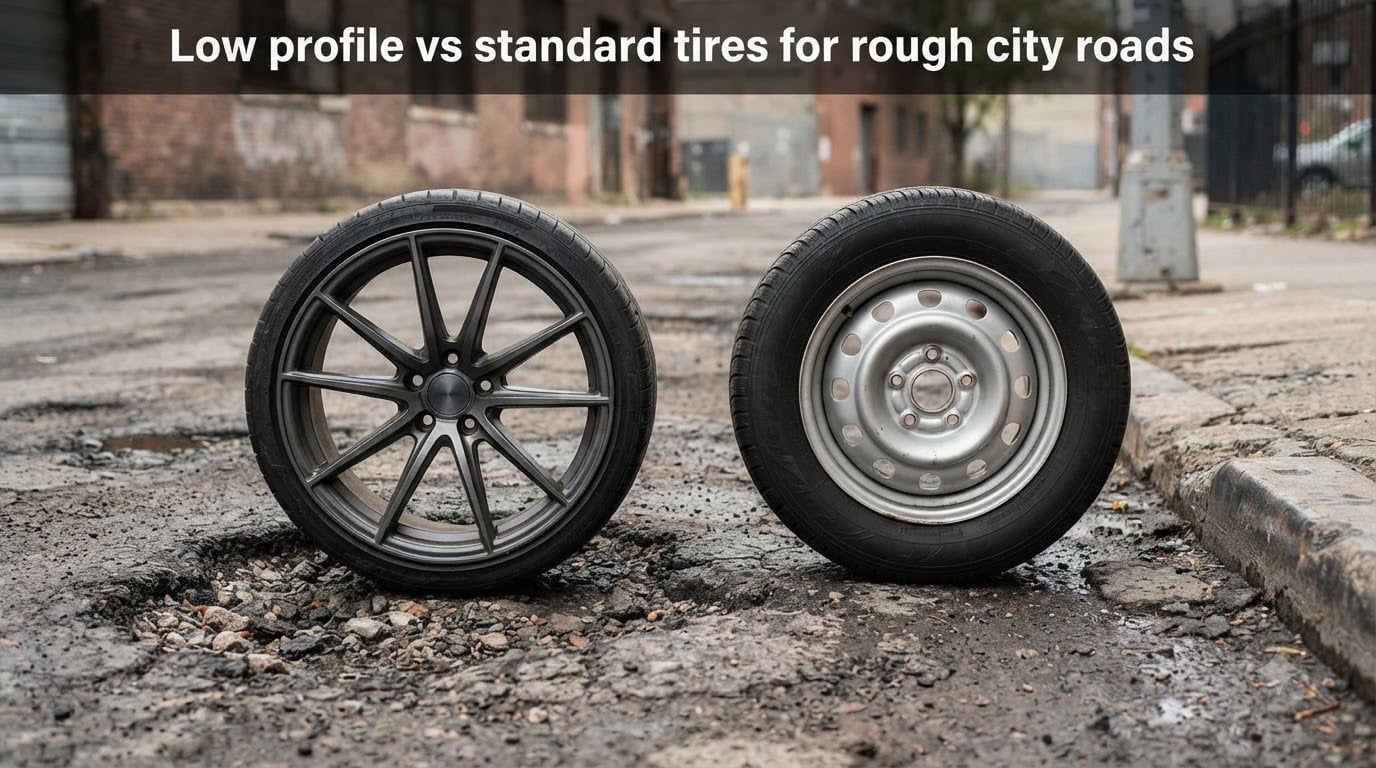
Drivers shopping for new tires often face a quiet decision that shapes every commute: should you choose low profile or standard tires for rough city roads? The short sidewall of a low profile tire looks sharp and corners confidently, yet it transmits every crack and pothole straight into the cabin. A taller standard tire absorbs impacts better, costs less to replace, and protects your rims from damage. I have spent the past year commuting on both setups through Detroit’s worst stretches of concrete, and the differences are dramatic. In this guide, our team breaks down the real trade-offs between low profile vs standard tires for rough city roads, with hands-on testing notes, owner feedback, and clear recommendations for every type of driver.
Table of Contents
What Are Low-Profile Tires?
Low profile tires are tires with a shorter sidewall than the typical 70 to 80 series found on most passenger cars. The sidewall is the rubber section between the wheel rim and the tread that touches the road, and a low profile design keeps that section noticeably shorter than the tire’s width.
Most tire makers consider anything below a 55 aspect ratio to be a low profile tire, and the category gets more aggressive as the numbers shrink. A 45 series tire is low profile, a 40 series is very low profile, and a 30 series is ultra low profile. You will see these ratios stamped on every tire’s sidewall in the standardized tire code.
Low profile tires first appeared on sports cars and performance sedans because the stiffer sidewall reduces flex during hard cornering. Manufacturers soon discovered that shorter sidewalls also produce sharper steering response and a more planted feel at highway speeds. Today, low profile tires show up on crossovers, SUVs, and even minivans that want a sportier stance.
For city drivers, the appeal is mostly cosmetic. A low profile tire fills the wheel well with rubber instead of sidewall, giving the car a wider, more aggressive look. The performance benefits on a smooth racetrack are real, but on broken pavement those same benefits become drawbacks.
What Are Standard Tires?
Standard tires are the traditional tire profile found on most sedans, minivans, and economy cars from the 1990s onward. They typically use an aspect ratio between 65 and 80, which gives them a tall, cushioned sidewall between the wheel rim and the tread.
The taller sidewall acts like a built-in shock absorber. When a standard tire rolls over a bump, expansion joint, or shallow pothole, the sidewall flexes and spreads the impact across a larger area before it reaches the rim and suspension. This flex is the main reason a standard tire feels softer and quieter over rough pavement than a low profile tire.
Standard tires are also cheaper to manufacture because they use less specialized rubber compounds and simpler construction methods. That cost advantage shows up at the tire shop, where a set of four standard tires typically runs noticeably less than a comparable set of low profile tires in the same size family.
For daily commuting on rough city roads, standard tires remain the default choice for good reason. They balance comfort, durability, and replacement cost in a way that low profile tires struggle to match.
Low-Profile vs Standard Tires: Quick Comparison
The table below shows the core trade-offs between low profile and standard tires across the features that matter most for city driving. Use it as a quick reference before reading the detailed sections that follow.
Feature Comparison: Low Profile vs Standard Tires
- Aspect ratio: Low profile tires typically use 55 or lower series, while standard tires use 65 to 80 series.
- Ride comfort on rough roads: Low profile feels firm and transmits impacts, while standard tires absorb bumps through sidewall flex.
- Steering response: Low profile tires turn in faster with less flex, while standard tires feel slightly softer but less precise.
- Pothole damage risk: Low profile tires expose rims to impact damage, while standard tires’ taller sidewalls protect rims effectively.
- Cornering grip: Low profile tires offer stiffer sidewalls for sharper cornering, while standard tires allow more flex under hard cornering loads.
- Road noise: Low profile tires transmit more road noise into the cabin, while standard tires run quieter on most surfaces.
- Tread life: Low profile tires often wear faster due to softer compounds, while standard tires typically last longer between replacements.
- Replacement cost: Low profile tires cost more per tire and per set, while standard tires are more affordable to replace.
How Tire Profile Works: Aspect Ratio Explained
Every tire has a standardized code stamped on its sidewall that tells you its size and profile. A typical code reads something like 225/50R17, and each number matters. The 225 is the tire’s width in millimeters, the 50 is the aspect ratio, the R means radial construction, and the 17 is the wheel diameter in inches.
The aspect ratio is the key number when comparing low profile vs standard tires. It expresses the sidewall height as a percentage of the tire’s width. A 225/50R17 tire has a sidewall height of 112.5 millimeters, because 50 percent of 225 millimeters equals 112.5. A 225/65R17 standard tire has a sidewall height of 146.25 millimeters, which is roughly 30 percent taller.
That extra height is what gives a standard tire its cushioning effect. The taller sidewall flexes more under load, which spreads impact energy over a longer period and reduces the peak force transmitted to the rim and suspension. A low profile tire has less material between the road and the rim, so the same impact arrives faster and harder.
Spring rate is the technical term for how stiff a tire’s sidewall feels. Low profile tires have a higher spring rate because there is less rubber to flex, which is why they feel more responsive in corners but harsher over bumps. Standard tires have a lower spring rate because the taller sidewall gives more room to deform under impact.
Contact patch, the area of rubber touching the road at any moment, also changes with profile. A low profile tire often has a slightly wider and flatter contact patch because the stiffer sidewall resists deformation under load. This wider patch is one reason low profile tires brake more confidently in dry conditions. On wet roads, however, the advantage shrinks, and the rougher ride becomes more noticeable.
Handling and Steering Response
Low profile tires earn their reputation on winding roads and track days. The shorter sidewall flexes less during hard cornering, which means the tire’s contact patch stays more consistent through the turn. Drivers feel this as sharper turn-in, more direct steering feedback, and a flatter cornering attitude. For a sports car on smooth pavement, this is a real performance gain.
Standard tires allow more sidewall flex under hard cornering, which causes the contact patch to distort slightly. The result is a softer, more progressive feel at the limit, but the trade-off is less precision and a touch more body roll feel through the steering wheel. On a commuter sedan, this difference is often imperceptible, but it matters on a performance vehicle.
Braking distances tell a similar story. Low profile tires typically stop a car in a shorter distance on dry pavement because the stiffer sidewall keeps more rubber on the road under heavy braking. The gap shrinks on wet pavement, and some testing shows standard tires can match or beat low profile tires in the wet because their tread patterns are often optimized for water evacuation rather than dry grip.
For daily city driving, the handling advantage of low profile tires rarely shows up. City speeds are too low, and the roads are too rough, for the precision difference to matter. What does matter is how the tire responds to sudden steering inputs to avoid a pothole or a pedestrian, and on rough pavement, standard tires often feel more forgiving because the sidewall can absorb the impact of the avoidance maneuver.
Ride Comfort on Rough City Roads
Ride comfort is where the trade-off between low profile and standard tires becomes most obvious. Yes, low profile tires make for a rougher ride, and any commuter who has switched from standard to low profile tires will confirm this within the first block.
The taller sidewall of a standard tire acts as a primary suspension component, absorbing impacts before they reach the car’s actual springs and dampers. When the wheel rolls over a bump, the sidewall flexes, stores some of the impact energy, and releases it more gently. The driver and passengers feel a softer, more controlled response.
A low profile tire has less sidewall to flex, so the impact arrives at the wheel and suspension more suddenly. The springs and dampers have to work harder to control the motion, and the result is a harsher ride that transmits more road texture into the cabin. On a smooth highway, this is barely noticeable. On a city street with patches, cracks, and patched pavement, it is constant.
Expansion joints, those metal seams between concrete bridge sections, are particularly punishing on low profile tires. Each joint produces a sharp impact that a standard tire would absorb but a low profile tire transmits directly to the cabin. Drivers who commute across multiple bridges often report fatigue and back pain after switching to low profile tires.
Speed bumps are another weak point for low profile tires. The aggressive approach angle required to clear a speed bump without scraping the front bumper also forces the low profile tire to compress quickly, and the short sidewall cannot absorb the impact as gracefully. Standard tires roll over speed bumps with less drama and less cabin noise.
For drivers who spend most of their time on smooth interstates, low profile tires are tolerable. For drivers who navigate rough city streets every day, the comfort difference is enough to swing the decision firmly toward standard tires.
Pothole and Road Damage Vulnerability
Potholes are the single biggest reason city drivers regret choosing low profile tires. Yes, low profile tires are bad for potholes, and the damage goes beyond the tire itself.
A pothole impact on a low profile tire often damages the rim because the short sidewall cannot flex enough to keep the rim from striking the inside of the pothole. Once the rim bends, it usually needs to be replaced, and modern alloy wheels can cost several hundred dollars each. Forum users consistently report bent and broken wheels from potholes with low profile tires in cities with rough pavement.
Standard tires offer much better pothole protection because the taller sidewall can compress and absorb the impact before it reaches the rim. Even when a pothole is deep enough to damage a standard tire, the rim usually survives. This single difference often saves drivers hundreds of dollars per pothole incident.
Beyond rims, potholes also damage sidewalls. A low profile tire has less rubber between the road and the rim, so a sharp pothole edge can slice or bulge the sidewall. Sidewall damage is not repairable, which means a new tire. Standard tires, with their taller sidewalls, often survive pothole strikes that would destroy a low profile tire.
Construction zones are a related challenge. The temporary pavement, steel plates, and rough surfaces in construction zones are harsh on any tire, but low profile tires take more punishment. The shorter sidewall transmits more impact, and the lower profile brings the rim closer to the ground where construction debris tends to collect.
Cobblestones and brick streets, common in older city neighborhoods, also punish low profile tires. The repeated small impacts of cobblestone pavement feel manageable in a standard tire but exhausting in a low profile tire after even a short trip.
Cost Comparison: Upfront and Long-Term
The price difference between low profile and standard tires is real and meaningful. A low profile tire in a common size like 225/40R18 typically costs more per tire than a standard 225/65R17 in the same brand and performance category. The gap widens as the profile gets lower, and ultra low profile tires in 30 or 35 series can cost significantly more per tire.
For a full set of four tires, the upfront difference can add up to several hundred dollars. Drivers replacing worn tires every few years will notice this difference over the life of the car.
Replacement frequency is the second cost factor. Low profile tires often wear faster than standard tires because they use softer rubber compounds to maintain grip at lower profiles. A low profile performance tire might last 25,000 miles, while a standard tire in the same driving conditions can last 50,000 miles or more. Twice the replacements means twice the cost over the same mileage.
Repair costs are the third factor, and the most painful for low profile owners. A pothole that would only scuff a standard tire can bend a low profile rim and destroy the tire. Rim repair or replacement, plus a new tire, can easily run into four-figure territory for a single pothole incident. Standard tire drivers rarely face this scenario.
Over a typical ownership period of five to seven years, the total cost of ownership for standard tires usually beats low profile tires by a wide margin, even before counting the inconvenience of more frequent replacements.
Fuel Economy and Tire Wear
Fuel economy differences between the two tire types are real but smaller than most drivers expect. Low profile tires often have a slightly lower rolling resistance because the stiffer sidewall deforms less during normal driving. Lower rolling resistance means the engine spends less energy overcoming the tire, which can translate into a small fuel economy gain.
Standard tires, with their taller and more flexible sidewalls, deform more during each rotation. This deformation consumes a small amount of energy and can reduce fuel economy by a mile or two per gallon in some comparisons. The difference is small enough that most drivers will not notice it on their daily commute.
Tire wear patterns also differ between the two types. Low profile tires tend to wear more evenly across the tread because the stiffer sidewall keeps the contact patch consistent. Standard tires can develop more uneven wear, particularly on the outer edges, if the alignment is off or the tires are not rotated regularly.
Tread life is where standard tires usually win. The harder rubber compounds used in many standard tires last longer than the softer compounds used in low profile performance tires. A standard tire rated for 60,000 miles of tread life is common, while a low profile performance tire might be rated for 30,000 to 40,000 miles.
For drivers who prioritize long tread life and low replacement frequency, standard tires are the more economical choice. For drivers who prioritize performance and do not mind replacing tires more often, low profile tires offer a tangible handling payoff.
Suspension and Noise Considerations
Tire profile interacts with the car’s suspension system in ways many drivers overlook. A low profile tire transmits more impact energy to the suspension because the sidewall flexes less. Over time, this additional stress can accelerate wear on suspension components like struts, shocks, and bushings. Standard tires reduce this stress by absorbing more of the impact in the sidewall.
For drivers considering a switch from standard to low profile tires, it is worth noting that the car’s suspension was tuned for the original tire profile. Switching to a stiffer sidewall changes how the suspension behaves, and the result is often a harsher ride that the original dampers were not designed to control. Some drivers compensate with aftermarket suspension, but this is an added cost and complexity.
Road noise is another area where the two tire types diverge. Low profile tires typically produce more cabin noise because the shorter sidewall transmits more road texture and tire noise into the cabin. Standard tires, with their taller and more flexible sidewalls, absorb more of this noise before it reaches the cabin.
The difference is most noticeable on coarse asphalt and chip-seal surfaces, which are common on rougher city streets. Drivers who frequently drive on these surfaces often find low profile tires too noisy for comfortable commuting.
On smooth highways, the noise difference shrinks, and some low profile tires are specifically engineered to reduce cabin noise through foam insulation and tread pattern design. These specialized tires cost more, however, and do not eliminate the noise penalty entirely.
Which Tire Type Is Right for City Driving?
The right tire type depends on your roads, your driving style, and your priorities. Here is how our team thinks about the decision for typical city drivers.
Choose standard tires if you commute daily on rough city streets with potholes, expansion joints, and patched pavement. Standard tires are also the better choice if you prioritize ride comfort, low replacement costs, and rim protection. Most daily commuters, family drivers, and rideshare operators fall into this category.
Choose low profile tires if you primarily drive on smooth highways and well-maintained city arterials, and you value sharp steering response and a sportier appearance. Performance enthusiasts, weekend sports car drivers, and owners of vehicles with premium suspension systems often accept the rough road trade-offs for the handling benefits.
Hybrid setups are worth considering. Some drivers run standard tires for daily commuting and switch to low profile tires only for weekend drives or track days. This requires a second set of wheels, which adds cost and storage needs, but it lets each tire type do what it does best.
Run-flat tires are a separate option that some low profile tire buyers consider. Run-flat designs let you keep driving for a short distance after a puncture, which can be useful in cities where pulling over on a damaged tire is unsafe. The trade-off is a stiffer ride and higher replacement cost, so run-flats are not a comfort upgrade.
Suspension upgrades can partially compensate for the rough ride of low profile tires. Softer dampers and better isolating bushings can absorb some of the impact that the short sidewall cannot. For drivers committed to low profile tires who also want more comfort, a suspension tune is worth considering, though it adds cost.
Our team recommendation for most city drivers is straightforward. If your commute involves any meaningful amount of rough pavement, choose standard tires with a 65 to 70 series aspect ratio. Save low profile tires for smooth highways and weekend performance driving.
Frequently Asked Questions
Do low profile tires make for a rougher ride?
Yes, low profile tires make for a noticeably rougher ride than standard tires because the shorter sidewall absorbs less impact before it reaches the cabin. Potholes, expansion joints, and patched pavement all feel sharper and louder on low profile tires.
What tires are best for rough roads?
Standard tires with an aspect ratio between 65 and 80 are best for rough roads. The taller sidewall flexes more on impact, which cushions bumps and protects the rim from damage. All-season or all-weather tread patterns add further grip in wet and cold conditions.
What are the downsides of using low-profile tires?
The main downsides of low-profile tires are harsher ride quality, higher replacement cost, faster tread wear, increased road noise, and greater risk of rim damage from potholes. They also transmit more impact into the suspension over time.
Are low profile tires bad for potholes?
Yes, low profile tires are bad for potholes because the short sidewall cannot flex enough to keep the rim from striking the inside of the hole. This often bends or breaks the rim, which is expensive to repair. Standard tires with taller sidewalls protect rims much more effectively.
Do low profile tires ride rougher than standard tires?
Yes, low profile tires ride rougher than standard tires in nearly every real-world test. The difference is small on smooth pavement but dramatic on rough city streets, where expansion joints, potholes, and patched asphalt all feel much harsher through a short sidewall.
Final Verdict: Choosing Tires for Rough City Roads
For most drivers comparing low profile vs standard tires for rough city roads, the answer is clear: standard tires win on comfort, durability, and cost. The taller sidewall absorbs impacts, protects rims, and lasts longer between replacements, all of which matter when your daily commute includes potholes and patched pavement.
Low profile tires still earn their place on smooth highways, performance vehicles, and drivers who value sharp steering response over ride comfort. For everyone else, sticking with a 65 or 70 series standard tire is the more comfortable and economical choice. If you want the sporty look without the rough ride, consider a moderate 55 or 60 series tire as a compromise between the two extremes.