
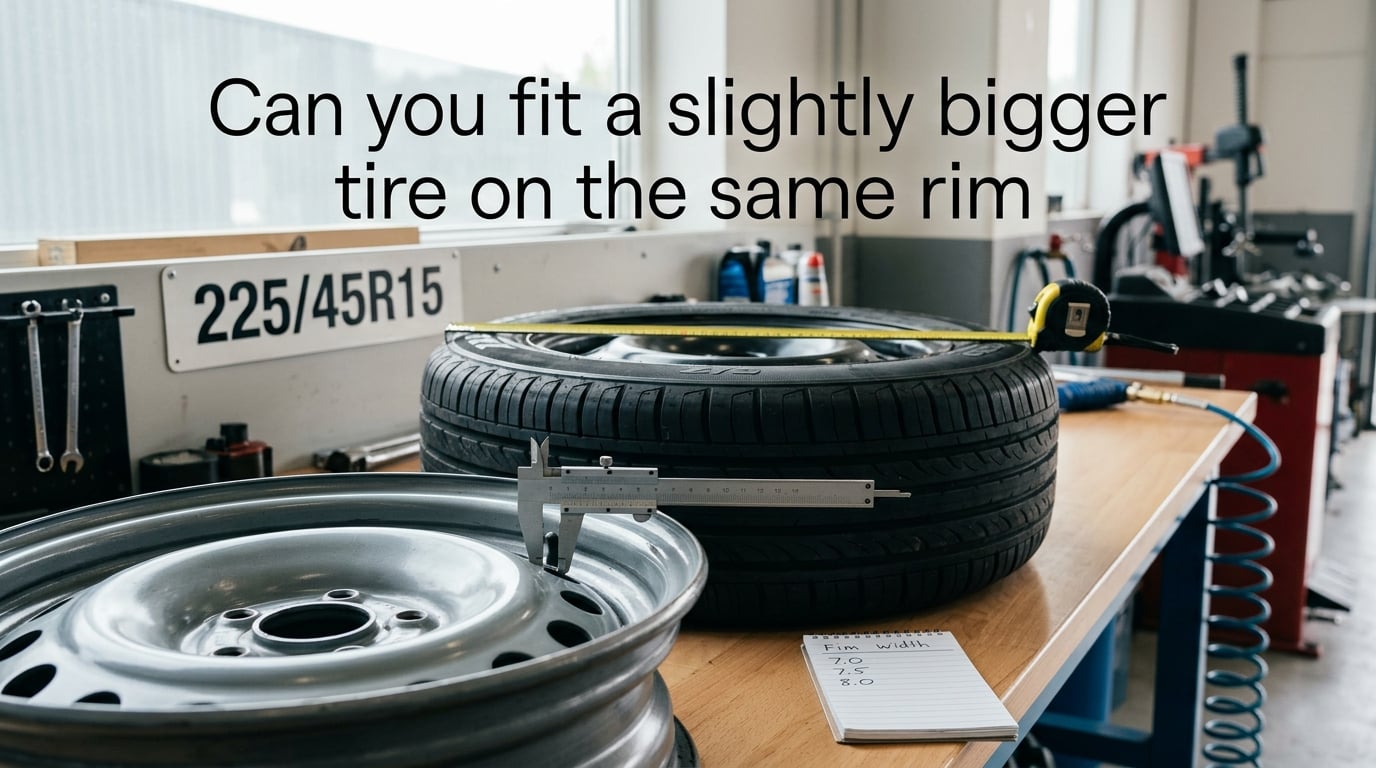
Can you fit a slightly bigger tire on the same rim? Yes, you can fit a slightly bigger tire on the same rim, within two clear limits: stay up to about 20mm wider than your stock tire, and keep the new tire’s overall diameter within roughly 3 percent of the original. Go past those limits and the tire can rub the fender, round its tread, throw off the speedometer, and trigger ABS or traction-control warnings. The rest of this guide shows you exactly how to read your current tire, measure a safe upsize, and avoid the common pitfalls our team has seen in the shop.
Table of Contents
Can You Fit a Slightly Bigger Tire on the Same Rim?
Short answer: yes, slightly. Your rim’s diameter is fixed, so a tire must match that diameter exactly, but the tire’s width and sidewall height can flex within a safe band. The Tire and Rim Association publishes the official industry tolerances, and the practical rule used by most shops is the 20mm wider / 3 percent overall-diameter rule. Stay inside that band and you keep clearance, ride quality, and electronics happy.
Use this four-condition checklist before you buy:
- The new tire’s section width is no more than 20mm wider than stock.
- The new tire fits inside the rim’s approved width range (see chart below).
- Overall diameter (sidewall + rim) stays within 3 percent of the original.
- Load index and speed rating meet or exceed what your door-sticker calls for.
How to Read Your Tire Size (e.g., 225/45R15)
Every tire has a code stamped on the sidewall that tells you its three core dimensions plus construction type. Take 225/45R15 as the example our team uses most often:
- 225 is the section width in millimeters, measured from sidewall to sidewall when mounted and inflated.
- 45 is the aspect ratio: the sidewall height is 45 percent of the section width.
- R means radial construction (the standard for modern passenger tires).
- 15 is the wheel diameter in inches that the tire is designed to seat onto.
You will also see two more numbers after the size, like 91H. The 91 is the load index (a code that maps to a maximum weight the tire can carry), and the H is the speed rating (a letter that maps to a maximum sustained speed). Both must meet or exceed the values on your driver’s door jamb sticker. Owners on r/Cartalk frequently discover their spare or replacement tire drops a speed rating without realizing it, so check this before mounting.
Rim Width vs Tire Width: What Actually Limits the Fit
Here’s the detail most drivers miss: the binding constraint on a same-rim upsize is rim width, not rim diameter. A member of the Bronco6G forum put it cleanly: “The tire you can use is dependent on wheel width, not height of the tire. If a wheel is 7.5 inches wide, then you can use any tire that works.” That matches what Tire and Rim Association yearbooks have published for decades.
Every tire has a minimum, recommended, and maximum rim width stamped into its spec sheet. Mount a tire too narrow on a wide rim and it stretches into a banana shape, rounding the contact patch and wearing the center tread fast. Mount it too wide on a narrow rim and the sidewalls pinch inward, wearing both shoulders and risking a bead unseat under hard cornering. As a working rule of thumb, every half inch (12.5mm) of rim width change moves the mounted tire’s section width by roughly 5mm, or about one fifth of an inch.
So when our team gets asked “can I go from a 225 to a 245 on the same 7-inch rim,” the answer depends on whether 245 falls inside the tire maker’s approved range for that rim. Many 245 tires are approved for 7- to 8.5-inch rims, which means yes on a 7-inch rim. A 265 typically wants 7.5 to 9.5 inches, which means no on a stock 7-inch rim without going wider.
The 3% Rule: How Big Can You Safely Go on the Same Rim?
The 3 percent rule is the industry’s safety margin for keeping tire diameter close enough to original that the speedometer, odometer, ABS, and traction control still read correctly. If the new tire’s overall diameter is within plus or minus 3 percent of the stock tire’s diameter, your vehicle’s electronics stay within their calibration tolerance.
The companion rule, used by shops and confirmed by community members on goldeagle comments, is the 20mm wider rule. You can usually go up to 20mm wider than stock on the same rim width without clearance or handling problems. One commenter on that thread reported a clean swap from 185/65R14 to 195/65R14 with no rubbing, no speedometer drift, and no handling complaints.
Combine the two and you get the practical safe-upsize envelope: 20mm wider and within 3 percent of the original overall diameter. That envelope is wide enough to cover most enthusiast and winter-tire swaps, and narrow enough to avoid the failure modes below.
How to Calculate Your Safe Upsize Step-by-Step
Here is the calculation our team runs through with any customer who wants a same-rim upsize. The example uses a stock 225/45R15 on a 7-inch rim.
- Find sidewall height in mm. Section width times aspect ratio: 225 x 0.45 = 101.25mm.
- Convert rim diameter to mm. 15 inches x 25.4 = 381mm.
- Calculate overall diameter. Two sidewalls plus the rim: (101.25 x 2) + 381 = 583.5mm.
- Find the 3 percent band. 583.5 x 0.03 = about 17.5mm of total diameter wiggle room, so 566 to 601mm is safe.
- Check width against rim range. Confirm your proposed tire’s spec sheet lists your 7-inch rim as approved.
- Confirm load and speed ratings. Both must meet or beat the door-sticker values.
A common safe upsize from 225/45R15 would be a 235/45R15: 10mm wider (well under the 20mm rule) and within 3 percent of overall diameter. A more aggressive jump to 245/40R15 narrows the sidewall and keeps diameter close, which our team usually recommends only if the driver wants a lower-profile look and has confirmed fender clearance.
How Tire Size Affects Your Speedometer, Odometer, and ABS
Your speedometer reads vehicle speed by counting how fast the wheels turn. It assumes a specific tire circumference; change the circumference and the math is off. A taller tire rolls farther per revolution, so the speedometer under-reads your actual speed. A shorter tire over-reads it. Owners on multiple forums, including r/tires and r/Mustang, have reported speedometer errors of 2 to 5 mph after an upsize that pushed outside the 3 percent band.
The same circumference assumption drives your odometer, which means your recorded mileage will also drift by the same percentage. Modern ABS and electronic stability control modules also use wheel-speed sensors to compare left and right wheel speeds. A bigger tire on one axle than the other can make the system think a wheel is slipping when it is not, triggering a traction-control or ABS warning light. This is why Car From Japan’s guide specifically calls out anti-lock brake and torque-sensor errors as a risk of mismatched or oversized tires.
How to Recalibrate Your Speedometer After a Tire Size Change
If your upsize pushes you slightly outside the 3 percent band, or if you simply want peace of mind, recalibrate the speedometer. Most vehicles 2010 and newer support this through a dealer scan tool or a quality OBD-II programmer.
- Measure your actual tire’s overall diameter in mm, or look it up in the maker’s spec sheet.
- Find your stock tire’s overall diameter the same way.
- Compute the ratio: new diameter divided by old diameter. A 1.02 ratio means your new tire is 2 percent taller.
- Connect the scan tool or OBD-II programmer and enter the new tire size in the vehicle setup menu. Some brands hide this under “Tire Pressure Monitor” or “Vehicle Configuration.”
- Test against a GPS speed readout on a highway. Your speedometer should now match within 1 mph.
If your car is older and does not support electronic recalibration, a mechanical programmer can be installed in line with the speedometer cable. Most drivers skip this step for changes under 3 percent, since the error is small enough to ignore.
Avoiding Rubbing: Clearance and Fender-Well Tips
Rubbing is the most common same-rim upsize complaint we hear, and it is almost always preventable. Before you commit to a wider or taller tire, run through this list:
- Turn the steering wheel full lock both ways and check the front fender well at full lock.
- Load the trunk or bed with the weight you normally carry and re-check clearance.
- Drive over speed bumps at normal speed and listen for any contact.
- Reverse into a curb at a shallow angle and check the rear fender flare.
- If you have a winter-tire plan, test with the cold tire pressure you actually run in winter.
If you catch any rubbing, the fix is usually a smaller aspect ratio (shorter sidewall) rather than a smaller width. Going from 225/45R15 to 225/40R15 keeps the same width but trims overall diameter and clears the fender. Drivers on r/genesiscoupe have used this exact trick to fit a slightly wider tire without any rubbing issues.
When You Should Change the Rim Instead of the Tire
Sometimes the right answer is a new rim, not a bigger tire. You need a new rim when the tire size you want falls outside your current rim’s approved width range, when the upsize needed for your goal (load rating, EV range, off-road clearance) exceeds the 20mm / 3 percent band, or when your vehicle requires a different bead-seat profile for safety systems like run-flat or low-profile performance tires.
You should also consider a rim change if your existing rims are damaged, corroded, or older than the tire’s planned service life. A worn rim will not seat a new tire safely, no matter how careful the size math is. Owners on bobistheoilguy have repeatedly warned against mounting new tires on questionable wheels because the bead seal is what keeps the tire on the car at highway speed.
Quick Reference: Rim Width to Tire Width Compatibility Chart
Below is the compatibility band most tire makers publish for a given rim width. Match your proposed tire’s approved rim range to your current rim width before you buy. The numbers are the minimum, recommended, and maximum tire section width in millimeters for that rim.
| Rim Width (inches) | Min Tire Width (mm) | Recommended Tire Width (mm) | Max Tire Width (mm) |
|---|---|---|---|
| 5.5 | 165 | 175 | 185 |
| 6.0 | 175 | 185 | 195 |
| 6.5 | 185 | 195 | 205 |
| 7.0 | 195 | 205 to 215 | 225 |
| 7.5 | 205 | 215 to 225 | 235 |
| 8.0 | 215 | 225 to 235 | 245 |
| 8.5 | 225 | 235 to 245 | 255 |
| 9.0 | 235 | 245 to 255 | 265 |
| 9.5 | 245 | 255 to 265 | 275 |
| 10.0 | 255 | 265 to 275 | 285 |
Notice how a 245 tire lists 7.0 to 9.0 inches as a typical range, which means a 245 will physically mount on a 7-inch rim even though the recommended width is 7.5 to 8.5 inches. That physical possibility is exactly why so many drivers end up with stretched or pinched tires. A safe same-rim upsize stays inside the recommended column, not just the absolute range.
Frequently Asked Questions
What is the 3% rule for tire size?
The 3 percent rule means your new tire’s overall diameter should stay within plus or minus 3 percent of your original tire’s diameter. Inside that band, your speedometer, odometer, ABS, and traction control stay within their calibration tolerance. Outside that band, the systems start to drift and you may see warning lights.
Can I put a 245 tire on a 7 inch rim?
Most 245 tires list 7.0 to 9.0 inches as their approved rim range, so a 245 will physically mount on a 7-inch rim. The recommended rim width for a 245 is usually 7.5 to 8.5 inches, so a 7-inch rim is at the very edge of safe. A 235 is a safer same-rim choice on a 7-inch rim.
Will an 18 inch tire fit on any 18 inch rim?
No. Tire diameter must match the rim diameter exactly, but tire width and aspect ratio still have to fit the rim width and your vehicle’s clearance. An 18-inch tire that is too wide for your specific 18-inch rim will pinch the sidewalls, and one that is too narrow will stretch and round the tread.
Can I put a 10 inch wide tire on a 7 inch wide rim?
A 10-inch-wide tire (about 275mm section width) is well outside the approved range for a 7-inch rim. The tire’s recommended rim width would be 9 to 10 inches. Mounting it on a 7-inch rim will pinch the sidewalls severely and risks bead unseat under hard cornering. You need a wider rim for a 275 tire.
Does changing rim size affect the speedometer?
Yes. Changing rim diameter changes tire circumference, which changes how far the car rolls per wheel revolution. Your speedometer reads wheel rotations, so a taller setup under-reads speed and a shorter setup over-reads it. Recalibrate through a scan tool or OBD-II programmer if you change diameter by more than 3 percent.
What happens if one tire is slightly bigger than the rest?
Your ABS and traction control compare left and right wheel speeds, so a mismatched tire can trigger false slip warnings. All-wheel-drive vehicles can also send extra torque to the axle with the smaller tire and damage the drivetrain. Short-term on a two-wheel-drive car, a small mismatch is tolerable; long-term, match all four.
The Bottom Line
So, can you fit a slightly bigger tire on the same rim? Yes, as long as you stay inside the 20mm wider / 3 percent overall-diameter rule, confirm the new tire’s approved rim range, and check fender clearance with a real test drive. Follow those three steps and you can upsize safely, improve traction, and keep every warning light off. If the size you want falls outside that envelope, that is your cue to step up to a wider rim rather than push the tire past its safe range.