
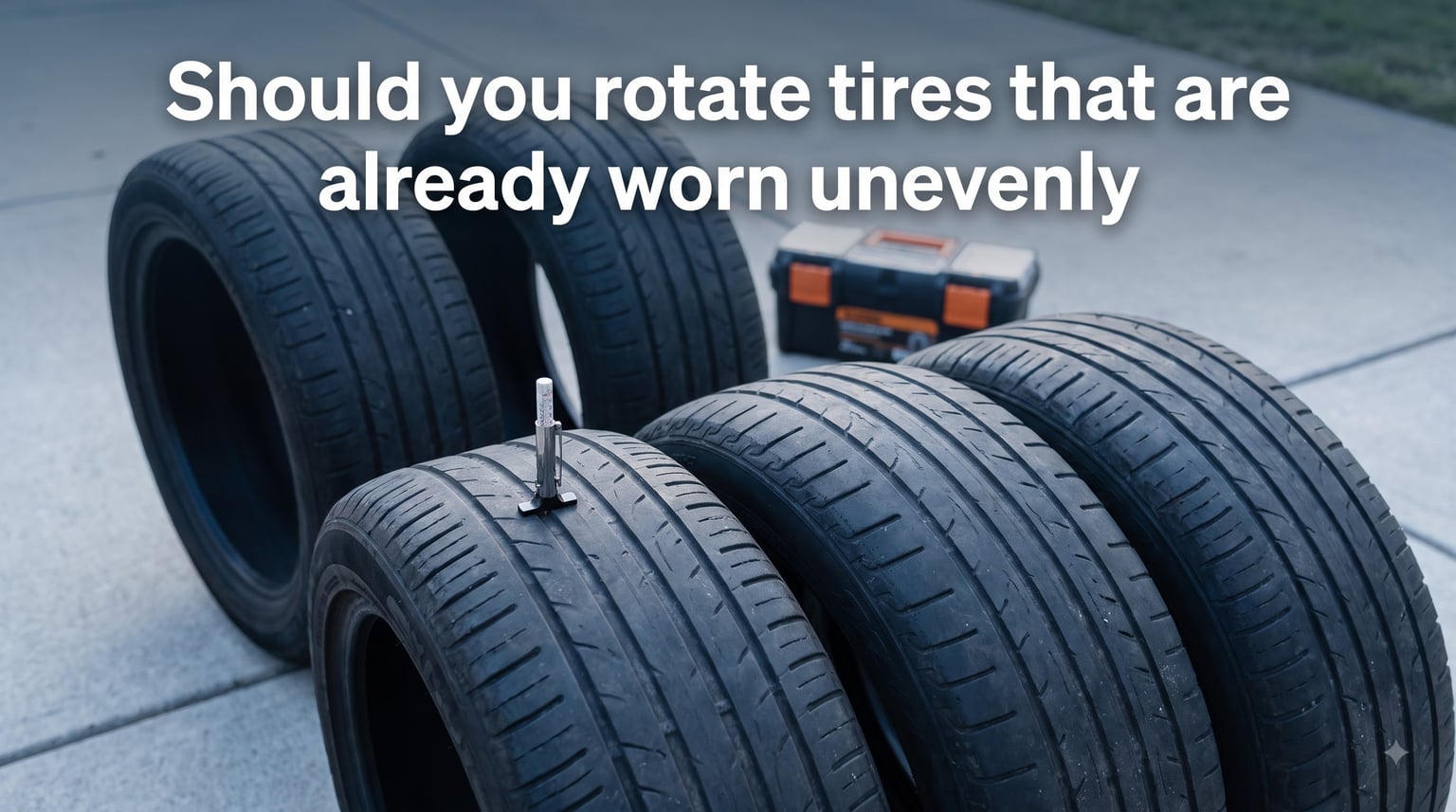
A Blazer EV owner on Reddit walked into Discount Tire expecting a quick rotation and walked out confused: the shop refused service because the front tires had 4/32 inch of tread left while the rears still had 8/32. That is a 4/32-inch spread on the same axle, and it is exactly the kind of case where the answer to “should you rotate tires that are already worn unevenly?” stops being simple.
I have spent the past few months digging into manufacturer guidance, talking with shop techs, and comparing forum threads to figure out where the line really sits. This guide gives you the same decision framework a good tire shop uses, so you know whether to rotate, wait, or replace.
By the end, you will know the 2/32-inch per-axle rule, what different wear patterns actually mean, why AWD vehicles have stricter limits, and when rotation is just throwing good money after bad. No product pitches – just the answer.
Table of Contents
Should You Rotate Tires That Are Already Worn Unevenly?
Yes, you can rotate tires that are already worn unevenly – but only when the tread-depth difference across the same axle stays within 2/32 inch. Beyond that threshold, rotation creates real risks: AWD transfer-case binding, braking imbalance, and even loss of traction in wet conditions.
The standard rule is that all four tires should sit within roughly 2/32 inch of each other, and the two tires on any single axle should be even closer. Most tire manufacturers – including Bridgestone, Michelin, and Continental – publish this in their owner materials. If your front pair is at 6/32 and your rear pair is at 8/32, you are in the safe zone to rotate.
If the spread is 3/32 to 4/32 inch on the same axle, the call gets harder. On a FWD or RWD car, a careful shop may still rotate to balance wear. On an AWD or 4WD vehicle, most reputable shops will refuse – and they are usually right to do so. A 4/32-inch difference on an AWD transfer case can bind the center differential and cause damage that costs far more than a new set of tires.
Why Tires Wear Unevenly in the First Place
Front tires almost always wear faster than rear tires on FWD and RWD vehicles. The front axle does most of the steering, most of the braking, and on FWD cars it also sends power to the road. All three of those jobs scrub rubber off the tread faster than the rear axle experiences.
On a typical FWD commuter, front tires may wear out 30-40% faster than the rears. On a RWD truck, the wear is closer to even because the rear axle handles engine torque. AWD vehicles split power across all four tires, which is why tread matching across all four positions matters so much more.
That is the entire reason rotation exists. You are not “fixing” uneven wear – you are spreading it out so all four tires reach the legal minimum tread depth (2/32 inch in most U.S. states) at roughly the same time. Rotation only re-distributes existing wear. It does not reverse it, and it does not fix whatever caused the uneven pattern to begin with.
The 2/32-Inch Rule: How Much Tread Difference Is OK
The industry-standard tolerance is that the difference between your deepest and shallowest tire should not exceed 2/32 inch, and tires on the same axle should be within 1/32 to 2/32 inch of each other. Tire Rack, Discount Tire, and most manufacturer warranty guides cite this range.
Some shops use a tighter rule: no more than 3/32 inch total spread across all four tires. That is the conservative version, and it is what you should aim for if your vehicle is AWD or 4WD. AWD systems rely on consistent tire circumference to keep the center differential happy – a 3/32-inch mismatch on opposite corners is enough to trigger traction control lights on some crossovers within a few hundred miles.
You will sometimes see the “3% rule” mentioned in forums and owner manuals. It means the same thing in different units – the rolling circumference difference between any two tires should stay below 3%, which works out to roughly 2/32 inch on a typical passenger tire. Either phrasing is fine; the underlying number is what protects your drivetrain.
Common Wear Patterns and What They Mean
Before you decide whether to rotate, you need to know what kind of uneven wear you are looking at. Rotation treats the symptom (uneven tread depth). It does not treat the cause. If you rotate first and never fix the cause, the same uneven pattern shows up again within a few thousand miles.
| Wear Pattern | What It Looks Like | Likely Cause | What To Do |
|---|---|---|---|
| Cupping (also called scalloping) | Series of low and high spots around the tread, like a series of scoops | Unbalanced wheel, worn shocks or struts, failing wheel bearing | Fix the underlying issue first – balance, replace shocks, check bearings. Then rotate if depth allows. |
| Feathering | Tread blocks are smooth on one side, sharp on the other (run a finger across the tread to feel it) | Misaligned toe setting, most often from hitting a curb or worn suspension bushings | Get a four-wheel alignment. Rotation will not help and may accelerate wear in the new position. |
| Heel-and-toe wear | Tread blocks angled like saw teeth, sloping in one direction across the tire | Aggressive cornering, misalignment of scrub radius, sometimes incorrect inflation | Check alignment and inflation. Rotation to a non-driven axle can slow further wear. |
| Inner or outer edge wear only | One shoulder of the tire is bald while the center and other shoulder look fine | Negative or positive camber out of spec, often from worn struts or a recent suspension repair | Alignment first. Once corrected, rotate to even out – but only if remaining depth is within the 2/32-inch rule. |
| Center wear | Middle of the tread is bald, edges look fine | Over-inflation – tire rides on the center rib | Adjust pressure to the door-jamb spec. Tire is usually still rotatable. |
| Shoulder wear (both edges) | Both outer edges bald, center fine | Under-inflation – tire bulges and scrubs the shoulders | Adjust pressure. Replace if shoulder depth is at or below 2/32. |
If your tires show cupping, feathering, or any single-edge wear, get the underlying mechanical issue fixed before you spend money on a rotation. Otherwise, you are just moving the problem to a new position.
AWD and 4WD Vehicles: Why the Stakes Are Higher
AWD vehicles use a center differential or coupling to send power to all four wheels. That device assumes all four tires are rolling at roughly the same speed and circumference. When one tire has significantly less tread than its partner on the same axle, the differential has to constantly compensate – which is called “binding.”
Binding shows up as shuddering on tight turns at low speed, premature wear inside the transfer case, and in severe cases, an illuminated traction control or AWD warning light. Repairing a transfer case runs from 1,500 to 3,500 dollars at most shops. That is not a problem you create by rotating once – it is a problem you create by repeatedly running mismatched tires for thousands of miles.
This is why the Blazer EV owner’s shop said no. On most modern AWD crossovers and EVs, the factory recommendation is that all four tires stay within 2/32 inch of each other, and replacements should be done in sets of four when possible. Some manufacturers explicitly void AWD-related warranty coverage if you run mismatched tires beyond that tolerance.
How to Inspect Your Tires at Home in 10 Minutes
You do not need a mechanic to figure out whether rotation is safe. Here is the inspection I run on my own cars every few months.
Step 1 – Measure tread depth. A 10-dollar tread depth gauge from any auto parts store gives you exact 32nds readings. Stick the probe into the center tread groove of each tire at three points: outer edge, center, and inner edge. Write down the lowest number for each tire.
Step 2 – Look for wear bars. Most tires have small raised bars that run across the tread grooves at 2/32 inch of remaining depth. If the tread is flush with the wear bar, that tire is at the legal minimum and needs replacement, not rotation.
Step 3 – Run the penny test for a quick check. Place a penny into a tread groove with Lincoln’s head pointing down. If you can see the top of his head, you are below 2/32 inch. It is less precise than a gauge but a decent sanity check.
Step 4 – Check the sidewalls. Look for cracks, bulges, or cuts. Sidewall damage is an immediate “do not rotate and do not drive on this” signal. Rotation cannot help a tire with structural damage.
If your four measurements come back within 2/32 inch of each other and the sidewalls are clean, you are clear to rotate. If the spread is wider than 2/32 inch across the same axle, plan on replacing the shallower pair rather than rotating.
When You Should NOT Rotate – Replace Instead
There are clear cases where rotating unevenly worn tires is the wrong call. These four situations mean replacement, not rotation.
Tread is already at or below 2/32 inch on the shallowest tire. Once a tire hits the wear bars, it is legally and practically at the end of its service life. Rotating it just moves a bald tire to a new position.
Tread depth spread exceeds 2/32 inch on the same axle. This is the rule above. On AWD/4WD vehicles, treat anything over 2/32 across all four as the same “do not rotate” situation.
Sidewall damage, dry rot, or visible bulges. A bulge means the internal belt has broken. That tire can fail at highway speed regardless of tread depth. Rotate it and you put a known-dangerous tire on a steering position.
Mismatched tire models or sizes. If one tire was replaced under a previous repair and the other three are a different brand or model, rotation across the front/rear axle pairs (called “splitting pairs”) creates handling imbalance. Most shops will not rotate mismatched sets.
If any of these apply, the cost conversation shifts from “should I rotate” to “should I replace two or four.” That is a different decision with its own logic, but rotation is not on the table.
Rotation vs Replacement: The Cost Trade-Off
A standard tire rotation at most shops runs 25 to 50 dollars, and many tire purchases include free rotations for the life of the tire. Replacing two tires prematurely because rotation was skipped costs anywhere from 300 dollars for economy tires to 800 dollars or more for premium SUV or truck sizes.
The math works like this: if your tires would have lasted 50,000 miles with regular rotation, but uneven wear cuts that to 35,000 miles on the front pair, you are losing about 30% of usable life. On a 700-dollar set, that is roughly 200 dollars of tire you never got to use. Spend the 40 dollars on rotation every 7,500 miles and the math flips in your favor immediately.
That calculation assumes rotation is actually appropriate. If your spread is already past 2/32 inch on the same axle, no amount of rotation will recover the lost life – replacement is the only option that gets you back on the curve.
Frequently Asked Questions
Can you rotate tires with uneven wear?
Yes, you can rotate tires with uneven wear if the tread-depth difference across the same axle is no more than 2/32 inch. Beyond that, rotation risks AWD transfer-case binding, braking imbalance, and reduced wet traction. On AWD and 4WD vehicles, most shops tighten the rule to 2/32 across all four positions, not just per axle.
Should you rotate your tires for even wear?
Yes, rotation is the standard way to even out wear across all four tires. Each position on your vehicle loads the tire differently – front tires steer, brake, and often drive, so they wear faster. Rotating every 5,000 to 7,500 miles moves each tire through different positions so the whole set wears down at a similar rate.
What is the 3% rule for tires?
The 3% rule means the rolling circumference difference between any two tires on the vehicle should stay below 3%. On a typical passenger tire, that works out to roughly 2/32 inch of tread depth. Most manufacturers state this directly in the owner’s manual, and exceeding it can cause AWD binding, ABS issues, and inaccurate speedometer readings.
What happens if tires are rotated but not balanced?
If you rotate tires but skip balancing, you will feel vibration at highway speeds, especially in the steering wheel. Balancing places small weights on the wheel to offset tiny heavy spots in the tire-and-wheel assembly. After rotation, those weights end up in the wrong position relative to the tire, so vibration appears until the wheel is rebalanced.
Is it bad to drive on unevenly worn tires?
Yes, unevenly worn tires reduce grip in wet conditions, lengthen braking distances, and on AWD vehicles can damage the transfer case and center differential. They also tend to be noisier and produce more vibration. If the spread is within 2/32 inch, drive gently and rotate soon. If it is wider than that, replace before doing any long-distance driving.
Bottom Line: Should You Rotate Unevenly Worn Tires?
Yes – rotate them, but only if the spread across the same axle is 2/32 inch or less. That single number is the rule that separates a smart, money-saving rotation from a decision that damages your drivetrain.
Before your next rotation, take 10 minutes to measure tread depth at three points on each tire, look for wear bars, and check the sidewalls. If your numbers fall inside the 2/32-inch window, rotate with confidence every 5,000 to 7,500 miles. If they fall outside that window, the right move is replacement, not rotation.
The Blazer EV owner who started this article ended up buying two new front tires to match the rear pair. They will rotate as a matched set from now on. That is the version of “should you rotate tires that are already worn unevenly” worth following: measure first, decide based on data, and remember that rotation re-distributes wear – it never reverses the underlying cause.