
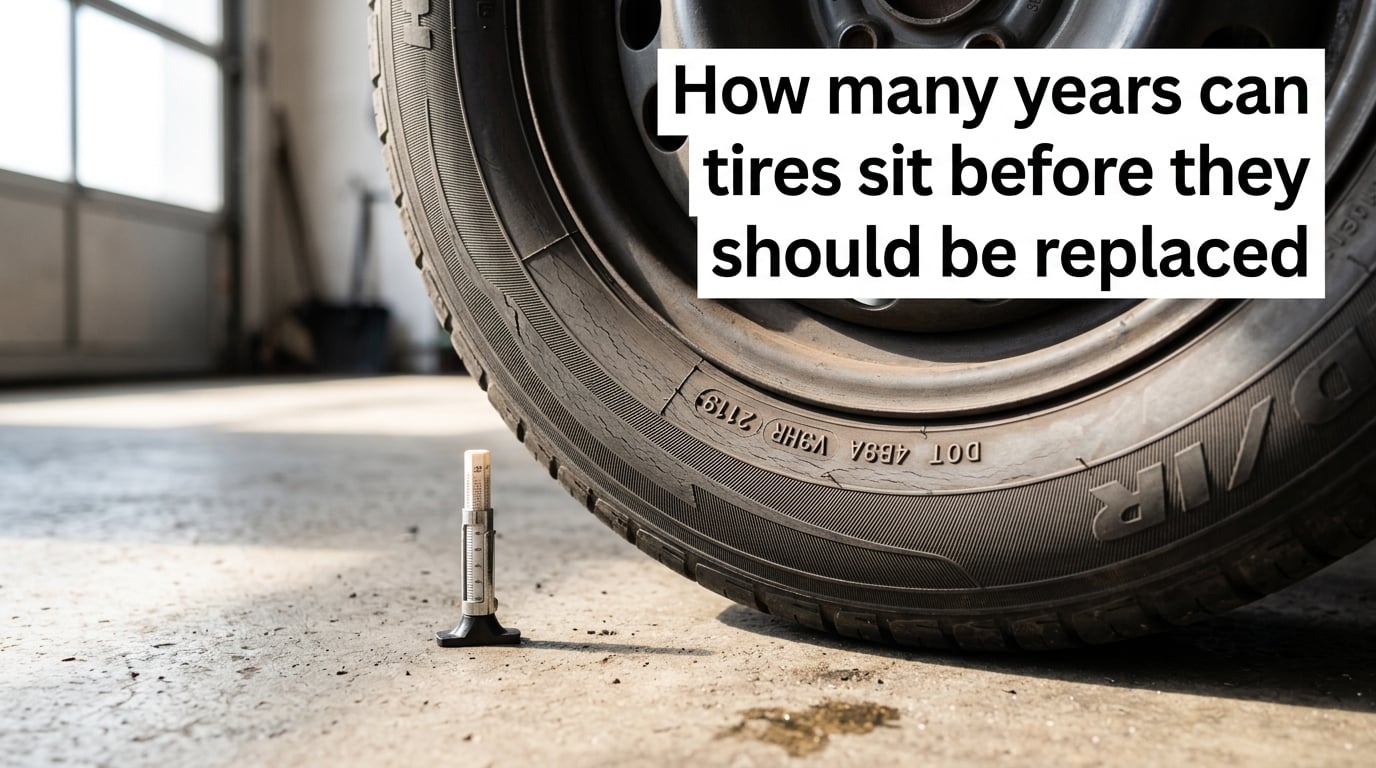
How many years can tires sit before they should be replaced? Most tires can sit unused for 6 to 10 years, but the National Highway Traffic Safety Administration (NHTSA) recommends replacing them at 6 years regardless of tread depth, and the U.S. Tire Manufacturers Association treats 10 years as a hard limit. Storage conditions matter as much as the calendar: heat, sunlight, humidity, and ozone can shrink that window dramatically.
I pulled together this guide after reading the same question asked hundreds of times on Reddit’s r/tires and r/cars, on Mechanics StackExchange, and in tire shop waiting rooms. One r/cars user put it bluntly: “my tires recently gave me a surprisingly hard time braking down from a relatively low speed” on a set that still looked fine. Tread depth tells you how worn a tire is. It does not tell you how old it is. Those are two different clocks, and only one of them is on the sidewall.
By the end of this article, you will know how to read your tire’s age straight off the DOT date code, what happens to rubber during each year of sitting, what NHTSA and the major manufacturers actually recommend, and how to inspect a tire that has been parked for weeks, months, or years.
Table of Contents
Quick Answer: How Many Years Can Tires Sit Before They Should Be Replaced
Tires can sit unused for roughly 6 to 10 years before they need replacement, but that range depends almost entirely on storage conditions. The NHTSA recommends replacement at 6 years regardless of remaining tread. Most major manufacturers, including Bridgestone, Michelin, Continental, and Goodyear, set 10 years as a hard limit.
TL;DR – The Two Numbers You Need
- 6 years: NHTSA replacement recommendation, regardless of tread depth.
- 10 years: Industry hard limit. No manufacturer recommends use past this age.
- Climate-controlled garage: Approximate the upper end of the range.
- Hot, sunny, or outdoor storage: Plan to replace years earlier – sometimes at 3 to 5.
If your tire’s DOT date code shows it was manufactured more than 6 years ago, treat it as a candidate for replacement and have it inspected. If it shows more than 10 years, replace it. Do not wait for visible cracks to appear; belt separation can happen inside the tire without any warning on the outside.
How to Read the DOT Date Code on Your Tire
The DOT date code is the only reliable way to know a tire’s age. It is stamped on the sidewall, and the last three or four digits are what matter. A tire with a 3-digit code was manufactured before the year 2000, while a 4-digit code means it was made in 2000 or later.
Here is how to decode the last four digits of any modern DOT code:
- The first two digits are the week of manufacture (01 through 52). Week 01 is the first week of January; week 52 is the last week of December.
- The last two digits are the year of manufacture. For example, “26” means 2026.
- For example, 3419 means the tire was made in week 34 of 2019, which is late August 2019.
To find the DOT code, look on the inner or outer sidewall for a string that begins with “DOT” followed by letters and numbers. The date is usually near the end of that string. On many modern tires, the date is on only one side; if you cannot find it, check the other sidewall.
A note for buyers: many new tires sit in a warehouse or on a dealer shelf for months before they reach your car. Discount Tire and other retailers generally will not sell tires older than a few years, but it is worth checking the date code on any tire you buy, new or used. A “new” tire that is already 2 years old is not a deal; it is half of its shelf life gone before installation.
Why Tires Degrade When They Sit: The Three Clocks
The moment a tire stops rolling, three independent clocks start. None of them require the car to be moving, and all of them keep running whether the tire is mounted on a car or stacked in a garage.
Clock 1: Pressure Loss
A parked tire loses roughly 1 to 3 PSI per month through slow permeation through the rubber itself. After two to three months, an underinflated tire can develop flat spots, where the sidewall flexes permanently under the car’s weight. Light flat spots usually drive out after 10 to 15 minutes of driving. Severe ones can cause a vibration you feel through the steering wheel for the rest of the tire’s life.
Clock 2: Chemical Aging
Modern tire rubber is loaded with antioxidants and antiozonants, chemicals that slow the reaction of oxygen, ozone, heat, and UV light with the polymer chains in the rubber. Over years, those protective chemicals are consumed. Once they run out, the rubber begins to harden, lose elasticity, and crack. This is what people mean by “dry rot,” and it is irreversible.
Clock 3: Physical Deformation
A tire is engineered to flex millions of times in a specific shape, then return to that shape. Sitting in one position for months subjects one area of the sidewall and tread to constant, uneven stress. Combine that with oxygen and ozone exposure, and you get the conditions for belt separation, where the internal steel and fabric plies pull away from the rubber. Belt separation is the failure mode that causes sudden blowouts at highway speed, and it can happen without any visible warning on the outside.
Heat and UV light accelerate all three clocks. A tire stored outdoors in Phoenix will age faster than the same tire stored in a climate-controlled garage in Minneapolis. As a rough rule, every 18 degrees Fahrenheit increase in storage temperature roughly doubles the rate of rubber oxidation.
A Timeline of What Happens to Tires That Sit
This timeline covers both mounted-and-parked and unmounted-stored tires. Use it as a decision aid, not a guarantee. Always inspect the tire before trusting it.
| Time Sitting | What Is Happening | What You Should Do |
|---|---|---|
| 2 weeks | PSI drops 2 to 6 PSI; sidewall flex memory begins to set. | Check pressure; start the car and roll it a few feet if parked long-term. |
| 1 month | Flat spots may form; antioxidants are still protecting the rubber. | Inflate to placard pressure; move the car periodically. |
| 3 to 6 months | First ozone cracks can appear on sidewalls exposed to sun; compound hardening begins. | Inspect visually; consider covers if stored outdoors. |
| 1 to 2 years | Sidewall elasticity drops noticeably; dry rot visible on older or sun-exposed tires. | Have a tire shop inspect; plan replacement if DOT date is over 6 years. |
| 5 to 6 years | NHTSA replacement recommendation window. Antioxidants are depleted. | Replace regardless of tread depth. |
| 10+ years | Hard limit per all major manufacturers and the U.S. Tire Manufacturers Association. | Do not use on a vehicle. Recycle. |
Notice that dry rot is just the visible symptom of chemical aging, not the disease itself. A tire without visible cracks can still be chemically aged past the point of safe use. Conversely, some climate-controlled stored tires show light surface cracks at 8 years and still test fine internally. Inspection matters more than the calendar, but the calendar is what tells you whether inspection is urgent.
Visible Signs an Old Tire Has Gone Bad
If you are deciding whether to trust a tire that has been sitting, walk around the car with a flashlight and a gloved hand. The five signs below are the ones a tire technician is trained to look for.
- Sidewall cracking. Fine, branching cracks on the outer sidewall, sometimes called “weather checking.” Light surface cracks are an early warning. Deep, visible cracks that you can fit a fingernail into mean the tire should be replaced immediately.
- Ozone cracks. Cracks that run circumferentially around the sidewall, often in a pattern that looks like a dried riverbed. These are caused by ozone reacting with the rubber.
- Bulges or bubbles. A bulge on the sidewall means the internal structure has failed. Do not drive on a bulging tire. Have it replaced.
- Brittle feel. Press your thumbnail into the sidewall in an inconspicuous spot. If the rubber feels hard and does not flex, the antioxidants are gone.
- Tread wear indicators. Most tires have small bars of rubber inside the tread grooves that become flush with the surface when the tread reaches 2/32 inch. If the bars are visible, the tire is worn out regardless of age.
Mechanics on r/Mechanics and Mechanics StackExchange repeatedly note the same thing: belt separation can be invisible. A tire can look perfect on the outside and still have internal ply damage that will cause a blowout under load. Past 6 years, do not rely on visual inspection alone. Have a shop dismount the tire and inspect the inside if you intend to keep using it.
What the Major Manufacturers Recommend
Most major tire manufacturers converge on a 10-year hard limit, but their guidance on when to replace earlier varies. Here is how the major brands and industry bodies line up.
| Source | Recommendation |
|---|---|
| NHTSA | Replace at 6 years of service, regardless of tread depth. |
| U.S. Tire Manufacturers Association | 10-year hard limit from date of manufacture. |
| Bridgestone | 10 years from manufacture date. |
| Michelin | 10 years from manufacture date. |
| Continental | Up to 10 years; recommend replacement at 6 for performance tires. |
| Goodyear | 6 years for service use, 10-year hard cap. |
Several automakers also publish owner-manual guidance. Mercedes-Benz, Volkswagen, and Nissan all recommend replacement at 6 years regardless of appearance. This is a useful data point because the automakers are the ones with the crash data, not just the marketing.
One important clarification: there is no federal U.S. law that requires tire replacement at a specific age. Tire age laws vary by state, and many states leave it to the manufacturer recommendations and the shop’s discretion. A tire shop that refuses to mount a tire older than 6 or 7 years is not being difficult; they are following NHTSA guidance.
How to Inspect Tires on a Car That Has Been Sitting
Use this checklist before driving a vehicle that has been parked for more than a few weeks. It takes about 10 minutes per tire.
- Read the DOT date code. If the tire is past 6 years, plan for replacement. If it is past 10 years, do not drive on it.
- Check tire pressure cold. Compare against the placard on the driver’s door jamb. Inflate to spec.
- Inspect sidewalls for cracks. Look for branching, circumferential, or deep cracks. Photograph anything suspicious for comparison in a month.
- Look for bulges or bubbles. Run a hand along the sidewall. Any soft, raised area means internal damage.
- Measure tread depth. Use a tread depth gauge or a quarter (insert Washington’s head into the groove; if you can see the top of his head, the tread is below 4/32 inch).
- Check for flat spots. Roll the car 10 feet and look for vibration or wobble. Light flat spots usually drive out.
- Inspect the spare. The spare follows the same aging rules. If your car is over 6 years old, the spare has been aging right along with the road tires.
- Have a shop inspect the inside. Past 6 years, ask the shop to dismount the tire and check the inner sidewall, which sees different stresses than the outer sidewall.
Long-Term Storage Prep: Mounted vs Unmounted Tires
Whether your tires are mounted on a parked car or stored unmounted in the garage, a few simple steps can buy you years of extra life.
For Mounted Tires (Car Parked Long-Term)
- Inflate to the maximum pressure on the sidewall, not the placard pressure. This reduces flat spotting. Drop pressure back to spec before driving.
- Move the car a few feet every two weeks if possible. This shifts the contact patch and lets the sidewall flex back.
- Park on clean, dry concrete, not on dirt, grass, or asphalt that holds moisture. Moisture accelerates ozone damage.
- Use tire covers if the car is stored outdoors. UV exposure is the single biggest accelerator of dry rot.
- Avoid harsh cleaners and tire dressings containing petroleum distillates, which can leach antioxidants out of the rubber.
For Unmounted Tires (Stacked in Garage or Shop)
- Clean the tires with mild soap and water before storage. Brake dust and road grime hold moisture against the rubber.
- Store each tire in an airtight plastic bag, such as a large lawn and leaf bag with the tire inside. This blocks ozone, which is present even indoors.
- Store upright (standing on the tread), not hanging or stacked flat. Stacked tires can develop flat spots and deformation under their own weight over time.
- Keep them out of direct sunlight and away from electric motors, welding equipment, or other ozone sources.
- Aim for a cool, dry location. A climate-controlled basement or garage is ideal. An attic in Arizona is not.
Reddit users who store winter tires in climate-controlled barns consistently report tires still in usable shape at 6 to 8 years. Users who store tires in hot garages or outdoors report visible dry rot in as little as 3 years. The difference is almost entirely temperature and UV exposure.
Don’t Forget the Spare Tire in the Trunk
The spare tire ages at the same rate as the four tires on the ground, but it usually sits in a dark trunk where nobody looks at it. A full-size spare that is 10 years old is just as unsafe as a 10-year-old road tire.
NHTSA specifically recommends checking the spare on any vehicle over 6 years old. Lift the cargo floor, read the DOT code on the spare, and factor its age into your replacement decision. If your spare is older than the road tires, replace it at the same time.
Frequently Asked Questions
Can 20 year old tires still be good?
No. After 10 years, no major manufacturer, no industry body, and no safety authority recommends use. A 20-year-old tire is past the hard limit by a full decade. Even if the tread looks fine, the antioxidants are long gone, the rubber is hardened, and internal belt separation is a real risk. Recycle the tire and replace it.
Can tires go bad from sitting too long?
Yes. Three clocks start the moment a tire stops rolling: pressure loss of 1 to 3 PSI per month, physical deformation and flat spotting where the tire contacts the ground, and chemical aging as antioxidants and antiozonants in the rubber are consumed by oxygen, heat, UV, and ozone. Even unmounted tires stacked in a garage will degrade over years.
Are 7-year-old tires still safe to use?
Possibly, but you are past the NHTSA recommendation. The tire has crossed into the 6-to-10-year window where most manufacturers and the U.S. Tire Manufacturers Association recommend replacement. Have a shop inspect the inside of the tire for belt separation, and plan to replace within the next year even if inspection comes back clean.
Is it normal for tires to only last 3 years?
A 3-year tire failure is not normal from age alone. Three years is well within both the NHTSA recommendation and the 10-year hard limit. If your tires are failing at 3 years, the cause is almost always mileage wear, underinflation, alignment issues, or damage, not age. Check the DOT date code first to confirm the tire is actually 3 years old, then look at tread depth and driving habits.
How long can tires sit in storage before they go bad?
Tires stored unmounted in a cool, dry, climate-controlled space can remain usable for 6 to 10 years. Tires stored in a hot garage, outdoors, or exposed to direct sunlight can show visible dry rot in 3 to 5 years. Bag each tire in an airtight plastic bag, store upright, and keep them out of sunlight and ozone sources.
How long can a tire sit before it goes bad?
Mounted on a parked car, a tire can sit for 6 to 10 years before it should be replaced, with the lower end of that range for hot or outdoor storage. Unmounted and properly stored in a climate-controlled space, the same tire can sit closer to the 10-year mark. NHTSA recommends replacement at 6 years regardless of tread depth.
Do tires go bad if the car sits?
Yes. A parked car develops flat spots within a month, loses 1 to 3 PSI per month through permeation, and begins accumulating chemical damage from oxygen, ozone, and heat. After 6 months of sitting, you should check pressure, inspect for cracks, and roll the car a few feet. After 6 years, plan replacement regardless of appearance.
Are 10 year old tires safe if stored in the garage?
No. Even with ideal climate-controlled storage, 10 years is the industry hard limit. The antioxidants and antiozonants that protect the rubber are depleted, and belt separation can occur without visible warning. A 10-year-old tire should be replaced, not reused, regardless of how it was stored.
How long are tires good for after the dot date?
The DOT date code tells you when the tire was manufactured, not when it was put into service. From that manufacture date, the NHTSA recommends replacement at 6 years, and the U.S. Tire Manufacturers Association and major manufacturers set 10 years as the hard limit. The clock starts at manufacture, not at installation.
Is it okay to use 7 year old tires?
You are past the NHTSA recommendation but still inside the 10-year hard limit. Have a shop inspect the tires, especially the inner sidewall, for cracks and belt separation. If the tires pass inspection and storage conditions have been cool and dry, you can use them, but plan replacement within the next year or two.
How do you read a DOT tire date code?
Find the DOT stamp on the tire sidewall. The last four digits are the manufacture date: the first two are the week of the year (01 through 52), and the last two are the year. For example, 3419 means the tire was made in week 34 of 2019, which is late August 2019. Tires made before 2000 use a 3-digit code.
The Bottom Line on Tires That Sit
If you only remember three things about how many years tires can sit before they should be replaced, make it these: 6 years is the NHTSA replacement recommendation, 10 years is the hard limit, and storage conditions can pull that window in by years. A tire in a cool, dark, climate-controlled garage will outlast the same tire sitting on a blacktop driveway in direct sun, even if both have the same DOT date code.
Walk to your car today and read the last four digits of the DOT stamp on each tire. If any of them are over 6 years old, schedule a professional inspection. If any are over 10 years old, replace them. And do not forget the spare. It has been aging right alongside the road tires, and on the day you need it, you want it to be the youngest tire on the vehicle.