
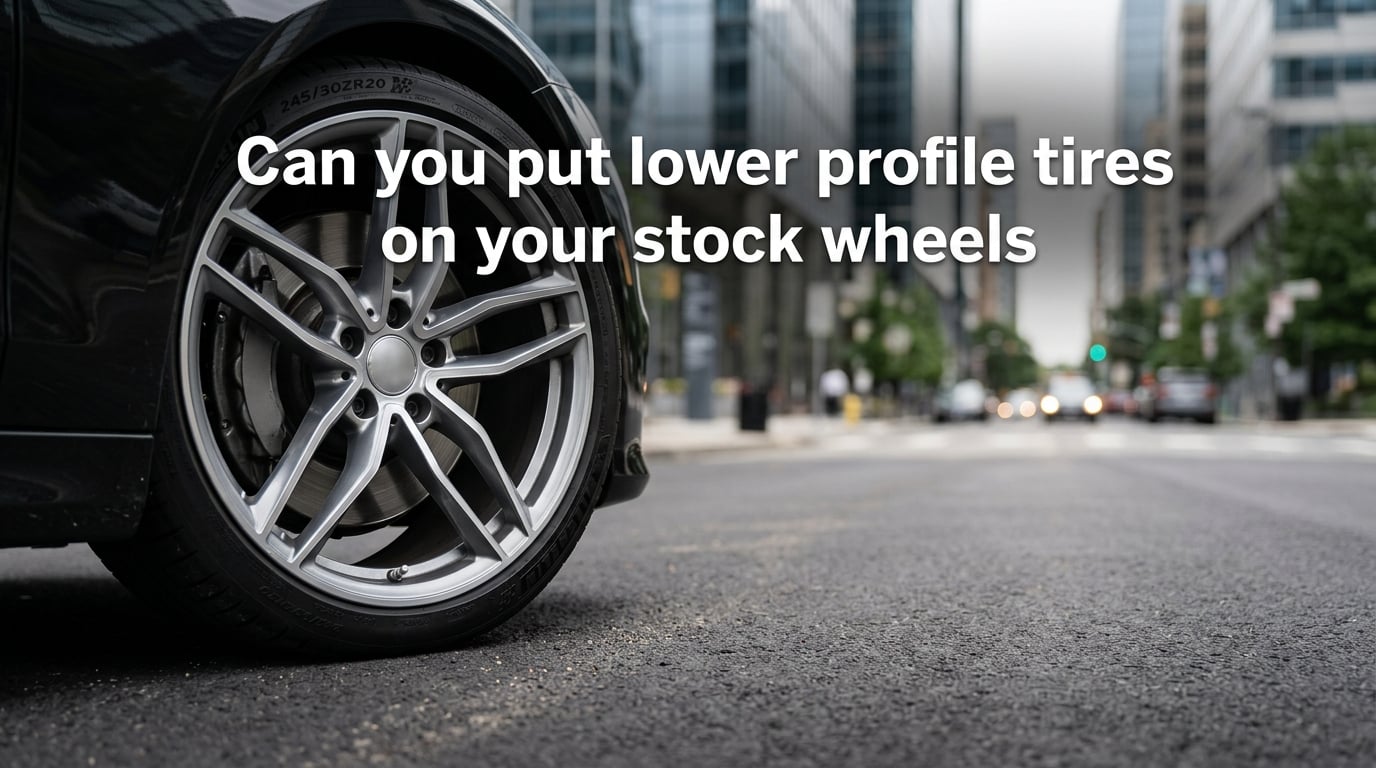
Yes, you can put lower-profile tires on your stock wheels, but only if you keep the wheel diameter the same and stay within about 3% of your vehicle’s stock overall tire diameter. A lower-profile tire simply means a shorter sidewall on the same rim size, so your stock wheels do not need to change. Just be aware that thinner sidewalls give up ride comfort, take pothole damage more easily, and may throw off your speedometer if the overall diameter shifts.
If you have ever looked at a car wearing 20-inch wheels with barely any rubber between the rim and the road and wondered whether you could pull off the same look with the wheels already in your garage, this guide walks you through the math, the trade-offs, and the fitment checklist. I have spent more weekends than I would like to admit in tire shops, and the rule that has saved me from a bad swap every single time is simple: preserve overall diameter.
Table of Contents
What Counts as a Lower-Profile Tire
A lower-profile tire is one with a shorter sidewall relative to its width. That ratio is called the aspect ratio, and it shows up as the second number in a tire size like 225/45R17. The 45 means the sidewall height is 45% of the 225mm tread width, which works out to about 101mm of rubber between the rim and the road.
The industry uses loose thresholds to label profiles:
- Standard profile – aspect ratio of 60 or higher. Common on family sedans, crossovers, and trucks from the 1990s and 2000s.
- Low profile – aspect ratio around 50 to 60. Most modern passenger cars ship from the factory here.
- Lower profile – aspect ratio in the 40s. This is the sport trim level on most vehicles.
- Very low profile – aspect ratio below 40. Performance and luxury cars live in this range.
- Ultra-low profile – aspect ratio of 30 or below. Found on supercars and aggressive aftermarket builds.
If you drop from a 55-series tire to a 45-series tire on the same wheel, you have made a meaningful change in profile. The visual difference is obvious, and the ride difference is too.
The Compatibility Rule: Preserve Overall Diameter
Here is the math behind why you can usually swap a lower-profile tire onto stock wheels without buying new rims. The overall tire diameter is the wheel diameter plus twice the sidewall height:
Overall diameter = wheel diameter + 2 x sidewall height
Sidewall height is the tire width multiplied by the aspect ratio (as a decimal). For a 225/45R17, the sidewall is 225 x 0.45 = 101.25mm, so the overall diameter is 17 inches (431.8mm) plus 202.5mm of rubber, or roughly 25.0 inches (634mm) overall.
Because the wheel diameter stays at 17 inches when you keep your stock rims, the only thing changing is the sidewall height. To keep the overall diameter close to stock, you simply pick a sidewall that compensates. Most tire manufacturers, dealers, and the Tire and Rim Association recommend staying within 3% of the original overall diameter. Anything beyond 3% risks rubbing the fender, throwing off your speedometer, and confusing your antilock brake system.
That 3% rule is the single most important number in this entire article. Memorize it before you walk into a tire shop.
Tire Size Comparison Table: Same Wheel Diameter
Most fitment confusion comes from not seeing the numbers side by side. Below is a real comparison using a common 17-inch stock wheel and the same 225mm tread width across four different aspect ratios.
| Tire Size | Sidewall Height | Overall Diameter | Delta vs Stock |
|---|---|---|---|
| 225/55R17 (typical stock) | 123.75mm | 679.3mm (26.7 in) | Baseline |
| 225/50R17 | 112.50mm | 656.8mm (25.9 in) | -3.3% (at the edge) |
| 225/45R17 | 101.25mm | 634.3mm (25.0 in) | -6.6% (too low) |
| 225/40R17 | 90.00mm | 611.8mm (24.1 in) | -9.9% (way off) |
Notice how dropping two profile steps from 55 to 45 changes the overall diameter by 45mm, or 1.77 inches. That is well past the 3% rule, so it is not a clean swap. The 225/50R17 sits right at the safe edge, but the 225/45R17 starts to compromise speedometer accuracy and fender clearance.
If you really want a 45-series look on 17-inch wheels, the cleaner move is to step up to 18-inch wheels so you can run a 225/45R18 with an overall diameter that matches the original 225/55R17. That is exactly how factory sport packages are spec’d.
Pros of Lower-Profile Tires
Lower-profile tires are popular for real reasons, not just for looks. Here is what you actually gain.
- Sharper steering response – Less sidewall flex means the tire reacts faster to your input at the wheel.
- Better cornering stability – The contact patch stays more consistent through hard turns, so the car feels planted.
- Sportier appearance – More wheel, less rubber. That aggressive look is the whole point for many owners.
- Shorter braking distances – On smooth pavement, stiffer sidewalls let the tire respond more directly to braking force.
- Lower center of gravity – A slightly shorter tire can shave a few millimeters off the car’s roll center, helping handling.
On a smooth canyon road or a track day, these advantages are real and noticeable. The trade-off shows up the moment you hit a rough patch of asphalt.
Cons of Lower-Profile Tires
Every forum I have read has the same cautionary thread, and the complaints cluster around five issues.
- Pothole and curb damage – A thinner sidewall has less rubber to absorb impact. A pothole that would not even register on a 60-series tire can bend a 35-series rim. One Acura TSX owner on Acurazine.com called it a terrible idea for that exact reason.
- Harsher ride – Less sidewall means less cushion. Subaru Outback owners on subaruoutback.org have written repeatedly about exposed wheels and a stiffer ride after moving to lower-profile rubber.
- Higher cost per tire – Lower-profile tires in unusual sizes tend to cost more and wear out faster because the sidewall flex concentrates wear.
- Shorter tread life – Stiffer sidewalls put more energy into the tread, which can shave miles off your tires.
- Speedometer and odometer drift – If you go too low and the overall diameter drops, your speedometer reads low and your odometer under-counts miles.
A 2021 XC60 owner I read about on benzworld.org reported constant sidewall bulging and tire replacement after switching to 265/35R22 Pirelli P Zeros. Real-world feedback like that is worth more than any spec sheet.
Speedometer Accuracy: The Hidden Math
Your speedometer is calibrated to your factory tire size. Drop the overall diameter and the indicated speed drifts low while your odometer under-counts.
Using the 225/55R17 vs 225/45R17 example above, the diameter difference is about 45mm, or 6.6%. If your speedometer reads 60 mph, you are actually traveling about 56 mph. Over a 10,000-mile year, your odometer records about 9,340 miles. That matters for lease mileage caps, warranty service intervals, and resale documentation.
Modern antilock brake systems and stability control also use wheel speed sensors that compare left to right and individual wheel speed to vehicle speed. A significant diameter mismatch can confuse these systems. Staying within 3% of stock keeps everything happy.
Fitment Checklist for Stock Wheels
Before you buy a set of lower-profile tires for your stock wheels, run through this list. It is the same checklist professional tire shops use.
- Confirm wheel diameter matches – A 17-inch tire only fits a 17-inch wheel. No exceptions.
- Check the rim width range – Every tire lists a recommended rim width range on the sidewall. A 225/45R17 typically fits 7.0 to 8.5-inch rims. Make sure your stock wheel falls in that range.
- Verify brake caliper clearance – Some cars have larger front brakes that need a specific wheel design. Measure the caliper to the inside of the wheel and check against the new tire size.
- Stay within 3% of stock overall diameter – The most important rule. Calculate before you buy.
- Match or exceed load rating – The new tire must carry at least the weight your stock tire did. Look for the load index number.
- Match or exceed speed rating – Never downgrade from H to T. Match or upgrade.
- Test-fit before committing – Many shops will mount one tire and roll the car to check for rubbing before finishing the install.
If any of those checks fail, the swap is not a clean fit. Walk away or reconsider the tire size.
When to Skip Lower-Profile Tires
Some driving situations make lower-profile tires a bad idea no matter how good they look. Skip the swap if any of these apply to you.
- Potholed city streets – If your daily route looks like a war zone, the sidewall cost adds up fast.
- Rough rural roads – Gravel washboard and frost heaves will eat lower-profile tires.
- Winter and snow regions – A taller sidewall gives a deeper tread block and better snow compaction. Low profile hurts winter performance.
- Curbside parking without sensors – Every parking job becomes a risk.
- Heavy load vehicles – Trucks and vans carrying real weight need the load-carrying capacity of taller sidewalls.
When Lower-Profile Tires Make Sense
There are times when dropping the profile is the right call.
- Smooth highways and well-paved city streets – The benefits show up without the downsides.
- Track day and autocross driving – Sharper turn-in and better braking matter more than ride comfort.
- Cosmetic priority – If the look is the goal and you accept the trade-offs, go for it.
- Cars already tuned for sport – If the suspension, brakes, and aerodynamics are all sport-oriented, the lower-profile tire completes the package.
Insurance and Inspection Considerations
Changing tire size is not just a mechanical decision. There are two non-mechanical angles to think through.
First, your door jamb sticker lists the original tire size as the manufacturer-recommended fitment. In some states, deviations outside that spec can affect safety inspection results, especially if the new tire interferes with the body, suspension, or steering components.
Second, your auto insurance policy is written around the vehicle as delivered. If you change tire size dramatically and then have a claim, the insurer can argue the modification contributed to the loss. The fix is simple: tell your insurer before the swap. Most carriers update the policy in five minutes and your premium does not change.
Frequently Asked Questions
Can I replace low profile tires with regular tires?
Yes. Going from a low-profile tire to a regular (higher-profile) tire on the same wheel diameter is usually easier than the reverse, because a taller sidewall gives you more cushion and is less likely to rub. The rule still applies: stay within 3% of the original overall diameter so your speedometer, odometer, and ABS stay accurate.
What is the 3% rule for tires?
The 3% rule means your new tire’s overall diameter must be within 3% of the original tire’s overall diameter, either plus or minus. This limit keeps your speedometer accurate, prevents fender rubbing, and keeps the antilock brake system happy. Calculate overall diameter as wheel diameter plus twice the sidewall height, then compare.
Do low profile tires need special rims?
Not necessarily. A low-profile tire can mount on the same rim diameter as your stock tire, but the rim width must fall within the tire manufacturer’s recommended range. Low-profile tires are less forgiving of width mismatch, so check the sidewall spec before mounting.
What are the downsides of using low-profile tires?
The main downsides are harsher ride quality, higher risk of pothole and curb damage, higher cost per tire, shorter tread life, and speedometer drift if the overall diameter changes. On rough roads, lower-profile tires can crack sidewalls and bend rims that a taller tire would have protected.
Are low profile tires worth it?
They are worth it if you drive mostly smooth roads, want a sportier look, and value sharper handling over ride comfort. They are not worth it if your daily route has potholes, if you face winter conditions, or if you carry heavy loads. Match the tire to your roads, not just to the catalog photo.
Can you put 12.5-inch wide tires on stock rims?
Only if the rim width falls within the tire manufacturer’s recommended range for a 12.5-inch-wide tire. Most 12.5-inch tires need at least a 9-inch wide rim, which is far wider than a typical stock rim. On a stock rim, a 12.5-inch-wide tire will balloon outward, fit poorly, and rub the fender.
The Verdict on Lower-Profile Tires and Stock Wheels
So can you put lower-profile tires on your stock wheels? Yes, as long as you preserve overall diameter, stay within the 3% rule, and accept the trade-offs. The wheel diameter does not have to change, which is why the swap is so popular, but the sidewall shrinks, and with it the cushion that protects both you and your rims.
Before you buy, run the math: take your stock tire size, calculate the overall diameter in millimeters, then check the candidate tire against the 3% window. Walk through the fitment checklist. Match load and speed ratings. Tell your insurer. If everything lines up, you get the sportier look and sharper handling without giving up safety or accuracy.
Our team has compared dozens of fitments over the years, and the swaps that worked out best always started with a calculator and ended with a test mount. Skip either step and you are gambling. Take both steps and you will end up with a setup that looks the part and drives the way you want.