
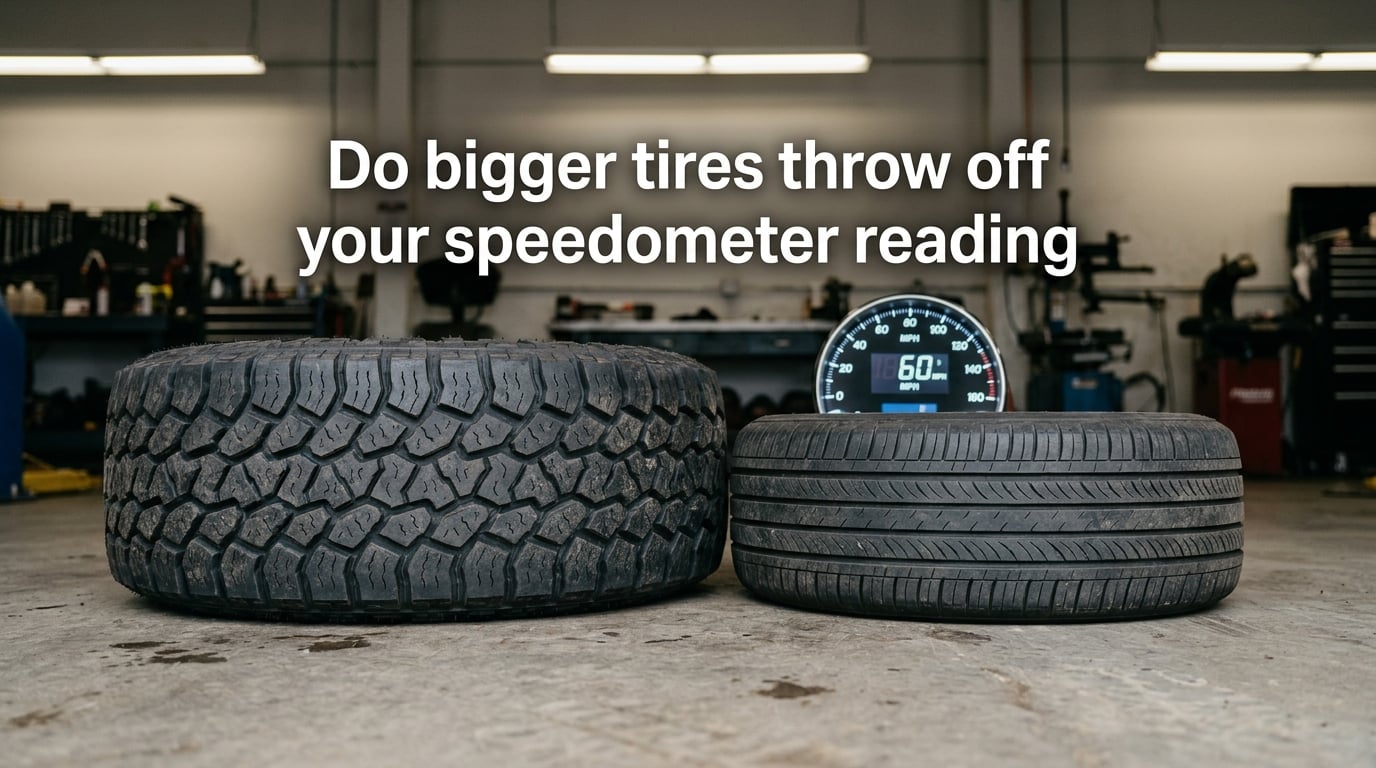
Do bigger tires throw off your speedometer reading? Yes – bigger tires throw off your speedometer reading by causing it to display a LOWER speed than you are actually traveling. The reason is simple: a taller tire covers more ground with every rotation than the factory-calibrated tire, so the vehicle’s computer under-estimates both your speed and the miles you have driven. A 3% increase in tire diameter produces roughly a 3% under-read, so a speedometer showing 60 mph usually means you are really going about 62 mph.
I have been writing about tire fitment and vehicle electronics for years, and this is the single most common question I get from truck and SUV owners. In this guide, I will walk you through exactly why bigger tires throw off your speedometer, how much error to expect at common sizes, and the practical ways to check and fix it. If you only have 30 seconds, the direct answer above is what you need – the rest of the article is for drivers who want the numbers, the test methods, and the fix.
Table of Contents
Why Bigger Tires Throw Off Your Speedometer
Bigger tires throw off your speedometer because the speedometer is calibrated to a specific tire size at the factory. When you change the tire’s outside diameter, you break that calibration – and the system has no way of knowing you did.
To understand exactly why, it helps to know how the system works in the first place.
How a speedometer and odometer actually work
Your vehicle’s powertrain control module (PCM) counts wheel revolutions using a vehicle speed sensor (VSS) – either at the transmission output shaft or inside each wheel hub on newer ABS-equipped vehicles. It then multiplies that count by a programmed tire circumference to convert revolutions into distance, and distance over time into speed.
The odometer uses the exact same calculation – it just adds up the total distance instead of dividing it by time. That is why an error in the assumed tire circumference throws off both readings at once, and in the same direction.
The physics: tire circumference and wheel revolutions
Tire circumference is the distance the vehicle travels in one complete wheel rotation. A taller tire has a larger circumference, so each revolution carries the vehicle further than the PCM expects.
If the PCM is programmed for a stock 31-inch tire (about 97 inches of circumference) and you fit a 35-inch tire (about 110 inches of circumference), every wheel rotation now covers roughly 13% more ground than the system thinks. The PCM sees the same number of revolutions per minute, so it reports 60 mph – but you are actually covering 13% more distance per minute, closer to 67.8 mph.
Direction of the error: speedometer reads LOW, not high
This is where a lot of drivers get confused. Bigger tires do not make the speedometer read fast – they make it read slow. Taller tires = more distance per revolution = the system under-counts = the displayed speed is LOWER than reality.
A common forum observation backs this up. On TacomaWorld, one owner put it plainly: “Since your tires are larger than stock your speedo should read LOWER than your actual speed. And your odometer would also read lower than actual.” Smaller tires do the opposite – the speedometer reads fast and the odometer over-reports miles.
One Reddit twist worth mentioning: many factory speedometers already read 2-5 mph high from the dealership, so installing slightly larger tires can actually bring your reading closer to true. That is not a reason to ignore the change – it just means a 3% upsize is sometimes a happy accident, not a license to skip recalibration.
How Much Will Your Speedometer Be Off?
How much your speedometer is off depends almost entirely on the percentage change in tire diameter from the factory size. The rule of thumb is straightforward: the percentage error in your speedometer roughly equals the percentage change in tire diameter.
Here is the worked example I use most often when explaining the math.
The 3% rule, worked through
Suppose your truck came with 30-inch tires and you upsize to 33-inch tires – a 10% jump in diameter. Your speedometer will now read about 10% low. If the gauge shows 60 mph, your actual speed is roughly 66 mph. If it shows 70 mph on the highway, you are really doing about 77 mph – fast enough to earn a ticket in a 70 mph zone.
The 3% rule is a community convention: stay within plus or minus 3% of factory tire diameter, and the speedometer error is small enough that most drivers never notice it. Beyond 3%, the error becomes obvious and starts to affect shift timing, cruise control, and odometer accuracy.
Speedometer error by tire size (the table nobody else has)
Below is a quick-reference list showing the approximate speedometer error you can expect at common tire size jumps, assuming a stock 30-inch tire. The exact percentage scales linearly with whatever your factory size was.
- +0 inch (stock): Speedometer reads true. No error.
- +1 inch: ~3.3% low. At a displayed 60 mph, actual speed is about 62 mph.
- +2 inch: ~6.7% low. At a displayed 60 mph, actual speed is about 64 mph.
- +3 inch: ~10% low. At a displayed 60 mph, actual speed is about 66 mph.
- +4 inch: ~13.3% low. At a displayed 60 mph, actual speed is about 68 mph.
- +5 inch: ~16.7% low. At a displayed 60 mph, actual speed is about 70 mph.
This is exactly the information competitors leave on the table. Pinning it to your specific factory size takes 10 seconds of mental math: divide the size jump by your stock diameter.
Will 33-inch and 35-inch tires affect the speedometer?
Will 35-inch tires affect the speedometer? Yes – and so will 33-inch tires if either is a jump from stock. A common Tacoma or Wrangler owner goes from a 30- or 31-inch factory tire to a 33-inch (about a 7-10% bump) or 35-inch (about a 13-17% bump). At those jumps, expect the speedometer to under-read by 7-17% at any given speed.
For a 35-inch tire on a truck that originally rolled on 31-inch tires, a displayed 65 mph is closer to 73 mph in reality. That is enough variance to matter in a school zone or for a speeding ticket.
Do Bigger Tires Affect Your Odometer Too?
Yes – bigger tires affect odometer readings just as much as they affect the speedometer, and in the same direction. Because the odometer counts the same wheel revolutions and multiplies by the same programmed circumference, a taller tire means the displayed mileage is LOWER than the miles you actually drove.
One Chevy truck owner on Reddit documented the effect across three tire sizes: going from 29-inch stock to 33-inch, then to 35-inch tires, the odometer progressively logged fewer miles than the vehicle actually traveled. The gap widened with each upsizing.
Why the odometer under-reports
The math is identical to the speedometer. A larger circumference means each wheel revolution carries the vehicle further than the PCM expects, so the total displayed mileage after, say, 10,000 actual miles might only read 9,000 on the dash. The exact shortfall scales with the percentage increase in tire diameter.
Resale, lease, and maintenance impact
Under-reported odometer miles can quietly cost you money in three places. First, resale value: a buyer or dealer using the odometer to assess wear will underestimate the miles, which can backfire if the discrepancy is discovered later. Second, lease returns: most leases charge per mile over a cap, but if your odometer reads low, you may still owe for miles you actually drove. Third, maintenance schedules tied to odometer miles – oil changes, transmission services, differential fluid – all happen later than they should, which can shorten component life.
How to Check If Your Speedometer Is Accurate
Before you spend anything on recalibration, verify whether you actually have a problem. Two free methods work well, and I recommend doing both for cross-checking.
Method 1: GPS speedometer app (smartphone test)
This is the easiest verification and the one forum users trust most. GPS speed readings are independent of your vehicle’s wheel-speed sensor, so they are a true ground reference.
- Install a free GPS speedometer app on your phone – options include SpeedView, DigiHUD, or the built-in Maps app while navigating.
- Find a flat, straight stretch of road with light traffic where you can hold a steady speed safely.
- Drive at a steady 60 mph on the speedometer (use cruise control for accuracy).
- Compare the phone’s GPS reading to the dash. The difference is your speedometer error.
- Repeat at 40 mph and 70 mph to confirm the error scales linearly (it should).
Method 2: Mile-marker test
This method uses highway mile markers to measure actual distance, then compares it to your odometer. It is more involved than the GPS test but does not require a phone signal.
- Reset your trip odometer to zero at a clearly marked mile post.
- Drive exactly 10 miles along the same highway, ending at another mile post.
- Check your trip odometer at the end of the run.
- If the odometer reads less than 10 miles after 10 actual miles, your speedometer is reading low (consistent with bigger tires).
- Repeat the test on a return run to rule out grade or GPS drift.
Interpreting the results
If your speedometer is within 1-2 mph of GPS at highway speeds, you are inside the 3% tolerance band and most drivers never bother recalibrating. Anything beyond 3% (roughly 2 mph error at 60 mph) is worth fixing – especially if you do any highway driving, tow, or have a leased vehicle.
How to Recalibrate Your Speedometer for Bigger Tires
How do you fix your speedometer after getting bigger tires? There are three practical paths, and which one makes sense depends on your vehicle’s age, your budget, and how often you change tire sizes.
Option 1: Dealership or specialist reprogramming
Most vehicles built after 2005 allow the tire size to be reprogrammed through the PCM using a factory scan tool or an aftermarket tool like a Snap-on Modis or Autel MaxiSys. A dealer or tire shop can usually do this in under an hour. This is the cleanest solution because it also corrects transmission shift points, cruise control set speeds, and any speed-triggered warning thresholds.
Option 2: Aftermarket calibration module
Standalone modules from brands like Superchips, Hypertech, Bully Dog, and Rough Country plug into the OBD-II port or splice into the VSS wiring and let you dial in a correction percentage that matches your tire size. They are reusable – if you change tire sizes again, you just update the setting instead of paying for another reprogram.
Option 3: Mechanical speedometer gear swap (older vehicles only)
Pre-electronic vehicles and many older trucks used a mechanical speedometer driven by a gear in the transmission. Swapping that driven gear for one with a different tooth count changes the calibration directly. This is a DIY-friendly job on older vehicles but is not an option for anything built in the last 15-20 years.
Recalibration cost comparison
Here is what drivers typically report paying in 2026, based on forum threads and shop surveys:
- DIY aftermarket module: Entry-level cost for the module, plus your time. Reusable across tire sizes.
- Dealer or specialist reprogramming: Mid-range cost for a one-time flash. Often rolled into the cost of a new tire purchase.
- Mechanical gear swap (older vehicles): Low-cost part plus shop labor if you do not DIY.
If you change tire sizes more than once every few years, the aftermarket module usually pays for itself. If this is a one-time upgrade, the dealer flash is the simplest path.
Other Systems Bigger Tires Affect
The speedometer and odometer are the most visible casualties, but they are not the only ones. Several other systems rely on the same wheel-speed data, and bigger tires can throw them off too.
Transmission shift timing
Modern automatics use vehicle speed to decide when to upshift and downshift. With taller tires, the PCM thinks the vehicle is moving slower than it actually is, so it holds lower gears longer and upshifts later than designed. The result is higher RPM at highway speeds, slightly worse fuel economy, and more engine noise on long drives.
Cruise control and traction control
Cruise control regulates speed based on the same sensor the speedometer reads. With a 10% under-read, the cruise control will hold your true speed about 10% higher than the number you set. Traction control and stability control also use wheel-speed data to detect slip, and an inaccurate baseline can make them trigger later than intended or behave inconsistently.
ABS and driver-assistance systems
Anti-lock brakes and modern driver aids like adaptive cruise control, lane-keep assist, and automatic emergency braking all rely on accurate wheel-speed data. Larger tires change the baseline these systems are tuned for, which can shift intervention thresholds. In most cases the change is small enough not to matter, but a proper recalibration keeps everything in sync.
Fuel economy and trip computer readings
Your trip computer calculates MPG from fuel used (real) and distance traveled (calculated from tire revolutions). With bigger tires, distance is under-reported, so the calculated MPG reads artificially high. If you use the trip computer to track fuel economy, recalibrating the speedometer also fixes this.
The 3% Rule: How Much Tire Size Change Is Acceptable?
The 3% rule is the de-facto community standard for tire size changes. The idea is simple: stay within plus or minus 3% of the factory tire diameter, and the speedometer, odometer, and shift-quality impacts stay small enough that most drivers never notice them.
Why 3% is the standard
At 3% diameter change, the speedometer error is roughly 1-2 mph at 60 mph – small enough to be within the noise of normal speedometer accuracy, and small enough that most drivers will not be at risk of a speeding ticket from the error alone. Beyond 3%, the error compounds quickly: a 5% change gives you about 3 mph of error at 60, and a 10% change gives you about 6 mph.
For a typical 31-inch factory tire, 3% works out to roughly a 1-inch diameter change in either direction – so up to a 32-inch tire before you start noticing real effects.
Plus-sizing as a no-calibration workaround
Plus-sizing means installing a wider tire or a different sidewall profile while keeping the overall diameter the same as stock. For example, going from a 265/70R17 to a 285/65R17 keeps the diameter identical while giving you a wider footprint and a slightly shorter sidewall. Because the diameter does not change, the speedometer calibration stays accurate and no recalibration is needed.
This is the easiest way to get the look and traction of a larger tire without touching the speedometer, odometer, or shift timing. It is widely used on street-driven trucks and SUVs that want a beefier stance without the off-road geometry of a true lift and tire upsizing.
Frequently Asked Questions
Do bigger tires mess up the speedometer?
Yes – bigger tires throw off the speedometer by causing it to read LOWER than your actual speed. Each wheel rotation covers more distance than the factory-calibrated tire expected, so the vehicle’s computer under-estimates how fast you are going.
How much will my speedometer be off with bigger tires?
The percentage error roughly equals the percentage change in tire diameter. A 3% increase in diameter produces about a 3% under-read, so a speedometer showing 60 mph usually means you are really going about 62 mph. A jump from a 30-inch to a 35-inch tire (about 17% larger) can put you 8-10 mph off at highway speeds.
Will 35 inch tires affect the speedometer?
Yes. On a truck that originally rolled on 31-inch tires, moving to 35-inch tires is about a 13% diameter increase. The speedometer will under-read by roughly 13%, meaning a displayed 65 mph is closer to 73 mph in reality.
Can I use 225 tires instead of 235?
Yes – swapping between 225 and 235 width tires usually changes the section width but not the overall diameter if the sidewall aspect ratio is adjusted to match. For example, a 225/65R17 and a 235/65R17 differ only in width and have nearly identical diameters, so the speedometer stays accurate.
What is the 3% rule for tires?
The 3% rule is the community convention that tire diameter should stay within plus or minus 3% of factory size to avoid noticeable speedometer, odometer, or shift-timing effects. At 3%, the speedometer error is only about 1-2 mph at 60 mph – small enough that most drivers never bother recalibrating.
Do bigger tires make your speedometer faster or slower?
Bigger tires make your speedometer read SLOWER than your actual speed, not faster. A taller tire covers more ground per revolution than the factory-calibrated tire, so the vehicle counts fewer revolutions per mile and reports a lower speed than you are actually traveling.
How do I fix my speedometer after getting bigger tires?
Three options work for most drivers: (1) have a dealer or tire shop reprogram the PCM with the new tire size; (2) install an aftermarket calibration module like Superchips or Hypertech, reusable across tire sizes; or (3) on older vehicles, swap the mechanical speedometer driven gear in the transmission.
Final Verdict
Do bigger tires throw off your speedometer reading? Yes – they always do, and the speedometer reads LOW. The fix is straightforward: verify the error with a free GPS app or mile-marker test, and if it is more than about 3%, recalibrate through a dealer flash or an aftermarket module.
If you are planning an upgrade and want zero recalibration hassle, plus-sizing (same diameter, wider tire) is the cleanest path. If you are already running oversized tires, a one-time PCM reprogram is usually the simplest fix. Either way, your speedometer will start telling the truth again – and your odometer, transmission, and driver aids will be back in sync with reality.