
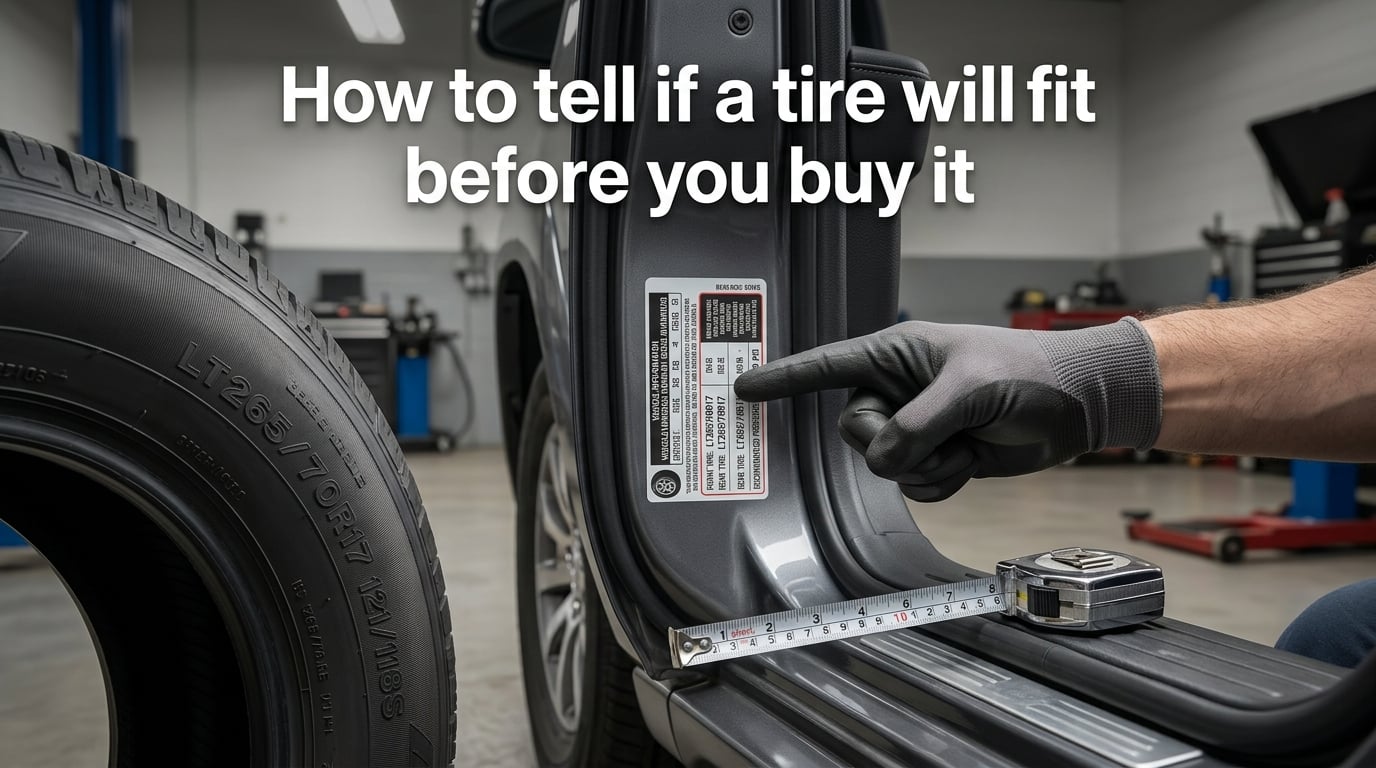
Buying the wrong tire costs you a return trip, possibly a wheel, and sometimes a tow. Knowing how to tell if a tire will fit before you buy it comes down to three checks: confirm your stock size on the door placard, decode the new tire’s code, and compare overall diameter, width, and wheel fitment.
I’ve been around tires long enough to know that most fitment mistakes come from skipping one of those three checks. In this guide, I’ll walk you through the exact steps our team uses when we verify fitment for customers, plus the questions drivers actually ask on forums like r/tires and r/Cartalk before they click “buy.”
Table of Contents
The 3-Step Answer (Read This First)
If you only have 60 seconds, here is the short version of how to know if a tire fits your car before buying:
- Find your stock size on the driver’s-side door placard (or in the owner’s manual, or by VIN lookup).
- Decode the new tire’s code (for example, P225/65R17) so you know its width, sidewall height, and wheel diameter.
- Compare the two using the 3% rule for overall diameter and the wheel-width range for your rim, then do a physical clearance check at full lock.
The rest of this guide explains each step in detail, the rules of thumb the pros use, and the exact PAA questions people ask right before they buy.
Step 1 – Find Your Stock Tire Size (Door Placard, Owner’s Manual, or VIN)
Your stock tire size is the single most important number in this entire process. Get this right first, and every other comparison becomes simple.
The Door Placard (Start Here)
Open the driver’s-side door and look at the door jamb sticker, often called the tire placard. On most vehicles built after 2005, it lists the manufacturer-recommended tire size, the cold inflation pressure, and the wheel size. This is the size your vehicle was engineered to run, and it is the answer to the question “Where is the tire size on my car?” for 9 out of 10 drivers.
The Owner’s Manual
If the placard is faded or missing (common on older trucks and used cars), the owner’s manual glovebox book lists the original tire size and acceptable alternatives. Look in the “Wheels and Tires” or “Specifications” section.
VIN Lookup and License Plate Lookup
For used cars where you don’t know the original spec, run your VIN through your dealer or a free tire-size-by-VIN tool. You can also search by license plate on most tire retailer sites. These tools cross-reference OEM build data and return the exact tire size the car left the factory with. Forum users on r/MechanicAdvice repeatedly ask for this because used cars often come with whatever the previous owner installed, which may not match the door sticker.
Write down three things from this step: your stock tire size (e.g., P225/65R17), your stock wheel size (e.g., 17×7.5), and any “acceptable alternatives” the manufacturer lists.
Step 2 – Decode the Tire Size Code (P225/65R17 Explained)
Once you have a candidate tire in front of you, the sidewall tells you almost everything you need to know. A code like P225/65R17 95H breaks down like this:
- P = P-metric (passenger vehicle). LT means light truck; no letter means Euro-metric.
- 225 = section width in millimeters, measured from the widest point of the sidewall to the widest point on the other side.
- 65 = aspect ratio, the sidewall height as a percentage of the section width. In this case, the sidewall is 65% of 225 mm, or about 146 mm.
- R = radial construction (almost universal on modern tires).
- 17 = wheel diameter in inches. This must match your rim exactly. You cannot put a 17-inch tire on an 18-inch wheel.
- 95H = load index (95 = 1,521 lbs per tire) and speed rating (H = 130 mph).
The “7 7 Rule” for Tires
You may see the “7 7 rule” mentioned on forums. It is shorthand for keeping overall diameter within 3% of stock (some call it the “3 3 rule” or “3% rule”). It is not a literal measurement rule but a safety rule of thumb that prevents speedometer drift and rubbing.
P-Metric vs LT – A Quick Caveat
P-metric tires are designed for passenger vehicles and ride softer. LT (light truck) tires have stiffer sidewalls and higher load capacity. They look similar but behave differently under load. If your door placard calls for LT, do not substitute P without checking load index, even if the size matches.
Step 3 – Compare New Size vs Stock (The 3% Rule)
Now the math. The single most useful comparison is overall diameter, because it controls both clearance and speedometer accuracy.
Calculate Overall Diameter
Use this formula for any tire size:
Overall diameter (mm) = wheel diameter (in) x 25.4 + 2 x (section width x aspect ratio)
For a P225/65R17: 17 x 25.4 + 2 x (225 x 0.65) = 431.8 + 292.5 = 724.3 mm overall.
The 3% Rule
Your new tire’s overall diameter should stay within plus or minus 3% of your stock tire’s overall diameter. A 3% jump on a typical 28-inch tire is about 0.85 inch (roughly 22 mm) in total diameter, or about 11 mm of sidewall change per side. Beyond that, your speedometer drifts, your ABS ring may misread, and your traction control may intervene at the wrong moment.
Common Swaps: 225 vs 235, 225 vs 245
This is one of the most asked PAA questions: “Can I use 225 tires instead of 235?” The answer depends on wheel width, not just width math. A 225 tire is 10 mm narrower than a 235; on the same wheel, the sidewall shape flexes slightly and you may see a small ride-quality change. Going from 225 to 245 is a 20 mm jump, which often pushes the tire outside its approved rim range on stock wheels. Always check your rim’s approved range before you swap widths.
Step 4 – Match the Tire to Your Wheel Width
Width and diameter are not the same rule. Wheel diameter must match exactly (an 18-inch tire fits only an 18-inch wheel). Wheel width, on the other hand, accepts a range. This is where most buyers make mistakes.
The J Number
Wheel width is stamped on the wheel as a J number, such as 7J, 7.5J, or 8J. The J is the bead-seat profile; the number is the width in inches. A 7.5J wheel is 7.5 inches wide.
Measuring Rim vs Approved Rim Range
Every tire has a “measuring rim width” (the rim the tire was tested on) and an “approved rim width range” (the safe rim widths it can be mounted on). On a tire spec sheet, you’ll see something like “Measured rim: 7.5″, Approved rim range: 6.5 – 8.5.” Stay inside that range.
The Half-Inch Rule
If you can’t find the spec sheet, use the half-inch rule: every 0.5 inch of rim width changes the tire’s section width by roughly 5 mm. Going from a 7-inch rim to an 8-inch rim widens a 225 tire to about 235. Going the other way narrows it to about 215.
Wheel Width to Tire Width – The Fitment Chart
This is the chart most people screenshot. It shows the minimum, ideal, and maximum tire section widths for common rim widths. Use it as a starting point, then always confirm with the tire maker’s spec sheet for your specific model.
| Rim Width (J) | Min Tire Width | Ideal Range | Max Tire Width |
|---|---|---|---|
| 5.5 inch | 165 mm | 175 – 185 mm | 195 mm |
| 6.0 inch | 175 mm | 185 – 195 mm | 205 mm |
| 6.5 inch | 185 mm | 195 – 205 mm | 215 mm |
| 7.0 inch | 195 mm | 205 – 215 mm | 225 mm |
| 7.5 inch | 205 mm | 215 – 225 mm | 235 mm |
| 8.0 inch | 215 mm | 225 – 235 mm | 245 mm |
| 8.5 inch | 225 mm | 235 – 245 mm | 255 mm |
| 9.0 inch | 235 mm | 245 – 255 mm | 265 mm |
| 9.5 inch | 245 mm | 255 – 265 mm | 275 mm |
| 10.0 inch | 255 mm | 265 – 275 mm | 285 mm |
| 10.5 inch | 265 mm | 275 – 285 mm | 295 mm |
| 11.0 inch | 275 mm | 285 – 295 mm | 305 mm |
| 12.0 inch | 295 mm | 305 – 315 mm | 325 mm |
Reading this chart: a 7-inch rim (7J) can run anything from a 195 mm tire (minimum) to a 225 mm tire (maximum), with 205 to 215 mm being the sweet spot. A 275 mm tire on a 7-inch rim would not seat safely.
Will a 10-Inch Tire Fit on a 7-Inch Rim?
No. A 10-inch tire refers to a 10-inch wheel diameter. A 7-inch rim is a 7-inch wheel diameter. They do not match. The diameter must be exact, which is why an 18-inch tire fits only an 18-inch wheel. Width is where you have flexibility.
Will an 18-Inch Tire Fit on Any 18-Inch Rim?
Not necessarily. The diameter has to match (yes, 18 to 18), but the rim width must fall inside the tire’s approved range. An 18-inch wheel could be 8J, 9J, or 10J, and a given tire may only fit one or two of those widths.
Is 275 Considered a Wide Tire?
Yes. Anything 245 mm and up is generally classified as a wide or “plus” tire. A 275 tire typically needs at least a 9-inch rim and is common on sports cars, SUVs, and light trucks where grip matters more than fuel economy.
Step 5 – Do a Physical Clearance Check at Full Lock
Numbers on a chart are a great start, but a real clearance check is what actually prevents the “I bought tires and they rub” forum post.
The Finger Test
Turn the steering wheel all the way to one lock. With the wheel at full turn, reach behind the tire and check the gap between the tire sidewall and the inner fender liner, the suspension strut, and the control arm. You want at least two fingers of clearance (about 15 to 20 mm) at full lock with normal ride height. Less than that, and you will rub the moment you hit a bump.
Common Rub Spots
The four places tires rub first, in order: the front bumper or bumper cover on tight turns, the inner fender liner near the strut, the rear of the front wheel well, and the mud flap. SUVs and trucks with leveling kits are especially prone to rub at full lock, even when the new tire is the same nominal size as the old one.
The Phone-Photo Tape-Measure Trick
Park next to a wall on flat ground. Hold your phone perpendicular to the tire and take a photo with a tape measure hanging from the fender lip down to the ground. The distance from fender to ground tells you how much taller you can go before the tire meets the fender. Multiply by two to find your max lift, minus a 10 mm safety margin.
If you cannot physically check before you buy (online order, ship-to-home), call the retailer and ask them to confirm fitment for your exact VIN. Most reputable tire shops will.
Step 6 – Verify Wheel Compatibility (Offset, Bolt Pattern, Hub Bore)
If you are keeping your stock wheels, skip ahead. If you are buying new wheels along with the tires, three numbers have to match: offset, bolt pattern, and hub bore.
Wheel Offset (ET)
Offset is the distance in mm between the wheel’s mounting surface and its centerline. A higher ET pushes the wheel inward; a lower ET (or negative offset) pushes it outward. Going too far outward is the number-one cause of rubbing on the fender. Going too far inward is the number-one cause of rubbing on the strut. Stock offset is printed on the wheel or in the owner’s manual; aftermarket wheels list it as ET35, ET45, and so on.
Bolt Pattern
Bolt pattern is written as lug count x pitch circle diameter, like 5×114.3 or 6×135. Five lug holes on a 114.3 mm circle is not the same as five lug holes on a 120 mm circle. This number must match exactly.
Hub Bore and Hub-Centric Rings
The hub bore is the center hole in the wheel. If it is larger than your hub (common with aftermarket wheels), you need a hub-centric ring to keep the wheel centered. Lug-centric wheels can vibrate at highway speed without one.
TPMS Sensor Compatibility
If your car has a Tire Pressure Monitoring System, the sensors inside your current wheels may not transfer to the new wheels. New wheels usually need new TPMS sensors, and a tire change alone is a good moment to replace aging sensors. This is one of the most overlooked fitment details and nobody mentions it until the warning light comes on.
Step 7 – Check Speedometer, ABS, and Traction-Control Impact
Your vehicle’s computers assume a specific tire circumference. Changing overall diameter by more than 3% confuses them.
Speedometer Drift
A tire 3% taller than stock reads about 3% slow. On a 60 mph road, your speedometer shows 60 but you are actually doing 61.8. That may sound small, but it adds up over a tank of fuel and skews odometer readings.
ABS and Traction Control
The ABS ring counts revolutions per mile. Bigger tires turn fewer times per mile; smaller tires turn more. The system is calibrated within a range, but if you go outside that range, ABS may engage late and traction control may cut power at the wrong moment. On most cars, anything within plus 3% is fine. On some, especially newer AWD vehicles, anything outside plus 1% triggers a check-engine light or requires ECU recalibration.
When to Recalibrate
If you change overall diameter by more than 2% on a vehicle with active stability control or AWD, plan a dealer visit or a hand-held ECU recalibration. It takes 20 minutes and saves you a dashboard full of warning lights.
Pre-Purchase Checklist (Print or Screenshot This)
Before you click “buy,” run through this list. If you can answer yes to every line, the tire will fit.
- Stock tire size confirmed from door placard, owner’s manual, or VIN.
- New tire diameter within plus 3% of stock (use the calculator above).
- New tire width falls inside the wheel’s approved rim-width range.
- Wheel diameter matches exactly (17 to 17, 18 to 18, and so on).
- Two fingers of clearance at full lock with normal ride height.
- No rub points on the inner fender, strut, or bumper cover.
- Wheel offset is within plus 5 mm of stock (if buying new wheels).
- Bolt pattern matches exactly.
- Hub bore matches or hub-centric ring installed.
- Load index meets or exceeds stock.
- Speed rating meets or exceeds stock.
- TPMS sensors transferred or replaced.
- Speedometer / ABS / traction-control impact assessed.
Frequently Asked Questions
How do you know if a tire will fit?
Start with the tire size on your driver’s-side door placard or in the owner’s manual. Compare the new tire’s overall diameter to your stock tire (keep it within plus or minus 3%), check that the rim width falls inside the tire’s approved range, then do a physical clearance check at full lock. If all three checks pass, the tire fits.
What is the 3% rule for tire size?
The 3% rule says your new tire’s overall diameter should stay within plus or minus 3% of the stock tire’s overall diameter. On a typical 28-inch tire, that is about 0.85 inch of total diameter change, or roughly 11 mm of sidewall per side. Staying inside the 3% rule keeps your speedometer, ABS, and traction control accurate.
Will a 10 inch tire fit on a 7 inch rim?
No. Tire diameter must match the wheel diameter exactly. A 10-inch tire fits only a 10-inch wheel, and a 7-inch rim is a 7-inch wheel. Width is the dimension that has flexibility, not diameter. If you want to mount a tire on a 7-inch wheel, look for tires labeled 7-inch or smaller in diameter.
Will an 18 inch tire fit on any 18 inch rim?
Not necessarily. The diameter must match (yes, 18 to 18 works), but the rim width must also fall inside the tire’s approved rim-width range. An 18-inch wheel can be 8J, 9J, or 10J wide, and a given tire may only fit one or two of those widths. Always check the manufacturer’s approved rim range for that specific tire model.
Can I use 225 tires instead of 235?
Yes, usually. A 225 tire is 10 mm narrower than a 235, and on the same wheel the sidewall flexes slightly differently. The swap is safe if the 225 width falls inside your rim’s approved range and the overall diameter stays within 3% of stock. The difference in feel is minor; the difference in grip and cost can be noticeable.
Can I use 225 tires instead of 245?
Often yes, but check your rim. A 225 tire is 20 mm narrower than a 245. On a stock 7.5-inch rim, a 245 may be near the upper limit of the approved range, while a 225 sits comfortably in the middle. The trade-off is grip (245 has more contact patch) versus ride quality and clearance (225 fits more vehicles). Confirm with the tire maker’s spec sheet for your model.
Is 275 considered a wide tire?
Yes. A 275 mm tire is generally classified as a wide or plus tire. Wide tires need wider rims (typically 9 inches or more) and are common on sports cars, SUVs, and light trucks where grip matters more than fuel economy. They also need extra clearance at full lock, so always check fender and suspension clearance before mounting a 275.
How important is looking up the offset?
Very important. Wheel offset controls how far inboard or outboard the tire sits. Too much outboard offset causes rubbing on the fender; too much inboard offset causes rubbing on the strut and suspension. Stock offset for your vehicle is in the owner’s manual or on the door placard. Stay within plus 5 mm of stock unless you have measured clearance to do otherwise.
Conclusion
Knowing how to tell if a tire will fit before you buy it boils down to a handful of checks. Read your stock size off the door placard, decode the new tire’s sidewall code, compare overall diameter within the 3% rule, confirm the rim width matches the tire’s approved range, and walk around the wheel well at full lock with two fingers of clearance in mind.
If you’re buying new wheels, add offset, bolt pattern, hub bore, and TPMS to your checklist. If you’re replacing tires only on stock wheels, the door-placard path through the seven steps above covers nearly every fitment question drivers actually ask.
Take five minutes with the printable checklist at the top of this guide before you order. A five-minute check saves a return trip, a tire change appointment, and in some cases a wheel. That’s our team’s standing rule, and it’s the same rule the regulars on r/tires and r/MechanicAdvice keep coming back to: measure twice, mount once.