
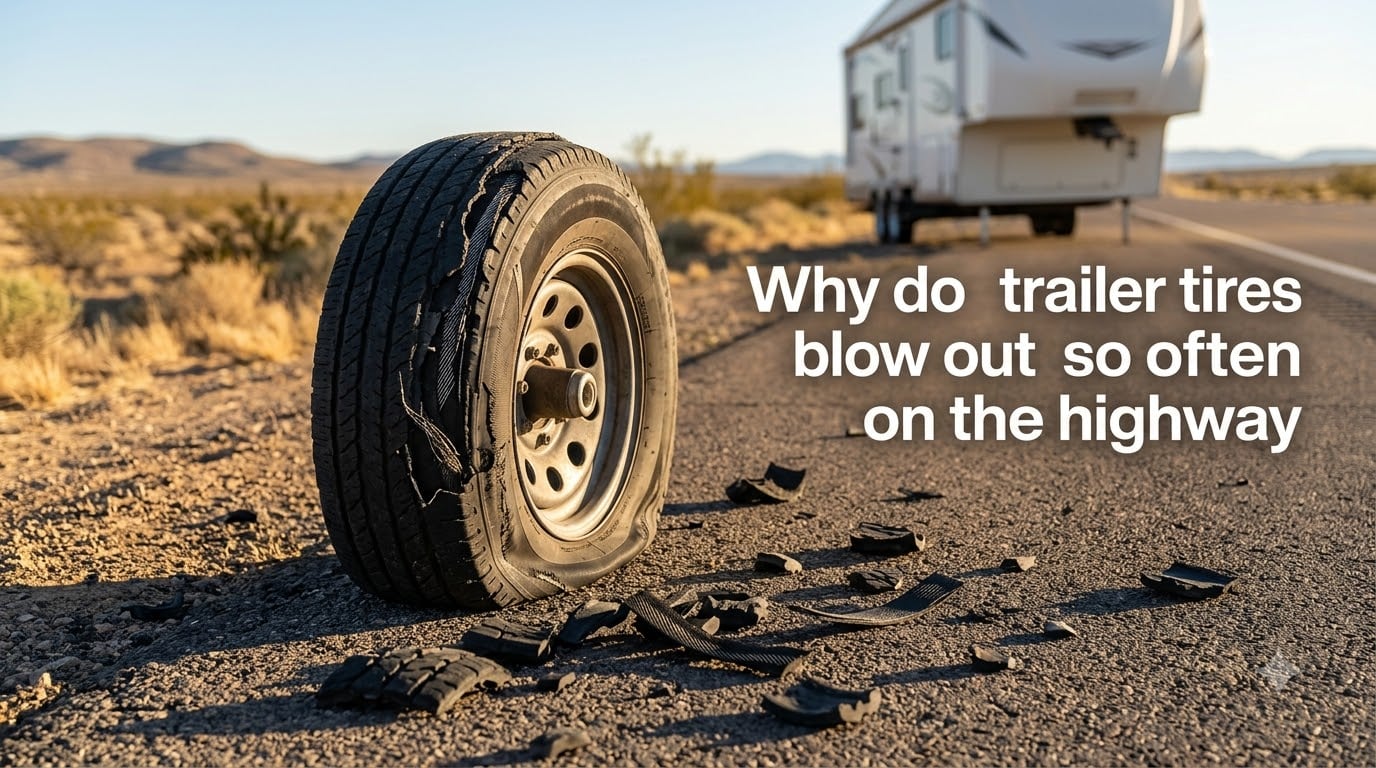
Trailer tires blow out on the highway because three forces stack against them at once: chronic underinflation that superheats the sidewalls, loads that exceed the tire’s load range, and highway speeds above the ST tire’s 65 MPH rating. Add aged rubber from storage, factory-installed budget tires, and heat-soaked summer asphalt, and a single highway mile can finish off a tire that was already on borrowed time. The good news: nearly every blowout is preventable with cold PSI checks, a working TPMS, and a 5-year replacement rule.
After 15 years of working with RV owners, livestock haulers, and weekend tower crews, I can tell you the highway blowout is almost never a surprise to the tire. It is a slow failure that nobody noticed. In this guide, I will walk through exactly why trailer tires fail more often than car tires, the six root causes, the physics inside the sidewall during those final seconds, and the pre-trip routine our team uses to keep our own trailers rolling.
Table of Contents
The 6 Main Reasons Trailer Tires Blow Out on the Highway
If you only have 30 seconds, this is the short list. Every blowout I have investigated traces back to one of these six root causes, and most trailers on the road have at least three of them working against the tire at the same time.
- Underinflation and heat buildup — the number one killer of trailer tires on the highway.
- Overloading the trailer or carrying uneven weight that exceeds the tire’s load range.
- Old age and dry rot — rubber fails after 5 to 6 years regardless of how much tread is left.
- Exceeding the 65 MPH speed rating stamped on every ST (Special Trailer) tire.
- Factory “China bomb” budget tires that came on the trailer from the dealer.
- Road hazards and mechanical issues — potholes, dragging brakes, overheated hubs, and single-axle bounce.
NHTSA estimates tire failures are responsible for around 11,000 vehicle crashes every year, and trailer blowouts make up a meaningful share of those. The rest of this article breaks down each cause and gives you the prevention playbook we use on our own rigs.
Underinflation and Heat Buildup: The #1 Root Cause
Underinflation is the single biggest reason trailer tires blow out on the highway, and it is also the easiest to prevent. When a trailer tire sits 5 to 10 PSI below its cold pressure target, the sidewall has to flex farther with every rotation. That extra flexing converts mechanical energy into heat, and heat is the enemy of every polyester cord and steel belt inside the tire.
Here is the failure sequence we walk customers through: as the tire heats up, the rubber compound softens. The bond between the steel belts and the carcass weakens. The tread begins to “squirm” rather than roll flat, which generates even more heat. Eventually the belts separate from the carcass, the tire loses its air seal, and the whole structure fails in a fraction of a second. From the driver’s seat it looks instant, but the cord fatigue started 200 miles earlier.
On a 90°F day with black asphalt, a tire that was 8 PSI low at the campground can climb 30 to 40 PSI by the time it is at highway speed. That pressure swing is normal — but only if you started at the right cold PSI. If you started low, you are now operating in the danger zone.
Our team always sets cold PSI based on the tire sidewall (the maximum cold inflation pressure stamped on the tire), not the door-sticker PSI on the trailer. The door sticker reflects the trailer manufacturer’s recommendation, but most tire and RV industry veterans recommend inflating to sidewall max cold PSI for stability and load carrying. Check the tire sidewall, then recheck it cold before every trip.
The Cold PSI Rule That Saves Tires
Cold PSI means the tire has been sitting for at least 3 hours, or driven less than a mile. Pressure rises 3 to 5 PSI once you are rolling, so a “warm” reading is not the same number as your target. Buy a quality digital gauge, check cold pressure before every tow day, and never bleed pressure when the tire is hot.
Overloading the Trailer and Exceeding Load Range
Overloading is the second member of the deadly triangle: heat, underinflation, and weight. Every trailer tire carries a load range stamped on the sidewall — Load Range C, D, or E being the most common. The load range tells you the maximum weight each tire is engineered to carry at its maximum cold PSI.
When you exceed that number, the sidewall flexes more on every rotation, the same way it does when underinflated. More flex means more heat. More heat means the belts separate sooner. A trailer that is even 10% over its Gross Vehicle Weight Rating (GVWR) will see tire temperatures climb 20 to 30°F hotter than a properly loaded rig under the same conditions.
The 60/40 rule for trailer loading is worth memorizing: roughly 60% of the cargo weight should sit in front of the trailer’s axle centerline, and 40% behind it. Getting this wrong puts too much weight on one axle and starves the other — the overloaded axle cooks its tires while the light axle bounces and scallops its tread.
Load Range Upgrades Worth Considering
If your trailer came with Load Range C tires and you regularly haul near the GVWR, stepping up to Load Range D or E gives you more headroom for heat and speed. The trade-off is a stiffer ride and slightly lower fuel economy, but for heavy haulers and gooseneck trailers, the upgrade is one of the smartest preventive moves you can make.
Old Age, Dry Rot, and the 5-Year Replacement Rule
Tread depth tells you very little about how safe a trailer tire really is. The single best predictor of a blowout is the tire’s age, and age is something you can read directly off the sidewall.
Every trailer tire sold in the U.S. carries a DOT date code on its sidewall. Look for a small oval with “DOT” followed by four numbers. The last four digits are the week and year of manufacture. For example, “1522” means the tire was built in the 15th week of 2022. Most trailer tires should be replaced 5 to 6 years after that date, regardless of how much tread is left.
Dry rot happens because rubber is an organic compound. UV light, ozone, and heat slowly break down the polymers, and the sidewalls develop cracking, checking, and brittleness long before the tread wears down. A trailer that sits in storage for 6 months every winter is aging whether or not it ever rolls a mile.
Our rule of thumb on the team: if a tire is more than 5 years old, we replace it before the next long trip — even if the tread looks fine. If the sidewalls show any visible cracking, we replace it immediately. The 5-year rule is not a marketing slogan; it is the difference between a safe arrival and a shoulder-of-the-interstate story.
The DOT Date Code Sidebar
Find the DOT stamp on the tire sidewall (driver’s side is easiest to read). The last four digits are WWYY — week and year. A tire marked “0824” was made in late February 2024. If you cannot find a date code, the tire is old enough to suspect and worth replacing.
Exceeding the 65 MPH ST Tire Speed Rating
ST (Special Trailer) tires are built with stiffer sidewalls than passenger (P) or light truck (LT) tires. That stiffness helps them carry heavy vertical loads without swaying, but it also means they flex less to absorb heat. Most ST tires are speed-rated L (75 MPH) on paper, but in real-world testing the consensus among tire engineers is that sustained speeds above 65 MPH dramatically shorten their life.
Here is the physics: at 65 MPH, a trailer tire rotates about 570 times per minute. Each rotation flexes the sidewall, generates internal friction, and produces heat. Push to 75 MPH and you have added nearly 15% more rotations per mile and roughly 20% more heat generation. The threshold is not the speed rating stamp; it is the heat your tire can shed before the belts let go.
Tow vehicles today are perfectly comfortable at 75 to 80 MPH. ST tires are not. This mismatch is one of the most common causes of summer highway blowouts, especially on long interstate pulls through the desert Southwest.
ST vs LT vs P Tires: Which Belongs on a Trailer
ST tires are designed for trailer duty: heavy load, lower speed, vertical load only. LT tires are designed for trucks and can handle steering and braking forces. P tires are designed for passenger cars and are the wrong choice for any trailer over 3,000 pounds. If you tow a fifth wheel or gooseneck at sustained highway speeds, a quality LT tire in the correct load range can outperform a budget ST tire — but it must be rated for trailer use and properly inflated.
Factory “China Bomb” Budget Tires
Walk the lot of any new travel trailer dealer and you will see a sea of trailers riding on the cheapest ST tires the manufacturer could source. RV insiders call these “China bombs” for a reason: they are budget-built tires with thin sidewalls, light belts, and inconsistent quality control. Many fail in under 2,000 miles — sometimes less.
I have personally inspected factory tires that came off a brand-new fifth wheel after a single 400-mile tow. The sidewall had a visible bulge where the belts had already begun separating. The owner had been running them at the door-sticker PSI (lower than sidewall max) and at 70 MPH on the interstate, which is exactly the failure recipe for a budget tire.
Replacement brands our team has had the best long-term results with include Goodyear Endurance, Sailun S637, and Carlisle Radial Trail. These are not the cheapest options, but the difference between a tire that lasts 6 years and one that fails in 6 months shows up quickly when you do the math on body damage, tow bills, and lost trip days.
Road Hazards, Mechanical Issues, and the Single-Axle Bounce Problem
Potholes, construction debris, and curbside impacts can bruise a trailer tire’s sidewall enough to set up a slow leak and eventual blowout. The bruise damages the internal cords without showing on the outside, and the tire gradually loses air over weeks before failing.
Mechanical factors get less attention but cause real damage. Dragging brakes (a stuck caliper or improperly adjusted electric brake) heat one wheel far hotter than the others. Overheated wheel bearings transfer heat into the tire through the rim. Misaligned axles scrub the tread sideways and build asymmetric heat. A single bent axle can take out two tires in a single trip.
The Single-Axle Harmonic Bounce
Here is the physics angle no written competitor covers well: a single-axle trailer has a natural harmonic frequency that sits right around 55 to 65 MPH. As you approach that speed, the trailer’s mass resonates with road irregularities and the tire sidewalls flex in a controlled oscillation that compounds with every rotation. Heat builds faster, the belts fatigue faster, and the failure window shrinks dramatically.
This is why single-axle trailers seem to “toss a tire” out of nowhere on the highway. The tire was already marginal, and the harmonic bounce finished the job. Tandem-axle trailers distribute this energy across more tires and rarely fail the same way.
How to Prevent Trailer Tire Blowouts: Step-by-Step Checklist
Our team runs this checklist before every tow day. It takes about 12 minutes and has saved us countless hours of roadside recovery.
- Check cold PSI on every tire, including the spare. Inflate to sidewall max cold PSI, not the door-sticker number.
- Visually inspect sidewalls for cracks, bulges, and embedded debris. Run your hand along the sidewall to feel for soft spots.
- Read the DOT date code on each tire. Replace anything over 5 years old before your next long trip.
- Verify the spare tire is inflated, mounted, and not older than the four road tires. Most owners forget the spare until they need it.
- Confirm the load is balanced using the 60/40 rule. Heavier items low and centered over the axle.
- Test your TPMS readings before you pull out. Set your alert threshold 5 PSI above cold and below cold.
- Drive the first 10 miles at 55 MPH or less to let the tires warm up gradually and confirm no leaks.
- Re-torque lug nuts to spec after the first 10, 25, and 50 miles of any new tire installation or seasonal re-mount.
- Use tire covers during any storage longer than 30 days to block UV and ozone exposure.
- Tow at 65 MPH or below on sustained highway runs, especially in summer heat.
A TPMS (Tire Pressure Monitoring System) is the single highest-ROI upgrade for any tower. Forum regulars across r/GoRVing, iRV2, and Thor Forums consistently call it “must-have equipment.” A good TPMS alerts you the moment pressure starts dropping, long before the tire is hot enough to fail.
What Happens Inside a Tire During a Blowout
A highway blowout looks sudden, but the tire has been failing for a while. Here is the sequence our techs walk customers through after a roadside incident.
First, the inner polyester cords fatigue from repeated over-flexing. The rubber around them weakens. Second, the steel belts begin to separate from the carcass — this is tread separation, and it is what throws the chunk of rubber you see in the ditch. Third, the air seal between the tire and rim fails. Fourth, the entire structure collapses in roughly 200 milliseconds, and the tire disintegrates.
The tire debris that comes off during a blowout is what causes the real damage. A chunk of tread at highway speed has the kinetic energy of a small projectile, which is why forum regulars report $1,500 to $3,000 in body, fender, and wiring damage from a $150 tire failure. One r/RVLiving member described his tow home after a blowout: “It shredded the fender skirt, ripped the brake line, and ended up wrapped around the axle. The tire cost me less than dinner. The damage cost me a month in the shop.”
What to Do When a Trailer Tire Blows Out on the Highway
Stay calm. A trailer tire blowout at highway speed is dramatic but rarely causes loss of control if you do three things in order.
- Grip the steering wheel firmly with both hands and keep the trailer tracking straight behind the tow vehicle.
- Take your foot off the gas immediately. Do not brake hard. Let the tow vehicle slow naturally.
- Gently steer toward the shoulder once speed is below 45 MPH, and only then apply light brake pressure.
Once stopped, turn on your hazard lights, set flares or triangles if you have them, and exit the cab on the passenger side away from traffic. A standard truck bottle jack will not safely lift a loaded trailer axle on the highway shoulder — call roadside assistance rather than risk the jack kicking out under load.
Do not continue driving with the blown tire in place. MyGrandRV forum regulars warn that the remaining shredded rubber flaps against the wheel well at speed and can take out brake lines, wiring, and fender skirts that were perfectly fine moments earlier. If the tire is shredded, the trailer needs a tow.
Frequently Asked Questions
Why do trailer tires blow out so often on the highway?
Trailer tires blow out because underinflation superheats the sidewalls, loads exceed the load range, towing speeds run above the 65 MPH ST rating, and the rubber ages out after 5 to 6 years regardless of tread depth. Factory budget tires, summer asphalt heat, and single-axle harmonic bounce compound the problem.
How do you prevent trailer tire blowouts?
Check cold PSI before every trip, inflate to the sidewall max cold pressure, replace any tire over 5 years old, install a TPMS, balance cargo 60/40 front-to-rear, and tow at 65 MPH or below on sustained highway runs. Re-torque lug nuts after the first 10, 25, and 50 miles of any new installation.
What is the 60/40 rule for trailers?
The 60/40 rule means roughly 60% of cargo weight should sit in front of the trailer’s axle centerline and 40% behind it. Proper balance prevents one axle from overheating while the other bounces and scallops its tread.
Can you drive a trailer with a blown tire?
No. The shredded rubber flaps against the wheel well at speed and can destroy brake lines, wiring, and fenders that were undamaged in the original blowout. Call roadside assistance and have the trailer towed rather than limping home.
How long do trailer tires last?
Trailer tires should be replaced every 5 to 6 years regardless of tread depth, because UV, ozone, and heat degrade the rubber compounds even when the trailer is in storage. Tread depth tells you very little about remaining tire life once the tire is past the 5-year mark.
What is the 7 7 rule for tires?
The 7 7 rule is a community shorthand suggesting tires should be replaced after 7 years of service or when tread depth drops below 7/32 of an inch, whichever comes first. It is a slightly more conservative cousin to the common 5-year rule.
Are trailer tires speed rated?
Yes. Most ST (Special Trailer) tires carry a speed rating of L, which is 75 MPH, but most tire and RV industry veterans recommend sustained speeds of 65 MPH or below to keep internal temperatures in a safe range. Towing at 75 to 80 MPH dramatically shortens ST tire life.
The Bottom Line on Highway Trailer Tire Blowouts
Trailer tires blow out on the highway because heat, load, speed, and age stack up faster than most owners realize. The two cheapest, highest-impact moves you can make today are checking your cold PSI and reading the DOT date code on each tire. From there, a quality TPMS, the 60/40 loading rule, and a 65 MPH towing habit will handle almost everything else.
If you only remember one thing from this guide, make it this: the blowout is not a surprise to the tire. It is a surprise to the driver. Spend 12 minutes on the pre-trip checklist, replace anything over 5 years old, and your trailer will be the one that arrives in one piece.