
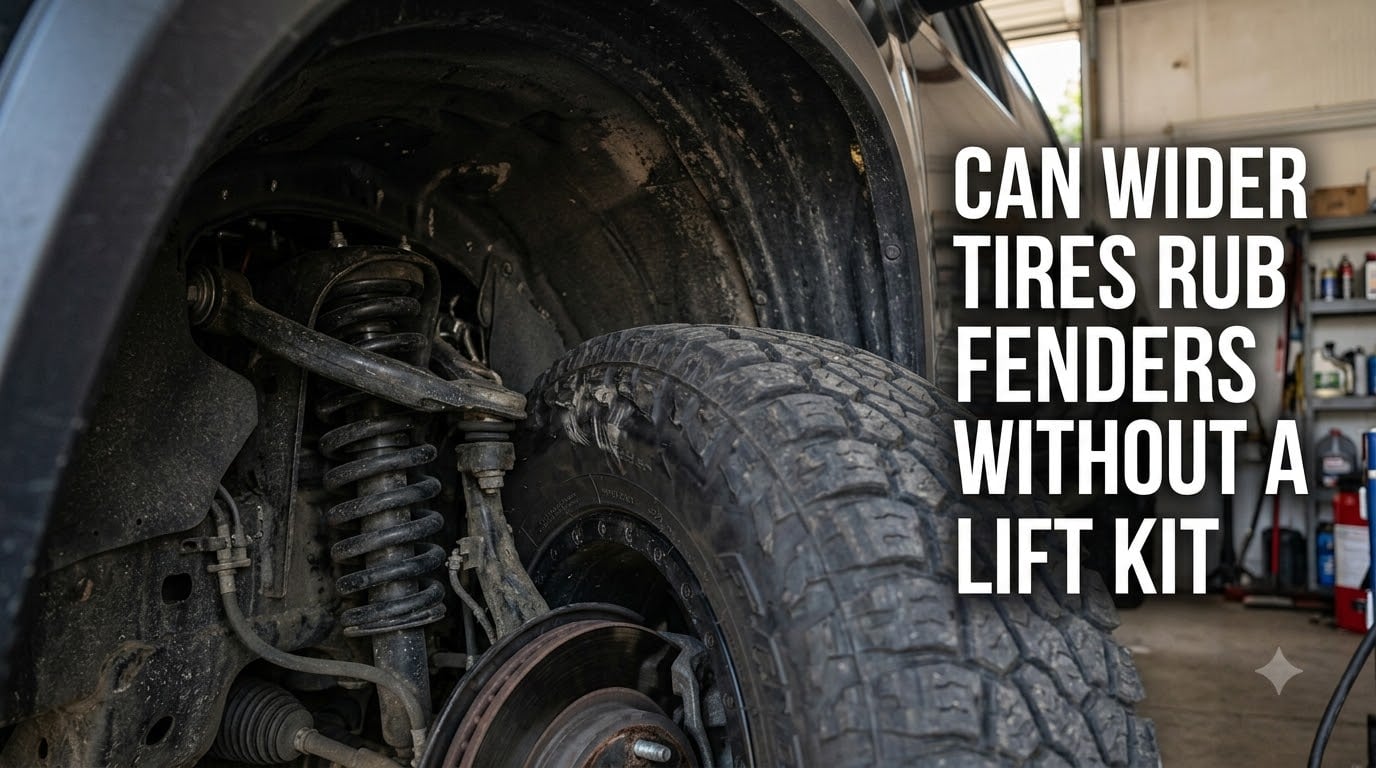
Wider tires can absolutely rub the fenders without a lift kit. The extra width pushes the tire’s sidewall closer to the inner fender, and during turns, suspension compression, or reversing, that sidewall can contact plastic liners, control arms, or sheet metal. Rubbing is one of the most common complaints I see from owners who upgrade their tires without upgrading ride height, and most of them are surprised that even a half-inch increase in width is enough to start the problem.
I wrote this guide because the question comes up every week on truck, SUV, and car forums, and the answers are usually vague. We’ll cover exactly why wider tires rub, how to measure your current clearance before buying, and what fixes actually work without a lift kit. By the end, you’ll know whether your next set of tires needs nothing, a simple fender roll, or a full suspension change.
Table of Contents
Quick Answer: Yes, Wider Tires Can Rub Without a Lift Kit
The short answer is yes. Adding width to your tires means the sidewall sits closer to the inner fender and to suspension components on both sides of the wheel well. Even if the tire diameter stays the same, that extra half-inch of width on each side leaves less room for the tire to flex, articulate, and rotate.
Rubbing usually shows up in three situations:
- At full steering lock, when turning into a driveway or parking spot
- During suspension compression, when hitting a bump or dip in the road
- While reversing, especially with the wheels turned
If your static ride-height looks fine but you hear scraping only at certain moments, width is almost always the cause.
Why Wider Tires Cause Rubbing Even With the Same Diameter
A wider tire has a larger contact patch with the road, but it also has a larger overall profile inside the wheel well. The tire’s outer edge sits closer to the fender lip, and its inner edge sits closer to the suspension. At static ride height, you might still see daylight between the tire and fender, but the available space shrinks fast once the wheel moves.
Three forces shrink that space at the same time:
Suspension Compression
When your vehicle hits a bump, the suspension compresses and the wheel moves up into the wheel well. A wider tire has less room to travel before the sidewall contacts the fender liner. This is the most common type of rubbing I see, and it often doesn’t show up on a flat parking lot.
Full Steering Lock
Turning the wheel to full lock rotates the tire and pulls it forward and inward. The steering angle changes the geometry so the tire swings into the fender or control arm. Even small width increases can trigger rubbing here, especially on cars with tight wheel wells like the Honda Civic, Subaru WRX, or BMW 3 Series.
Reverse and Curb Cuts
Reversing with the wheels turned puts the tire in a similar geometry to forward full lock, but with the suspension slightly loaded differently. Owners commonly report a scraping sound only when backing out of driveways.
Width vs Diameter: Which One Actually Causes Rubbing
Most articles treat “bigger tires” as one thing, but width and diameter affect clearance differently. A tire that’s wider but the same overall diameter adds clearance problems mainly on the sides. A tire that’s taller but the same width adds clearance problems at the top of the wheel well, especially during compression.
If you’re upgrading from a 265/70R17 to a 285/70R17, you’ve added width without changing diameter. The rubbing, if any, will show up at full lock or hard bumps. If you’re upgrading from a 265/70R17 to a 265/75R17, you’ve added diameter with no width change, and the rubbing will mostly show up over bumps when the front of the tire nears the fender liner.
The 3% Rule for Plus-Sizing
The 3% rule is a guideline used by tire shops and forum regulars. It says you should not increase overall tire diameter by more than about 3% without addressing clearance. A 33-inch tire can usually fit on a stock suspension if the vehicle was designed around 32-inch tires. A 35-inch tire on the same vehicle will need either trimming or a lift.
For width, the unofficial rule is that each 0.5 inch of added width wants roughly 0.25 inch of extra clearance somewhere. If your current tire has 1 inch of clearance to the fender liner at full lock, going wider by 1 inch puts you right at the rub point.
Wheel Offset and Backspacing Explained
Wheel offset is the distance between the wheel’s mounting surface and its centerline, measured in millimeters. A positive offset pushes the wheel inward toward the vehicle. A negative offset pushes it outward. Backspacing is measured differently but tells you the same thing: how far inward the wheel sits relative to the fender lip.
When you add width, the wheel itself can either stay in the same position or move outward depending on the offset. A wheel with less offset (more negative, or lower positive number) sits further out, which adds clearance on the inside but reduces clearance on the outside fender. A wheel with more offset sits further in, which can clear the fender lip better but may now contact the control arm, sway bar, or strut.
Practical Numbers
On a typical half-ton truck, going from a +25 offset to a 0 offset pushes the wheel outward by about 25 mm, or roughly 1 inch. That outward move often fixes inside rubbing at the cost of creating outside rubbing. On a Jeep Wrangler JK running 33-inch tires, owners on wranglerforum.com report that the factory offset works fine, but going to a wheel with more negative offset requires checking the fender flare clearance.
How to Measure Tire-to-Fender Clearance Before Buying
Forum users repeatedly ask how they can know whether new tires will fit before they spend the money. The answer is a quick measurement routine you can do in a parking lot. Here is the checklist our team uses when sizing tires for customers:
- Measure the gap between the tire and the fender lip at static ride height. Write down the smallest gap.
- Turn the steering wheel to full lock both directions and measure the gap between the tire sidewall and the inner fender liner or control arm.
- Push down hard on each corner of the vehicle (or drive over a speed bump slowly) and have a helper check the gap during compression.
- Reverse with the wheels turned and listen for any scraping or feel for binding.
- Repeat on the rear axle, since rear rubbing is less common but still possible with wider tires.
Once you have those numbers, add the expected width increase of your target tire. If the new total exceeds the available clearance, you know you’ll need a fix before mounting the tires.
No-Lift Fixes for Tire Rubbing
Before you commit to a lift kit, there are several less invasive fixes that solve most rubbing problems. They range from free to a few hundred dollars, and most owners can do them in a driveway.
Fender Rolling
A fender roller is a tool that gently bends the lip of the fender inward to create more clearance. It’s reversible on steel fenders, low-risk on aluminum, and works well for minor rubbing at full lock. The cost is usually between 80 and 200 dollars at a body shop. Owners on civicx.com report that rolling alone solved rubbing on their Honda Civic with a 20 mm wider tire.
Fender Trimming
Trimming is more invasive than rolling but provides more clearance. It involves cutting away a section of the inner fender liner or the fender itself with a rotary cutting tool. Trimming is permanent and should be done carefully to avoid damaging paint or structural metal. It is the go-to option when rolling does not provide enough room.
Wheel Spacers
Wheel spacers push the wheel outward by a fixed distance, typically 1 to 2 inches. This solves rubbing on the inside of the wheel well (control arm, sway bar) by moving the tire away from those components. The downside is that spacers add leverage to the wheel bearings and can push the tire outside the fender, where it may rub on the lip.
On Toyota 4Runners, owners on reddit report that even 0.2 inches of additional tire width can cause rubbing when spacers are added. The combination of a wider tire plus spacers pushes the tire beyond what the factory fender can clear.
Torsion Keys and Leveling Kits
A leveling kit raises the front of the vehicle to match the rear, which most trucks have slightly lower from the factory. Leveling kits add about 1 to 2 inches of front ride height without changing the rest of the suspension. They are popular on half-ton trucks and can solve rubbing from taller tires.
Torsion keys are an adjustable version of the same idea, used on trucks with torsion bar front suspensions. They let you crank the front ride height up by adjusting the torsion bar preload.
Steering Stops
Many vehicles have adjustable steering stops that limit how far the wheel can turn. Reducing the maximum steering angle slightly can prevent the tire from swinging into the fender at full lock. This is a free fix that costs nothing but a wrench, but it does make the vehicle turn in a slightly wider radius.
When a Lift Kit Becomes Necessary
A lift kit becomes necessary when the no-lift fixes either cannot provide enough clearance or would compromise safety or drivability. Generally, this happens when you want to fit tires that are both wider and taller than stock, or when your vehicle’s wheel well is simply too small for the tire profile.
A typical half-ton truck can fit 33-inch tires without a lift, but 35-inch tires usually need at least a 2-inch leveling kit. Wrangler JK owners commonly report that 33-inch tires need a leveling kit at minimum to clear fenders off-road. A 4Runner with 0.2 inches of additional tire width sometimes needs spacers and fender trimming on top of the factory suspension to clear body mounts.
If your goal is 35-inch tires or larger, plan on a 2 to 4 inch lift kit plus possible trimming. Anything beyond that enters the territory of long-arm suspension kits and significant cost.
Risks of Chronic Tire Rubbing
Light, occasional rubbing is mostly cosmetic, but chronic rubbing causes real damage over time. Tire sidewalls that constantly contact the inner fender wear thin and can eventually fail. Fender liners crack, and the cut edges can slice into the tire itself.
On the suspension side, chronic contact with control arms or sway bars wears the rubber bushings faster and can scratch painted components, leading to rust. Chronic rubbing also throws off alignment, which then causes uneven tire wear and poor handling. At highway speeds, an unexpected rub during a turn can be unsettling and even dangerous if the tire suddenly grips and releases.
If your tires are rubbing more than occasionally, treat it as a problem to solve rather than an inconvenience to ignore.
Frequently Asked Questions
How to stop tires from rubbing fenders on a truck?
The fastest no-lift fixes are fender rolling, trimming the inner fender liner, and adding wheel spacers to push the tire outward. If those do not work, a leveling kit adds 1 to 2 inches of front ride height. For tires 35 inches or larger, plan on a 2 to 4 inch lift kit.
Can I get bigger tires without a lift kit?
Most half-ton trucks can fit 33-inch tires without a lift. Cars like the Honda Civic or Subaru WRX can usually accept a 20 mm wider tire with fender rolling alone. Anything beyond those sizes typically needs a leveling kit or trimming.
Will a lift kit stop tires from rubbing?
A lift kit adds clearance at the top of the wheel well by raising the vehicle’s ride height. It does not add clearance to the sides of the wheel well, so it solves diameter-based rubbing but not width-based rubbing. For wide tires, you still need correct offset, spacers, or fender mods.
What are the downsides of using wider tires?
Wider tires add weight, which reduces fuel economy and slightly slows acceleration. They can rub the fender or suspension without clearance fixes, and they sometimes need a wider wheel to mount properly. Wider tires also tend to hydroplane more in standing water if the tread pattern is not designed for it.
Does tire height or width cause rubbing?
Tire height causes rubbing at the top of the wheel well during compression, especially over bumps. Tire width causes rubbing on the sides during full steering lock and can also contact control arms or sway bars. Both can occur at the same time on a larger tire upgrade.
Is tire rubbing a big deal?
Occasional light rubbing is mostly cosmetic and wears paint or liner edges. Chronic rubbing damages tire sidewalls, wears suspension bushings, throws off alignment, and can be unsafe at speed. Treat chronic rubbing as a problem to solve before it causes a failure.
Conclusion
Wider tires can absolutely rub the fenders without a lift kit, even when the diameter stays the same. The fix depends on how much wider you’re going, what vehicle you drive, and how much clearance you already have. For most owners, fender rolling, trimming, or a leveling kit solves the problem without a full suspension lift. Measure your current clearance first, plan your upgrade around those numbers, and you can avoid the scraping that catches so many first-time upgraders by surprise.