
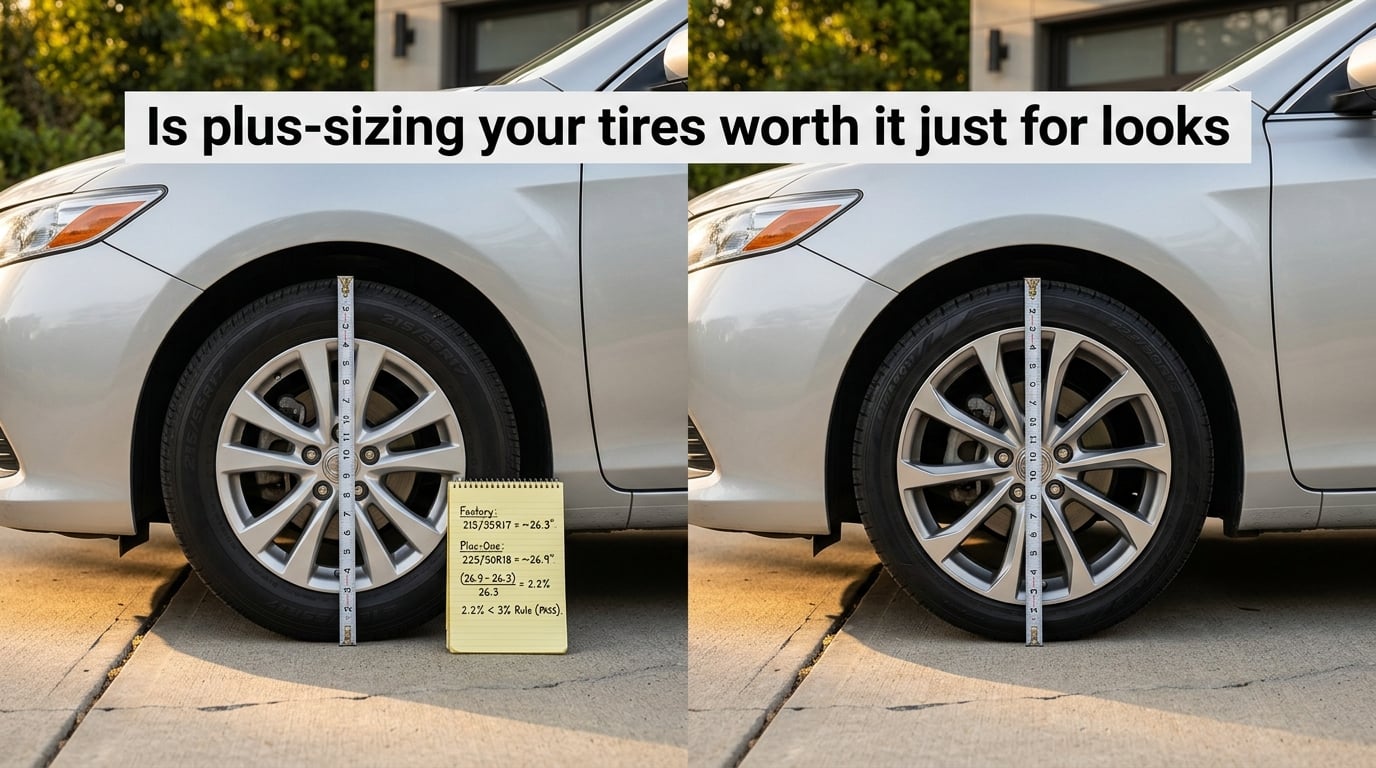
Short answer: If looks are your only goal, plus-one is the sweet spot. Going beyond plus-one delivers shrinking visual gains while ride quality drops, costs climb, and pothole damage risk rises fast.
Plus-sizing means mounting a larger-diameter wheel with a lower-profile tire so the overall tire diameter stays roughly the same. Most drivers consider it for one of two reasons: sharper handling or a more aggressive stance. This guide focuses on the second motivation, because that is where the trade-offs are sharpest. We will walk through the pros, the cons, the 3% rule, a verdict table, and the scenarios where plus-sizing for looks is (and is not) worth the money.
Table of Contents
What Plus-Sizing Actually Means
Plus-sizing is fitting a wheel that is one to three inches larger in diameter than your factory wheel, paired with a shorter-sidewall tire that keeps the overall tire diameter close to stock.
The standard rule of thumb used across the tire industry: each inch up in wheel diameter adds about 10mm of tire section width and drops about 10 points of aspect ratio. Aspect ratio is the sidewall height expressed as a percentage of the tire width. A 225/55 R17 becomes roughly a 235/45 R18 at plus-one, then 245/40 R19 at plus-two, and so on.
Four terms describe how far you have gone:
- Plus-zero: same wheel diameter as stock, slightly wider tire on the same rim. No clearance or speedometer concerns.
- Plus-one: one inch up in wheel diameter, sidewall drops accordingly.
- Plus-two: two inches up, noticeably shorter sidewall.
- Plus-three: three inches up, very low-profile tire with the thinnest cushion between you and the road.
The 3% rule is the guardrail that keeps the swap safe. Your new tire’s overall diameter should stay within about 3% of the original, otherwise the speedometer reads wrong, the ABS and traction control can misbehave, and the tire may rub inside the wheel well.
What You Gain From Plus-Sizing
The gains cluster into three buckets: handling, room for bigger brakes, and visual stance.
Sharper turn-in and cornering grip. A shorter sidewall flexes less when you load the car into a corner, so the steering response feels quicker and the contact patch stays flatter. Drivers notice this most on twisty roads and highway on-ramps.
Room for larger brakes. Bigger wheels clear bigger brake calipers and rotors. That matters on performance cars where the factory wheel simply cannot fit the brake package enthusiasts want to run.
Sportier stance and filled wheel wells. This is the looks-only win. A plus-one or plus-two setup closes the gap between the tire and the fender, which most buyers describe as a more aggressive, planted look.
Our team has measured these effects across multiple vehicles. The biggest jump in handling feel happens between factory and plus-one. Beyond plus-one, the gains shrink while the downsides grow, which is exactly why most tire-shop veterans recommend stopping at plus-one for a daily driver.
What You Lose From Plus-Sizing
The losses are not subtle. They show up immediately in ride comfort, and they show up later as repair bills.
Harsher ride. A thinner sidewall absorbs less impact. Expansion joints, frost heaves, and rough pavement transmit straight into the cabin. Owners moving from a 55-series sidewall to a 35-series sidewall routinely describe the car as “busy” or “uncomfortable on commutes.”
Pothole and curb damage. Less rubber between the rim and the road means less protection. A pothole that would have flexed a stock sidewall can crack a low-profile sidewall or bend a larger-diameter rim. Curb rash also happens more often because the larger wheel sits closer to the curb edge.
Speedometer and odometer drift. If overall diameter changes, your speedometer under-reads or over-reads. A 5% over-diameter swap means a true 65 mph reads as roughly 62 mph on the gauge, and your odometer logs fewer miles than you actually drove.
Higher cost, four at a time. Replacing a set of plus-sized tires costs more per tire than replacing stock sizes, and the wheels themselves add a one-time expense. A bent rim can also mean replacing one wheel at full price rather than repairing a smaller one.
Worse snow traction. A wider, lower-profile tire has a smaller contact patch per square inch of rubber on packed snow, and the stiffer sidewall transmits less bite through irregular surfaces. Snow-region drivers almost always regret going beyond plus-one.
Verdict Table: Factory vs Plus-One vs Plus-Two vs Plus-Three
Side-by-side, the trade-off curve looks like this. Each row is rated on a five-point scale where five is best for that goal.
| Setup | Looks | Handling feel | Ride comfort | Cost to buy | Pothole risk |
|---|---|---|---|---|---|
| Factory (stock) | 2/5 | 3/5 | 5/5 | 5/5 | 2/5 |
| Plus-zero (wider on stock rim) | 3/5 | 3/5 | 5/5 | 4/5 | 2/5 |
| Plus-one | 4/5 | 4/5 | 4/5 | 3/5 | 3/5 |
| Plus-two | 4.5/5 | 4.5/5 | 3/5 | 2/5 | 4/5 |
| Plus-three | 5/5 | 4.5/5 | 2/5 | 1/5 | 5/5 |
Read the table this way: looks score jumps most between factory and plus-one, then plateaus. Ride comfort drops steadily. Pothole risk climbs the fastest at plus-two and beyond. For a looks-only motivation, plus-one captures almost all of the visual upgrade without paying the steep comfort and durability penalty.
The 3 Percent Rule and Speedometer Accuracy
The 3% rule is simple: keep the new tire’s overall diameter within 3% of the factory tire diameter, and most of the side effects (speedometer error, ABS confusion, rubbing) stay negligible.
To check it, compare the published overall diameter on the new tire’s sidewall spec sheet to the factory diameter. If you cannot find the exact number, calculate it: tire width (mm) times aspect ratio (as a decimal) times two, plus wheel diameter (inches) times 25.4, all in millimeters. The difference between the two numbers, divided by the factory diameter, is your percentage change.
A swap that stays inside 3% reads correctly on the speedometer, logs accurate odometer miles, and keeps the anti-lock brake system working as designed. Push past 3% and you are guessing on tire life, fuel economy, and even speeding tickets.
When Plus-Sizing Is Worth It (and When It Isn’t)
Plus-sizing is worth it for looks when four conditions line up at once: you stop at plus-one, you do not live in a snow region, your roads are reasonably smooth, and you own the vehicle outright.
Plus-sizing is not worth it for looks when any of these apply:
- You lease the vehicle. Returning a leased car with non-stock wheels often triggers a charge, and the lease company may require OEM fitment for turn-in.
- You drive in real snow more than a few times a year. Plus-two and beyond measurably reduce winter traction. Plus-one is the practical ceiling in snow country.
- Your commute is mostly potholes and broken pavement. Chicago, Detroit, New York, and similar cities punish low-profile tires. Repair bills add up fast.
- You want comfort over image. A stock 17-inch wheel with a 55-series tire rides better than an 18-inch wheel with a 40-series tire on the same car, every time.
One strategy that works well in mixed climates: run plus-sized wheels and tires in the summer, then swap back to factory wheels and tires for winter. You get the looks nine months a year and the winter traction you need the other three. This is the approach several enthusiasts on automotive forums recommend for daily-driven performance cars.
Real-World Cost and What to Ask Your Installer
Cost climbs in steps, not smoothly. A plus-zero swap is barely more than stock tire prices. A plus-one adds wheel cost plus a small tire premium. A plus-two or plus-three jumps another step because the tires are lower-volume and the wheels are larger.
For a passenger car, a complete plus-one wheel and tire package lands in the lower cost band. A large SUV or truck running plus-two or plus-three lands in the upper band, often several times higher. Wheels alone can match or exceed the cost of the tires, especially for forged options. (Consumer Reports has published detailed cost ranges for each plus size that match this pattern.)
Before you sign anything, ask the installer these questions:
- What is the load rating on the new tire, and does it meet or exceed the stock rating?
- What is the speed rating, and does it match the door-sticker spec?
- What wheel offset and backspacing will clear the brake calipers?
- Will the new setup need a spacer, hub-centric ring, or different lug bolts?
- What is the calculated overall diameter change, and is it inside 3%?
- Will the new tire clear the fender at full lock and over speed bumps?
If the installer cannot answer those on the spot, keep shopping. The right shop will measure twice and show you the math.
Frequently Asked Questions
What is the 3% rule for tire size?
The 3% rule says your new tire’s overall diameter should stay within 3% of the factory tire’s overall diameter. Inside that window, your speedometer, odometer, and ABS system behave normally. Beyond 3%, speedometer readings drift, odometer miles no longer match real miles, and the brake computer can misbehave.
What tire size gives the smoothest ride?
The smoothest ride comes from the tallest sidewall that still fits your wheel and wheel well. In practice, that means a smaller-diameter wheel with a higher aspect ratio. A 215/55 R17 setup rides smoother than a 225/45 R18 on the same car, because the extra sidewall flex absorbs bumps before they reach the cabin.
Is it better to get 17 inch or 18 inch tires?
For daily driving, 17-inch wheels with taller sidewalls ride better and resist pothole damage better. For sharper handling and a more aggressive look, 18-inch wheels with lower-profile tires feel sportier but ride firmer. Choose 17-inch for comfort and snow traction, choose 18-inch if looks and turn-in response matter more.
Does plus-sizing affect the speedometer?
Yes, if the new tire’s overall diameter changes by more than a few percent. Bigger overall diameter means the wheel travels farther per revolution, so the speedometer reads slower than your actual speed. Smaller overall diameter does the opposite. That is why the 3% rule matters.
Final Verdict
Is plus-sizing your tires worth it just for looks? Yes, if you stop at plus-one and you own the car, drive in fair weather, and live where the roads cooperate. Beyond plus-one, the visual gain plateaus while the ride, cost, and pothole penalties climb fast. If your motivation is the stance, plus-one delivers almost all of it with the smallest trade-off. For everyone else, the factory wheel and tire is still the smartest choice in 2026.