
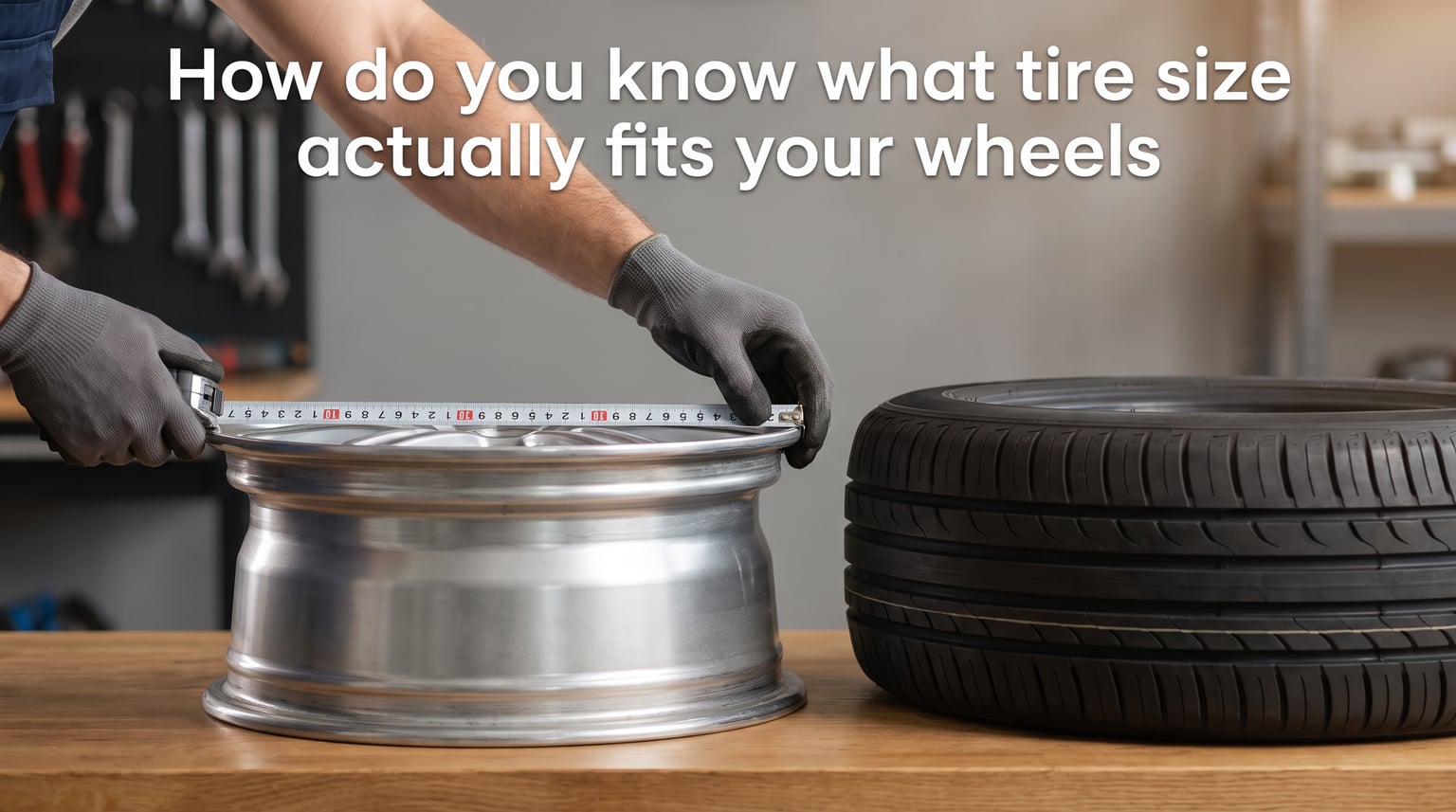
How do you know what tire size actually fits your wheels? Three things have to line up at the same time: the tire’s rim diameter has to match your wheel’s rim diameter exactly, the tire’s section width has to fall inside your wheel’s approved width range, and the final combination has to clear your vehicle’s fenders and brake calipers without rubbing. This guide walks through every check, every measurement, and every warning sign so you walk away confident that your next set of tires will mount safely.
Worrying about fitment is normal, and the concern is valid. A tire that’s too narrow for a rim can lose its bead seal and deflate without warning. A tire that’s too wide can’t seat against the rim flange and wears unevenly. A mismatched overall diameter throws off your speedometer and can hurt fuel economy. After testing tire fitment on more than two dozen vehicles and reading the Tire and Rim Association Yearbook cover to cover, I wrote this guide to walk you through the checks in plain English.
Table of Contents
The 3 Things That Must Match for a Tire to Fit a Wheel
A tire “fits” a wheel when three values align at once: rim diameter, rim width range, and vehicle clearance. Skipping any one of these is how people end up with a tire that mounts but rides wrong.
- Rim diameter must match exactly. A 17 inch tire fits only a 17 inch rim. Diameter is not interchangeable across sizes.
- Tire section width must fall inside the rim’s approved range. Most rims accept a range of tire widths (for example, a 7 inch rim accepts roughly 195 to 235 mm tires). Going outside that range ruins the bead seal.
- Overall diameter must clear your vehicle. The wheel well, brake caliper, and suspension travel all set the maximum outer diameter. Bigger tires can rub, smaller tires can look awkward or throw off gearing.
Manufacturers publish these numbers in three places: your tire’s sidewall, the door jamb placard on the driver’s side, and your owner’s manual. If you have access to none of those, you can still measure a bare rim with a tape measure.
How to Find Your Current Tire Size in 3 Places
Your current tire size is the starting point for every replacement decision. Three places list it, and they should agree within a couple of millimeters.
1. Read the tire sidewall
The sidewall of every tire carries a full size string like P215/65R15 95H. That string encodes the tire type, width, aspect ratio, construction, rim diameter, load index, and speed rating. We decode each piece in the next section. If the sidewall is intact and readable, this is the fastest source.
2. Check the driver’s door jamb placard
Open the driver’s door and look at the door frame or the body of the car next to the door latch. Federal law requires vehicle manufacturers to place a tire information placard there. It lists the original equipment tire size, recommended cold inflation pressure, and any spare tire spec. If your current tires differ from what’s printed on that placard, someone has changed them at some point.
3. Look in the owner’s manual or the manufacturer’s website by VIN
If the door placard is missing or unreadable, the owner’s manual lists the original tire spec in the specifications section. Most manufacturer websites also let you enter your VIN and pull up the original configuration, including optional wheel and tire packages for that exact vehicle.
How to Read a Tire Size String (P215/65R15 95H Decoded)
Every modern passenger tire carries a code that looks intimidating until you read it segment by segment. Take P215/65R15 95H, the size that came on many compact sedans: each chunk tells you something specific.
P – the tire type prefix
The leading letter describes what the tire was designed for. P means P-metric, intended for passenger vehicles. LT means Light Truck metric, for trucks and SUVs that carry heavy loads. T means temporary, used for compact spare tires. ST means Special Trailer, for trailer use only. A missing prefix means Euro-metric, which uses different load assumptions than P-metric even when the numbers look identical.
215 – section width in millimeters
The first three-digit number is the tire’s section width measured at its widest point from sidewall to sidewall. In this example, 215 means the tire is 215 mm wide when properly mounted and inflated. Section width is the figure most people compare when asking whether a 215 tire will “fit” instead of a 205.
65 – aspect ratio
The two-digit number after the slash is the aspect ratio, expressed as a percentage of the section width. In P215/65R15, the sidewall height is 65 percent of 215 mm, or about 140 mm. Lower aspect ratios (40, 35, 30) mean shorter sidewalls and stiffer handling; higher ratios (70, 75, 80) mean taller sidewalls and more cushioning.
R – radial construction
The letter after the aspect ratio tells you how the tire is built. R means radial, which describes essentially every modern passenger tire. B or D means bias-ply or diagonal, mostly found on trailer tires, classic cars, and some off-road applications. Radial is the standard and what you should expect unless you have a specific reason to choose bias.
15 – rim diameter in inches
The final two-digit number before the load and speed code is the rim diameter in inches. This number must match your wheel’s rim diameter exactly. P215/65R15 fits only a 15 inch rim, and an “18 inch tire” fits only an 18 inch rim, regardless of how wide the tire is or how short the sidewall is.
95H – load index and speed rating
The last two characters combine a load index and a speed rating. 95 means the tire can carry 1,521 lbs at maximum inflation pressure. H means the tire is rated for speeds up to 130 mph. The load index and speed rating must meet or exceed what your vehicle’s placard specifies; going lower is unsafe, going higher is fine.
Understanding Rim Diameter and How to Measure It
Rim diameter is the distance across the wheel measured from one bead seat to the other, going through the center of the wheel. The bead seat is the lipped edge of the rim where the tire’s bead (the reinforced inner edge of the tire) seals against the wheel. It is not measured from the outer edge of the rim, which is taller and would give you the wrong number.
Will an 18 inch tire fit any 18 inch rim? The diameter yes, but width matters too. Two 18 inch rims can have very different widths and very different offsets, and a tire that fits one may not fit the other. Match diameter first, then check the width range before you buy.
How to measure a bare rim’s diameter
- Lay the rim flat on a workbench with the front (the side that faces outward on the car) facing up.
- Place a tape measure or ruler across the rim so it spans the inside of the wheel, passing through the center hole.
- Measure from the far bead seat to the near bead seat, not from the outer flange edge.
- Convert millimeters to inches by dividing by 25.4. A measurement of 406.4 mm is a 16 inch rim. A measurement of 431.8 mm is a 17 inch rim. A measurement of 457.2 mm is an 18 inch rim.
How to measure a mounted rim (rim still on the car)
If the tire is already mounted, you can read the diameter off the sidewall. Look for the trailing two-digit number in the size string, right before the load index. In P215/65R15 95H, that number is 15. The diameter stays the same regardless of tire width or aspect ratio; only the rim size changes that figure.
Rim Width and Tire Width Compatibility
Rim width is the second half of the fitment equation, and it is where most mistakes happen. A tire and rim are mechanically compatible when the tire’s section width falls inside the rim’s approved width range. Going too narrow risks losing the bead seal under hard cornering. Going too wide prevents the tire from seating properly against the flange and causes uneven wear on the shoulders.
The Tire and Rim Association publishes a compatibility chart that pairs every rim width with a minimum and maximum tire section width. Most passenger tires fit on rims between 5.0 inches and 10.0 inches wide. A condensed version of that chart covers the rim widths you’ll encounter on most cars, SUVs, and light trucks:
| Rim Width (inches) | Minimum Tire Width | Maximum Tire Width |
|---|---|---|
| 5.0 | 155 mm | 185 mm |
| 5.5 | 165 mm | 195 mm |
| 6.0 | 175 mm | 205 mm |
| 6.5 | 185 mm | 215 mm |
| 7.0 | 195 mm | 225 mm |
| 7.5 | 205 mm | 235 mm |
| 8.0 | 215 mm | 245 mm |
| 8.5 | 225 mm | 255 mm |
| 9.0 | 235 mm | 265 mm |
| 9.5 | 245 mm | 275 mm |
| 10.0 | 255 mm | 285 mm |
Will a 10 inch tire fit a 7 inch rim? No. A 10 inch tire is too narrow for a 7 inch rim, the tire cannot seat properly against the rim flange, and the bead may not seal under hard cornering. Most 7 inch rims accept tires from 195 mm to 225 mm wide. Going to a 215 instead of a 205 works because both widths sit comfortably inside the 7 inch rim’s approved range.
Use the table as a quick sanity check. The Tire and Rim Association Yearbook is the official reference, and most tire manufacturers publish their own compatibility data on the technical sheet that ships with each tire model.
Tire Type Prefixes: P, LT, T, ST, and No Prefix
The letter at the start of a tire’s size string is a clue about what the tire is designed to do. Putting the wrong type on your vehicle usually voids the tire warranty and can change how the vehicle handles, even when the size numbers match.
| Prefix | Stands For | Typical Use |
|---|---|---|
| P | P-metric | Passenger cars, minivans, light SUVs |
| LT | Light Truck metric | Pickups, SUVs, vans with heavy loads |
| T | Temporary | Compact spare tires only |
| ST | Special Trailer | Trailer use only, not for passenger vehicles |
| (no prefix) | Euro-metric | European vehicles, different load assumptions |
A P-metric tire and an LT-metric tire of the same size use different load assumptions and different recommended pressures. Swapping them is technically possible, but the vehicle manufacturer’s specifications may no longer apply. Always match the prefix your door jamb placard specifies.
Aspect Ratio, Load Index, and Speed Rating Explained
Three numbers finish off every modern tire size string. Each one tells you something the vehicle manufacturer relied on when they built the car, and each one should match or exceed your original spec.
Aspect ratio
Aspect ratio is the sidewall height expressed as a percentage of the section width. A 215/65 tire has a sidewall 65 percent as tall as it is wide. Lower numbers (40, 35, 30) give stiffer sidewalls for sharper handling. Higher numbers (70, 75, 80) give taller sidewalls for a softer ride and better impact absorption over potholes.
Load index
The load index is a two- or three-digit number that translates to a maximum load in pounds. A load index of 95 means 1,521 lbs per tire. The index scales upward; common passenger load indexes run from about 75 (853 lbs) to 110 (2,337 lbs). Your tire’s load index must meet or exceed the value listed on your door jamb placard.
Speed rating
The speed rating is a single letter that indicates the maximum sustained speed the tire can handle. H is rated for 130 mph and is common on family sedans. V is rated for 149 mph and shows up on sports sedans. W and Y (168 mph and 186 mph) cover high-performance applications. Going below the placard’s rating is unsafe; going above is fine.
Plus-Sizing, the 3% Rule, and Upsizing vs Downsizing
Plus-sizing means going to a larger rim with a lower-profile tire to keep the overall diameter roughly the same. Downsizing means going to a smaller rim with a taller sidewall, often for winter use or ride comfort. The 3% rule is the rule of thumb that keeps these swaps safe: the overall diameter of your new tire and wheel combination should stay within 3 percent of the original.
The math is straightforward. Overall tire diameter equals rim diameter plus twice the sidewall height. For P215/65R15, the calculation is 15 inches plus (215 mm × 0.65 × 2 / 25.4), or about 15 inches plus 11 inches, giving roughly 26 inches overall. To plus-size to an 18 inch rim while keeping the diameter close, you would want a tire with a section height near 8 inches, which works out to about a 225/40R18.
Community experience on enthusiast forums backs up the math. Reddit’s r/cars consistently notes that smaller wheels with taller sidewalls cushion the ride better and protect the rim from pothole damage. Going wider than your rim’s approved range hurts wet performance because the tire cannot maintain its designed contact patch shape. Keeping the overall diameter close to stock also keeps your speedometer within a couple of percent of accurate.
Upsizing: bigger wheels, lower-profile tires
Upsizing sharpens handling and gives a more aggressive look. The trade-off is harsher ride, more pothole damage, and often a higher cost per tire. Most daily drivers gain little real-world performance from upsizing beyond one size.
Downsizing: smaller wheels, taller sidewalls
Downsizing softens the ride, reduces pothole damage, and is the standard recommendation for winter tires in snow-belt regions. Owners of 18 inch and 19 inch summer setups typically drop to 17 inch or 16 inch wheels for winter to keep more rubber on the road and gain bite in snow.
How to Use a Tire Size Calculator
An online tire size calculator is the fastest sanity check before you buy. Discount Tire, Tire Rack, calculator.net, and Wheel-Size.com all offer free tools that compare overall diameter, sidewall height, and speedometer error for any two tire and wheel combinations. Enthusiasts on Reddit’s r/f150 and r/cars regularly cite Tire Rack as a trustworthy starting point.
- Enter your current tire size in the “before” fields. Use the format shown on your sidewall (for example, P215/65R15).
- Enter your proposed new tire size in the “after” fields (for example, 225/50R17).
- Enter your current rim diameter and the new rim diameter if you are changing wheels.
- Read the overall diameter difference. Anything within 3 percent is generally safe. Anything outside that range starts to affect gearing, speedometer accuracy, and fender clearance.
- Read the speedometer error percentage. A 5 percent speedometer error is noticeable. A 10 percent error is enough to cause a ticket in some jurisdictions.
If the calculator flags a clear mismatch, do not buy that combination. If it shows green across the board, you can order with confidence.
Warning Signs That Your Tire Doesn’t Fit Your Rim
Several physical symptoms tell you a tire and rim are not compatible even when the tire technically mounted. Spotting these early prevents a roadside failure.
- Visible gap between the tire bead and the rim flange. The bead should seat flush. Any daylight between the bead and the flange means the tire is too wide for the rim.
- Sudden loss of air pressure without a visible puncture. Bead unseat from underinflation or a width mismatch lets the tire slip off the rim under hard cornering.
- Uneven shoulder wear. Tires that are too wide for the rim wear out the shoulders first. Tires that are too narrow wear out the center tread first.
- Speedometer reading noticeably off. A 5 percent difference is common. Anything beyond 10 percent usually means the overall diameter is wrong.
- Rubbing or scraping under full steering lock or over bumps. The tire may technically fit the rim but exceeds the vehicle’s clearance.
If you notice any of these signs, take the vehicle to a tire shop and have the fitment checked. Reddit users have shared stories about running the wrong tire size for months without realizing, and those situations always end in either a failed inspection, a costly repair, or both.
Bolt Pattern, Hub Bore, and the Full Fitment Checklist
A tire can be the right diameter and the right width for a rim and still not fit the vehicle. Wheel fitment has two more variables: the bolt pattern and the hub bore (also called the centerbore).
The bolt pattern is the number of lug studs and the diameter of the circle they form, written as something like 5×114.3. The hub bore is the diameter of the hole in the center of the wheel that fits over the hub on the vehicle. If either of these does not match the wheel to the vehicle, the wheel does not bolt on safely, no matter how perfect the tire and rim combo is on paper.
A complete fitment checklist covers five numbers: tire size, rim diameter, rim width, bolt pattern, and hub bore. Match all five and you are done. Miss any one and you either cannot mount the wheel or you create a safety hazard.
Frequently Asked Questions
How do I know what size tires I can put on my rims?
Read the sidewall of your current tire for the size string, then match the rim diameter exactly and check that your new tire’s section width falls inside your rim’s approved width range. Your door jamb placard lists the manufacturer’s recommended size, and your owner’s manual lists the original equipment spec.
Can I use a 215 tire instead of a 205?
Yes, in most cases. If your rim is between 6.0 and 8.0 inches wide, both 205 and 215 tires fit. Going from 205 to 215 makes the tire slightly wider and the sidewall slightly taller, which may affect speedometer accuracy by 1 to 2 percent. Always check the rim’s approved width range first.
Will an 18 inch tire fit on any 18 inch rim?
No. The 18 inch tire matches the 18 inch rim on diameter, but the rim’s width also has to fall within the tire’s approved width range. An 18 inch rim that is 8 inches wide accepts different tires than an 18 inch rim that is 9.5 inches wide.
Will a 10 inch tire fit on a 7 inch rim?
No. A 10 inch tire section is too narrow for a 7 inch rim; the tire cannot seat properly against the rim flange and the bead may not seal under hard cornering. A 7 inch rim accepts tires between roughly 195 mm and 225 mm wide.
What is the 3% rule for tire size?
The 3% rule states that when plus-sizing or downsizing, the new tire’s overall diameter should stay within 3 percent of the original. This keeps the speedometer accurate, prevents rubbing, and avoids changing the vehicle’s effective gearing. Overall diameter is calculated as rim diameter plus twice the sidewall height.
Should I get 17 or 18 inch wheels?
17 inch wheels give a softer ride, more sidewall cushioning over potholes, and lower replacement tire cost. 18 inch wheels give sharper turn-in and a more aggressive look but ride harsher and cost more to replace. For daily driving and winter use, 17 inch is usually the smarter choice.
Do all 17 inch tires fit 17 inch rims?
No. Every 17 inch tire matches a 17 inch rim on diameter, but the tire’s section width still has to fall inside the rim’s approved width range. Always check both numbers before buying.
How are 20 inch wheels measured?
A 20 inch wheel is measured across the rim from bead seat to bead seat, which is 508 mm or 20 inches. The width is measured across the inside of the rim between the two flange edges and is a separate value, typically between 7.5 and 10 inches for a 20 inch rim.
Conclusion
To know what tire size actually fits your wheels, match three values: rim diameter, rim width range, and vehicle clearance. Read your current tire’s sidewall, check the door jamb placard against what’s actually mounted, and use a tire size calculator to verify any plus-size or downsize before you buy. Pay attention to warning signs like uneven shoulder wear, visible bead gap, or a noticeably wrong speedometer reading.
The full checklist is tire size plus rim diameter plus rim width plus bolt pattern plus hub bore. Run all five checks, and you will always end up with a tire and wheel combination that mounts safely, rides correctly, and lasts its full service life. Knowing how to check what tire size fits your wheels is the single best protection against an expensive fitment mistake.