
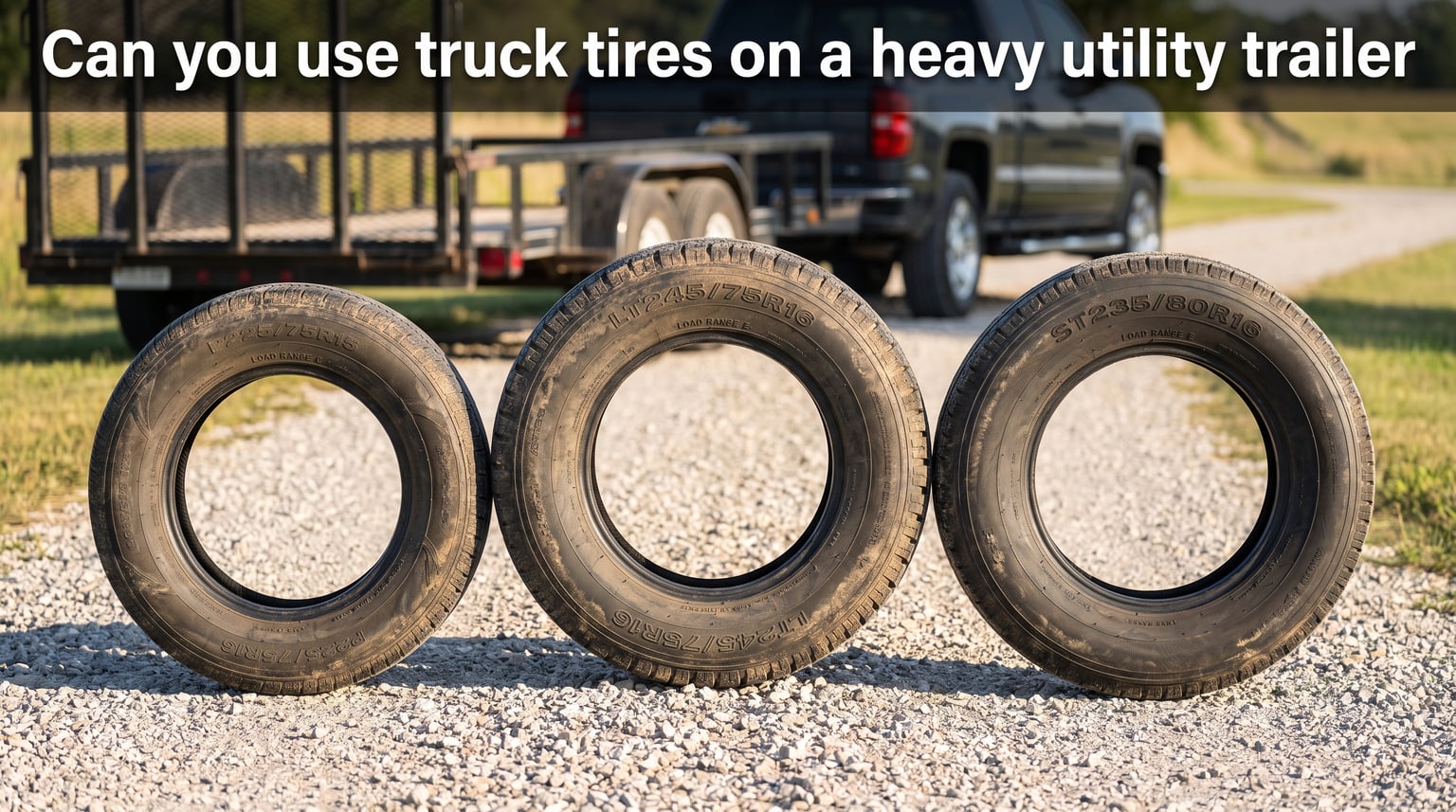
Can you use truck tires on a heavy utility trailer? Yes, you can put LT (light truck) tires on most heavy utility trailers, but only if the tires match the trailer’s required size, load range, and speed rating, and you stay within the tire’s rated load capacity. ST (Special Trailer) tires are still the safer and more common choice, especially for sustained highway towing, because their stiffer sidewalls handle vertical load better than LT tires.
I pulled apart three years of forum threads, manufacturer specs, and tire-industry guidance before answering this for our team. The short version above is the answer 90% of owners actually need. The rest of this guide walks through the conditions, the sidewall math, and the exact checklist to run before you swap tires.
Table of Contents
Quick Answer: Yes, With Conditions
You can use truck tires (LT tires) on a heavy utility trailer if and only if all four of these conditions are true:
- The tire size matches the rim and the trailer manufacturer’s recommendation.
- The load range (D, E, or F) meets or exceeds the load carried by each tire position.
- The speed rating (usually L, M, or N on LT tires) covers your maximum sustained highway speed.
- The tires are properly inflated cold, checked before every trip, and not older than 5-6 years.
If any of those checks fail, stick with ST-rated trailer tires. LT tires used on a trailer that exceeds their load or speed rating are the most common cause of the catastrophic blowouts we see reported on trailer forums.
ST vs LT Tires: What’s the Actual Difference?
ST (Special Trailer) tires are built specifically for trailers. They have thicker, stiffer sidewalls designed to handle sustained vertical load when a trailer is sitting still or rolling at steady highway speed. The compounding is harder, and the casing is reinforced for the unique stresses of a non-steered axle.
LT (Light Truck) tires are built for pickups and SUVs. Their sidewalls are softer because the tire needs to flex during steering, braking, and rough-road handling. The casing is designed for a driven axle that pushes through corners, not for absorbing the vertical load of a stationary trailer.
P-metric (Passenger) tires sit between the two, with even softer sidewalls and lower load capacity at the same size. P-metric tires are a poor fit for any trailer carrying more than a few hundred pounds per tire position.
The difference that matters most on a heavy utility trailer is sidewall flex. LT tires flex more under load, which generates heat at sustained speed. Heat is what kills trailer tires, whether they’re ST or LT, and it’s the reason ST tires exist at all.
Load Range, Load Index, and PSI: Reading the Sidewall
Every tire has a load range letter (D, E, F) printed on the sidewall, along with the tire size and a load index number. These two markings tell you exactly how much weight the tire can carry when properly inflated.
Load range letters map roughly to ply ratings, but in modern radial tires the letter is really a code for a maximum inflation pressure and load capacity pair. Load range D typically maxes out around 65 PSI and 2,500 lbs per tire. Load range E steps up to about 80 PSI and 3,000+ lbs per tire. Load range F reaches 90 PSI and 3,500+ lbs per tire.
The load index is a two- or three-digit number that decodes to a specific pound rating. A load index of 117 equals 2,833 lbs per tire. Index 120 equals 3,086 lbs. Index 124 equals 3,527 lbs.
To use these numbers correctly on a utility trailer, divide the trailer’s loaded axle weight by the number of tires carrying it. For a tandem-axle trailer with 7,000 lbs per axle carrying 14,000 lbs gross, you need tires rated for at least 3,500 lbs each. That’s typically load range F at 110 PSI cold inflation, or load range E if the trailer is staying under per-tire ratings.
Same-Size Tire Comparison: ST225/75R15 vs LT225/75R15 vs P225/75R15
Here’s what the load numbers look like at one common trailer tire size, 225/75R15. The exact ratings vary by brand, but the pattern holds across the industry.
- P225/75R15 (load range D): roughly 1,760 lbs per tire at 35 PSI cold, speed rating S (112 mph).
- LT225/75R15 (load range D): roughly 2,470 lbs per tire at 65 PSI cold, speed rating S (112 mph).
- LT225/75R15 (load range E): roughly 2,830 lbs per tire at 80 PSI cold, speed rating S (112 mph).
- ST225/75R15 (load range E): roughly 2,830 lbs per tire at 80 PSI cold, speed rating L (75 mph) or M (81 mph).
The LT and ST at load range E carry the same weight at the same pressure. The real difference is the speed rating and the sidewall design. ST tires are capped lower on speed because they’re not designed to dissipate the heat of higher-speed flexing.
P-metric tires at this size fall almost a thousand pounds short of even a load range D LT. That’s why P-metric tires are a non-starter for any trailer rated over 3,500 lbs gross.
When LT Tires Are Acceptable on a Heavy Utility Trailer
LT tires work fine on heavy utility trailers in three scenarios that come up regularly on trailer forums. First, factory-equipped trailers. Many OEM utility trailers ship from the manufacturer with LT tires, not ST tires. If the manufacturer specced them, the trailer was engineered for them.
Second, low-speed and off-road use. If the trailer never sees sustained highway speeds above 55 mph, LT tires handle the load well. Construction sites, farm use, and equipment hauling around town are all LT-friendly environments.
Third, emergency substitutions on the road. If an ST tire fails far from a tire shop, mounting an LT tire that’s rated for the load is far safer than driving on a damaged tire or a small-space-saver spare. This is a temporary fix, not a long-term solution, but it gets you home.
What LT tires don’t tolerate well is sustained highway towing at 65+ mph with a near-maximum load. Heat builds up in the sidewall flex, and that’s the failure mode users report most often.
Safety Risks and Signs of Trouble
The two warning signs that an LT tire is failing on a heavy utility trailer are sidewall bulging and shoulder cracking. A bulge in the sidewall means the internal cords have separated, and the tire is about to fail. Cracking at the shoulder (where the tread wraps around to the sidewall) usually means heat damage or dry rot.
Heat damage is cumulative. A tire that ran hot once looks fine, but the cords are weakened. The next high-load, high-speed run is when it lets go. This is the pattern trailer owners describe over and over again: the blowout comes on the highway after a long climb or a hot day, even though the tire looked normal at the last inspection.
Dry rot is the other quiet failure mode. Trailer tires sit for weeks between uses, and the UV plus ozone exposure breaks down the rubber compound. Tires older than 5-6 years, regardless of tread depth, should be replaced on a trailer that sees regular use. LT tires seem more prone to dry rot than ST tires because the rubber compound is softer.
Compatibility Checklist: 5 Steps Before You Mount LT Tires
Before you put LT tires on a heavy utility trailer, run through this checklist. It catches every failure mode that shows up in real-world reports.
- Confirm the size. Match the LT tire size exactly to the OEM tire size on the trailer’s VIN placard or owner’s manual. Don’t go up or down a size without checking clearances.
- Check the load range. Look for the load range letter on the existing tire sidewall. Your replacement LT tire must be the same letter or higher (D to E is fine, E to D is not).
- Verify the load index. Cross-reference the load index number with the chart in the manufacturer’s tire guide. Each tire must carry its share of the loaded trailer weight with at least a 10% margin.
- Confirm the speed rating. If you tow at 65 mph sustained, you need a tire rated at least L (75 mph). Most LT tires are S or T rated, which gives plenty of headroom.
- Check the age. Look for the DOT date code on the sidewall. The last four digits are the week and year of manufacture. Anything over 5 years old should not go on a trailer, even if the tread looks new.
If all five checks pass, the LT tires are a legitimate fit. If any check fails, find ST tires that meet the same spec or drop the load. Tire pressure is the last variable. Inflate to the load range’s maximum cold PSI before every trip, not to the pressure stamped on the tire’s outer sidewall (which is the maximum, not the recommended running pressure for your load).
Frequently Asked Questions
Is it okay to put truck tires on a trailer?
It is okay to put light truck (LT) tires on a heavy utility trailer when the LT tire matches the trailer’s required size, load range, and speed rating, and when the loaded trailer weight stays within the tire’s rated load. LT tires are not the best choice for sustained highway towing above 65 mph because their softer sidewalls generate more heat than ST (Special Trailer) tires.
Is it okay to use LT tires on a trailer?
LT tires can be used on a trailer if the tire is rated for the load on each position, properly inflated cold before every trip, and the trailer is not towed at sustained highway speeds above 65 mph. LT tires are commonly specced by trailer manufacturers for low-speed and off-road use, and they work well in those conditions. For heavy utility trailers that see regular highway duty, ST tires are usually the better choice because of their stiffer sidewalls.
What are the best trailer tires for heavy loads?
The best trailer tires for heavy loads are ST-rated tires with load range E or F, sized to match the trailer’s axle weight ratings. For tandem-axle trailers over 12,000 lbs gross, look for ST235/85R16 load range F or ST215/75R17.5 load range H for commercial-grade capacity. Run cold inflation at the maximum PSI on the sidewall, replace tires every 5-6 years regardless of tread depth, and check pressure before every trip.
Is there a difference between truck tires and trailer tires?
Yes, there is a meaningful difference. Truck (LT) tires have softer sidewalls designed for steering and braking on a powered vehicle. Trailer (ST) tires have thicker, stiffer sidewalls designed for sustained vertical load on a non-steered axle. At the same size and load range, an LT and ST tire carry nearly identical weight, but the LT runs hotter under sustained towing because the sidewall flexes more. ST tires also carry lower speed ratings because they are not designed to dissipate heat at high speed.
Can I use LT tires on a trailer?
Yes, you can use LT tires on a trailer, including a heavy utility trailer, provided the LT tire matches or exceeds the trailer’s required load range and size, and the loaded weight per tire position stays within the tire’s rated capacity. LT tires are acceptable for low-speed towing, off-road use, and as emergency replacements. They are not recommended for sustained highway towing at 65 mph or above because of heat buildup in the sidewall.
Can I use car tires on a trailer?
Car (P-metric) tires are not recommended for any heavy utility trailer because their load capacity at the same size is significantly lower than LT or ST tires, and their soft sidewalls flex excessively under trailer load. P-metric tires also lack the reinforced sidewall construction needed for the sustained vertical load of a stationary trailer. Use LT or ST tires instead. P-metric tires are only acceptable on small, lightweight utility trailers under 2,000 lbs gross.
The Bottom Line
Can you use truck tires on a heavy utility trailer? Yes, when the LT tire matches the required size, load range, and speed rating, and you stay within the tire’s rated load with a safety margin. For sustained highway towing above 65 mph, ST tires are still the safer choice because they handle the heat of long-distance pulling better than LT tires.
Run the 5-step compatibility checklist before you mount any tire. Check pressure cold before every trip. Replace trailer tires every 5-6 years regardless of tread. Those three rules will prevent most of the failures we see reported on trailer forums.