
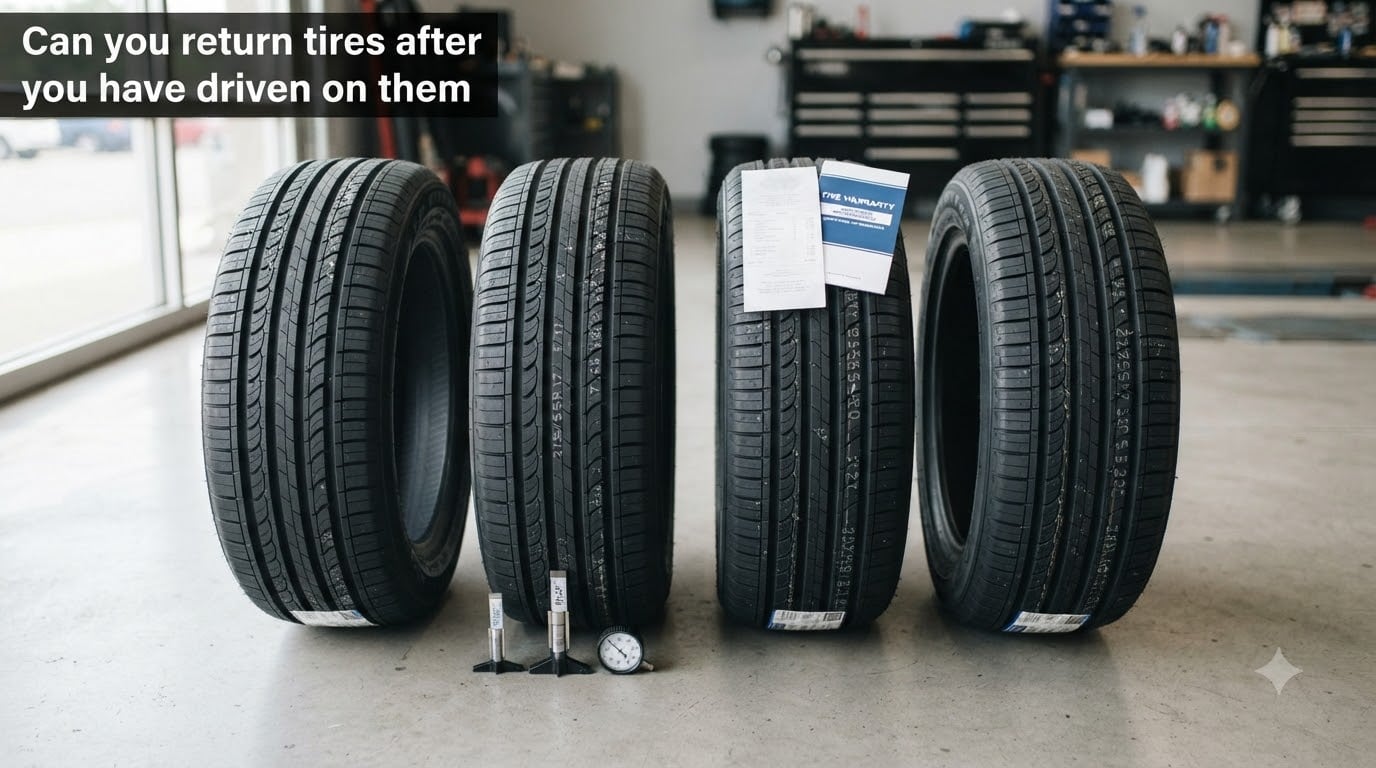
Yes, you can return tires after you have driven on them at most major tire retailers, but only if you act quickly and the tires meet specific condition requirements. Nearly every national chain we have dealt with offers a return window of 30 days, combined with a tread wear limit of 2/32 inch or less. Below, we walk through exactly how that works, which stores honor the policy, and what to do if your return gets denied.
If you just rolled out of a tire shop and realized you picked the wrong size, found a defect, or simply had second thoughts, this guide is for you. Our team pulled the return policies from Discount Tire, Costco, Walmart, Tire Rack, and American Tire, then cross-checked them against real customer experiences from r/tires and r/MechanicAdvice so you know what actually happens at the counter.
Table of Contents
Can You Return Tires After You Have Driven on Them?
Yes, you can return tires after you have driven on them at most major retailers, provided the tires show less than 2/32 inch of tread wear and you act within the return window. The standard policy across the industry is a 30-day satisfaction guarantee with minimal driving allowed, and most stores will exchange or refund the purchase as long as the tires remain in safe, roadworthy condition.
The catch is that return policies are not one-size-fits-all. Costco is famously generous with its tire returns, while Walmart’s policy varies store by store. Discount Tire typically exchanges rather than refunds, and Tire Rack follows strict shipping rules for online orders. Throughout this guide we will break down each retailer’s specific rules so you know exactly where you stand before you walk in or call.
What the Typical Policy Looks Like
Across the major chains we reviewed, three rules show up again and again. You usually have 30 days from purchase, the tread wear must stay under 2/32 inch, and you need your original receipt plus the tires themselves. Some stores add a restocking fee, others only offer store credit, and a few will deduct the cost of mounting and balancing from your refund.
If your situation falls outside those rules, you still have options. Manufacturer warranties cover defects for far longer than 30 days, and credit card purchase protections can add another layer of leverage. We will cover those paths later in the article.
General Tire Return Policy Overview
The tire return policies at most major retailers share a common skeleton: a time window, a condition requirement, and a documentation requirement. Understanding that skeleton helps you predict whether your return will be accepted before you ever load the tires into your trunk.
The most common return window is 30 days from the date of purchase. Discount Tire, Costco, American Tire, and Walmart all use a 30-day frame. Tire Rack gives you 30 days as well, but counts from delivery date rather than order date for online orders.
The condition requirement is a tread wear limit. Most stores specify that tires must show no more than 2/32 inch of wear compared to a new tire. A new tire starts with roughly 10/32 to 12/32 inch of tread, so 2/32 of wear means you can drive roughly 500 to 1,000 miles before hitting the limit. Costco is more lenient and rarely measures tread wear for member returns.
The documentation requirement is your original receipt or proof of purchase. Without a receipt, most stores can only offer store credit at the lowest sale price in the last 90 days, and some retailers refuse the return outright. If you lost your receipt, ask the store to look up the transaction by payment method before giving up.
Why Tire Stores Allow Returns on Driven Tires
Tire retailers know that consumers need to test their purchase. Tires behave differently once they hit real roads, and a set that feels great on paper might buzz at highway speed or pull to one side after 200 miles. That is why the industry converged on the 30-day, 2/32-inch standard. It gives drivers a meaningful trial period without opening the door to swapping tires every quarter.
How Many Miles Can You Drive on Tires and Still Return Them?
Most tire stores will accept a return as long as you have driven fewer than 500 to 1,000 miles, which translates to no more than 2/32 inch of tread wear. The exact mileage limit depends on your driving style, the tire compound, and the roads you drive on, but the tread depth measurement is what store managers actually check.
A brand-new passenger tire starts with about 10/32 inch of tread. After 500 miles of mixed driving, expect to see roughly 1/32 inch of wear. After 1,000 miles, you are approaching the 2/32 limit. Aggressive driving, hard braking, or high-speed highway miles can push that wear faster, while gentle suburban driving can keep you under the limit even past 1,200 miles.
How to Measure Tread Depth at Home
You can check your tread depth in under a minute with a tread depth gauge, which costs a few dollars at any auto parts store. Insert the gauge into the center groove of the tire and read the number on the sliding pin.
If you do not have a gauge handy, the penny test works in a pinch. Insert a Lincoln penny into the tread with Lincoln’s head facing down. If you can see the top of Lincoln’s head, the tread is below 2/32 inch and the tire is no longer eligible for return.
What Counts as Excessive Wear
Uneven wear across the tire is also a red flag. If the inside edge is bald but the center is fresh, the store will suspect an alignment issue or improper inflation rather than normal driving. Sidewall scuffs, curb rash, or visible punctures also disqualify most returns, since those are considered damage rather than dissatisfaction.
Condition Requirements for Returning Driven Tires
Stores do not just check mileage. They look at the tires as a whole to make sure they are still sellable as new. Here is the checklist our team recommends reviewing before you load up the tires.
- Original receipt or proof of purchase: Required at every major retailer we reviewed. Without it, your refund will shrink or disappear.
- Tread depth at 2/32 inch or more: Measured against a new tire of the same model. Use a tread gauge to confirm before driving to the store.
- No sidewall damage: Scuffs, gouges, dry rot, or curb rash will void the return. Inspect the sidewalls in good lighting.
- No punctures or repairs: A plugged or patched tire is no longer considered new and is usually excluded from the satisfaction guarantee.
- Original packaging or paperwork: Some stores want the tire back in its original wrap, especially for online orders.
- No chemical contamination: Tire shine, solvent, or silicone dressing can make a tire look used and may trigger a refusal.
Bring everything you have: the receipt, the warranty booklet, the mounting invoice, and any emails from the retailer. Documentation wins arguments more often than a smooth tongue.
Major Retailer Tire Return Policies Compared
Below is a side-by-side comparison of the return policies at the five retailers our readers ask about most. Policies update regularly, so call your local store before making the trip.
Discount Tire Return Policy
Discount Tire offers a 30-day return window on tires, and the company is known for its hassle-free exchange process. If you bought the wrong size, want a different brand, or simply do not like the tires, the store will swap them out. Refunds are also available but may include a deduction for the cost of mounting, balancing, and any road hazard warranty you purchased.
The tread wear requirement is similar to the industry standard. Bring your receipt, and the store handles the rest. Discount Tire locations are independently owned, so a few edge cases vary by store manager.
Costco Tire Return Policy
Costco runs the most generous tire return policy of any national retailer. Members can return tires at any time for a full refund, regardless of tread wear, as long as the tires are not damaged. Costco does not even require the tires to be off the vehicle, so you can roll in, ask for a refund, and walk out with your money back.
The catch is the membership requirement. You need an active Costco membership to make the purchase and the return. If you bought the tires as a guest, you cannot return them. Costco also deducts the cost of installation and balancing from your refund, so factor that in when comparing prices.
Walmart Tire Return Policy
Walmart’s tire return policy varies by store location, which is the single biggest complaint we see on r/MechanicAdvice. The corporate policy allows returns within 90 days for tires purchased online and 30 days for in-store purchases, but individual stores can set stricter rules.
Our team recommends calling your local Walmart before driving over. Ask the automotive department specifically about their tire return process, what documentation they need, and whether they measure tread wear. Some stores accept returns easily, others push you toward exchanges.
Tire Rack Return Policy
Tire Rack sells tires primarily online, so the return process is built around shipping. You have 30 days from delivery to return tires, and the company provides a prepaid return label for defective products. If you changed your mind, you pay return shipping.
Tire Rack also coordinates manufacturer warranty claims on your behalf, which is a real benefit if the tires turned out to be defective. The catch is that mounted and driven tires are harder to return than unmounted ones, since Tire Rack needs to inspect them in original packaging.
American Tire Return Policy
American Tire follows the same general standard as the rest of the industry: 30 days, minimal tread wear, original receipt. The store network is smaller than the national chains, but the policy is clear and consistently applied across locations.
If you bought the tires from American Tire and want to return them, bring the receipt, the tires, and any mounting paperwork. The store will inspect the tires and process the refund or exchange on the spot in most cases.
Defective Tires vs Changed-Mind Returns
Defective tires fall under a different return path than changed-mind returns. Manufacturer warranties cover defects for years, not days, and they typically include free replacement plus a prorated mounting allowance.
If your tire has a manufacturing problem such as a sidewall bubble, uneven wear from the factory, or a belt separation, you have a warranty claim. Bring the tire to the original retailer, who will inspect it and contact the manufacturer on your behalf. Common warranty brands are Michelin, Goodyear, Continental, Bridgestone, and Pirelli, and most offer warranties of 40,000 to 80,000 miles depending on the tire model.
Warranty vs Return: When to Use Which
Use the retailer return policy when you changed your mind, bought the wrong size, or simply do not like the tires. You have a tight 30-day window and a tread wear limit, but the process is fast.
Use the manufacturer warranty when the tire is defective. The window is much longer, often measured in years, and the protection is stronger. You can file a warranty claim even if the retailer return window has closed.
One more thing. Retailer returns refund the purchase price, while warranty claims typically give you a credit toward a new tire based on remaining tread depth. If you want cash back, the retailer return path is your friend.
Step-by-Step: How to Return Tires After Driving on Them
The actual return process takes about 30 minutes if you come prepared. Here is how our team handles it.
- Measure your tread depth. Use a tread gauge on each tire before you load them. If any tire is below 2/32 inch, return through the manufacturer warranty instead of the retailer.
- Gather your documentation. Original receipt, mounting invoice, warranty booklet, and any emails from the retailer. Place everything in a folder.
- Inspect the tires visually. Look for sidewall scuffs, curb rash, dry rot, or punctures. If you see any of these, fix them before going or accept that the return may be denied.
- Call the store ahead of time. Confirm the policy is still in effect, ask what they need, and find out if a specific employee handles tire returns. This avoids a wasted trip.
- Transport the tires safely. Drive them in your trunk if they fit, or strap them in your truck bed. Most stores will not accept tires rolling loose in your vehicle.
- Request the refund at the service desk. Be polite, have your documentation ready, and ask for the store manager if the first employee pushes back. Reviews show that escalations to managers resolve most disputes.
- Get the refund confirmation in writing. Whether it is store credit, exchange, or cash refund, ask for a receipt showing the transaction. That protects you if the refund does not post correctly.
If the store denies the return, ask for the reason in writing and contact your credit card company to dispute the charge. Many cards extend purchase protection windows beyond the retailer’s policy.
Tips for Getting Your Tire Return Approved
After digging through hundreds of forum threads and shopper experiences, our team found a few patterns that separate successful returns from denied ones. These tips work across all major retailers.
Keep All Paperwork from Day One
The single biggest reason returns get denied is missing documentation. As soon as you buy the tires, put the receipt, mounting invoice, and warranty booklet in a labeled folder. If you wait until you want to return them, you will misplace at least one of those documents.
Avoid Tire Shine Before the Return
Tire shine, dressing, and silicone sprays make a tire look used. Stores sometimes refuse returns on tires that appear to have been treated, since they cannot resell them as new. Wash the tires with plain soap and water before the return and skip the dressing.
Be Specific About the Reason
“I do not like them” is a weaker reason than “the ride is too rough at highway speed” or “the tires pull to the left.” Specific complaints make the store more comfortable processing the return, since they signal you have actually tried the tires.
Ask for a Manager
First-line employees often refuse returns as a default. Reviews show that store managers have discretion to approve returns even when the policy seems to exclude them. If the first response is no, calmly ask for the manager on duty.
Consider an Exchange Instead of a Refund
Stores are far more willing to process an exchange than a refund, since exchanges keep the sale in the store. If you do not love the tires but see another set you prefer, ask for a swap. You might walk away with the right tires and skip the refund wait.
Frequently Asked Questions
What is the tire return policy at major retailers?
Most major tire retailers offer a 30-day return window with a tread wear limit of 2/32 inch. Costco is the most generous and accepts returns at any time. Discount Tire and American Tire follow the 30-day standard, while Walmart’s policy varies by store. Tire Rack gives you 30 days from delivery for online purchases.
How many miles can you drive on tires and still return them?
You can typically drive 500 to 1,000 miles on new tires and still return them. The actual limit depends on your tread depth, which must stay above 2/32 inch compared to a new tire. Use a tread depth gauge or the penny test to verify before heading to the store.
Do tire shops accept returns on used tires?
Most tire shops will accept returns on tires that show minimal driving use, meaning less than 2/32 inch of tread wear. Truly used tires with significant wear, sidewall damage, or visible repairs are generally not returnable. Defective tires may qualify for manufacturer warranty replacement instead.
Can I return tires to Costco after driving?
Yes, Costco accepts tire returns at any time for members, regardless of tread wear. The tires must not have sidewall damage or visible defects, and you must have your original receipt. Costco deducts the cost of installation and balancing from your refund.
What is Walmart’s tire return policy?
Walmart allows tire returns within 90 days for online purchases and 30 days for in-store purchases, according to corporate policy. Individual stores can set stricter rules, so call your local Walmart automotive department before making the trip. Documentation and minimal tread wear are required.
Final Verdict on Returning Driven Tires
Yes, you can return tires after you have driven on them at most major retailers, as long as you stay within the 30-day window and keep tread wear under 2/32 inch. Costco is the easiest, Discount Tire and American Tire follow the standard rules, Walmart varies by store, and Tire Rack focuses on online orders.
Our team recommends measuring your tread depth and gathering all paperwork before you load the tires. If the retailer return window has passed or the tread is worn beyond the limit, file a manufacturer warranty claim instead. Defective tires are covered for years, not days, and the manufacturer handles the inspection for you.
For more help with your next tire purchase or return, explore our other guides on tire warranties, tread depth measurement, and choosing the right tire size for your vehicle.