
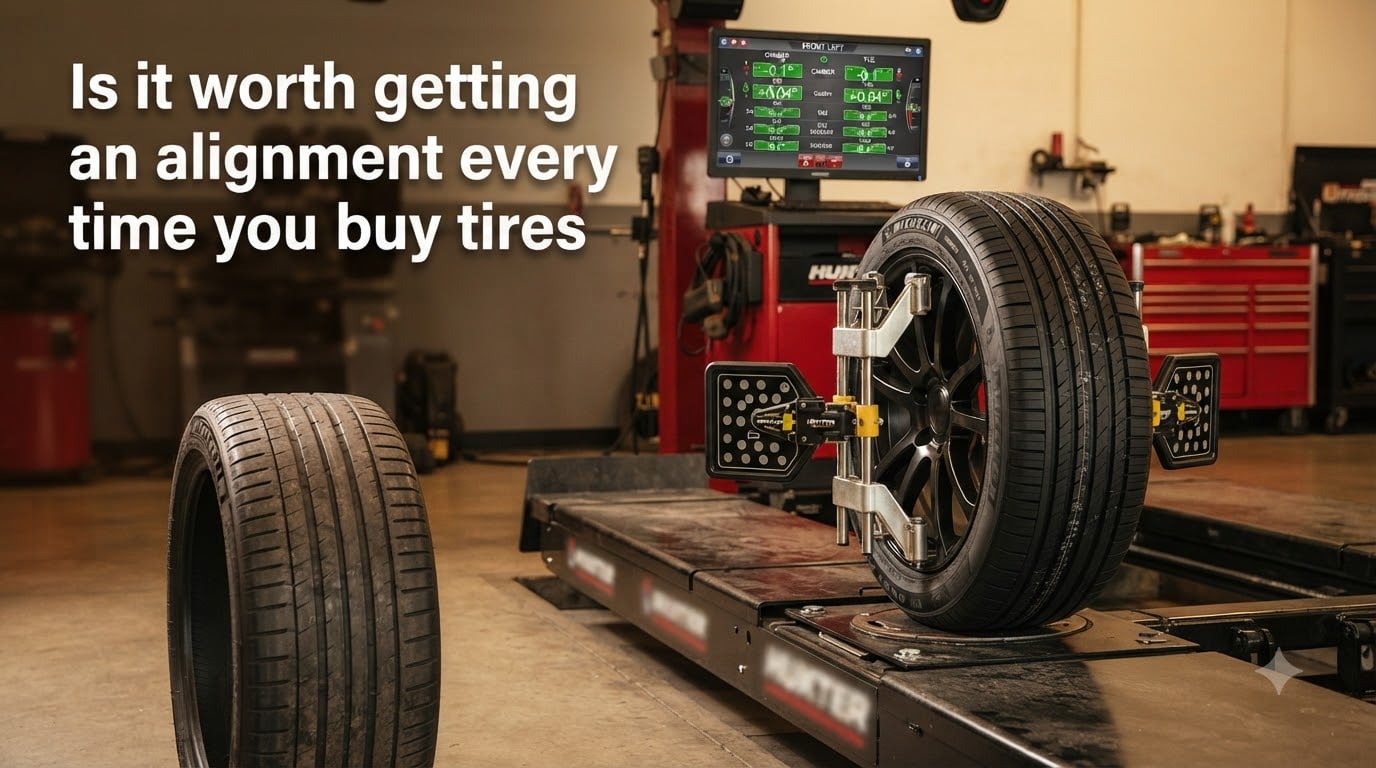
Short answer: no, you do not need an alignment every single time you buy tires. An alignment is not required when you install new tires because the tire swap itself does not change your suspension geometry. However, if your old tires wore unevenly, if you recently hit a pothole or curb, if your last alignment was over two years ago, or if you bought premium tires with a mileage warranty, then the alignment pays for itself. Most drivers benefit from getting one roughly every two to three years, or every 10,000 to 15,000 miles, depending on driving conditions. The rest of this guide walks through exactly when it is worth it and when it is safe to politely decline.
Table of Contents
What Wheel Alignment Does and Why It Matters
A wheel alignment is the adjustment of your vehicle’s suspension components so all four tires make proper contact with the road at the correct angles. A technician attaches sensors to each wheel, measures those angles against your manufacturer’s specifications, and then adjusts suspension parts using shims, cams, or eccentric bolts to bring the angles back into spec. It is geometry work, not tire work.
Three angles get measured every time:
Camber is the inward or outward tilt of the tire when viewed from the front of the car. Negative camber means the top of the tire tilts inward. Positive camber means the top tilts outward. Too much of either causes inner-edge or outer-edge tire wear.
Caster is the forward or backward tilt of the steering axis when viewed from the side. Think of the angle of a bicycle fork. Caster affects straight-line stability and steering feel but does not cause tire wear on its own.
Toe is whether the fronts of the tires point toward each other (toe-in) or away from each other (toe-out) when viewed from above. Even a tiny toe misalignment, measured in fractions of a degree, causes the fastest tire wear of the three angles. That is why toe is the one technicians check first.
The reason alignment matters is not just tire life. It also affects fuel economy, stopping distance, and how predictable your vehicle feels at highway speeds. Now the question is whether installing new tires changes any of these angles.
Does Getting New Tires Throw Off Your Alignment
No. Installing new tires does not mechanically change your alignment. Your suspension angles are identical before and after the swap, because the wheels and tires mount to the same hubs, ball joints, and control arms regardless of what rubber is wrapped around the rim.
What often happens is this: the old tires were masking a misaligned suspension. They wore in whatever pattern the bad geometry created, and once those tires are replaced, the new tires start wearing in that same pattern right away. The alignment was already off. The new tires just expose it faster because their tread is fresh and symmetrical.
A quick sanity check: lay your hands flat on each of the old tires before they leave the shop. Run your fingers across the tread in both directions. If the surface feels smooth one way and rough or sharp the other, that is feathering, a classic sign of bad toe alignment. If the inner or outer edge is noticeably more worn than the center, that is camber drift. Either finding is a strong argument for an alignment right after the new tires go on.
When You Need an Alignment With New Tires
Here is the situation list where I would always recommend getting an alignment at the same visit. These are the cases where skipping the service almost guarantees you will replace the new tires sooner than you should.
- Your old tires wore unevenly. Any visible feathering, sawtooth edges, inner or outer edge wear means your suspension geometry is off. New tires installed on misaligned geometry will repeat that wear pattern.
- You hit a significant pothole or curb within the last six months. A hard impact can bend a steering or suspension component enough to shift alignment out of spec. Even one pothole at speed can do it.
- It has been over two years or 15,000 miles since your last alignment. Normal driving on imperfect roads gradually moves alignment out of spec. Bushings settle, springs sag, and components wear.
- Your steering wheel sits off-center when driving straight. If you have to hold the wheel slightly left or right to go straight, alignment is already off.
- The vehicle pulls to one side. Pulling left or right under steady throttle on a flat road is the most common alignment symptom drivers notice.
- You bought premium tires with a mileage warranty of 50,000 miles or more. Manufacturers like Michelin, Bridgestone, and Continental can deny warranty claims if irregular wear shows up and you cannot prove you kept alignment in spec.
If any of those six situations apply to you, get the alignment done while the tires are still fresh. Waiting six months and then aligning is fine mechanically, but it locks in any early wear the new tires picked up.
When You Can Skip the Alignment (Honest Checklist)
Now the part that most tire shops will not tell you. There are real cases where you can skip the alignment and not regret it. Tick every box below and you are probably safe to decline.
- Your old tires wore perfectly evenly across the full tread width.
- The tread depth was consistent from the inside shoulder to the outside shoulder.
- Your steering wheel was centered and the vehicle drove straight on flat roads.
- You have an alignment printout or receipt from within the last 12 months.
- You have not hit any potholes, curbs, or had suspension work in that window.
- You replaced economy or short-life tires (under 40,000 mile warranty) where the cost of alignment is a meaningful share of the tire cost.
- The shop offers a free alignment check, and the printout shows all angles in spec.
If all seven apply, the alignment is optional. Many independent mechanics, including several voices on r/cars and r/askcarguys, confirm this same logic. The car is a mechanical system. If everything measures correctly, no adjustment is needed.
One honest note here: most shops make a margin on alignment, which is why they push it on every tire sale. That does not mean they are lying about whether you need one. It means their default recommendation leans toward yes because that is the safe answer. You have to do the inspection yourself, or at least ask the right questions, to know whether your situation is a yes or a no.
Warning Signs Your Vehicle Needs an Alignment
Sometimes alignment problems show up before any tire wear is visible. Watch for these symptoms, especially right after a new tire install. If you notice any of them in the first 1,000 miles, take the car back.
- Vehicle pulls to one side under steady driving on a flat, straight road.
- Steering wheel is off-center when the car is driving straight.
- Steering wheel vibration at highway speeds that was not there before.
- Uneven or rapid tire wear showing up on the new tires within the first 10,000 miles.
- Loose or wandering steering feel, like the car cannot decide which way to go.
- Squealing tires on turns when you are not driving aggressively.
Performance Plus Tire and other industry sources note that misalignment can shorten stopping distance performance by up to 20% on wet or icy surfaces, because the misaligned tire does not lay full rubber on the road. That is a safety number, not just a convenience one.
How Often Should You Get a Wheel Alignment
Most manufacturers recommend a wheel alignment check once a year or every 10,000 to 15,000 miles, whichever comes first. That interval assumes normal driving on well-maintained roads. The honest answer for real-world drivers is to lean toward every two years or 12,000 to 15,000 miles, with extra checks after any suspension impact event.
Drivers in pothole-heavy regions, those who commute on rough winter roads, and anyone who frequently parallel parks near curbs should probably shorten that to once a year. All-wheel-drive and performance vehicles with aggressive alignments should also follow the annual cadence.
New tires are not on the alignment interval. They do not reset the clock, because the alignment was not changed by the swap. They simply give you a fresh baseline of even tread to start measuring future wear against.
How Much Does an Alignment Cost vs Skipping It
Here is the cost-benefit math that usually makes the decision for me.
Alignment service: Most independent shops charge between $80 and $120 for a four-wheel alignment. Dealerships typically charge $150 to $200. Many tire shops include the alignment free with a four-tire purchase, especially on premium tires. Most shops will run a free alignment check and hand you a printout.
Premature tire replacement cost: A set of four quality tires runs $600 to $1,200 installed. If misalignment cuts tire life in half, that is $300 to $600 thrown away every tire cycle. Over three tire cycles, skipping alignment can cost $1,000 to $1,800 more than paying for alignments along the way.
Fuel economy impact: Industry data suggests a 10% increase in rolling resistance from misalignment translates to roughly 1 to 2% worse fuel economy. Over a year of driving 12,000 miles at 25 mpg, that adds up to a noticeable extra fuel cost.
Stopping distance impact: Misalignment can increase stopping distance by up to 20% on wet or icy surfaces. That is the difference between stopping in time and not stopping in time.
The math is not even close. Pay the $100 alignment once every couple of years and you avoid the $1,200 premature tire bill, plus you keep better fuel economy and safer braking. The alignment is one of the cheapest insurance policies you can buy on a new set of tires.
Alignment vs Tire Balancing: What’s the Difference
These two services get confused constantly, but they do completely different jobs. Here is the comparison.
Wheel alignment adjusts the angles of your wheels relative to each other and to the road. It affects tire wear, steering feel, and straight-line stability. You need alignment if you see uneven tire wear or pulling.
Tire balancing adds small weights to the wheel so the tire and wheel spin smoothly without vibration. It affects ride comfort and steering wheel shake at speed. You need balancing every time tires are mounted or removed.
You almost always need balancing with new tires. You only sometimes need alignment with new tires. That is the cleanest way to think about the two services.
How to Tell If Your Old Tires Wore Evenly
Before you decide on alignment, spend five minutes inspecting the old tires. This single step tells you 80% of what you need to know. Pull each tire off and lay it flat, then look straight down at the tread from the front of the tire, not from above.
Even wear across the full width: The tread depth is consistent from the inner shoulder to the outer shoulder. This means your alignment was likely in spec, or close to it, for the life of the tire. You can probably skip alignment.
Inner or outer edge wear only: One side of the tire is significantly more worn than the other. This is a classic camber problem. Get an alignment, and ask the technician to check for worn ball joints or strut bearings, because camber drift is often caused by worn components, not just adjustment needs.
Center wear: The middle of the tread is more worn than the edges. This is almost always over-inflation, not alignment. Skip alignment and check your tire pressure instead.
Feathering: Run your hand across the tread. It feels smooth one direction and rough or sharp the other. This is toe misalignment, and it is the most common alignment problem. Get the alignment.
Sawtooth or diagonal wear pattern: Look at the tread blocks. They appear angled like fish scales, with one edge sharper than the other. This is also toe-related and almost always requires alignment, possibly combined with worn bushings.
The Tire Warranty Trap Most People Miss
Most premium tire mileage warranties, including those from Michelin, Bridgestone, Continental, and Goodyear, require the tires to be rotated at recommended intervals and the vehicle to be kept in alignment. If you file a warranty claim for a tire that wore out at 30,000 miles but had a 60,000-mile warranty, the manufacturer will ask for your rotation records.
If the tire shows irregular wear patterns, feathering, or camber wear, the manufacturer can deny the claim as owner neglect. The alignment documentation is not strictly required by every manufacturer, but having an alignment printout from a shop within the last year is the strongest defense if a claim gets disputed.
This is why buying premium tires without ever checking alignment is risky. The whole point of paying for a 60,000-mile tire is to get 60,000 miles out of it. If bad alignment cuts that in half, you paid premium prices for economy tire life.
After Potholes and Curb Strikes: When to Re-Align
One hard impact event can knock alignment out of spec by enough to cause measurable tire wear. A pothole at 35 mph, a curb strike during parking, or any contact with road debris can bend a steering knuckle, deflect a control arm, or shift a wheel sensor position. Even if the car drives straight afterward, the alignment may be off by a degree or more.
Two rules of thumb after an impact event. First, inspect the wheels and tires immediately for visible damage, bulges, or bends. Second, if the impact felt hard enough to make you check the car, get a free alignment check within the next week. If anything is out of spec, get the alignment before installing new tires or shortly after.
Suspension work, including replacing struts, control arms, ball joints, tie rod ends, or springs, always requires a four-wheel alignment afterward. The mechanic has to disassemble components to replace them, and the original geometry will not come back together exactly the same way by hand. Plan the alignment cost into the suspension repair budget.
Questions to Ask Your Tire Shop Before Saying Yes
Most upsells happen because customers do not know what to ask. Here is a short script you can use at the counter. It works at chain stores, dealerships, and independent shops alike.
- “Can I see the alignment printout from before the new tires went on?” This tells you if the alignment was in spec before the install.
- “What were the camber, caster, and toe numbers on my last alignment?” Specific numbers mean the tech actually measured something.
- “Are there any suspension parts you recommend replacing before alignment?” If yes, ask for the measurement that shows the part is worn. A bent tie rod end is visible. A “preventive” recommendation is often an upsell.
- “How much is the alignment if I get it today versus coming back next week?” Same price, usually. That question tests whether the urgency is real.
- “Will you re-balance for free if I notice vibration after driving 50 miles?” The shop should stand behind the install.
If the shop pressures you on a same-day decision, that is a yellow flag. Good shops will let you take the car home and return within a week for the alignment at the same price.
Frequently Asked Questions
Do I need a wheel alignment every time I buy new tires?
No. Installing new tires does not change your alignment, because the tire swap does not affect suspension geometry. You only need an alignment with new tires if your old tires wore unevenly, you recently hit a pothole or curb, your steering wheel is off-center, or it has been over two years since your last alignment.
Is an alignment necessary when getting new tires?
It is necessary in some cases and not in others. If your old tires wore evenly, the car drives straight, and your last alignment was recent, alignment is optional. If you see any uneven wear or feel pulling, alignment is recommended to protect your new tire investment.
How much does a wheel alignment cost?
Most independent shops charge $80 to $120 for a four-wheel alignment. Dealerships typically charge $150 to $200. Many tire shops include alignment free with the purchase of four new tires, and almost all shops will run a free alignment check on request.
What are the signs that my vehicle needs an alignment?
Common signs include the vehicle pulling to one side, the steering wheel sitting off-center when driving straight, uneven or rapid tire wear, steering wheel vibration at highway speed, and a loose or wandering steering feel. If any of these show up on new tires within the first 1,000 miles, take the car back for an alignment.
How often should I get my wheels aligned?
Most manufacturers recommend an alignment check once a year or every 10,000 to 15,000 miles. Drivers in pothole-heavy areas, those who park near curbs, and performance vehicle owners should lean toward the annual interval. New tires do not reset the alignment clock because the swap itself does not change suspension angles.
Can I skip alignment if my old tires had even wear?
Yes. If your old tires wore evenly across the full tread width, the steering wheel sat centered, the car drove straight on flat roads, and you have no recent pothole or curb impact, alignment is generally safe to skip. A free alignment check at most shops can confirm this for you with a printout.
Does getting new tires throw off your alignment?
No. The tire swap does not change suspension geometry. Your camber, caster, and toe angles are identical before and after the new tires go on. What new tires do is expose pre-existing alignment problems faster, because the fresh, symmetrical tread makes any abnormal wear pattern immediately visible.
Is an alignment the same as a tire balance?
No. Alignment adjusts the angles of your wheels relative to each other and the road, affecting tire wear and steering. Balancing adds small weights to the wheel so it spins smoothly without vibration. You need balancing every time tires are mounted. You only sometimes need alignment with new tires.
Can I do an alignment myself at home?
A true alignment requires a laser or camera alignment rack and manufacturer specifications. Some enthusiasts use string alignment or a homemade toe gauge for rough toe adjustments, but the result will not match a shop rack measurement. For most drivers, a shop alignment is the practical choice, especially given the low cost.
Do you need an alignment when replacing just two tires?
The alignment decision is the same whether you replace two or four tires. The geometry does not change. If your old tires showed uneven wear, get an alignment. If they wore evenly, you can usually skip it. However, installing two new tires on the rear axle is the safer placement for most vehicles, regardless of alignment.
Final Verdict: Is It Worth Getting an Alignment Every Time You Buy Tires
Whether it is worth getting an alignment every time you buy tires comes down to three questions. Did your old tires wear evenly? Has anything changed in the last two years that could have knocked alignment out of spec? Are the new tires expensive enough that premature wear would sting?
If the answer to all three is yes, the alignment is optional and you can save the money. If the answer to any one of them is no, pay for the alignment. The $100 service protects a $600 to $1,200 tire investment, and it is one of the cheapest insurance policies you can buy on a new set of tires.
The real skill is knowing how to inspect your old tires before saying yes at the counter. Spend five minutes running your hands across the tread, looking for feathering, edge wear, or sawtooth patterns. That single step tells you almost everything you need to decide. If the answer is unclear, take the shop up on the free alignment check and ask to see the printout. Numbers in spec mean skip. Numbers out of spec mean align. Either way, you made the call with real data instead of guessing.