
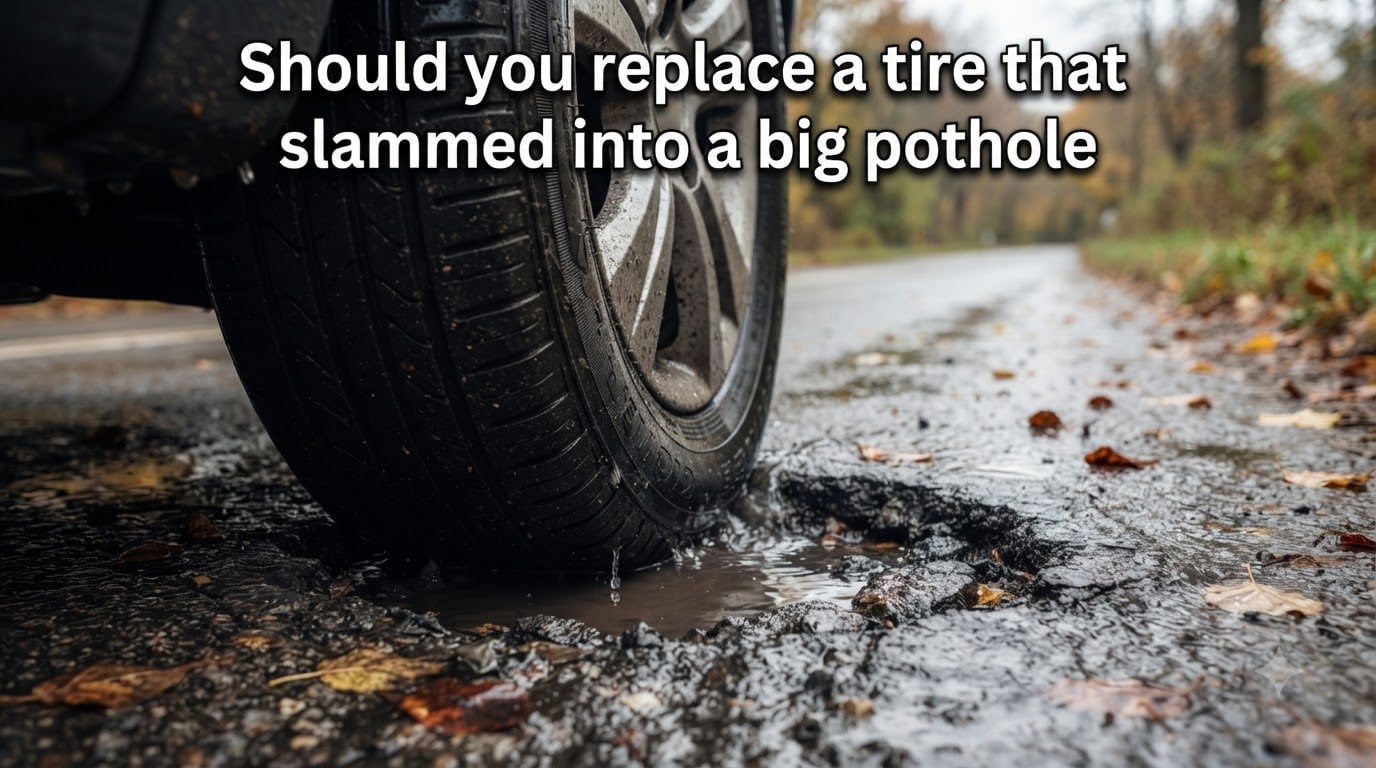
You just felt that sickening jolt — the wheel dropped into a pothole and your whole car shuddered. Now you’re staring at the tire wondering if it’s still safe. We’ve been there, and the answer isn’t always obvious. Here’s how to tell if you need to replace a tire that slammed into a big pothole, and what to check before you get back on the highway.
Table of Contents
Should You Replace a Tire That Slammed Into a Big Pothole?
Replace the tire immediately if the pothole caused a sidewall bulge, visible cord or fabric, ongoing air loss, or new vibration at highway speed. If none of these signs are present, the tire may be fine — but get a professional inspection within 24 hours and recheck tire pressure daily for 72 hours. Damage from a pothole can be invisible at first and show up days later as a late-appearing bulge or sudden blowout.
The severity depends on how fast you were going, the angle of impact, and the depth of the hole. A deep pothole hit at 40+ mph can break the tire’s internal steel cords even when the outside looks perfectly normal.
What Happens Inside a Tire When It Hits a Pothole
When your wheel drops into a pothole, the tire’s sidewall gets pinched between the rim and the sharp edge of the road. This is called pinch shock — and it can snap the internal steel or textile cords that give the tire its structure.
Those cords, also called the casing or ply layers, are what hold the tire together under load. Once they break, the rubber above that spot has nothing supporting it. Air pressure pushes outward at the weak point, and you get a sidewall bulge or bubble.
The tricky part is that broken cords don’t always announce themselves right away. The outer rubber can hold its shape for hours or even days before the bulge appears. This is what Reddit users call the “looks fine now, fails next week” problem — and it’s the number-one reason to recheck a pothole-hit tire within 24 to 72 hours.
Signs That Mean Replace the Tire Immediately
Certain pothole tire damage signs mean the tire is no longer safe to drive on, period. If you spot any of these, do not attempt to drive to a shop — call for a tow or install your spare.
Sidewall bulge or bubble. A raised bump on the sidewall means internal cords have broken and the tire can blow out at any moment. This is not repairable.
Visible cord, fabric, or wire. If you can see white or metallic threads through a cut in the rubber, the structural layers are exposed. The tire has lost its integrity.
Continuous air loss. If the tire won’t hold pressure after inflation, there is a puncture or casing breach that needs professional evaluation. Driving on a flat destroys the tire and damages the rim.
New vibration or steering shake at speed. A broken belt or shifted tread can cause the wheel to wobble. If your steering wheel shakes after the pothole hit and it did not shake before, stop driving.
Sidewall vs Tread Damage: Can It Be Repaired?
The location of the damage determines whether a tire can be saved. This is the single most important rule in tire repair.
Sidewall damage — never repairable. The sidewall flexes constantly while driving. No patch or plug can stay bonded to a flexing surface, and the internal cords that provide strength cannot be restored. If the sidewall is cut, bulged, or has exposed cord, the tire must be replaced.
Tread center — sometimes repairable. A puncture in the center tread area (the flat part that contacts the road) can often be fixed with a patch-plug combination, as long as the hole is smaller than 1/4 inch and no cord is exposed. Most tire shops follow this industry standard.
Shoulder and bead area — generally not repairable. The shoulder (where the tread meets the sidewall) and the bead (where the tire seals against the rim) are high-flex zones. Damage here usually means replacement.
5-Step Post-Impact Inspection You Can Do Right Now
Pull over to a safe, flat spot as soon as possible after hitting a pothole. Here’s what to check before deciding whether to keep driving or call for help.
Step 1: The cord-flap test. Look at the sidewall and tread for cuts or flaps of rubber. If you find one, gently lift the flap. If you see white or metallic threads underneath, those are exposed cords — the tire needs replacing. If you only see black rubber, the damage may be cosmetic.
Step 2: Flashlight sidewall check. Walk around the tire with a flashlight (your phone works). Look for any bulges, bubbles, or cracks on the sidewall. Run your hand over the surface — a bulge feels like a raised bump that should not be there.
Step 3: Pressure check. Use a tire pressure gauge or your car’s TPMS reading. Compare it to the recommended pressure on the driver’s door jamb sticker. A drop of more than 5 psi from your last check suggests an active leak.
Step 4: Tread inspection. Look for raised or uneven tread blocks, chunks missing from the tread, or flat spots. Any of these can cause vibration and uneven wear.
Step 5: Rim and wheel check. Look at the edge of the wheel rim for bends, cracks, or gouge marks. A bent rim can cause a slow leak even on an undamaged tire.
Driving Symptoms That Mean Something Is Wrong
Sometimes the damage is not visible during a roadside check but shows up as soon as you start driving. Pay attention to these symptoms in the first few miles after a pothole hit.
Steering wheel vibration or shake that wasn’t there before usually means a broken belt, shifted tread, or bent rim. The faster the vibration appears (at lower speeds), the worse the damage.
The car pulling to one side can indicate a bent rim, knocked-out alignment, or uneven tire pressure from a slow leak on the pothole side.
A rhythmic thumping or humming noise from one wheel area often means a flat spot on the tread or internal belt separation.
The TPMS warning light coming on after the hit means the tire has lost pressure. Even a slow leak will eventually cause a blowout if ignored.
What If the Tire Looks Fine After Hitting a Pothole?
A tire that looks fine immediately after a pothole hit is not necessarily fine. Internal damage — broken cords, belt separation, casing compromise — can be completely invisible from the outside.
The real danger is the latent damage timeline. Multiple drivers on Reddit’s r/tires have reported sidewall bulges appearing 24 to 72 hours after impact, on tires that looked perfectly normal at the roadside. The internal cord break slowly lets air pressure push the rubber outward until a visible bubble forms.
If you hit a pothole hard enough to feel it in the steering wheel but see no visible damage, here is the protocol:
Recheck tire pressure at 24 hours, 48 hours, and 72 hours after the hit. Any drop of more than 2 psi between checks is a red flag. Inspect the sidewall with a flashlight at each check — look for new bulges that weren’t there before. Pay attention to any new vibration, noise, or pull during your normal driving.
Getting a professional tire inspection within the first 24 hours is the safest move. A shop can put the tire on a lift and check for internal damage that you cannot see from outside.
AWD Vehicles: Do You Need to Replace All Four Tires?
If your vehicle is all-wheel drive, replacing a single tire can cause problems. AWD systems rely on all four tires being the same diameter to distribute power evenly. A new tire with full tread depth paired with three worn tires creates a diameter mismatch that can damage the transfer case or differential.
The general rule is that all four tires should be within 2/32 inch of tread depth. If the other three tires have significant wear, you may need to replace all four or have the new tire shaved down to match the others. Some tire shops offer this service.
For front-wheel drive and rear-wheel drive vehicles, replacing a single tire is usually fine as long as the new tire matches the same size, speed rating, and load index as the others. Put the new tire on the rear axle for best stability.
How Speed and Angle Affect Pothole Damage Severity
Not all pothole hits are equal. The faster you’re going when you hit the hole, the more energy gets transferred into the tire and wheel.
Under 20 mph: Damage is usually limited to cosmetic rim scuffs or minor tread damage. The tire can usually absorb the impact without structural failure.
20 to 40 mph: This is the danger zone for sidewall pinch and rim bending. Most pothole tire damage from “normal” driving falls in this range. Broken belts and sidewall bulges are common.
Over 40 mph (highway): Severe damage is likely — cracked rims, complete sidewall failure, suspension component damage. The tire may blow out immediately or suffer internal damage severe enough to fail within days.
A direct, square-on hit does more damage than a glancing blow. If you see the pothole coming and can’t avoid it, slightly steering so the tire enters at an angle reduces the peak impact force.
Who Pays for Pothole Tire Damage?
You have three potential sources for recovering the cost of pothole tire damage, though none are guaranteed.
Your auto insurance. If you have collision coverage, pothole damage is typically covered minus your deductible. For a single tire replacement, the cost may be below or close to your deductible, making a claim not worthwhile. Comprehensive coverage generally does not cover pothole damage.
Municipal or state reimbursement. Many cities and states have a claims process for pothole damage. The critical requirement is prior notice — the pothole must have been reported to the city (through 311 or similar) before your incident, and the city must have failed to fix it within a reasonable time. Reddit users on r/rva have confirmed that claims succeed when prior notice exists.
Road hazard tire warranty. Some tire manufacturers and retailers include a road hazard warranty that covers pothole damage for the first year or first 2/32 inch of tread wear. Check your tire purchase paperwork for this coverage.
To file any claim, document everything: GPS coordinates, photos of the pothole (with a reference object for size), photos of the damage, date and time, police report if applicable, and copies of any prior reports to the city.
5 Common Mistakes Drivers Make After a Pothole Hit
These mistakes can turn a manageable situation into a dangerous one.
Driving on a sidewall bulge. A bulge means the tire can blow out at any speed. Do not drive on it — even to the shop. Install your spare or call a tow.
Ignoring a slow leak. A tire that loses 2-3 psi per week after a pothole hit has internal damage. The leak will get worse, not better, and a slow leak at highway speed becomes a rapid deflation.
Trusting a wheel balance to fix the vibration. Balancing corrects weight distribution, not structural damage. If the tire has a broken belt, balancing it won’t help and the vibration will return.
Skip the 72-hour recheck. Latent damage — especially late-appearing sidewall bulges — is real. Checking once and forgetting about it misses the window when hidden damage surfaces.
Not documenting the pothole. If you plan to file a claim, you need evidence collected at the scene. Driving away without photos, GPS coordinates, or a 311 report weakens your case significantly.
Frequently Asked Questions
Can you drive with a tire that hit a pothole?
You can drive on a pothole-hit tire only if it holds pressure, has no visible sidewall bulge or exposed cord, tracks straight, and causes no new vibration. Even then, drive straight to a tire shop for a professional inspection. Do not drive at highway speeds on a tire you haven’t checked.
How do you know if a tire is damaged from a pothole?
Check for a sidewall bulge or bubble, cuts exposing white or metallic cord, pressure loss after inflation, and new vibration or steering shake at speed. If none of these appear, recheck at 24, 48, and 72 hours — internal damage can take days to surface.
What does a damaged tire sidewall look like?
A damaged sidewall may show a raised bulge or bubble where the rubber pushes outward from broken internal cords. It may also have a cut or gash where white textile or steel cords are visible through the rubber. Any sidewall bulge means the tire must be replaced immediately.
Can a pothole damage a tire without causing a flat?
Yes. A pothole can break internal steel or textile belts without puncturing the outer rubber. The tire holds air but has a structural weak point that can fail days later as a sudden blowout or late-appearing bulge. This is why rechecking pressure and sidewall condition for 72 hours after the hit is critical.
Is a sidewall bulge on a tire dangerous?
Yes, a sidewall bulge is extremely dangerous. It means the internal cords have broken and only the outer rubber is holding the air in. The tire can blow out without warning at any speed. Do not drive on a tire with a sidewall bulge — replace it immediately.
Should I replace all four tires if one is damaged from a pothole?
It depends on your drivetrain. For AWD vehicles, all four tires need to be within 2/32 inch of tread depth, so replacing all four may be necessary. For FWD and RWD vehicles, replacing a single tire with the same size and speed rating is usually fine. Place the new tire on the rear axle.
Can you repair a tire with sidewall damage from a pothole?
No. Sidewall damage — including bulges, cuts, and exposed cord — cannot be repaired. The sidewall flexes too much for any patch or plug to hold, and broken internal cords cannot be restored. The only option is replacement.
How long can I drive on a tire that hit a pothole?
If the tire shows no visible damage, holds pressure, and causes no vibration, you can drive normally — but recheck it at 24, 48, and 72 hours. If you see a bulge, cord, or ongoing air loss, stop driving immediately and install a spare or call for a tow.
Who pays for pothole tire damage?
You may recover costs through collision insurance (minus your deductible), a municipal pothole damage claim (requires proof the city knew about the pothole and didn’t fix it), or a road hazard tire warranty if your tires are still covered. Document the pothole with photos, GPS, and date/time at the scene.
Conclusion
Deciding whether to replace a tire after hitting a pothole comes down to what you can see and what you can feel. A sidewall bulge, exposed cord, or ongoing air loss means the tire is done — no exceptions. But even if everything looks fine, the 72-hour recheck protocol exists because internal damage takes time to surface. Check pressure at 24, 48, and 72 hours. Watch for new bulges. Pay attention to vibration. And when in doubt, get a professional inspection. The cost of a tire is always less than the cost of a blowout at highway speed.