
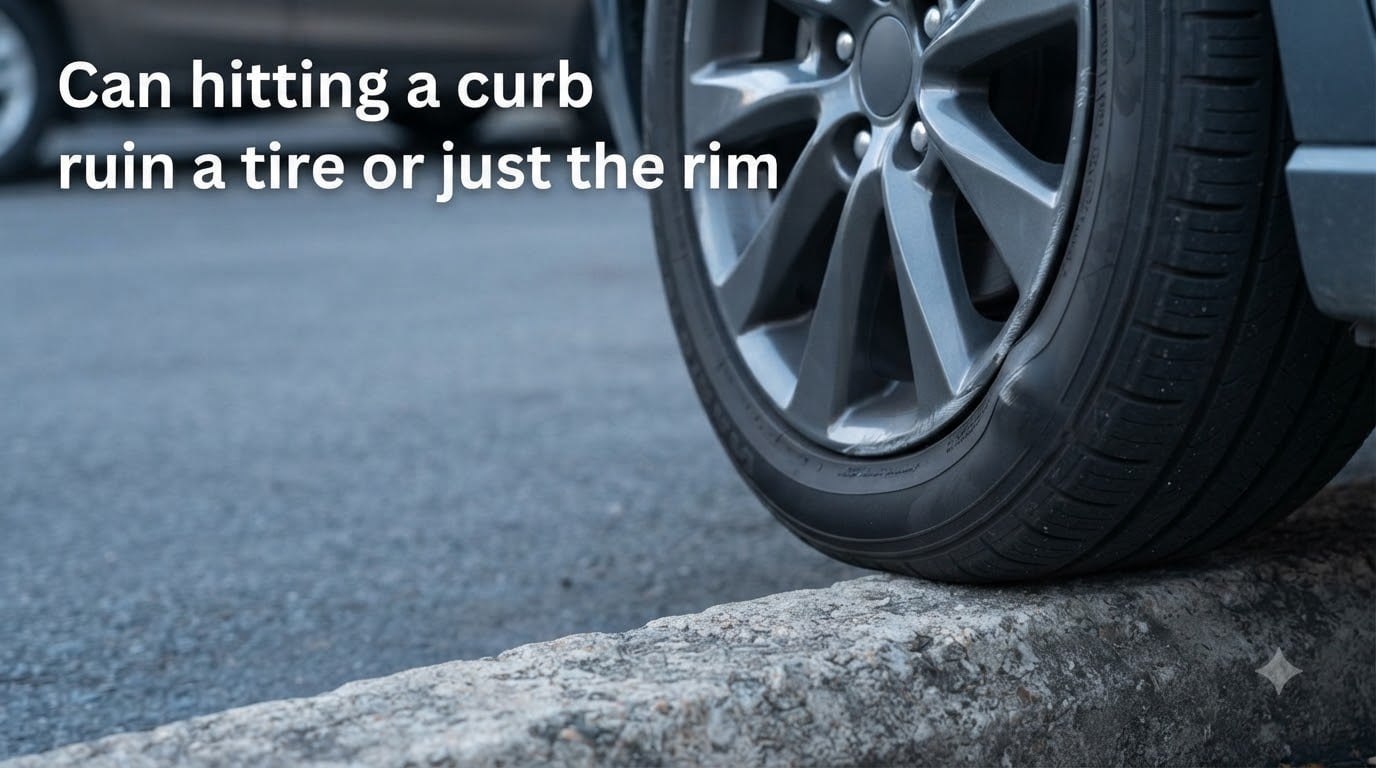
Yes — hitting a curb can ruin a tire, the rim, or both, depending on speed, angle, and tire type. Low-speed scrapes usually damage only the rim (often just cosmetic curb rash), while angled or higher-speed strikes tend to bend the rim, break the bead seal, or push the tire’s sidewall hard enough to bulge, cut, or blow out. The fastest way to tell which one you ruined is a 5-minute inspection: look for a bulge, exposed cords, a cracked rim, fast air loss, or a crooked steering wheel.
I have been on the receiving end of this exact question more times than I can count — usually in a parking lot, usually panicked, usually right after a parallel-parking miss. Our team put this guide together so you can answer it yourself in five minutes, with the same checklist a tire tech would walk you through at the shop.
Table of Contents
What Happens to a Tire When You Hit a Curb
The tire is the first thing to absorb a curb impact, and the sidewall — the flexible rubber between the tread and the bead — is the most vulnerable part. It is thin by design so the tire can flex over bumps, which means a sharp lateral force from a curb edge can stretch or rupture its internal cords in a single impact.
Sidewall bulges and exposed cords
A sidewall bulge looks like a soft bubble on the side of the tire. It means the polyester or steel cords inside have broken and the air pressure is pushing the inner liner out through the gap. Per USTMA (U.S. Tire Manufacturers Association) guidelines and Michelin/Continental inspection standards, a sidewall bulge is not repairable — the tire must be replaced, even if it still holds air. Driving on a bulged tire is a blowout waiting to happen.
Cuts, gashes, and pinch flats
A curb edge can slice the sidewall or shear off a chunk of tread rubber. A “pinch flat” happens when the tire is compressed hard enough between the rim and the road that the inner liner gets pinched and punctured — sometimes visible only from the inside. USTMA repair criteria limit tread punctures to 1/4 inch or less, with no shoulder involvement. Anything larger, or anything on the sidewall, means replacement.
Bead-seal breaks and slow leaks
The bead is the wire ring that seals the tire to the rim. A hard curb strike can break that seal, and the tire will lose air slowly — sometimes over days. Reviewers on automotive forums report discovering a low tire a week after the original hit because the bead unseated just enough to hiss under pressure.
Tread separation and internal belt damage
The most dangerous failure is also the hardest to spot. A curb strike can crack a steel belt inside the tire without leaving a visible mark on the outside. The tread can then separate from the carcass weeks later, often at highway speed. This is the scenario mechanics warn about most — a tire that “looked fine” after the hit but failed on the interstate.
What Happens to a Rim When You Hit a Curb
Rims — especially aluminum alloy wheels — deform differently than tires. They bend, crack, or scratch depending on where the curb struck and how hard. The rim is usually the first casualty in a low-speed parking-lot tap, which is why the question “did I ruin the tire or just the rim?” comes up so often.
Curb rash (cosmetic)
Curb rash is the scratched, scuffed paint on the outer lip of the wheel. It is purely cosmetic — the wheel is still round, still sealed, still safe to drive on. Many drivers live with curb rash for years. It only matters if you care about appearance or resale value.
Bent rim (functional)
A bend in the rim lip or flange usually shows up as a slow leak, a vibration at speed, or uneven tire wear. You can sometimes spot a bent rim by spinning the tire and watching the outer edge — it will wobble slightly. Wheel straightening shops can often repair a single bend for less than the cost of a new wheel.
Cracked rim (structural)
A crack in the wheel — usually radiating from the spoke base or along the rim flange — is a structural failure. Cracked rims cannot be safely repaired; they must be replaced. Driving on a cracked alloy wheel risks a sudden catastrophic failure under load.
Bead-seal damage on the wheel
Even when the rim itself looks fine, a curb strike can deform the bead seat (the curved area where the tire seals against the wheel) just enough to break the air seal. This is one of the most common sources of slow leaks after a curb hit and often gets blamed on the tire when the wheel is actually at fault.
Tire vs. Rim Damage at a Glance
Here is the cheat sheet our team uses when triaging a curb-hit phone call. Speed and angle matter far more than most drivers realize.
| Impact type | Most likely damage | Typical severity |
|---|---|---|
| Low-speed straight scrape (under 5 mph) | Curb rash on rim | Cosmetic only |
| Low-speed angled tap (5-10 mph) | Bent rim lip, possible bead-seal break | Functional, often repairable |
| Medium-speed sideswipe (10-20 mph) | Bent rim, sidewall scuff, slow leak | Repair or replace |
| Medium-speed angled strike (15-25 mph) | Bent rim, sidewall bulge or cut | Tire replacement likely |
| High-speed head-on strike (25+ mph) | Cracked rim, exposed cords, possible blowout | Replace both rim and tire |
Low-profile tires (typically series 45 or lower) make every row of this table worse. Less sidewall height means less cushion between the rim and the curb, so the rim absorbs more of the impact. If you run 35-series or 40-series tires, treat even minor curb contact as a real event and inspect thoroughly.
Your 5-Minute Post-Curb Inspection Checklist
You do not need to be a mechanic to do this. Walk around the hit wheel with this list and you will catch 90% of the damage that matters.
- Look at the sidewall. Crouch next to the tire and scan the entire side — both sides — for any bulge, bubble, or raised line. A bulge means internal cord damage and a tire that needs to come off the car.
- Check for cuts and exposed cords. Run your hand (carefully) along the sidewall and tread shoulder. If you feel fabric, wire, or a deep gash, the tire is done.
- Inspect the rim. Look for curb rash (cosmetic), a visible bend in the lip, or any crack. Spinning the wheel slowly while watching the outer edge makes a wobble easy to spot.
- Check tire pressure. Use a gauge or watch the TPMS (tire pressure monitoring system) light. A pressure drop of more than 2-3 psi from the other three tires means a leak.
- Spray soapy water on the bead. If you have a spray bottle, mist the tire-to-wheel seam and look for bubbles. This finds slow leaks the eye will miss.
- Drive 100 feet and check again. Pull forward slowly, then re-check pressure and look at the tire’s footprint. A dragging sidewall or visible deformation under load means the tire is unsafe.
Visual walk-around quick reference
If you see any of these in the first five minutes, the tire or wheel has failed inspection: a sidewall bubble, exposed fabric or wire, a cracked rim, fast hissing air, or a steering wheel that sits off-center even before you drive.
Hidden Damage: Alignment and Suspension
The most expensive curb-hit consequences are the ones you cannot see from the driver’s seat. A hard enough impact can knock your alignment out of spec, bend a suspension component, or crack a wheel bearing — and none of those show up on a visual inspection.
Toe, camber, and caster misalignment
Alignment is measured in three angles: toe (whether the wheels point straight ahead), camber (whether the tire stands straight up or tilts), and caster (the angle of the steering axis). A curb strike can shift any of them. The most common symptom is the car pulling to one side, but it can also show up as a crooked steering wheel, uneven tire wear, or a vague, wandering feel at highway speed.
Bent tie rods, control arms, and struts
Beyond alignment, the physical components can bend. Tie rods connect the steering rack to the wheel hub; control arms connect the hub to the frame; struts damp the suspension. A hard enough hit can bend any of them, and the failure mode is often delayed — a bent control arm bushing might hold for a week and then fail under a pothole.
Time-delayed symptoms to monitor
Damage that does not show up on day one often shows up later. Watch for these on a schedule:
- Day 1: Pressure loss, vibration, pulling, crooked steering wheel, visible damage.
- Week 1: Uneven tire wear showing up on the inside or outside edge of the hit tire, a slow leak that reappears after refilling.
- Month 1: New noises over bumps (clunks, rattles), TPMS light coming back, a tire that needs air more often than the other three.
Mechanics regularly see customers come back a month after a curb hit complaining of “tires that wear out fast” or “a steering wheel that has never been straight since that day in the parking lot.” Both trace back to the original event.
Can You Keep Driving After Hitting a Curb?
This is the question every driver really wants answered. Use this decision box before you pull out of the parking space.
Safe to keep driving if: no visible bulge, no exposed cords, no cracked rim, tire pressure is within 2-3 psi of the other three, steering wheel is centered, and the car tracks straight at low speed.
Stop now and call a tow if: there is any sidewall bulge, you can see fabric or wire, the rim is cracked (not just scratched), the tire is losing air in front of you, the steering wheel is sharply off-center, or the car pulls hard to one side.
When in doubt, drive slowly to the nearest tire shop — under 25 mph, straight lines only — and have them inspect before you commit to the highway. A short, slow trip to a professional is always cheaper than a tow and a wrecked tire.
Repair vs. Replacement: What to Do Next
Once you have inspected, the next decision is whether the tire or rim can be saved or has to be replaced.
Tire repair thresholds
The USTMA repair standard is the industry benchmark. A tire can be repaired only if the puncture is in the tread, 1/4 inch or smaller, with no shoulder or sidewall involvement, and the repair uses a plug-and-patch combination (not a plug alone). Sidewall cuts, exposed cords, bulges, and shoulder damage all fall outside repair criteria — the tire must be replaced.
Rim straightening vs. replacement
A single bend in an alloy rim can usually be straightened by a specialty wheel shop for a fraction of the cost of a new wheel. A cracked rim cannot be repaired safely and must be replaced. Aftermarket alloy replacement wheels are widely available, and many are designed specifically to take curb impacts better than OEM (original equipment manufacturer) wheels.
Insurance coverage reality
Curb damage is almost always classified as a collision event — your car hit a stationary object. That means it falls under collision coverage, not comprehensive. If you only carry liability, the curb hit comes out of your pocket. Some policies also offer a tire-and-wheel rider (an optional add-on that extends coverage specifically to tires and rims) that covers curb damage with a smaller deductible; check your declarations page or call your agent.
How to Avoid Curb Damage in the First Place
Most curb hits happen in three scenarios: parallel parking, tight U-turns in parking lots, and pulling too far forward at a stop. All three are preventable with a few habits.
Spatial awareness and reference points
Set your side mirrors so you can just see the curb line as you approach a parking space. Pick a fixed reference point on your dashboard — the A-pillar, a wiper blade position, or a hood ornament — that lines up with the curb when you are 12-18 inches away. That single trick prevents most parallel-parking scrapes.
Parking and turning techniques
Pull past the spot, then reverse in. The turn radius is tighter going forward than reversing, so the curb is harder to hit. For tight U-turns, go wider than feels necessary — the curb is almost always closer than it looks from the driver’s seat.
Rim protectors and tire choices
Some aftermarket wheels come with a rim protector — a raised rubber or plastic lip on the outer edge that absorbs the curb hit instead of the alloy. Higher-profile tires (series 55 and up) give the sidewall more cushion to absorb impacts before the rim takes the hit. Neither is a guarantee, but both reduce the odds of a real repair bill.
Frequently Asked Questions
Is curb rash just cosmetic?
Yes. Curb rash is scratched or scuffed paint on the outer lip of the wheel. The rim is still round and still sealed, and the tire is unaffected. It only matters for appearance or resale value, not safety.
Can a sidewall bulge be repaired?
No. A sidewall bulge means the internal cords have broken. Per USTMA and manufacturer guidelines (Michelin, Continental), the tire must be replaced — even if it still holds air. Driving on a bulged tire risks a blowout.
Can hitting a curb cause a slow tire leak?
Yes. A curb strike can break the bead seal (the air seal between tire and wheel) or damage the rim flange just enough to let air seep out slowly. Drivers often notice the low pressure days after the original hit.
Will insurance cover tire damage from hitting a curb?
Usually only if you carry collision coverage, because hitting a curb is classified as a collision event with a stationary object. Comprehensive does not apply. Some insurers offer a tire-and-wheel rider that covers curb damage with a lower deductible.
How can I tell if my wheel alignment is off after a curb hit?
Watch for the car pulling to one side, a steering wheel that sits off-center when driving straight, uneven tire wear (especially on the inside or outside edge of the hit tire), or a vague wandering feel at highway speed. Any of these warrant an alignment check.
How soon should I inspect my tire after hitting a curb?
Immediately, while you are still in the parking lot. The five-minute checklist above catches most urgent damage. Then re-check pressure and handling at one week and one month — some damage, especially alignment and internal belt issues, only shows up over time.
The Bottom Line on Curb Damage
Yes, hitting a curb can ruin a tire, the rim, or both — and which one took the hit depends on speed, angle, and tire profile more than anything else. Low-speed scrapes usually damage only the rim, often cosmetically. Angled or higher-speed strikes tend to bend the rim, break the bead seal, or bulge the sidewall — and any sidewall bulge or exposed cord means replacement, not repair.
Use the five-minute inspection checklist before you pull out of the parking spot, watch for delayed symptoms over the next month, and have a tire shop confirm anything you are unsure about. The curb hit itself is already done — what you do in the next five minutes and the next thirty days is what protects your wallet and your safety.