
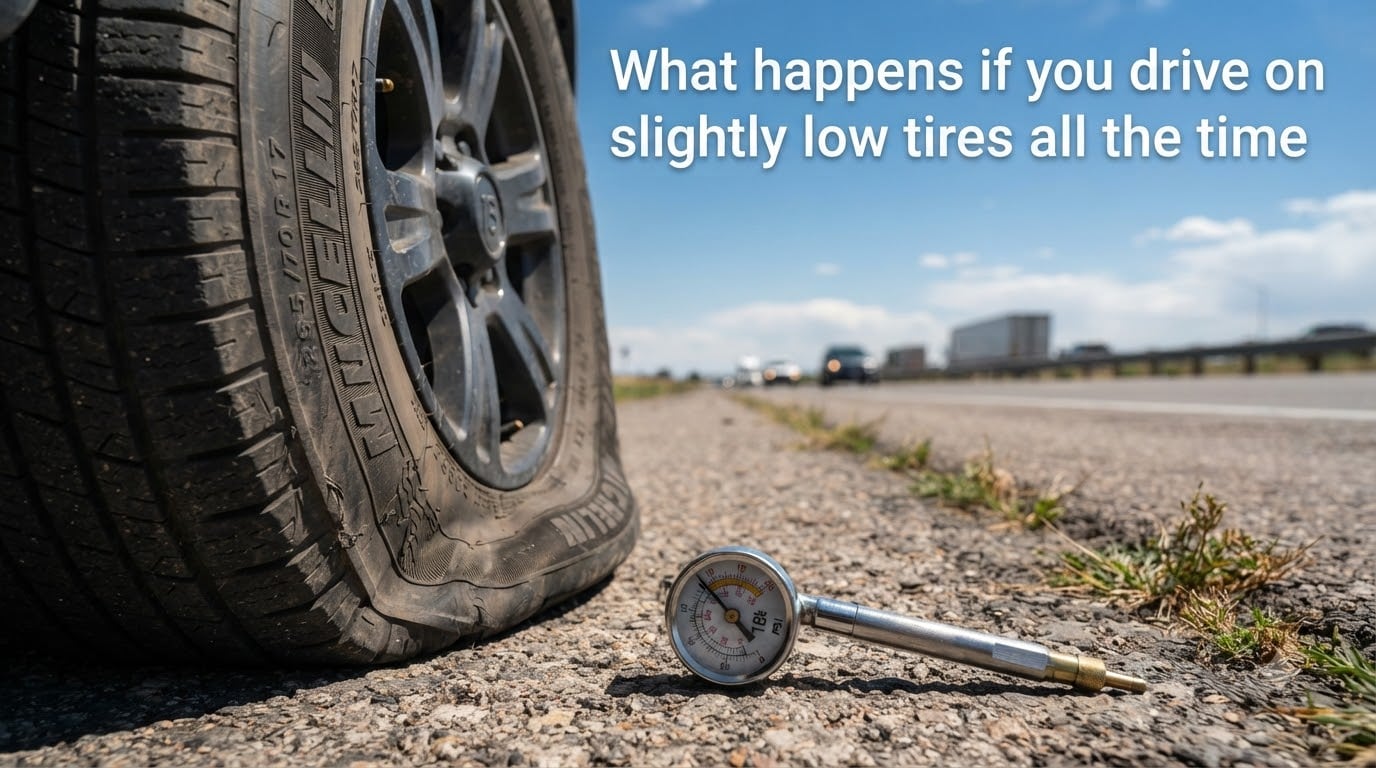
If you’ve been driving on slightly low tires all the time, you’re putting yourself at real risk without realizing it. Slightly low means 5-10 PSI below the manufacturer’s recommended pressure on your door-jamb placard — and the consequences stack up fast. You’ll see reduced fuel economy, accelerated shoulder wear on your tires, dangerously longer stopping distances, and a significantly higher chance of a blowout at highway speeds.
Most drivers don’t notice because the TPMS warning light only triggers at a 25% pressure drop, which is already dangerously low. By the time that light turns on, you’ve likely been driving on underinflated tires for weeks or months. I’ve spent years studying tire maintenance and consulted with automotive engineers to break down exactly what happens — and more importantly, what you need to do about it right now.
Table of Contents
What Counts as “Slightly Low” Tire Pressure
Slightly low tire pressure means running 5-10 PSI below the number printed on your driver’s door-jamb placard — not the maximum pressure on the tire sidewall. For most passenger cars, that placard reads 32-35 PSI, so “slightly low” usually means 23-30 PSI. The sidewall number (often 44-51 PSI) is the absolute maximum the tire can safely hold, not what you should drive on daily.
Many drivers mix these two numbers up. I’ve seen forum posts from owners running their tires at 35-45 PSI when the placard calls for 51 PSI, thinking they were fine — until the TPMS light finally came on at 25 PSI. The placard is your target. The sidewall is the ceiling. Never aim for the sidewall number.
| PSI Below Placard | Classification | Risk Level |
|---|---|---|
| 1-4 PSI | Marginally low | Minimal short-term risk — check and inflate soon |
| 5-10 PSI | Slightly low | Measurable fuel loss, wear acceleration begins |
| 11-15 PSI | Significantly low | Handling compromised, blowout risk rises sharply |
| 16-25% below | Dangerously low | TPMS light triggers — do not continue driving |
| Below 20 PSI | Critically low | Immediate tire failure possible — pull over now |
Here’s the problem: your TPMS light won’t trigger until your tire is roughly 25% below the placard recommendation. For a 35 PSI tire, that’s about 26 PSI. You could drive on 28 PSI for months without any dashboard warning — and your tires are already suffering.
The Cumulative Damage Timeline
This is where driving “all the time” on slightly low tires really matters. The damage isn’t instant — it compounds. Here’s what happens at each stage when you consistently run 7-10 PSI below recommendation.
After the first week, you won’t notice much. Your tires run a bit warmer than designed, and your fuel economy drops by roughly 1-2%. The contact patch — the part of the tire touching the road — is already distorting, putting extra load on the outer shoulder edges.
After one month, the shoulder wear pattern becomes measurable. Your tires are wearing 10-15% faster on the outer edges than the center. Rolling resistance has increased enough that you’re losing about 1-3% fuel economy. The sidewalls are flexing more with every rotation, generating heat that’s slowly degrading the rubber compounds.
After six months, the damage is significant and irreversible. Shoulder wear is clearly visible. You’ve potentially cut your tire life by 25-50%, meaning you’ll need replacement tires thousands of miles sooner than expected. The structural integrity of the sidewall has been stressed repeatedly. At highway speeds, those tires are one hard bump or sharp turn away from a blowout.
Forum users on Reddit frequently describe this exact pattern: they’ll say “I discovered my tires were running low for months before the TPMS light came on.” The question they always ask is “could I have done any damage?” The answer is almost always yes — and the damage was invisible the entire time.
How Low Tire Pressure Affects Fuel Economy
The U.S. Department of Energy estimates that tires lose about 0.2% in fuel economy for every 1 PSI they’re underinflated. For a typical driver covering 12,000-15,000 miles per year, that adds up fast. Running 7 PSI low (common for “slightly low” scenarios) costs roughly 1.4% in fuel efficiency — translating to meaningful waste over a full year.
The physics are straightforward. Underinflated tires have a larger contact patch against the road, which increases rolling resistance. The tire’s sidewalls flex more with every rotation, and that flexing converts kinetic energy into heat through a process called hysteresis. Your engine has to work harder to maintain speed, burning more fuel to overcome that resistance.
On a vehicle averaging 30 MPG, even a 2% fuel economy loss means you’re burning an extra 8-10 gallons per year. Over the life of a set of tires, the combined fuel waste and premature replacement costs can easily run into hundreds of dollars. That’s money leaving your tank with every mile you drive on soft tires.
Tire Wear Patterns You Can’t See Until It’s Too Late
The most insidious consequence of driving on slightly low tires is shoulder wear — the kind you don’t notice until you’re at the tire shop being told your tires need replacement. When pressure drops below specification, the tire’s contact patch flattens and widens. The outer edges of the tread — the shoulders — bear disproportionate load and wear faster than the center.
On a properly inflated tire, wear distributes evenly across the tread surface. On an underinflated tire, the center actually lifts slightly, concentrating all the friction on the two shoulder edges. After several thousand miles of this, you get pronounced shoulder wear with a nearly new-looking center tread — a telltale sign that pressure was chronically low.
Low-profile tires are especially dangerous in this scenario. They have shorter sidewalls that flex less, so the “soft ride” symptom many drivers use to detect low pressure barely registers. By the time you feel something is wrong, the internal tire structure may already be compromised. If you drive a vehicle with low-profile performance tires, regular pressure checks aren’t optional — they’re essential.
Safety Risks: Handling, Braking, and Blowout Danger
Underinflated tires fundamentally change how your vehicle handles. The sidewalls flex excessively during cornering, which delays steering response and makes the car feel mushy or vague. Emergency maneuvers that would be routine on properly inflated tires become unpredictable and dangerous. You’ll notice longer stopping distances — especially on wet roads — because the distorted contact patch can’t grip as effectively.
Hydroplaning risk increases dramatically. A properly inflated tire channels water through its tread grooves efficiently. An underinflated tire’s flattened contact patch creates a wider, shallower footprint that traps water underneath instead of evacuating it. Testing data suggests that the hydroplaning threshold drops from around 60 MPH on properly inflated tires to as low as 45 MPH on underinflated ones — a massive safety gap in highway driving.
The blowout risk is the most dangerous consequence. Underinflated tires generate significantly more heat from sidewall flexing. Rubber compounds degrade faster at elevated temperatures, and repeated heat cycling weakens the tire’s internal belts and carcass. The NHTSA identifies underinflation as one of the leading causes of tire-related crashes. A blowout at highway speed can cause instant loss of vehicle control, especially on vehicles without electronic stability control or on rear tires that fail suddenly.
Cold Weather and Seasonal Pressure Loss
Tire pressure drops roughly 1 PSI for every 10-degree Fahrenheit decrease in ambient temperature. That means a tire set perfectly at 34 PSI in a 75°F garage can read 30-31 PSI on a 40°F winter morning. This is why the TPMS light commonly triggers on the first cold morning of fall — it’s not a tire problem, it’s physics.
If you’re already running slightly low in warm weather, cold snaps will push you into the significantly low or even dangerously low range without you changing anything. I recommend checking your tire pressure at the start of every seasonal change and adding 1-2 PSI above your placard target in early fall to account for overnight temperature drops.
AWD Vehicles and Transmission Damage
If you drive an all-wheel-drive vehicle, chronically low tire pressure on even one tire can damage your drivetrain. AWD systems depend on all four tires rotating at nearly identical speeds. An underinflated tire has a slightly smaller effective diameter, which means it rotates faster to cover the same distance as the properly inflated tires.
That speed difference forces the center differential or transfer case to compensate constantly. Over months of driving, this creates excess heat and wear in the differential, potentially leading to expensive drivetrain repairs. Most AWD owner’s manuals specify that all four tires must be within a certain tread depth and pressure range — ignoring that specification by running uneven pressures is a costly mistake.
How to Tell If Your Tires Are Slightly Low
You can’t reliably detect slightly low pressure by feel or visual inspection alone. The “penny test” and kicking the tire don’t work. Here’s what actually works, in order of reliability:
Use a tire pressure gauge monthly. Digital gauges are accurate to within 0.5 PSI and cost very little. Check all four tires plus the spare when the tires are cold — meaning the car has been parked for at least three hours or driven less than a mile.
Watch for these driving symptoms: a softer or mushier ride than usual, the vehicle pulling to one side, steering that feels heavier or slower to respond, and increased road noise. None of these are definitive — they could indicate other issues — but they’re reasons to check pressure immediately.
Don’t wait for the TPMS light. As I mentioned, that light only triggers at a 25% pressure drop. A tire at 28 PSI (when it should be 35) won’t trigger the light, but it’s already suffering measurable wear and efficiency loss. Think of TPMS as an emergency alert, not a maintenance reminder.
What To Do Right Now If Your Pressure Is Low
If you suspect your tires have been running low, here’s your immediate action plan. First, find your correct pressure on the driver’s door-jamb placard (or your owner’s manual), not the tire sidewall. Check all four tires with a quality gauge when cold.
Inflate each tire to the placard recommendation. If one tire is significantly lower than the others, it may have a slow leak from a puncture, a damaged valve stem, or a corroded rim — get it inspected at a tire shop. After inflating, recheck pressure in 48 hours. A drop of more than 2-3 PSI in that window indicates a leak that needs professional repair.
If your tires show visible shoulder wear, sidewall cracking, or have been driven significantly low for months, have a tire professional inspect them before assuming they’re safe. Sometimes the internal damage isn’t visible from outside, and continuing to drive on structurally compromised tires is a gamble with your safety.
Frequently Asked Questions
Is it bad to drive with slightly low tire pressure?
Yes. Running 5-10 PSI below the recommended pressure reduces fuel economy by 1-3%, accelerates shoulder wear on your tires, lengthens stopping distances, and raises blowout risk. The damage compounds over time — the longer you drive on low tires, the worse it gets.
How long can you drive with low tire pressure?
Technically you can drive for weeks or months on slightly low pressure without an immediate failure. But each mile is causing cumulative damage — increased tire wear, wasted fuel, and degraded sidewall integrity. There is no safe window for chronic underinflation; the sooner you correct it, the less damage you’ll need to live with.
Is 5 PSI low too low for tires?
Five PSI below your door-jamb recommendation puts you in the ‘slightly low’ category. You’ll lose roughly 1% fuel economy, and tire wear will begin shifting to the shoulders. It’s not an emergency, but you should inflate to the correct pressure as soon as possible to prevent cumulative damage.
Can low tire pressure cause a blowout?
Yes, especially over time. Underinflated tires generate excess heat from sidewall flexing, which degrades the rubber and weakens internal belts. The NHTSA identifies underinflation as a leading cause of tire-related crashes. A blowout is most likely at highway speeds after the tire has been chronically underinflated for months.
Does low tire pressure waste gas?
Yes. The Department of Energy estimates a 0.2% fuel economy loss per PSI of underinflation. A tire running 7 PSI low wastes about 1.4% of your fuel. Over a year of normal driving, that adds up to roughly 8-10 extra gallons burned per tire set — real money wasted with every fill-up.
Should I drive with the TPMS light on?
You should not continue driving normally with the TPMS light illuminated. That light means at least one tire has dropped roughly 25% below recommended pressure — a potentially dangerous level. Reduce speed, avoid hard cornering, and inflate your tires at the nearest safe opportunity. If the light stays on after inflation, you may have a leak or a TPMS sensor fault.
How much does low tire pressure affect fuel economy?
Every 1 PSI of underinflation costs roughly 0.2% in fuel economy according to DOE data. A tire that’s 7-10 PSI low — the ‘slightly low’ range — wastes 1.4-2% of your fuel. For the average driver covering 13,500 miles per year at 30 MPG, that’s 6-9 extra gallons burned annually per tire set.
What does low tire pressure feel like while driving?
Slightly low pressure makes the ride feel softer or mushier than normal. Steering becomes heavier and less responsive. The vehicle may pull to one side. You might hear more road noise. However, these symptoms are subtle with only 5-10 PSI of underinflation — which is why monthly gauge checks are the only reliable way to catch it early.
Conclusion
Driving on slightly low tires all the time is one of the most common and most costly maintenance mistakes car owners make. The damage is silent and cumulative — you won’t feel it happening, but your fuel economy drops, your tires wear out prematurely from shoulder damage, and your blowout risk climbs every mile. Now that you know what happens, check your tire pressure today with a gauge, inflate to the door-jamb placard number, and make it a monthly habit. Your tires, your wallet, and your safety all depend on those few minutes of attention.