
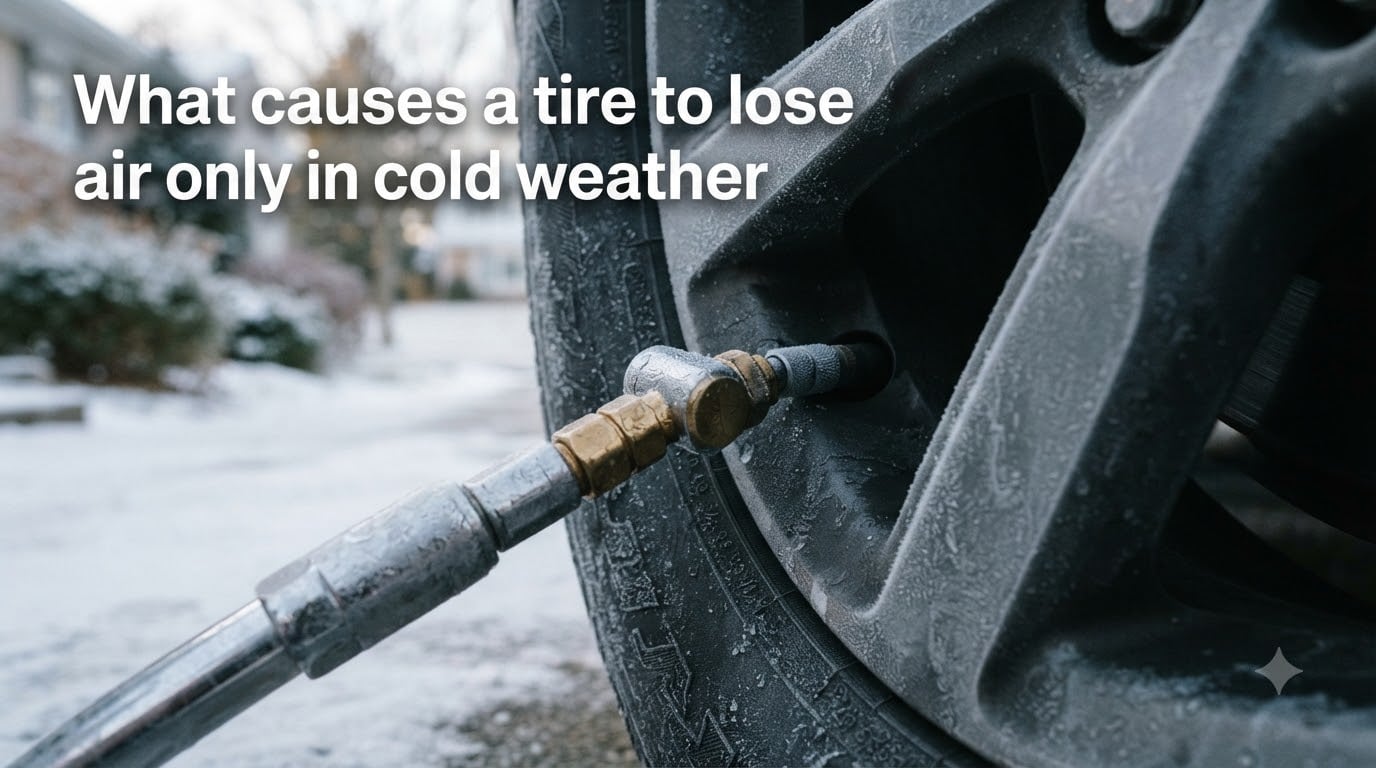
Tires lose air in cold weather because the air inside the tire contracts as the temperature drops. The standard rule is about 1 PSI lost for every 10°F fall in temperature. This is the Ideal Gas Law (PV=nRT) at work, not a leak. If your low tire pressure light flickers on every cold morning and turns off after a few miles of driving, you’re seeing normal physics, not a defective tire.
Cold-weather pressure loss is one of the most common winter driving concerns we hear about at American Tire. Most of the time, the answer is straightforward. The air molecules inside your tire slow down, hit the inner walls less often, and the gauge reads lower. In this guide, I’ll walk you through the science, show you a quick reference table, and explain when a drop in pressure actually means a real leak.
Table of Contents
The Science: Why Cold Air Loses Pressure
Cold air loses pressure because gas molecules have less kinetic energy at lower temperatures. The Ideal Gas Law (PV=nRT) tells us that pressure and temperature move together – when temperature drops, pressure drops too, assuming the tire’s volume stays roughly constant.
Here’s what happens at the molecular level. Air molecules inside your tire are in constant motion, bouncing off the inner liner thousands of times per second. Each bounce creates a tiny push against the tire wall, and the sum of all those pushes is what your tire pressure gauge reads. When the temperature falls, those molecules slow down. They bounce less often and less forcefully, so the pressure drops.
The tire itself and the metal rim also contract slightly in the cold, but this effect is small compared to the gas contraction. The bigger variable is rubber permeation – air molecules slowly seep through the tire’s inner liner over time – which is why tires lose roughly 1 to 3 PSI per month even in stable weather.
NHTSA and the U.S. Tire Manufacturers Association both confirm the 1 PSI per 10°F relationship as a reliable rule of thumb. Consumer Reports, Tire Rack, and AAA echo the same figure in their cold-weather tire care guides.
How Much PSI You Lose: A Temperature-Drop Reference Table
The table below shows how much tire pressure you can expect to lose as outside temperatures fall. If your tires were set to 35 PSI on a 60°F afternoon, a 30°F drop to 30°F overnight leaves them at roughly 32 PSI – a drop most drivers never notice. But a 40°F swing from 70°F to 30°F takes the same tire down to about 31 PSI, and that’s enough to nudge some TPMS systems toward their warning threshold.
| Temperature Drop | PSI Lost | Starting 35 PSI Ends At |
|---|---|---|
| 10°F drop | 1 PSI | 34 PSI |
| 20°F drop | 2 PSI | 33 PSI |
| 30°F drop | 3 PSI | 32 PSI |
| 40°F drop | 4 PSI | 31 PSI |
| 50°F drop | 5 PSI | 30 PSI |
| 60°F drop | 6 PSI | 29 PSI |
| 70°F drop | 7 PSI | 28 PSI |
Drivers in northern climates often notice a routine pattern: add 2 to 3 PSI in November and another 2 to 3 PSI in January as the deep cold settles in. That pattern is exactly what the physics predicts.
Why Only One Tire Loses Air Faster: Real Leaks vs. Cold Loss
If all four tires lose pressure at the same rate in cold weather, you’re seeing normal physics. If only one tire consistently reads 3 or more PSI lower than the others, even after a long drive, you likely have a real leak. Here’s how to tell the difference.
Common Sources of a Real Tire Leak
Valve stem leaks are the number one cause. The rubber valve stem dries out, cracks, or the small brass valve core inside loosens with age. A quick spray of soapy water on the valve will produce telltale bubbles if air is escaping.
Tire bead seal leaks happen where the tire seats against the wheel rim. Corrosion, dirt, or a bent rim can break the seal. Hit a pothole hard enough and the bead can pop slightly, causing a slow leak that’s almost invisible until pressure drops 5 PSI or more.
Rim corrosion accelerates leaks in winter because road salt and moisture collect on the steel or aluminum rim. Salt eats at the metal surface and breaks the airtight seal between tire and wheel. Cleaning the rim bead with a wire brush before remounting is standard shop practice.
Punctures and embedded objects are the most obvious cause. A nail, screw, or piece of glass can leak so slowly that you only notice it when temperatures fall and the baseline pressure drops lower than the puncture can keep up with.
Why One Tire Reads Lower Even Without a Leak
If the same tire always runs a couple PSI below the others, check whether it sits in the shade. A tire parked on the sunny side of the car can run 3 to 5 PSI higher than the shaded side because the rubber and air inside absorb solar heat. In winter, with low sun angles and longer shade, this asymmetry gets more noticeable.
A quick diagnostic: in the morning before moving the car, measure all four tires. Then drive 10 miles and recheck. If the low tire catches up to the others after driving, it was a temperature issue, not a leak. If it stays low, you have a leak that needs attention.
The classic soap-and-water test confirms a leak. Mix dish soap and water in a spray bottle, soak the valve stem, tire bead, and any visible puncture area, then watch for bubbles. Bubbles mean escaping air.
TPMS in Cold Weather: Why the Light Comes On, Then Disappears
Your Tire Pressure Monitoring System (TPMS) warning light comes on when any tire falls about 25% below the vehicle’s placard pressure. A car with 35 PSI door-jamb pressure triggers its TPMS at roughly 26 PSI. So a 35 PSI tire that loses 9 PSI overnight from a 90°F swing in temperature will light up the dashboard in the morning.
Here’s why the light often turns off after you start driving. Friction from the road and flexing of the tire warm the air inside by 40 to 60°F within a few miles. That temperature rise brings the pressure back up by 4 to 6 PSI, above the TPMS threshold, and the light goes off. This is the textbook signature of temperature-driven pressure loss, not a leak.
If the TPMS light stays on after 10 to 15 minutes of driving, or comes back the next morning, the tire is likely leaking faster than driving heat can compensate. That’s the cue to check pressure manually and look for a real leak.
How to Check Tire Pressure When It’s Cold: A 4-Step Guide
Cold tire pressure means the tires have been parked for at least 3 hours or driven less than 1 mile. Checking them in this state gives you an accurate baseline, not an artificially high reading from driving heat.
Step 1: Find your placard pressure. Open the driver’s door and look at the door-jamb sticker. It lists the manufacturer-recommended cold inflation pressure for the front and rear tires. This number is your target, not the max-PSI stamped on the tire sidewall, which is the tire’s structural ceiling, not the recommended fill.
Step 2: Check when tires are cold. Park for 3 hours or overnight, especially in the morning before driving. A tire that was driven even 5 miles can read 3 to 5 PSI high from flex heat.
Step 3: Use a quality gauge. Gas-station gauges are often inaccurate by 2 PSI or more. A personal digital gauge costs very little and gives consistent readings. Check all four tires plus the spare.
Step 4: Add air in small increments. Inflate to the door-jamb pressure, not the sidewall max. If you’re adding air at a station, use the side with both a high-pressure and a low-pressure gauge, and double-check with your own gauge after a minute or two.
Cold-Weather Tire Care Checklist
Here’s the routine our team recommends to keep winter pressure under control without weekly trips to the gas station.
Check pressure once a month minimum. Even in stable weather, tires lose 1 to 3 PSI per month from normal permeation. Cold weather stacks on top of that.
Set pressure slightly above placard on falling-temperature days. If you know a cold snap is coming, adding 1 to 2 PSI above the door-jamb pressure gives you a buffer for the temperature drop without overinflating.
Watch for asymmetric readings. One tire consistently 3 or more PSI below the others after a long drive means a real leak, not cold contraction.
Document your baseline. Write down the pressure in each tire after a long park. When you recheck in a week, you’ll know exactly how much each tire has lost and whether the loss is uniform or isolated to one corner.
Bring it in if the TPMS light stays on. A persistent TPMS light after driving means the leak rate exceeds what warming can offset. That’s the moment for a professional inspection.
If you’d rather not track this yourself, American Tire offers a complimentary seasonal pressure check and tire rotation with every service visit. Our technicians check all four tires plus the spare, log the readings, and flag anything that’s trending toward a leak before it strands you on a cold morning.
Frequently Asked Questions
Why do my tires lose air when it’s cold?
The air inside your tire contracts as temperature falls. Air molecules slow down and hit the inner walls less often, so the gauge reads lower. The standard rule is about 1 PSI lost for every 10°F drop in temperature, which is the Ideal Gas Law (PV=nRT) at work, not a leak.
How much tire pressure is lost in cold weather?
Tires typically lose about 1 PSI for every 10°F drop in outside temperature. A tire set to 35 PSI on a 60°F afternoon will read roughly 32 PSI after the temperature falls to 30°F overnight, and around 28 PSI if the temperature drops 70°F.
Can cold weather cause one tire to lose air faster than others?
Cold weather causes all four tires to lose pressure at the same rate, so if one tire consistently reads 3 or more PSI lower than the others after a long drive, you likely have a real leak. Common causes include a faulty valve stem, a broken tire bead seal, rim corrosion from road salt, or a slow puncture.
Is it normal for the tire pressure light to come on in cold weather?
Yes. The TPMS warning light triggers when any tire falls about 25% below the vehicle’s placard pressure, and a cold snap can easily push a tire below that threshold. The light often turns off after a few miles of driving because road friction warms the air inside the tire and brings pressure back up.
Should I add air to my tires in cold weather?
Yes, but only after checking pressure when the tires are cold, parked for at least 3 hours or driven less than 1 mile. Inflate to the door-jamb placard pressure, not the max-PSI stamped on the sidewall. In cold weather, plan on adding 2 to 3 PSI in November and another 2 to 3 PSI in deep winter.
Why does my tire pressure light go off when I drive?
Driving warms the air inside your tire by 40 to 60°F within a few miles, which raises pressure by 4 to 6 PSI. That is usually enough to clear the TPMS threshold and turn the warning light off. If the light stays on after 10 to 15 minutes of driving, the tire is leaking faster than driving heat can compensate.
The Bottom Line on Cold-Weather Tire Pressure
Cold weather causes tires to lose air because of basic physics, and the rule is reliable: 1 PSI per 10°F drop in temperature. A tire pressure light that flickers on cold mornings and disappears after driving is normal. A tire that stays low after a long drive is not. The fix is the same in both cases: check pressure monthly, inflate to the door-jamb placard value, and watch for asymmetric readings that point to a real leak. If you’d like a professional eye on it, the team at American Tire runs a complimentary pressure and rotation check with every visit.