
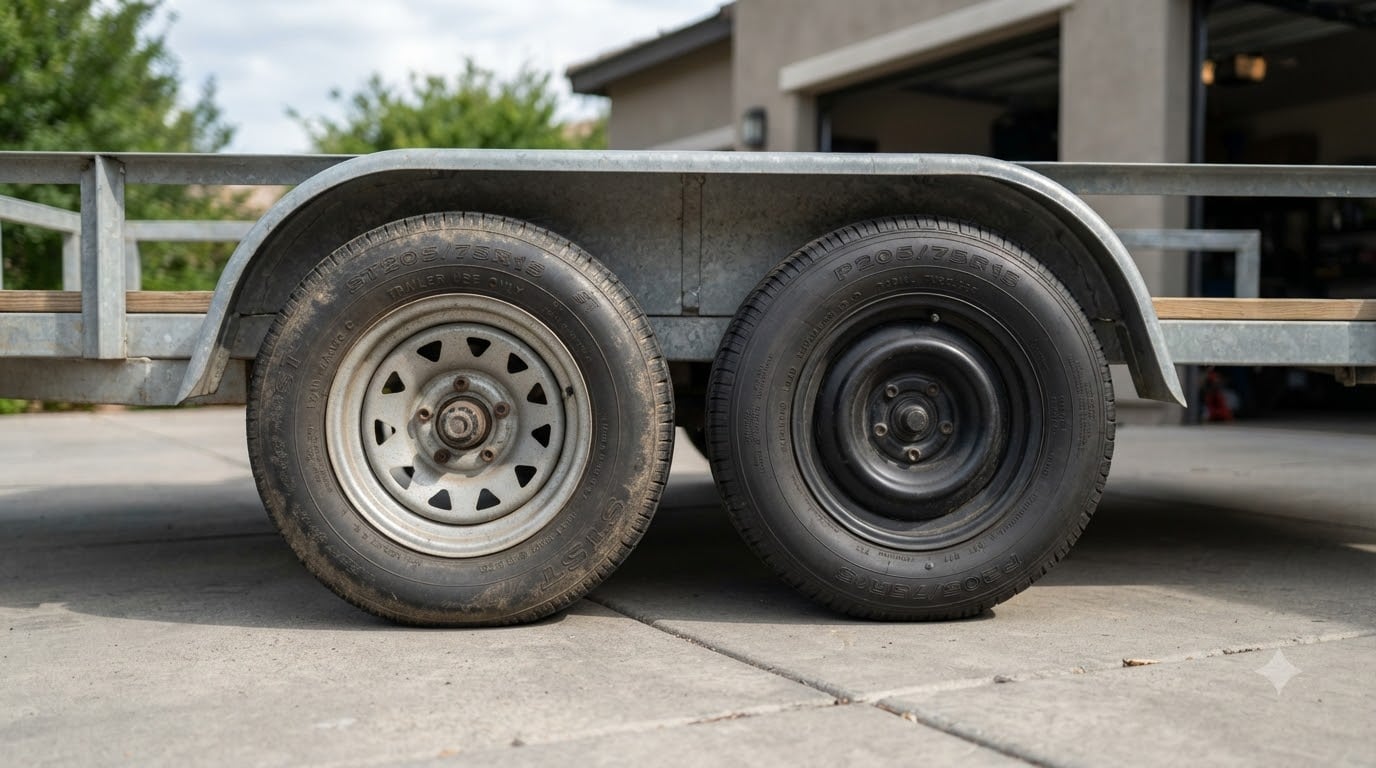
If you have a small utility trailer sitting in your driveway with worn tires and a stack of spare car tires in the garage, you have probably asked yourself: can you use regular car tires on a small utility trailer? It is one of the most common questions in trailer forums, and the short answer surprises most people.
You technically can mount passenger tires on some trailers, but whether you should depends on load rating, sidewall construction, axle type, and how fast you plan to drive. In this guide we break down the real differences between trailer tires (ST) and car tires (P-metric), explain the dangers of using the wrong tire, and help you decide what actually fits your small utility trailer in 2026.
Table of Contents
Quick Answer: Can You Use Car Tires on a Small Utility Trailer?
Yes, but only in narrow circumstances: a passenger (P-metric) tire may work on a small, single-axle utility trailer kept well under its gross vehicle weight rating (GVWR), driven at low speeds, and only loaded with light cargo such as yard waste or mulch bags. In every other situation – tandem axles, highway speeds, heavy or shifting loads, or near-capacity hauling – dedicated ST (Special Trailer) tires are the safer choice.
The mismatch exists because car tires are engineered for steering, braking, and cornering grip. Trailer tires are engineered for vertical load carrying and straight-line stability. Putting a car tire on a trailer that does heavy work is the single most common cause of roadside trailer tire blowouts.
Can Car Tires Work on a Small Utility Trailer?
The honest answer is that car tires can work in a narrow window. If you have a single-axle utility trailer with a 1,500-pound GVWR, are hauling bags of pine bark, and drive under 45 mph, a quality passenger tire with the right load index will get you home and back without drama.
Things fall apart when load, speed, or axle count goes up. A passenger tire’s sidewall is built to flex for ride comfort and cornering response. A trailer’s sidewall has to resist constant vertical load and lateral sway forces that car tires were never optimized for. Trailer tires use stiffer, reinforced sidewalls and higher inflation pressures (often 50-65 psi for ST tires versus 30-35 psi for P-metric tires) specifically to fight those forces.
Forum experience supports both positions. A TractorByNet member who runs a small utility hauler noted: “If you recognize that, load the weight on the trailer properly, and keep your speed down, passenger vehicle tires will work just fine.” Conversely, BobIsTheOilGuy contributors take the opposite stance: “Do not use car tires on a trailer. If you’re even approaching the trailer load you will have tire failure.” Both groups are right – they are describing different trailers and different use cases.
What Is the Difference Between Trailer Tires and Car Tires?
Trailer tires and car tires look similar at a glance, but they are built around completely different design priorities. Here are the core differences that matter for small utility trailer owners:
- Sidewall construction: ST tires use stronger, stiffer sidewalls with extra ply layers to resist vertical load and sway. P-metric tires use more flexible sidewalls that prioritize ride comfort and cornering grip.
- Load rating: Trailer tires are routinely rated for higher loads per tire at higher pressures. They are sized around load index numbers that assume the full-rated PSI will be in the tire.
- Tread pattern: Trailer treads are optimized for straight-line stability and water evacuation in a straight path. Car treads are designed for steering response, braking traction, and cornering grip.
- Heat management: ST compounds are tuned to dissipate the heat that builds up under sustained load. Car compounds prioritize traction and tread life over heat cycling.
- Speed rating: Most ST tires are rated L (75 mph) or M (81 mph). Many car tires are rated H (130 mph) or higher. The opposite of what most people assume.
- Recommended inflation: Trailer tires run at 50-65 psi for typical loads; passenger tires usually run 30-35 psi. Inflating a car tire to trailer pressures changes its handling profile dramatically.
Discount Tire’s published guidance is blunt: “Car tires do not usually have the appropriate load rating for towing and could fail due to stress.” That stress often shows up first as a sidewall blowout, the most common trailer tire failure mode.
How to Read Trailer and Car Tire Sidewall Codes
Every tire has a Department of Transportation (DOT) code stamped on its sidewall. Learning to read this code is the fastest way to know whether the tire in front of you is rated for trailer use. Here is what each designation means:
- ST – Special Trailer: Built exclusively for trailer service. Strongest sidewalls, highest load range ratings for their size. Never use on a passenger vehicle.
- LT – Light Truck: Designed for pickup trucks and SUVs. Can be used on some trailers when the load rating meets or exceeds the trailer’s per-tire requirement.
- P – Passenger (P-metric): Built for cars, minivans, and crossover SUVs. The most common tire type. Sidewalls are softer; load index at standard pressure may be too low for trailer use.
- T – Temporary: Spare tires only. Never intended for sustained trailer service.
After the type letter, you will see numbers like 205/75R14 and a load index plus speed rating. A load index of 95 means the tire can carry 1,521 pounds at its recommended pressure. Multiply the number of tires by that figure and you get the absolute maximum load the tire set can handle. Always keep 10-15% safety margin below that number, because heat, age, and rough roads eat into real-world capacity.
A quick example: a small single-axle utility trailer with two tires, each rated load index 95, theoretically can carry 3,042 pounds of cargo plus trailer weight. Sounds generous until you remember that rough pavement, a loaded truck bouncing, or a hot day can drop effective capacity by 15-20%.
Why Car Tires Fail on Trailers: 4 Real Risks
The forum and shop posts about trailer tire failures share common themes. None of them happen with a properly specified ST tire. Here are the four failure modes that car tires introduce:
- Sidewall blowout: The most common failure. Car-tire sidewalls flex more than trailer sidewalls. Under load and heat that flex turns into a rupture, often at highway speed with a loaded trailer behind you.
- Heat buildup: P-metric compounds are not built for sustained high PSI. Towing for an hour or more generates tire heat that builds until the tire fails – sometimes without warning.
- Trailer sway: Softer sidewalls deflect more in crosswinds and during lane changes. That deflection feeds sway, which feeds more deflection, which is the beginning of a loss-of-control event.
- Dynamic loading: When you hit a bump, the load on a tire momentarily doubles or triples. ST tires are designed around that spike. Car tires, sized for steady-state passenger loads, are not.
Discount Tire’s published guidance captures the core issue: car tires simply lack the load rating for towing and can fail under stress. The etrailer expert team echoes this from the safety-engineering side, noting that stiffer trailer-tire sidewalls handle vertical loads much better. Reddit’s r/Justrolledintotheshop has repeated photo evidence of sidewall ruptures on trailers that came in on passenger tires – usually after the owner figured out the cost of “saving” by skipping dedicated trailer rubber.
Trailer Tire Types: ST, LT, and Radial vs Bias-Ply
Once you decide to use a proper trailer tire, you still have choices. The two big ones are ST versus LT, and radial versus bias-ply construction.
ST (Special Trailer) tires are the industry default for utility trailers. They have the highest load range for their size and the stiffest sidewalls. Choose ST for nearly every small utility trailer application.
LT (Light Truck) tires are an acceptable compromise on some trailers, especially heavier single-axle or tandem setups that match LT load ratings well. Forum consensus on r/tires and TractorByNet is that LT tires work when their load index at recommended pressure exceeds the trailer’s per-tire load requirement. The Mechanical Elements blog goes so far as to argue LT tires can outperform ST tires on some trailers because of better heat dissipation.
Radial versus bias-ply is the second choice. Radial tires flex more, run cooler, and give a softer ride. Bias-ply tires are stiffer, carry heavier loads per size, and cost less, but they heat up faster and wear unevenly on pavement. For a small utility trailer that occasionally tows on the highway, radials are the safer modern choice.
When Car Tires Might Be Okay on a Trailer
There are specific circumstances where a passenger tire is genuinely acceptable, not just tolerated. Here is the short list where car tires will not put you at serious risk:
- Single-axle, low-GVWR trailer: Total trailer weight plus cargo under 2,000 pounds.
- Low-speed, local use only: Trips under 45 mph on local roads, no highway.
- Cargo is light and stable: Yard debris, mulch, camping gear, lawn equipment – nothing that shifts the load dramatically.
- Tire load index exceeds per-tire requirement: With at least 15% safety margin built in.
- Spare tire, not primary: Used only as an emergency spare to get you to a tire shop.
If your situation does not check every box above, step up to an ST tire. The cost difference is small compared to a tow bill, a roadside tire change, or a wreck.
Trailer Tire Inflation, Age, and Maintenance Tips
Even the right tire fails early without basic maintenance. Three habits prevent most trailer tire problems:
Inflation: Check tire pressure every month and before any long trip. Trailer tires lose air faster than car tires because of their stiffer sidewalls and higher pressures. Carry a quality tire gauge and check pressure when tires are cold.
Age: Trailer tires age out before they wear out. The DOT date code is a four-digit stamp – first two digits are the week, last two are the year. Most tire and trailer manufacturers recommend replacement at 5-7 years regardless of tread depth, because the rubber hardens and sidewalls weaken with age. This is especially important for trailers that sit unused for months between trips.
Storage: Store trailers out of direct sunlight when possible. UV exposure is the single biggest cause of sidewall cracking. Use tire covers, park in a garage, or block the trailer so the tires sit in shade. Dry rot from ozone and UV is what creates those “perfect tread, crumbling sidewall” tire failures you see on stored trailers.
Frequently Asked Questions
Can I use car tires as trailer tires?
You can mount them physically, and they will work for a light, single-axle trailer at low speeds. For anything beyond local, light hauling, dedicated ST (Special Trailer) tires are strongly recommended because car tires lack the load rating and sidewall strength for sustained trailer service.
Do utility trailers need special tires?
Most utility trailers do best with ST-rated trailer tires because those tires are engineered for vertical loads and high inflation pressures. Small, light single-axle trailers can sometimes run passenger tires, but a dedicated trailer tire is the safer default.
Is there a difference between a trailer tire and a car tire?
Yes – significant differences. Trailer tires have stiffer, reinforced sidewalls, higher load ratings at higher pressures, and tread patterns optimized for straight-line stability. Car tires have softer sidewalls, lower load indices, and treads built for steering and cornering grip rather than sustained load carrying.
Is it okay to use LT tires on a trailer?
LT (Light Truck) tires are an acceptable choice on many trailers, provided the tire’s load index at full recommended pressure exceeds the per-tire load requirement of your trailer. Many trailer owners run LT tires successfully, especially on heavier single-axle and tandem setups.
Are car tires the same as trailer tires?
No. They look similar but serve different engineering goals. Car tires optimize for steering, braking, and ride comfort; trailer tires optimize for vertical load, high inflation pressure, and resistance to sway and heat buildup.
What happens if I put trailer tires on a car?
Trailer tires are not designed for steering or braking forces, so they handle poorly on a passenger vehicle – vague steering, poor cornering grip, and unusual wear patterns. They also are not rated for the dynamic loads a steerable axle experiences, so they can fail under normal driving.
Is it illegal to put car tires on a trailer?
In most U.S. states it is not explicitly illegal, but tire rating rules and vehicle equipment laws generally require that every tire on the road meet or exceed the load carried. Using an underrated tire can create liability in a crash and may violate state equipment standards. Check your state’s specific vehicle code before relying on passenger tires for regular trailer use.
Bottom Line: Choosing the Right Tire for Your Utility Trailer
The question of whether you can use regular car tires on a small utility trailer really comes down to how you use that trailer. If you own a single-axle, light-duty trailer and stick to short, slow local trips with carefully balanced loads, a quality passenger tire with sufficient load index will serve you well. For anything more demanding – tandem axles, highway speeds, near-capacity loads, or regular towing – the answer changes to a clear yes, invest in proper ST trailer tires. Read the sidewall, match the load index to your trailer’s per-tire requirement, keep inflation pressure dialed in, and replace tires every 5-7 years regardless of tread. Doing those four things will keep you – and whatever you are towing – safely down the road in 2026 and beyond.