
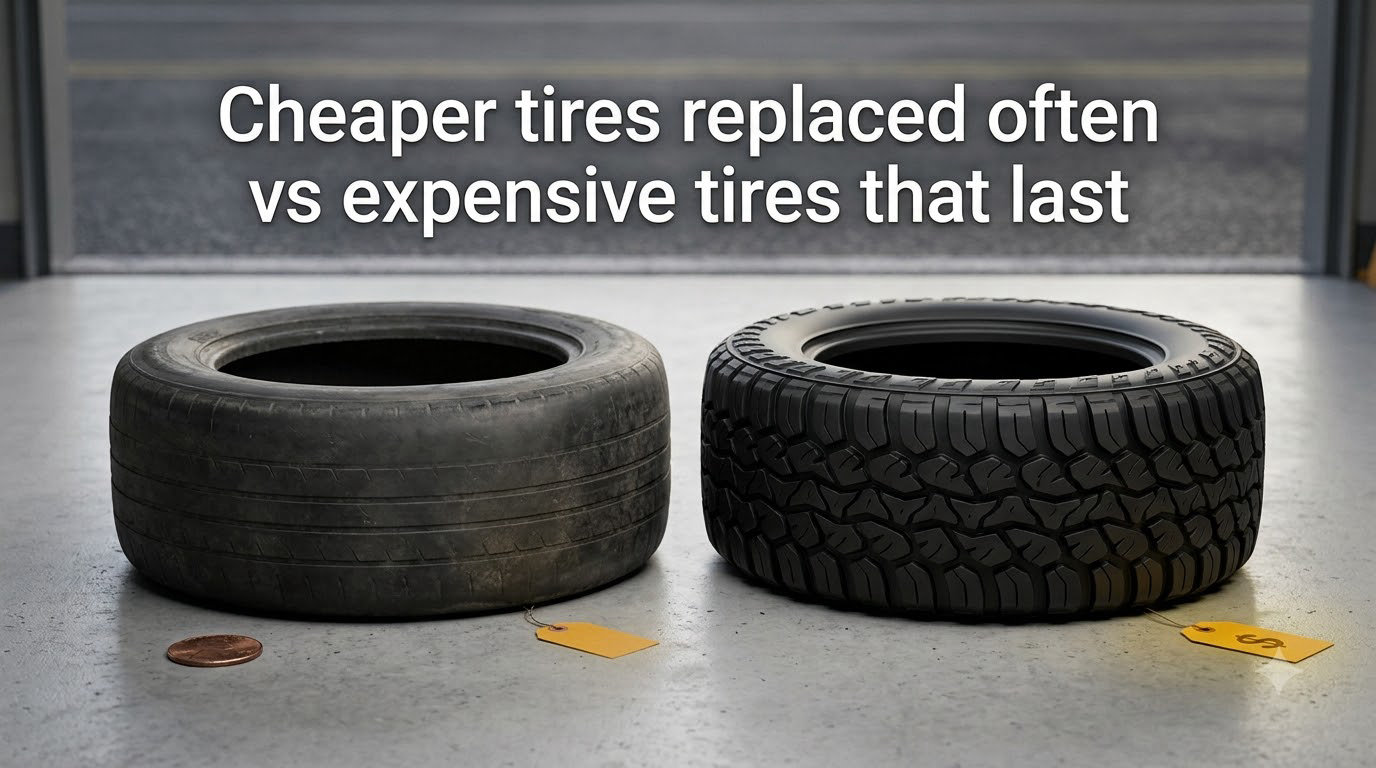
Cheaper tires replaced often vs expensive tires that last is a question I hear constantly from drivers trying to stretch their tire budget. The short answer: over a typical 10-year ownership window, the total spending is often surprisingly close, but premium tires usually win on safety, comfort, and convenience. The real tiebreaker is how many miles you drive, what climate you live in, and what kind of vehicle you own.
I’ve spent years comparing tires across price tiers, and the math rarely matches what people assume. Sticker shock makes expensive tires feel wasteful, while cheap tires feel like the smart buy until they need replacing in half the time. Let me walk you through how the numbers actually shake out, what engineering differences justify the higher price, and which driver profile should pick which approach.
Table of Contents
Quick Answer: Is It Cheaper to Replace Tires Often or Buy Expensive Ones?
Yes, replacing cheap tires often costs roughly the same as buying expensive tires once over 10 years. Budget tires typically last 30,000 to 40,000 miles, while premium touring tires last 60,000 to 80,000 miles, so you buy two sets of cheap tires for every one set of premium.
When you divide total dollars by total miles, premium tires often come out ahead on cost per mile. Add in safety gains (shorter wet braking, better grip), fuel economy improvements, and the inconvenience of extra shop visits, and premium tires win for most drivers who put on real mileage. The exceptions are low-mileage urban drivers and owners of older vehicles near end of life, where mid-range tires are usually the smarter call.
What Counts as Cheap, Mid-Range, and Premium Tires?
Tire prices cluster into three tiers, and the gap between them is wider than most people realize. Budget tires typically run $80 to $130 per tire, mid-range tires run $130 to $200 per tire, and premium tires run $200 to $350 per tire, all for a standard 16 to 18 inch all-season size.
Budget tier brands include Douglas, Westfield, Telluride, and many house-brand labels sold at warehouse clubs and discount chains. Mid-range brands include Cooper, General, Falken, Kumho, Nexen, and Hankook. Premium brands include Michelin, Continental, Goodyear, Bridgestone, Pirelli, and Yokohama. Knowing which tier you’re shopping in is the foundation for everything that follows.
What Actually Makes Expensive Tires Different?
Expensive tires differ from cheap ones in three engineering areas: rubber compound, tread design, and internal construction. These differences show up as longer life, better grip, and quieter rides.
Rubber compound is the biggest factor. Premium manufacturers blend multiple synthetic rubber polymers with silica and carbon black to balance grip, durability, and rolling resistance. Budget tires use simpler single-compound recipes that wear faster and lose grip when cold or wet. The compound science is genuinely expensive to develop.
Tread pattern design also differs. Premium tires use computer-modeled tread blocks with variable sipe density, asymmetric patterns, and tuned groove geometry for water evacuation. Budget tires use generic patterns copied from older premium designs, which work fine in dry conditions but struggle in heavy rain.
Internal construction matters too. Premium tires use two or three polyester sidewall plies, steel belts, and sometimes nylon cap plies for stability at speed. Budget tires use lighter constructions that flex more, leading to vague handling and faster wear under highway speeds.
Do Expensive Tires Actually Last Longer?
Yes, premium tires typically last 60,000 to 80,000 miles while budget tires last 30,000 to 40,000 miles in real-world driving. That 2x difference is the single most important number in this whole comparison, because it means you replace premium tires half as often.
Mid-range tires land in the middle at 45,000 to 60,000 miles, which is why many mechanics on forums recommend them as the best value. The UTQG treadwear rating gives you a rough preview, though real-world results vary based on driving habits, climate, road surface, and tire maintenance.
Three factors shorten tire life regardless of tier: aggressive acceleration and braking, high-speed highway driving, and living in hot climates. Proper inflation, regular rotation every 6,000 to 8,000 miles, and wheel alignment when needed can extend any tire’s life by 10% to 20%.
Cost Per Mile: The Math Nobody Else Shows You
Cost per mile is the fairest way to compare tires, and it usually favors premium and mid-range tires. Here’s a worked example for a driver who puts on 12,000 miles per year over 10 years (120,000 total miles).
Budget tires at $100 each, lasting 35,000 miles, cost about $0.0029 per mile. Mid-range tires at $165 each, lasting 55,000 miles, cost about $0.0030 per mile. Premium tires at $275 each, lasting 70,000 miles, cost about $0.0039 per mile on the surface, but factor in the tread life warranty (often 60,000 to 80,000 miles) and the lower replacement frequency, and the gap narrows further.
Over 10 years, that same driver buys roughly 3.5 sets of budget tires, 2.2 sets of mid-range tires, and 1.7 sets of premium tires. Total spending lands in a tight band: budget about $1,400, mid-range about $1,450, and premium about $1,870. That’s a 30% premium price for a 2x longer life, better wet grip, and two fewer shop visits.
Add installation and disposal fees (often $20 to $30 per tire per swap) and the budget option starts looking worse. Two extra replacement cycles at four tires each means an extra $160 to $240 in shop fees alone.
Performance and Safety Differences That Matter
Performance gaps between cheap and expensive tires show up most in wet braking, cornering grip, and highway stability. Independent testing by Tire Rack and Consumer Reports consistently shows 15 to 30 foot shorter wet stopping distances for premium tires versus budget tires.
Wet braking is the safety number that matters most. On a 60 mph panic stop from 60 mph in standing water, the difference between a $100 tire and a $275 tire can be two car lengths. That gap closes fast if you drive in rain, snow, or on coastal roads.
Dry handling and cornering also favor premium tires. Better sidewall construction means the tire holds its shape through aggressive turns, giving you more steering feedback and grip at the limit. Budget tires feel vague and squirmy in comparison, especially on vehicles with firm suspensions.
Noise and ride comfort differ too. Premium tires use variable pitch tread blocks and foam liners to dampen road noise. Budget tires are typically 2 to 4 decibels louder, which adds up on long highway drives.
When Cheaper Tires + Frequent Replacement Make Sense
Cheap tires replaced often make sense in three specific scenarios. Low-mileage urban drivers (under 6,000 miles per year), owners of vehicles with less than two years of expected life remaining, and drivers facing a short-term budget crunch all benefit from budget tires.
Low-mileage drivers face a different problem: tires age out from rubber degradation after 6 to 8 years regardless of tread depth. A premium tire that lasts 70,000 miles won’t help if you’re only driving 5,000 miles a year. The tire will be 10 years old before it wears out, and old rubber is dangerous regardless of brand.
Older vehicles near end of life don’t justify premium tire investments. If your car is worth $2,000 and you’re about to replace it, putting $1,100 worth of premium tires on it doesn’t pencil out. Budget tires make more sense.
When Expensive Tires Pay for Themselves
Expensive tires pay for themselves when you drive 12,000+ miles per year, live in wet or snowy climates, or own a vehicle without modern safety systems. Highway commuters, families, and owners of older cars without traction control or stability control benefit most.
Mechanics consistently warn about putting budget tires on older vehicles without ABS, traction control, or electronic stability control. These systems compensate for tire grip limits, and without them, the tire’s wet and snow performance becomes your only safety margin. Premium tires give you that margin.
Wet climate drivers (Pacific Northwest, Gulf Coast, Southeast, Northeast) face hydroplaning risk that budget tires handle poorly. The extra water evacuation channels and silica-rich compounds in premium tires make a real, measurable safety difference in standing water or heavy rain.
The Mid-Range Sweet Spot Most Drivers Overlook
Mid-range tires from Cooper, General, Falken, Kumho, and Nexen deliver roughly 70% to 80% of premium tire performance at 50% to 60% of the price. For most drivers, this is the real answer to cheap vs expensive tires.
Community discussions on r/MechanicAdvice consistently recommend these brands as the best bang for the buck. A $165 Kumho or General tire will outlast a $100 budget tire by 20,000 miles and grip better in rain, all for only $260 more per set. That’s where most drivers land when they actually run the numbers.
Premium tires still win outright for maximum longevity, ultimate wet grip, or vehicles with high horsepower that push tire limits. But for daily driving on a commuter car, mid-range is the rational sweet spot.
Which Tire Tier Fits Your Driving?
Match your tire choice to your actual driving reality, not the marketing. Here’s the decision framework I’d use for each common scenario.
Highway commuter driving 15,000+ miles a year in mixed weather: premium tires. The longevity advantage and wet safety justify the cost over 5 to 7 years of ownership.
Suburban family hauler driven 10,000 to 12,000 miles a year in moderate climate: mid-range tires. You’ll get 5 years of life from a quality Cooper or General, with most of the safety benefit of premium.
Low-mileage urban driver under 6,000 miles a year: mid-range tires, replaced every 6 years by age, not mileage. Avoid the temptation to buy budget just because you don’t drive much; old rubber is the real risk.
Older vehicle without traction control, any mileage: mid-range minimum, premium if budget allows. Your tires are your only safety system.
Performance car or enthusiast vehicle driven hard: premium tires. Budget and even mid-range tires can’t handle repeated high-speed cornering or braking without falling apart.
Vehicle being sold within 12 months: budget tires. No point investing in rubber that goes with the car.
Frequently Asked Questions
Do more expensive tires actually last longer?
Yes, premium tires typically last 60,000 to 80,000 miles while budget tires last 30,000 to 40,000 miles in real-world driving. That 2x longevity difference means you replace premium tires half as often, which often closes the upfront price gap over a 10-year ownership window.
What is the 3% rule for tires?
The 3% rule refers to a widely cited guideline that you should replace tires when tread depth drops to about 3/32 inch (roughly 30% of original tread depth). This is also the threshold where wet traction starts to drop noticeably, and where hydroplaning risk rises on most tires.
Is $500 a lot for 4 tires?
$500 for 4 tires is a solid mid-range price and represents good value for most drivers. Budget sets run $320 to $520 installed, mid-range runs $520 to $800, and premium runs $800 to $1,400. Whether $500 is a lot depends on the vehicle and how long you plan to keep it.
Are expensive tires worth the investment?
Expensive tires are worth the investment for high-mileage drivers, wet-climate drivers, owners of older vehicles without modern safety systems, and performance car owners. For low-mileage urban drivers or owners of vehicles near end of life, mid-range tires usually deliver better value.
Is 30000 miles on a set of tires good?
30,000 miles is a normal lifespan for budget tires and below average for mid-range and premium tires. If your tires wear out at 30,000 miles, you likely had budget tires, drove aggressively, skipped rotations, or had an alignment issue. 50,000 to 70,000 miles is a more typical lifespan for quality tires with proper maintenance.
What is the difference between cheap and expensive tires?
Cheap and expensive tires differ in rubber compound (multi-polymer silica blends vs simpler single-compound recipes), tread design (computer-modeled patterns vs generic copies), internal construction (more plies and steel belts vs lighter builds), and quality control (tighter tolerance on premium tires). These differences show up as longer life, shorter wet braking, better handling, and quieter ride on premium tires.
Bottom Line
Cheaper tires replaced often vs expensive tires that last comes down to your mileage, climate, and vehicle. For most drivers putting on 10,000+ miles per year, mid-range tires from Cooper, General, Falken, Kumho, or Nexen are the sweet spot: 70% to 80% of premium performance at roughly half the price.
If you drive 15,000+ miles a year, live in a wet or snowy climate, or own an older vehicle without traction control, premium tires justify the higher upfront cost through longer life and better safety margins. Low-mileage urban drivers and vehicles near end of life should stick with mid-range and replace by age (every 6 to 8 years), not by tread depth alone.
The cheapest tire is the one that fits your actual driving reality, not the one with the lowest sticker price. For most drivers in 2026, that means a quality mid-range tire paired with regular rotations and proper inflation.