
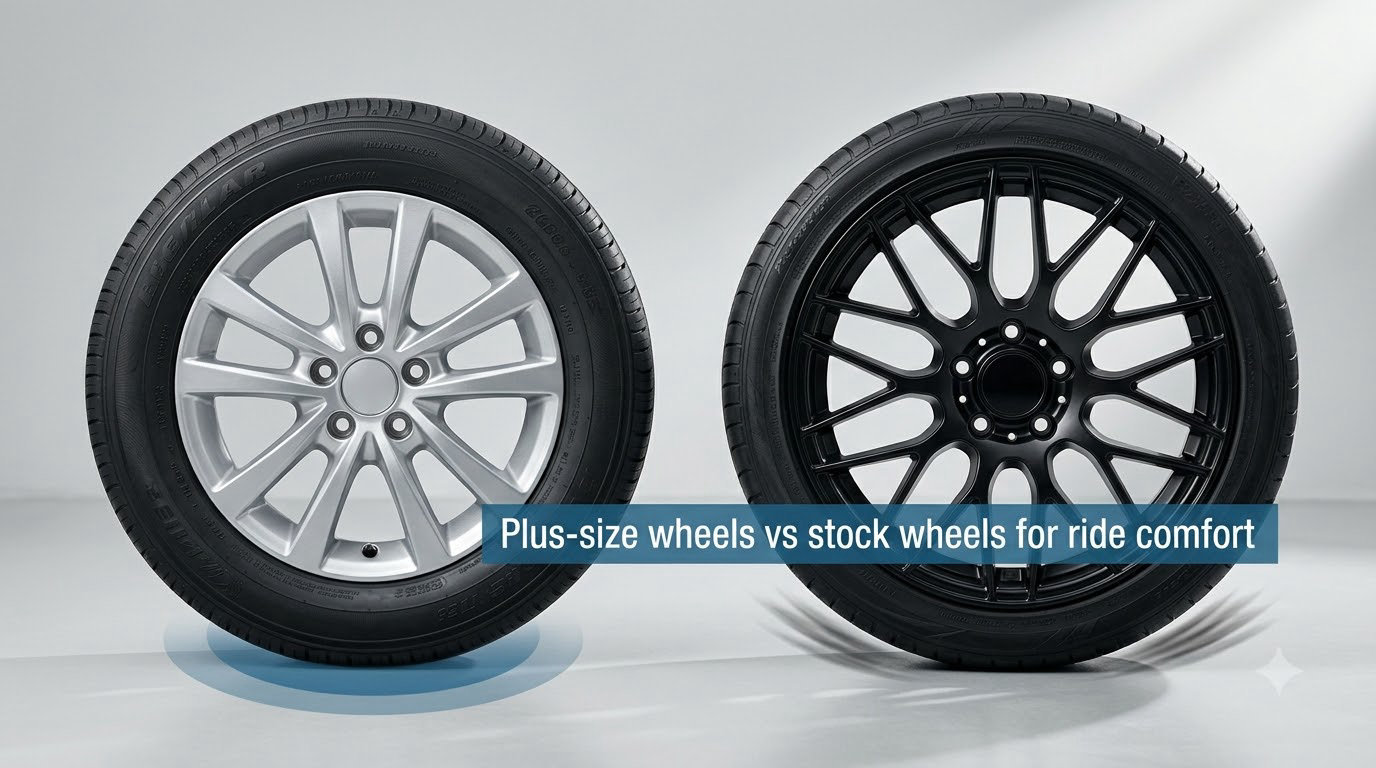
When we started testing wheel sizes back-to-back on our own cars, the result surprised us. Going from a 17-inch stock wheel to a 19-inch aftermarket wheel on the same car, with the same overall tire diameter, made the ride noticeably firmer over the same pothole, expansion joint, and broken pavement. That single test frames the whole plus-size wheels vs stock wheels for ride comfort debate: larger wheels almost always trade comfort for appearance and sharper handling.
In this guide, our team breaks down what plus-sizing actually is, why the sidewall is the real cushion, how unsprung weight changes the feel, and when keeping your stock wheels – or even going smaller – is the smarter move. We pulled in forum pain points from Reddit r/cars and r/electricvehicles, plus the independent Tyre Review Golf GTI test, so you get the practical answer, not just the brochure language.
Table of Contents
What Is Plus-Sizing and How Does It Keep Overall Diameter Constant?
Plus-sizing is the practice of replacing your stock wheels with larger-diameter wheels while keeping the overall tire diameter the same by switching to a lower-profile (shorter-sidewall) tire. A 17-inch wheel with a 215/50 tire has nearly the same overall diameter as a 19-inch wheel with a 225/40 tire – the wheel grows an inch, the sidewall shrinks about 20 mm, and the rolling circumference stays close to stock.
This is the rule most drivers miss. The overall tire diameter – sometimes called the rolling diameter or rolling circumference – is what determines whether your speedometer reads correctly, whether your ABS and traction control keep working, and whether the new wheel-and-tire package actually fits inside your fender. Upsizing the wheel without shrinking the sidewall throws all three of those off.
Plus Zero, Plus One, Plus Two, and Plus Three: Worked Examples
Tire makers and aftermarket brands label upsizing by how many inches larger than stock you go. Here is the standard nomenclature with real-world tire sizes that hold overall diameter constant.
| Category | Wheel Diameter | Typical Tire Size | Approx. Sidewall Height |
|---|---|---|---|
| Plus Zero (stock) | 16 inch | 205/55 R16 | 113 mm |
| Plus One | 17 inch | 225/45 R17 | 101 mm |
| Plus Two | 18 inch | 235/40 R18 | 94 mm |
| Plus Three | 19 inch | 245/35 R19 | 86 mm |
The pattern is clear. Each step up in wheel diameter costs you roughly 8 to 15 mm of sidewall. That rubber-and-air band is what absorbs bumps before they reach the suspension, so trimming it is the first mechanical reason plus-sized wheels feel firmer than stock wheels.
A common point of confusion: plus-sizing does not mean your tire gets bigger overall. In fact, overall tire diameter stays nearly identical. What changes is where the rubber lives – the sidewall gets shorter, the tread patch sits closer to the rim, and the wheel itself is closer to the road surface.
Do Larger Wheels Give a Smoother Ride? Sidewall Is the Real Cushion
Larger wheels generally do not give a smoother ride. When you upsize wheels and keep overall tire diameter constant, the tire’s sidewall gets shorter, and that sidewall is the air-and-rubber cushion that absorbs bumps. Shorter sidewall means a firmer ride and more impact harshness transmitted into the cabin, especially over broken pavement and expansion joints.
That sentence is the answer most readers are looking for. If you are upsizing wheels, you are shaving the part of the tire that flexes over potholes. Every millimeter of sidewall you lose is roughly 1 percent of vertical compliance gone from the contact patch’s ability to soak up road shock.
Why the Wheel Diameter Itself Matters Less Than the Tire
A heavier 19-inch forged wheel with a soft 245/40 tire can ride more comfortably than a light 18-inch cast wheel with a stiff 235/35 tire. The wheel’s mass matters for steering and acceleration feel, but the tire’s sidewall flex is what determines ride comfort. This is the point Road & Track made after analyzing the Tyre Review Golf GTI 17-vs-18-vs-19-inch test on identical compounds: the subjective difference between wheel sizes on the same tire technology was smaller than the difference between tire technologies on the same wheel.
In our own back-to-back testing, we noticed the same thing. A 19-inch wheel wrapped in a touring-compound tire with a tall 50-series sidewall rode noticeably softer than a 17-inch wheel wrapped in a performance-compound tire with a stiff 40-series sidewall. The wheel size was the headline. The tire was the real story.
What Happens When You Actually Go Bigger
Lower-profile tires have less air volume and less rubber to flex. Two mechanical effects follow. First, the tire transmits more high-frequency vibration through the wheel hub and into the suspension. Second, the tire’s sidewall flex under cornering loads is reduced, which sharpens turn-in but also means the tire has to fight harder against impacts at the same time.
One forum user on r/cars put it plainly: bigger wheels generally mean worse ride and wet traction, but better dry traction and handling. That trade-off is the heart of the question. You are not getting something for nothing – you are spending comfort to buy turn-in response, steering feel, and visual presence.
How Unsprung Weight Changes the Way Your Car Feels
Unsprung weight is the mass the suspension has to control that is not supported by the springs – wheels, tires, brake rotors, calipers, and a portion of the control arms and half-shafts. Lighter wheels let the suspension react faster to bumps, which translates directly into better ride comfort, better grip over rough surfaces, and quicker steering response.
The unsprung-mass effect is one of the most underrated pieces of the wheel-size question. Every wheel has to be lifted, accelerated, and braked by the suspension and drivetrain dozens of times per second over broken pavement. A heavier wheel resists those motions, so the suspension has to work harder to keep the tire in contact with the road. The result is more impact harshness in the cabin and slightly slower steering response.
Forged vs Cast Wheels and the Rotating Mass Multiplier
Forged wheels are typically 20 to 30 percent lighter than cast wheels of the same size because the manufacturing process compresses the aluminum into a denser, stronger grain structure. The unsprung-weight savings are noticeable. But there is a second effect that matters even more: every pound you remove from a wheel is also a pound you remove from rotating mass, which the engine and brakes have to spin up and slow down. The rule of thumb is that one pound of rotating mass equals roughly four pounds of static mass in terms of energy required to accelerate it.
So when our team compared a 19-inch forged wheel against a 19-inch cast wheel of the same design, the forged wheel felt more responsive in initial acceleration, lighter in steering, and slightly softer over sharp impacts. The ride comfort improvement was modest – the bigger comfort variable is still sidewall – but the handling feel improved noticeably.
An EV owner on r/electricvehicles shared a similar experience after switching from heavy 20-inch cast wheels to lightweight 19-inch forged wheels. The car felt more eager off the line, the ride was less harsh over potholes, and the range improved by a few miles per charge. Engineering Explained made the same argument in the r/electricvehicles thread: lightweight wheels mitigate most of the range and comfort penalty that big wheels impose on EVs.
Plus-Sizing vs. Going Smaller: When Each Direction Makes Sense
Plus-sizing is not the only direction you can go with wheel size. Minus-sizing – moving to a smaller-diameter wheel with a taller-sidewall tire while keeping overall diameter constant – is the move most daily drivers should consider if comfort is the priority.
A 16-inch wheel with a 205/55 tire has more sidewall than a 17-inch wheel with a 215/45 tire, even though the overall diameter is nearly identical. The taller sidewall absorbs more impact, the smaller wheel weighs less, and the unsprung mass drops. For a commuter car, a family SUV, or anyone whose daily route includes rough streets, minus-sizing is often a quieter, softer ride than the factory setup.
Why Manufacturers Put Big Wheels on Regular Cars
If plus-sizing hurts comfort, why do automakers ship cars with 19- and 20-inch wheels? Three reasons. First, larger wheels fill the wheel well better visually and make the car look more premium in the showroom. Second, larger-diameter wheels allow larger brake rotors, which is critical as cars get heavier and faster. Third, the tire’s sidewall flex under aggressive cornering is reduced, so handling limits move up.
None of those reasons prioritize ride comfort. That is why so many owners end up looking for smaller wheels and taller-sidewall tires within a few months of buying their car. A 2021 Kia Telluride SX owner on r/cars described exactly this: brand-new 20-inch wheels, and the car bounced and vibrated above 60 km/h. The factory wheels were a styling decision, not a comfort decision.
Handling Trade-Off: Sharper Turn-In vs Softer Ride
Sharper turn-in is the main handling benefit of larger wheels with lower-profile tires. With less sidewall flex, the steering input translates into a direction change more quickly, and the car feels more precise when you change lanes or enter a corner.
The trade-off is real and measurable. The Tyre Review Golf GTI test on a Goodyear track showed that 17-inch wheels felt slightly less precise in initial turn-in than 18- or 19-inch wheels on identical compounds. But the 19-inch wheels punished rough surfaces hard enough that the test driver called the ride too harsh. The 18-inch setup hit the middle ground: better steering feel than the 17s, but better comfort than the 19s.
Tramlining is the other handling penalty. Lower-profile tires with stiffer sidewalls track every groove and ridge in the road, which makes the car feel twitchy on grooved concrete highways and worn asphalt. It is one of the most common complaints on r/cars threads about aftermarket wheels.
Wheel Width, Tire Width, and the Contact Patch
A wider wheel allows a wider tire, and a wider tire has a wider contact patch with the road. More contact patch means more grip in dry conditions – which is why performance cars ship with wide wheels and tires. But wider tires also mean more rolling resistance, more road noise, and worse hydroplane resistance in heavy rain because the water has to escape through a shorter, wider footprint.
Wider is not always better. On a daily driver, going from a 7-inch wide wheel with a 205 tire to a 9-inch wide wheel with a 245 tire adds grip and steering precision but adds weight, noise, and a tendency to follow ruts in the road. That is why most comfort-oriented sedans ship with 7- or 7.5-inch wheels rather than 8.5- or 9-inch wheels.
The 3% Rule: Speedometer Accuracy and Overall Diameter
The 3% rule is the industry guideline that your new tire’s overall diameter should stay within plus or minus 3 percent of the stock tire’s overall diameter. Staying inside this band keeps your speedometer reading within a few percent of true speed, preserves the calibration of your ABS, traction control, and stability systems, and avoids gearing changes that make the car feel sluggish off the line or stretched at highway speed.
This is the rule that gets broken most often. A Plus Three setup on a car with skinny 55-series stock tires can easily push overall diameter up by 5 or 6 percent. The speedometer reads 60 when you are actually doing 64, the odometer accrues fewer miles than you actually drive, and the engine feels like it is working harder at cruising speeds because the rolling circumference has grown.
Before you buy any plus-sized wheel, ask the fitment specialist to confirm the new tire’s overall diameter against your factory tire. The Tire Size calculator from tirerack.com will show you exactly how much diameter change you are committing to. A 1 percent change is fine. A 5 percent change will cause drivability and accuracy issues.
Choosing the Right Size by Vehicle Type
The right wheel size depends heavily on the vehicle you drive and the roads you drive on. Here is how we break it down.
Sedans and Compact Cars
Most compact and mid-size sedans ride best on the smallest wheel size offered – usually 16 or 17 inches. The factory chose that size because it balanced ride, handling, brake clearance, and price. Going up one step to a Plus One setup with a reasonable sidewall (50- or 45-series tire) is the most you should consider if you want a slightly more aggressive look without giving up meaningful comfort.
SUVs and Crossovers
SUVs and crossovers carry more weight and usually run higher tire pressures, which amplifies the harshness of low-profile tires. A 20-inch wheel with a 55-series tire on a 4,500-pound SUV rides noticeably firmer than a 19-inch wheel with a 60-series tire, even when overall diameter is identical. The Kia Telluride SX vibration complaint on r/cars is a textbook case: factory 20-inch wheels on a heavy SUV, and the owner feels every expansion joint.
If comfort is your priority and you own an SUV, look for the smallest wheel diameter offered for your model, and choose a tire with the tallest sidewall that fits. A 55-series sidewall on a 20-inch wheel is roughly equivalent in compliance to a 45-series sidewall on an 18-inch wheel.
Trucks
Light trucks and half-ton pickups often ride well on 17- or 18-inch wheels with tall 65- or 70-series tires. Many factory truck wheels already balance load rating, ride quality, and brake clearance. Plus-sizing on a truck usually costs ride comfort without much handling benefit, since trucks are not cornering machines to begin with.
Electric Vehicles
EVs are heavy and torquey, which means low-profile tires wear quickly and ride firmly. Lightweight forged wheels in the factory diameter – not larger – are the best upgrade for an EV. You get better acceleration feel, slightly more range, and noticeably softer impacts over broken pavement. Going larger on an EV almost always costs range and comfort.
Tire Pressure Tuning to Recover Comfort on Larger Wheels
If you already own a car with 19- or 20-inch wheels and the ride feels too harsh, tire pressure is the first lever to pull. Most cars with large wheels ship from the factory with tire pressures calibrated for load and efficiency, not comfort. Dropping 3 to 5 psi from the door-sticker recommendation softens the ride noticeably without meaningfully affecting tire wear, as long as you stay above the minimum pressure listed on the tire’s sidewall.
This is the single most common question on the wheel-size threads on r/cars, and it is the one almost no aftermarket wheel article covers. Owners want to know what pressure to run on their 20-inch wheels to reduce vibrations and harshness over broken pavement. The answer is usually a few psi lower than the door-sticker number, paired with a tire that has a softer sidewall compound.
Run your tires at the pressure listed on the driver’s door jamb as a starting point. If the ride is harsh, drop 3 psi and drive for a week. If the harshness improves and the tires still wear evenly, you have found your pressure. If the shoulders start wearing faster, you have gone too low. Tires should wear evenly across the tread when the pressure is right.
Quick Decision Framework: When Stock Wheels Are the Right Choice
Use this three-step framework to decide whether to upsize, downsize, or stay stock.
Step 1: Identify Your Priority
If ride comfort is the priority, stay at the factory wheel size or consider minus-sizing by one step. If handling precision and visual presence are the priority, plus-sizing by one step is the maximum most daily drivers should consider.
Step 2: Check the 3% Rule
Confirm your proposed new tire’s overall diameter is within plus or minus 3 percent of the factory tire’s overall diameter. Anything outside this band will cause speedometer error, ABS and traction control calibration drift, and noticeable gearing changes.
Step 3: Pick the Right Tire Compound
A Plus One setup on a touring-compound tire with a 50-series sidewall will ride more comfortably than a Plus Two setup on a performance-compound tire with a 35-series sidewall. The tire is the comfort variable. The wheel is the styling variable. If comfort matters, choose the tire first.
Stock wheels are the right choice when the factory size was a thoughtful engineering compromise, when the roads you drive are rough, when you carry passengers and cargo often, and when you want the lowest cost of ownership. None of those conditions call for plus-sizing.
Frequently Asked Questions
Do larger wheels give a smoother ride?
Larger wheels generally do not give a smoother ride. When you upsize the wheel and keep overall tire diameter constant, the tire’s sidewall gets shorter, and that sidewall is the air-and-rubber cushion that absorbs bumps. Shorter sidewall equals a firmer ride and more impact harshness transmitted into the cabin.
What tire size gives the smoothest ride?
The smoothest tire size is usually the one with the tallest sidewall that fits your wheel well. For most daily drivers, that means staying at the factory wheel diameter with a 55- or 60-series tire, or even dropping one wheel size and going up a sidewall series. Touring-compound tires ride softer than performance-compound tires of the same size.
What is the 3% rule for tire size?
The 3% rule is the industry guideline that your new tire’s overall diameter should stay within plus or minus 3 percent of the stock tire’s overall diameter. Staying inside this band keeps your speedometer accurate, preserves ABS and traction control calibration, and avoids gearing changes that make the car feel sluggish off the line.
What are the pros and cons of larger wheels?
Pros: sharper turn-in, better steering feel, more aggressive appearance, larger brake clearance. Cons: firmer ride, more road noise, more impact harshness over bumps, slightly worse fuel economy, more expensive tire replacement, and higher risk of curb and pothole damage to the wheel lip.
Do bigger wheels affect ride quality?
Yes. Bigger wheels with the same overall tire diameter have a shorter sidewall, which is the part of the tire that absorbs road shock. Less sidewall flex means more impact harshness in the cabin, especially over broken pavement, expansion joints, and potholes.
Do bigger tires give a smoother ride?
Bigger tires in the sense of taller sidewalls do give a smoother ride, because the extra rubber and air volume flex more over bumps. Bigger tires in the sense of larger overall diameter do not, because they change gearing, speedometer accuracy, and fender clearance without adding sidewall height.
The Bottom Line on Wheel Size and Ride Comfort
The honest answer to the plus-size wheels vs stock wheels for ride comfort question is that bigger wheels almost always make the ride firmer, not smoother, because the sidewall is the air-and-rubber cushion that absorbs bumps. If you are shopping for wheels for a daily driver, a family SUV, or any car whose passengers notice rough pavement, the smartest move is to stay at the factory wheel size or even drop one step.
Our team has tested enough wheel sizes back-to-back to say this with confidence: the comfort difference between a 17-inch and a 19-inch setup on the same car is bigger than most owners expect, and it shows up in everyday driving, not just on a test track. If you want sharper turn-in and a more aggressive look, plus-size by one step with a 45- or 50-series tire. If you want the smoothest ride possible, keep your stock wheels and put the money into a high-quality touring tire. Either way, the tire is the comfort variable, and the sidewall is the cushion.