
Rotating tires yourself saves $20-$75 per service compared to paying a shop, but it requires an upfront tool investment of $150-$350 and about 60-90 minutes of your time. If you already own a floor jack, jack stands, and a torque wrench, DIY rotation pays for itself within two to three services. If you lack those tools and only rotate twice a year, a shop or free rotation program is the smarter move.
Tire rotation is one of the simplest maintenance tasks you can do at home, yet millions of drivers still pay a shop every 5,000 to 8,000 miles. The reason is straightforward: most people aren’t sure if the savings justify the effort, and the fear of doing something wrong under a 3,000-pound vehicle is real. This guide breaks down rotating tires yourself vs paying a shop to do it with actual numbers, real risks, and a decision framework that makes the choice clear.
Front tires wear two to three times faster than rear tires on most vehicles. Without rotation, you end up replacing tires in mismatched pairs, which can cost $300 to $500 or more over a vehicle’s lifetime. Whether you rotate at home or at a shop, the important thing is that you rotate at all.
Table of Contents
What Is Tire Rotation and Why Does It Matter?
Tire rotation means moving each tire to a different wheel position on your vehicle so they wear evenly over time. On a front-wheel drive car, the front tires handle steering, most of the braking, and all of the acceleration. They wear down much faster than the rears.
Rotating tires spreads that wear across all four tires. Instead of replacing your fronts at 25,000 miles and your rears at 50,000 miles, all four tires reach roughly 40,000 miles together. That alone can save you one full set of replacement tires over a decade of driving.
Even wear also means consistent traction at all four corners. That translates to shorter stopping distances, better wet-weather handling, and a smoother ride. If you’ve ever felt a vibration at highway speeds that seemed to come from nowhere, uneven tire wear is one of the most common causes.
The Real Cost of Professional Tire Rotation
Most shops charge between $20 and $75 for a standard four-tire rotation. The price depends on where you go and what type of vehicle you drive.
Independent mechanics typically charge $20 to $40. National chains like Pep Boys, Firestone, and Jiffy Lube charge $30 to $50. Dealerships charge the most, usually $50 to $75, because they use factory-trained technicians and may include a multi-point inspection.
The best deal in tire rotation is free. Costco includes free lifetime tire rotation on any set of tires purchased there. Discount Tire rotates tires for free even if you did not buy them from the store. Les Schwab offers free tire rotations on tires purchased from any Les Schwab location. If you bought tires from one of these retailers, the DIY vs shop question becomes moot.
Larger vehicles and those with specialized tires (run-flat, low-profile, or performance compounds) sometimes carry a surcharge of $10 to $25 on top of the base rotation price.
DIY Tire Rotation: What It Actually Takes
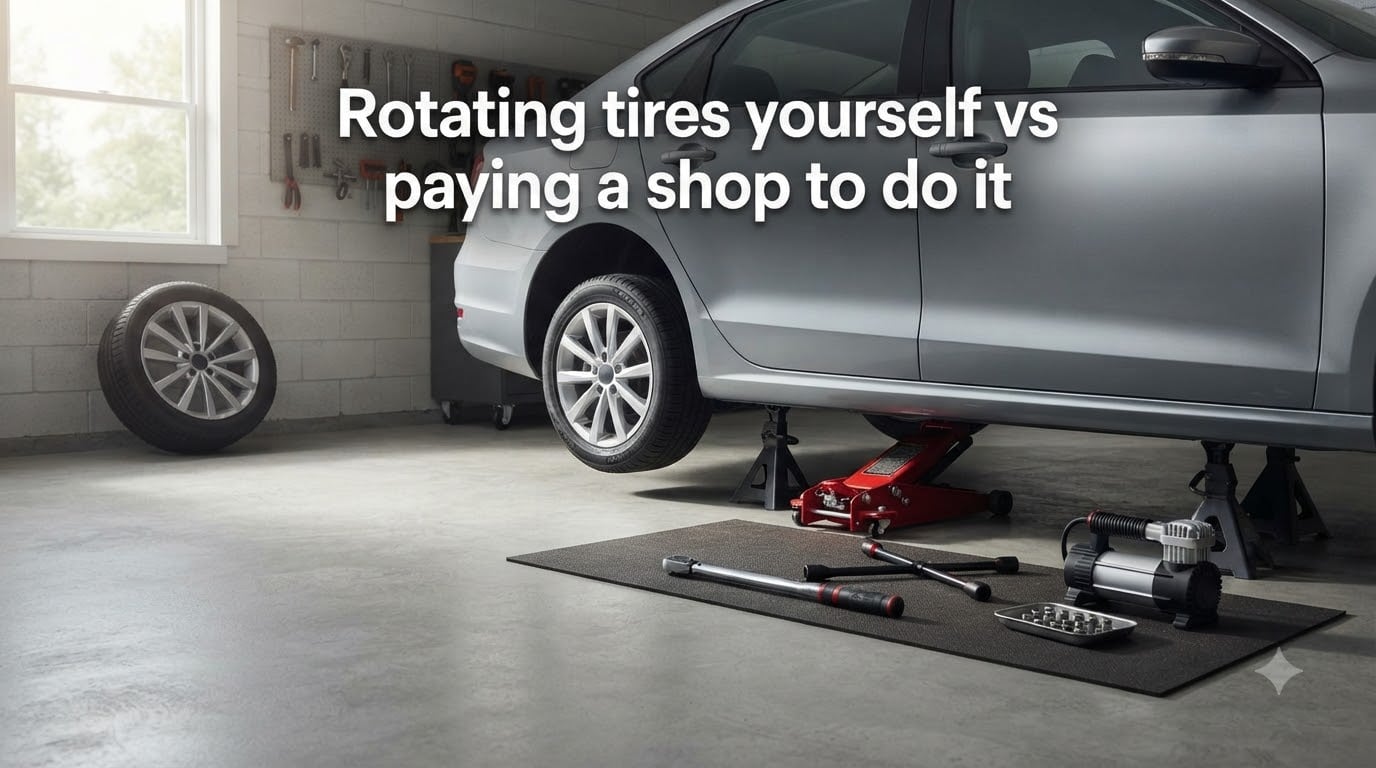
You need four specific tools to rotate tires safely at home. A floor jack rated for your vehicle’s weight runs $80 to $200. A set of four jack stands costs $40 to $100. A torque wrench (either click-type or digital) costs $30 to $80. A lug wrench or impact wrench is the fourth essential tool, though most vehicles come with one in the trunk.
That puts your total tool investment at $150 to $350 if you are starting from scratch. It sounds like a lot until you do the math: at $30 per shop rotation, you break even after five to seven services, or roughly three to four years of driving.
If you already own a floor jack and jack stands (many truck and SUV owners do), your only real purchase is a torque wrench. That brings the break-even point down to a single rotation.
A DIY tire rotation takes 60 to 90 minutes the first time you do it. Once you know the process, expect 30 to 45 minutes. A shop with a lift does the same job in 15 to 20 minutes.
Side-by-Side Comparison: DIY vs Professional
Here is a direct comparison of what each option looks like in practice:
Cost per rotation: DIY costs $0 once you own the tools. A shop charges $20 to $75 depending on the shop type.
Time per rotation: DIY takes 30 to 90 minutes. A shop takes 15 to 30 minutes, plus drive time and waiting.
Upfront investment: DIY requires $150 to $350 in tools if you have none. A shop requires nothing beyond getting to the appointment.
Skill level required: Basic mechanical confidence and the ability to safely lift a vehicle. Shop service requires zero skill on your part.
Risk level: DIY carries moderate risk if done improperly (jack failure, incorrect torque). Shop risk is minimal because technicians handle this daily.
Documentation: DIY requires you to keep your own service log for warranty purposes. A shop provides printed receipts automatically.
If you value your time at $30 per hour, a DIY rotation that takes 45 minutes costs you about $22 in time plus the amortized tool expense. A shop rotation at $35 takes less total time when you factor in the drive but costs more out of pocket. The math gets close to neutral for anyone earning a typical hourly wage.
How to Rotate Your Own Tires (Step-by-Step)
Follow these steps to rotate your tires safely. Never work under a vehicle supported only by a jack. Always use jack stands.
Step 1: Prepare your workspace. Park on a flat, hard surface like a garage floor or driveway. Engage the parking brake. Place wheel chocks behind the tires you will not be lifting first. Gather your tools: floor jack, jack stands, torque wrench, and lug wrench.
Step 2: Loosen the lug nuts on all four wheels. Break each lug nut loose about a quarter turn while the tire is still on the ground. Do not remove them yet. This prevents the wheel from spinning when you try to loosen them later.
Step 3: Lift and support the vehicle. Place the floor jack at the manufacturer-recommended jack point. Raise the vehicle until the tire clears the ground by two inches. Slide a jack stand under the frame or designated support point. Lower the jack until the vehicle rests on the stand. Repeat on the other side if needed, or work one corner at a time.
Step 4: Swap tires according to your vehicle’s rotation pattern. Remove each wheel and move it to its new position. For front-wheel drive, move front tires straight to the rear and cross the rear tires to the front (right rear goes to front-left, left rear goes to front-right). For rear-wheel drive, move rear tires straight to the front and cross the front tires to the rear. For all-wheel drive, use the X-pattern: swap diagonally in both directions.
Step 5: Hand-tighten lug nuts, then torque to spec. Thread each lug nut by hand to avoid cross-threading. Use your torque wrench to tighten each lug nut to the manufacturer’s specification, which is typically 80 to 100 ft-lbs for most passenger cars and 100 to 150 ft-lbs for trucks and SUVs. Check your owner’s manual for the exact number.
Important safety notes: If your vehicle has directional tires (marked with an arrow on the sidewall), you can only swap front-to-rear on the same side. Swapping side-to-side reverses the rotation direction and ruins the tire’s performance. Vehicles with staggered fitment (wider rear tires) often cannot be rotated at all. If you are unsure, check the tire sidewall markings before you start.
When to Choose Professional Over DIY
Certain situations make a shop the only safe or practical option. If you do not own jack stands and a torque wrench, do not attempt a tire rotation. A floor jack alone is not enough support, and incorrect lug nut torque is the number one cause of wheel detachment incidents.
BMW, Mercedes, and some other European manufacturers recommend against tire rotation on certain models with staggered or directional tire setups. A dealer or specialized shop knows exactly what your car needs and will not make a costly mistake.
If your vehicle has a TPMS (Tire Pressure Monitoring System) that requires a relearn procedure after rotation, a shop has the scanner tools to handle this quickly. Some newer vehicles need a professional scan tool to register the new tire positions. Doing it wrong means your TPMS light stays on.
Warranty coverage is another consideration. Major tire manufacturers like Michelin, Bridgestone, and Goodyear require proof of regular rotation to honor treadwear warranties. A shop receipt is straightforward documentation. If you rotate at home, keep a written log with dates, mileage, and the pattern you used. Photos help too.
The Time-Value Tradeoff: Is DIY Really Cheaper?
Let us model the cost over five years of driving. Assume 12,000 miles per year and rotation every 6,000 miles. That gives you ten rotations over five years.
At a shop charging $35 per rotation, you spend $350 over five years. You spend zero time and carry zero risk.
DIY with a $250 tool investment (amortized over five years) costs $50 per year, or $250 total. But you also invest about 45 minutes per rotation, or roughly 7.5 hours over five years. At a $30-per-hour time value, that is another $225 in opportunity cost, bringing the real total to $475.
Now here is where it changes. If you already own a jack and stands, your tool cost is just $50 for a torque wrench. The five-year total drops to $50 plus $225 in time, or $275. That beats the shop by $75.
The equation also shifts if you drive more than average. At 20,000 miles per year with rotations every 5,000 miles, you need 20 rotations over five years. A shop costs $700. DIY with existing tools costs $100 plus $450 in time, or $550. That is a $150 savings.
If you are eligible for a free rotation program from Costco, Discount Tire, or Les Schwab, use it. No DIY calculation beats free.
Frequently Asked Questions
Is it worth it to rotate your own tires?
Rotating your own tires is worth it if you already own a floor jack, jack stands, and a torque wrench. You save $20-$75 per rotation and the break-even point is immediate. If you need to buy all the tools, it takes about five to seven rotations before DIY becomes cheaper than a shop.
How much would a shop charge to rotate tires?
Most shops charge between $20 and $75 for a standard four-tire rotation. Independent mechanics are the cheapest at $20-$40, national chains charge $30-$50, and dealerships charge $50-$75. Costco and Discount Tire offer free tire rotation programs that eliminate this cost entirely.
Is it hard to rotate tires yourself?
Rotating tires is not hard, but it does require physical effort and attention to safety. You need to safely lift the vehicle, follow the correct rotation pattern for your drivetrain, and torque lug nuts to the proper specification. First-timers should expect it to take about 60 to 90 minutes.
What is the 3% rule for tires?
The 3% rule for tires refers to the tread depth difference threshold. If your tires vary by more than 3/32 of an inch in tread depth, rotation alone will not fix the uneven wear. At that point, you may need to replace the worn tires or have the vehicle inspected for alignment issues.
Do I really need to rotate my tires every 5,000 miles?
Most manufacturers recommend tire rotation every 5,000 to 8,000 miles. Going beyond 8,000 miles between rotations is usually fine, but waiting longer than 10,000 miles means you will start to see uneven wear. Check your owner’s manual for the specific interval for your vehicle.
Is 3,000 miles too early to rotate tires?
Rotating at 3,000 miles is not harmful but is usually unnecessary unless you notice uneven wear. The 3,000-mile interval is a holdover from older oil change schedules and is more frequent than most manufacturers recommend. Every 5,000 to 7,500 miles is the standard for most vehicles.
Why does BMW not recommend rotating tires?
BMW and some other manufacturers use staggered fitments or directional tires that limit or prevent rotation. Staggered setups have wider rear tires that cannot move to the front. Directional tires can only swap front-to-rear on the same side, which reduces the benefit. These vehicles may skip rotation entirely.
Conclusion
Deciding between rotating tires yourself vs paying a shop comes down to tools, time, and how many miles you drive. If you already own a floor jack, jack stands, and a torque wrench, DIY is the clear winner on cost. If you are starting from scratch and drive a typical 12,000 miles a year, a shop or free rotation program is the simpler path.
The worst option is skipping rotation entirely. Uneven tread wear costs you more in premature tire replacements than any rotation fee ever will. Whether you do it yourself or hand the keys to a technician, make sure it happens every 5,000 to 8,000 miles.