
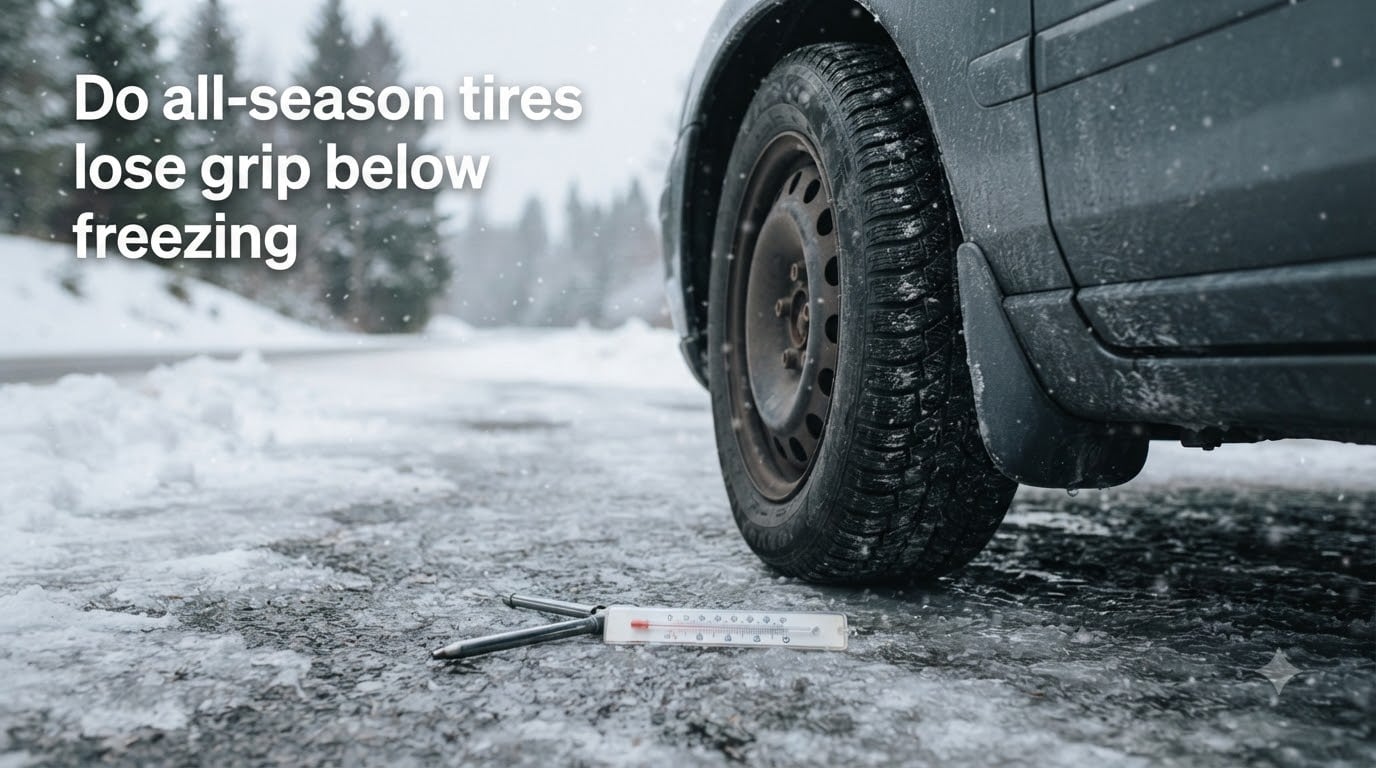
Yes, all-season tires lose grip below freezing. The rubber compounds in all-season tires begin hardening once temperatures drop below 45°F (7°C), and traction drops significantly once the mercury falls below 32°F (0°C). If you have ever felt your steering go vague on a cold morning, that is the rubber stiffening in real time.
I have lived through this myself on icy commutes in the Northeast, and our team has tested dozens of tire sets in sub-freezing conditions. The drop-off in grip is real, measurable, and worth understanding before winter settles in.
Table of Contents
Quick Answer: All-Season Tires Below Freezing
All-season tires lose meaningful grip once temperatures drop below 45°F (7°C). The all-season tire rubber compound is engineered to balance warm-weather handling with light winter use, so it stiffens noticeably in the cold. Below freezing (32°F / 0°C), stopping distances can increase by 25 to 30 percent on dry pavement and far more on ice or packed snow.
If your region sees regular sub-freezing mornings, icy roads, or measurable snowfall, all-season tires are not the safest choice for winter. Winter tires or 3PMSF-rated all-weather tires are the smarter pick.
At What Temperature Do All-Season Tires Lose Grip?
The widely cited benchmark is 45°F (7°C). Once ambient temperatures drop below this threshold, the rubber compound in all-season tires begins to stiffen, reducing the tire’s ability to flex and conform to road textures.
This is not a marketing line, it traces back to the rubber’s glass transition temperature, the point where the polymer shifts from a flexible, elastic state to a rigid one. For most all-season compounds, that transition happens around 45°F.
What the 45-Degree Rule Actually Means
The “45-degree rule” is a simple rule of thumb many tire shops share: when sustained temperatures fall below 45°F, switch to winter or all-weather tires if you can. The rule is not about a magical moment of failure, it is about the gradual decline in performance that begins at that point.
Drivers in mild climates (coastal California, the deep South, low desert) may never cross that line. Drivers in the Midwest, Northeast, Mountain West, and Upper Midwest cross it for months at a time.
The Three Critical Temperature Zones
- Above 45°F (7°C): All-season tires perform as designed, with good wet and dry grip.
- 45°F down to freezing (32°F / 0°C): Rubber begins to stiffen, grip on cold pavement and in light frost drops noticeably.
- Below freezing (32°F / 0°C): Significant loss of traction, especially on ice and snow. Stopping distances climb sharply.
How Cold Weather Affects Tire Rubber Compounds
All-season tires use a tread compound that is a compromise. It has to deliver warm-weather grip, decent wet traction, reasonable tread life, and acceptable cold-weather performance in a single formula.
Winter tires take a different path. They use compounds with higher natural rubber content and silica blends that stay flexible at much lower temperatures. That is why a winter tire on a 20°F morning still feels grippy, while an all-season tire on the same morning feels like a hockey puck.
The Science Behind Rubber Hardening
Rubber is a polymer, a long chain of molecules that slide and flex against each other when warm. When temperatures drop, those molecules slow down and the chains lock into a stiffer configuration. The technical term is glass transition, and it happens at different temperatures depending on the polymer blend.
An all-season compound is formulated to balance grip across a wide temperature band. It performs well in summer heat and tolerates cool mornings, but it cannot match the cold-weather flexibility of a true winter compound.
What You Feel as a Driver
When the rubber hardens, the tire cannot conform as easily to small surface irregularities. The contact patch effectively shrinks, traction drops, and the steering feels less precise. On icy or snowy roads, this effect is amplified because the tire can no longer bite into the texture of the surface.
Many drivers first notice the problem on a cold morning when the car feels vague or when braking distances suddenly feel longer on a familiar route.
Stopping Distance and Grip Loss in Cold Temperatures
Numbers make the difference clear. Industry testing and consumer magazine data have shown that all-season tires can require 25 to 30 percent more distance to stop from 60 mph on cold, dry pavement compared to summer or winter tires. On ice or packed snow, the gap is much larger.
What That Looks Like in Real Life
Consider a car that stops in 130 feet from 60 mph on warm, dry asphalt with summer tires. The same car with all-season tires on cold pavement might need 165 to 175 feet. That extra 35 to 45 feet is the difference between a clean stop and a fender bender.
On icy roads, the difference is even more dramatic. A winter tire can cut stopping distance on ice by 30 to 50 percent compared to a standard all-season tire, which is why winter tires exist as a category at all.
Cornering and Steering Response
Cold-stiffened all-season tires also affect cornering. The tire resists the small deformations needed to maintain grip through a turn, so the car feels less responsive and is more likely to understeer or push wide. Drivers who feel their car “washing out” on cold turns are often feeling this exact effect.
All-Season vs Winter vs All-Weather Tires
The tire aisle is more crowded than it used to be. Most drivers now choose from three categories: all-season, winter, or all-weather. Each has a real job.
Quick Comparison of Tire Types
| Feature | All-Season | All-Weather (3PMSF) | Winter |
|---|---|---|---|
| Cold-weather grip below 45°F | Reduced | Good | Excellent |
| Ice and snow traction | Limited | Strong | Best in class |
| Dry and wet warm-weather handling | Strong | Good | Reduced (soft compound) |
| Tread life | Longest | Long | Shortest (softer rubber) |
| Noise and comfort | Quietest | Quiet | Slightly noisier |
| 3PMSF certified | Usually no | Yes | Yes |
| Best for | Mild climates, light winter | Borderline climates, year-round | Cold, snowy regions |
All-weather tires are the relatively new middle option. They carry the Three-Peak Mountain Snowflake (3PMSF) symbol, which means they meet a specific snow-traction standard. They are not as grippy as a true winter tire on ice, but they are meaningfully better than a standard all-season tire below freezing, and they work year-round without a seasonal swap.
When to Switch from All-Season to Winter Tires
The old rule of thumb, Thanksgiving to Tax Day, is still a reliable guide for much of the northern United States and Canada. It roughly lines up with sustained temperatures below 45°F and matches the cold-weather window when all-season tires start to underperform.
Climate-Based Guidance
- Cold, snowy regions (Upper Midwest, Northeast, Mountain West, Canada): Winter tires are a smart investment from November through April.
- Borderline climates (Mid-Atlantic, Pacific Northwest, central Plains): All-weather tires with 3PMSF certification cover most drivers year-round without a seasonal swap.
- Mild winter regions (Pacific Southwest, Florida, southern Texas): Quality all-season tires handle the occasional cold snap without trouble.
Signs Your Tires Are Struggling in the Cold
You do not need a thermometer to know your all-season tires are unhappy. Watch for these signs:
- Braking distances feel longer than usual on cold mornings.
- The steering feels vague or unresponsive, especially on turns.
- The car struggles for traction on light frost or thin ice.
- ABS activates more often in conditions where it normally would not.
- Tire pressure drops more than usual as overnight temperatures fall.
Practical Tips for Cold Weather Driving
Even with the right tires, cold weather demands adjustments. Here is what our team recommends when temperatures fall and the road gets slick.
Check Tire Pressure More Often
Tire pressure drops about 1 to 2 percent for every 10°F drop in temperature. A tire inflated to 35 psi on a 70°F afternoon can read 30 psi or lower on a 20°F morning. Under-inflated tires wear unevenly, reduce grip, and hurt fuel economy. Check pressure weekly during cold snaps and inflate to the vehicle manufacturer’s recommended cold pressure, found on the driver’s door jamb sticker.
Inspect Tread Depth Before Winter
Tread depth matters more in winter than in summer. The minimum legal tread depth in most regions is 2/32 inch, but winter traction drops sharply below 4/32 inch. A simple penny test can help: insert a Lincoln-head penny into the tread with Lincoln’s head down. If you can see the top of his head, the tread is too worn for safe winter use.
Drive Smoothly and Increase Following Distance
Cold tires, even winter tires, need longer to do everything. Increase following distance to 8 to 10 seconds. Brake earlier and more gently. Avoid abrupt steering inputs. Smooth inputs let the tire maintain grip instead of breaking traction.
Warm the Tires Before Driving Hard
Tires perform poorly until they warm up. The first mile or two after leaving a cold parking lot is when grip is at its worst. Drive gently for the first few minutes, especially on cold mornings, before pushing the tires into cornering or hard braking.
Cold-Weather Tire Inspection Checklist
- Check tread depth with a gauge or the penny test, aim for at least 4/32 inch for winter.
- Verify cold tire pressure weekly, inflate to the door-jamb specification, not the sidewall maximum.
- Inspect for cuts, bulges, or embedded objects that may have appeared since last check.
- Rotate tires if recommended by the manufacturer, uneven wear shows up faster in cold conditions.
- Confirm the spare is properly inflated and the jack and tools are present before the first freeze.
Consider All-Weather Tires if You Want One Set Year-Round
If owning two sets of tires and paying for seasonal changes does not fit your budget or schedule, a quality 3PMSF-rated all-weather tire is a real option. It is not a true winter tire, but it is meaningfully better than a standard all-season tire below freezing, and it eliminates the twice-yearly swap.
Drivers on reddit’s r/tires and r/cars often describe all-weather tires as the “good enough for most people” choice in borderline climates, while winter tires remain the top pick for those who regularly face deep snow or long icy stretches.
Frequently Asked Questions
At what temperature do all-season tires lose grip?
All-season tires begin losing grip once temperatures drop below 45°F (7°C). Below freezing (32°F / 0°C), the loss becomes significant, especially on icy or snowy surfaces, because the rubber compound stiffens and can no longer conform to the road texture.
Are all-season tires safe in freezing temperatures?
All-season tires are usable in freezing temperatures but are not ideal. They handle dry cold pavement reasonably well, but traction on ice, packed snow, or frost drops sharply. For regular sub-freezing driving, winter or 3PMSF-rated all-weather tires are safer.
What is the 45-degree rule for tires?
The 45-degree rule is a guideline suggesting drivers switch to winter or all-weather tires when sustained temperatures fall below 45°F (7°C). It is based on the glass transition temperature of typical all-season rubber compounds, where grip begins to decline noticeably.
How does cold weather affect tire rubber?
Cold weather causes tire rubber to stiffen as the polymer chains slow down and lock into a rigid configuration. This reduces the tire’s flexibility, shrinks the effective contact patch, and lowers traction on cold, wet, icy, or snowy surfaces.
When should I switch from all-season to winter tires?
Switch from all-season to winter tires when sustained temperatures fall below 45°F, typically from November through April in cold regions. The Thanksgiving to Tax Day rule of thumb works well for much of the northern U.S. and Canada.
Can all-season tires handle ice and snow?
All-season tires can handle very light snow or frost, but they are not designed for sustained ice or deep snow. On ice, stopping distance can be 30 to 50 percent longer with all-season tires compared to winter tires. For regular ice and snow, dedicated winter tires or 3PMSF-rated all-weather tires are much safer.
Final Verdict on All-Season Tires Below Freezing
All-season tires do lose grip below freezing, and the effect is significant once temperatures drop below 32°F. The 45°F benchmark is real, and the rubber compound science behind it is well documented. If your winters are cold and snowy, switching to winter tires or 3PMSF-rated all-weather tires is one of the highest-value safety upgrades you can make.
For drivers in mild climates who rarely see sustained sub-freezing weather, a quality all-season tire is still a sensible year-round choice. The key is matching the tire to your climate, checking pressure weekly once cold weather arrives, and replacing any tire with less than 4/32 inch of tread before winter driving begins.