
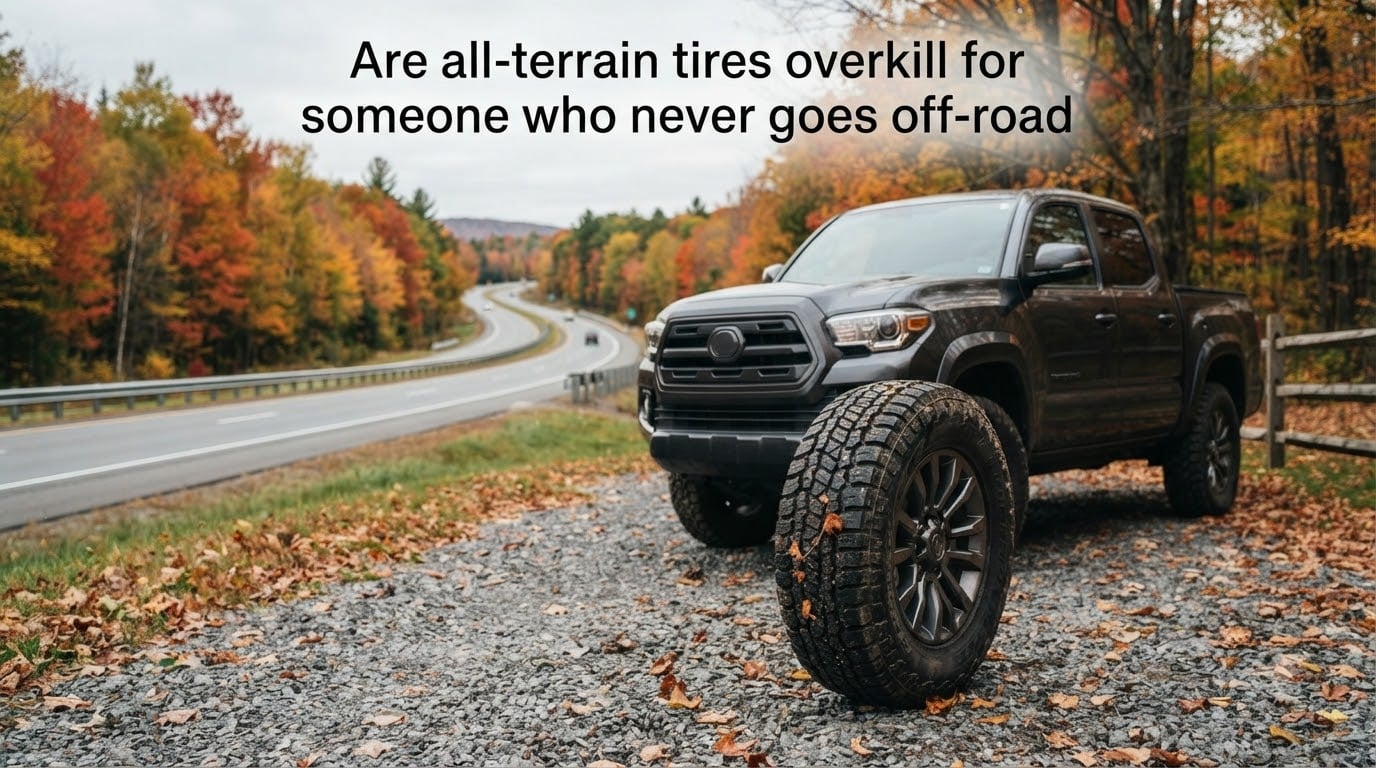
If you bought a truck or SUV for the look but never leave pavement, you’ve probably asked yourself this exact question: are all-terrain tires overkill for someone who never goes off-road? I’ve worked with hundreds of daily drivers in this situation, and the answer is more nuanced than the tire industry wants you to believe.
The short version: for most highway-only drivers, all-terrain tires are overkill in pure performance terms. But for a meaningful slice of drivers — truck owners in snow country, rural commuters, weekend adventurers — they’re actually a smart buy. This guide breaks down exactly where that line falls for 2026.
Quick Answer: All-terrain tires are overkill for highway-only drivers who never see dirt, gravel, or snow. You’ll pay more at purchase, lose 1-3 MPG, hear more cabin noise, and replace them sooner. The right tire for a pure pavement commuter is a modern highway or grand-touring tire. AT tires earn their trade-offs only when you regularly encounter unpaved roads, severe weather, or both.
By the end of this article, you’ll know:
- The real cost of running AT tires on pavement (not just the sticker price)
- How much fuel economy you actually lose
- Whether the noise complaint is hype or real
- When AT tires are the right answer — even for a daily driver
- The 5-question decision checklist our team uses with customers
Let’s start with what these tires actually are, because most of the confusion comes from a simple misnomer.
Table of Contents
What All-Terrain Tires Actually Are (And What Highway Tires Are Not)
All-terrain tires were designed for a very specific job: keep a pickup moving when the pavement ends at a jobsite, a campground, or a snow-covered county road. That “all-terrain” label isn’t marketing fluff — it’s a real engineering category, and the design choices that make them good off-road are exactly what costs you on the highway.
An all-terrain tire is built with three signature features. First, large, aggressive tread blocks with deep voids between them — those gaps give the tire something to bite into when you’re on dirt or mud. Second, a tougher sidewall construction, often with extra ply layers, to resist punctures from rocks and stumps. Third, a tread compound that’s harder and more cut-resistant than what you’d find on a highway tire, sacrificing some grip on cold wet pavement for durability on rough surfaces.
Highway tires sit at the opposite end of the spectrum. Their tread pattern is mostly continuous ribs with small sipes — tiny slits that improve wet and snow traction without creating noise. The sidewalls are softer for ride comfort. The compound is stickier and softer, optimized for warm pavement, short braking distances, and low rolling resistance. They’re quieter, more efficient, and longer-lasting on smooth roads.
There’s also a middle category worth mentioning: the hybrid tire (sometimes called “crossover” or “touring A/T”). Brands like Continental, Michelin, and General have all released tires in this space. They borrow some of the visual aggression of an A/T but with shallower tread depth, smaller voids, and a softer compound. For many drivers, they’re the real answer to the question this article is asking — but more on that later.
The key point: an all-terrain tire is a compromise product that does its primary job very well and its secondary job acceptably. If you never use the primary job, you’re paying the compromise premium for nothing.
The Real Pros of All-Terrain Tires for Highway Drivers
Before we get into the case against A/T tires on pavement, let’s be honest about the upside. There are real benefits, and dismissing them would be lazy advice.
1. Emergency capability when you actually need it. A snowstorm hits. A road closes. You need to detour through a gravel access road to reach your cabin. With all-terrain tires, you just go. With highway tires, you’re stuck waiting for a plow or a friend with a real truck. Our team has talked to dozens of drivers who said their A/T tires paid for themselves in a single weekend when weather or road conditions changed unexpectedly.
2. Better performance in heavy rain and slush. The deeper tread voids on an A/T evacuate water faster than the shallow grooves on a highway tire. On standing water and slushy winter roads, that gap matters. Reviews from tire testing publications consistently show A/T tires outperform highway tires in deep water and slush conditions — sometimes by a measurable margin in stopping distance.
3. All-weather versatility without a second set. Many modern all-terrain tires carry the Three-Peak Mountain Snowflake (3PMSF) symbol, meaning they’re rated for severe winter service. For a driver in a snow-belt state, that eliminates the cost and hassle of a winter tire swap twice a year. One set, mounted year-round, covers most conditions from summer road trips to January commutes.
4. Higher puncture and impact resistance. The harder compound and reinforced sidewalls shrug off potholes, curb scrapes, and the occasional nail that would have left a highway tire flat on the shoulder. Drivers who log serious highway miles through construction zones report fewer failures with A/T tires.
5. The aesthetic and resale factor. I’ll be direct — this matters to many buyers. An SUV or truck on all-terrain tires simply looks more capable. For some owners, that’s reason enough. And if you ever sell the vehicle, the tires stay with it, potentially improving resale appeal in markets where off-road styling is valued.
6. Confidence for the occasional unpaved road. If your life includes a gravel driveway, a boat launch, a hunting lease, or a mountain cabin access road, A/T tires mean you don’t have to think about your tires. You just go. That peace of mind has real value — even if “off-road” for you is just a few miles a year.
The Real Cons of All-Terrain Tires on Pavement
Now the other side of the ledger. These are the trade-offs you’ll feel every single day if you run A/T tires on a pavement-only routine.
1. Noticeably more cabin noise. This is the most consistent complaint in owner forums. The aggressive tread blocks on all-terrain tires create a low-frequency drone between 50 and 70 mph that highway tires simply don’t produce. Tire Rack’s testing data and independent reviews consistently show A/T tires running 2-5 decibels louder than comparable highway tires at highway speed — a small number on paper, but a real-world difference in cabin quietness.
2. Lower fuel economy. The harder compound and aggressive tread pattern increase rolling resistance. Real-world owner reports cluster around a 1-3 MPG drop when switching from highway tires to all-terrain tires, with the higher end of that range on heavier trucks. Over 50,000 miles of driving, that adds up — though I’ll leave the exact dollar figure to your local fuel prices.
3. Faster tread wear on pavement. The harder compound that resists cuts off-road wears faster on smooth asphalt. Highway tires in the same vehicle commonly last 60,000-80,000 miles. All-terrain tires in pure-pavement use often hit the wear bars at 40,000-55,000 miles. That’s not a deal-breaker for everyone, but it’s a real lifetime cost difference.
4. Rougher ride quality. Stiffer sidewalls mean more impact harshness over expansion joints, potholes, and rough pavement. Highway tires absorb these inputs more gracefully. Drivers who prioritize a quiet, smooth ride — especially in luxury SUVs or family crossovers — usually notice this within the first hundred miles.
5. Longer braking distances on dry pavement. The softer, grippier compound of a highway tire stops shorter in dry, warm conditions. Multiple tire tests show A/T tires adding 5-10 feet to a 60-0 mph stopping distance compared to a dedicated highway tire. In an emergency, that’s a meaningful gap.
6. Lower steering precision. The looser, more compliant tread blocks of an A/T tire give up some of the crisp turn-in and on-center feel that highway tires deliver. If you drive a sports sedan or a vehicle where steering feel matters, this is a real loss.
All-Terrain vs Highway Tires: Side-by-Side Comparison
The table below summarizes the core trade-offs. Use it as a quick reference when comparing your driving habits against each tire’s strengths.
| Feature | All-Terrain Tires | Highway Tires | Hybrid/Crossover Tires |
|---|---|---|---|
| Primary Use | Mixed paved and unpaved roads | Paved roads, mostly highway | Paved with occasional dirt/gravel |
| Road Noise at 60 mph | Noticeable hum/drone | Very quiet | Mild hum, much less than AT |
| Fuel Economy Impact | -1 to -3 MPG typical | Baseline (best) | -0.5 to -1 MPG |
| Tread Life (Pavement Use) | 40,000-55,000 miles | 60,000-80,000 miles | 50,000-65,000 miles |
| Dry Pavement Grip | Good, but not class-leading | Excellent | Very good |
| Wet Traction | Very good (deep voids) | Good to excellent | Very good |
| Snow Performance | Excellent (most carry 3PMSF) | Fair to good | Good to very good |
| Off-Road Capability | Strong | Poor | Light duty only |
| Ride Comfort | Firmer, more impact harshness | Smooth, refined | Comfortable, near-highway feel |
| Puncture Resistance | Excellent (tough sidewalls) | Moderate | Good |
| Upfront Cost | Higher than highway | Baseline (lowest) | Mid-range |
Notice the hybrid column. For many drivers, that middle row is the actual answer — but we’ll come back to that after we sort the real A/T question.
Who Should Choose All-Terrain Tires
All-terrain tires earn their keep when your driving life includes regular contact with the unpaved world, severe weather, or both. Here’s who I recommend them for.
Truck and SUV owners in snow-belt states. If you drive a pickup or body-on-frame SUV and live anywhere that gets real winter weather — the upper Midwest, the Mountain West, the Northeast, the Pacific Northwest hill country — all-terrain tires with the 3PMSF symbol are one of the smartest purchases you can make. They outperform all-season highway tires in deep snow and on icy access roads, and they let you skip the seasonal tire swap.
Rural drivers with unpaved roads. Anyone who regularly drives gravel, dirt, or poorly-maintained county roads benefits from A/T tires. The puncture resistance alone pays for itself if you’ve ever had a flat from a sharp rock or piece of farm equipment debris.
Active lifestyle owners. If your weekends include camping at non-paved sites, towing a boat to a rough launch, hunting on lease land, or mountain biking on fire roads, A/T tires remove the friction of “should I take the truck or the car” from those decisions.
Drivers who value one-tire simplicity. Some owners don’t want to manage two sets of wheels and tires, store them somewhere, and swap them twice a year. For them, the modest compromises of an A/T tire are worth not having to think about tires at all.
Anyone whose work or family life occasionally calls for unpaved access. Contractors, ranchers, volunteers who respond to rural emergencies, anyone with a cabin — these are the drivers A/T tires were really designed for.
Who Should Stick With Highway Tires
Now the other side. If none of the above sounds like you, all-terrain tires are likely overkill. Here’s who should choose a modern highway or grand-touring tire instead.
Sedan and crossover commuters on paved roads. If your daily drive is on well-maintained pavement and you never see weather worse than a light dusting, you give up nothing meaningful by skipping A/T tires. A quality highway tire will outlast, out-quiet, and out-fuel-economy an A/T tire in this use case.
EV drivers watching range. Electric vehicle owners are unusually sensitive to rolling resistance because it directly cuts driving range. Highway tires with low rolling resistance ratings preserve more miles per charge. The 1-3 MPG hit of A/T tires translates to a noticeable range penalty for an EV owner.
Luxury SUV owners prioritizing refinement. If your vehicle is a Lexus, a Genesis, a BMW X5, or a Mercedes GLE, the whole point is quiet, smooth operation. All-terrain tires undermine that promise on every drive. Highway tires with a premium touring designation preserve the experience you paid for.
Fuel-conscious drivers on a budget. When gas prices spike, every MPG matters. The combined hit of lower fuel economy and shorter tread life makes A/T tires a costly choice for a tight budget.
Drivers in mild-weather climates with no unpaved access. Southern California, Florida, the desert Southwest, and similar regions simply don’t ask much of tires. Highway tires in these conditions last 70,000+ miles and perform perfectly. All-terrain tires are a solution looking for a problem.
Decision Framework: A Simple 5-Question Checklist
This is the framework our team walks customers through. Answer each question honestly. If you answer “yes” to three or more, all-terrain tires are likely the right choice. Two or fewer, and you’re probably better served by highway tires — possibly a hybrid if you want some flexibility.
Question 1: Do you regularly drive on gravel, dirt, or unpaved roads at any point in your typical week?
Question 2: Do you live in or regularly drive through a region that gets significant winter snow or severe ice?
Question 3: Does your work or active lifestyle (camping, hunting, towing off-road, etc.) take you off pavement more than a few times per year?
Question 4: Would managing a second set of winter or off-road tires (storage, swap costs, hassle) be a real inconvenience for you?
Question 5: Do you own a truck, body-on-frame SUV, or vehicle where the slight noise and ride compromises of A/T tires are acceptable to you?
Score yourself. Five “yes” answers: A/T tires are practically tailor-made for your situation. Three to four “yes” answers: A/T tires earn their trade-offs. One to two: lean toward highway tires, but consider hybrids. Zero “yes”: highway tires are the right answer, full stop.
Real-World Experiences From Daily Drivers
The framework above is helpful, but it’s useful to hear how real drivers describe the trade-offs. These are paraphrased from owner forums and community discussions where daily drivers shared their honest experiences after switching to or away from all-terrain tires.
One owner of a half-ton pickup summed it up this way: “I put A/T tires on my truck for the look and the snow. The first time I drove 300 miles on the highway, I was annoyed by the noise. After two weeks, I stopped noticing it. After two winters, I stopped noticing the snow too — because I was always getting where I needed to go.” That’s the A/T owner’s typical arc.
Another driver, this one with a midsize SUV used purely for commuting, told a different story: “I had A/T tires on my SUV for three years. They looked great. They were quiet enough at first. But when I had to replace them at 42,000 miles, I switched to highway tires. My gas mileage went back up, my ride got smoother, and I honestly don’t miss the off-road look. I never used it.”
A third owner, who lives on a gravel road in the mountain West, offered a useful middle perspective: “I tried the dedicated hybrid tires — the ones with mild A/T looks but more highway manners. Honestly, they’re perfect for me. I get most of the snow traction and gravel confidence without the full noise penalty. Best of both worlds for someone like me.”
These experiences line up with what tire engineers and independent reviewers consistently report: the trade-offs are real, they’re measurable, and whether they’re worth it depends entirely on how often you need the capability you’re paying for.
For drivers who want a middle path, a few specific hybrid options worth asking about include the Continental CrossContact ATR, the Michelin CrossClimate SUV, the General Grabber GT Plus, and the Falken Wildpeak H/T. These give up only a small amount of off-road capability in exchange for most of the quiet and efficiency of a highway tire. If you’ve been leaning toward A/T tires “just in case,” one of these is often the smarter real-world choice.
Frequently Asked Questions
Are all-terrain tires worth it if I never go off-road?
For most highway-only drivers, all-terrain tires are not worth the trade-offs. You’ll lose 1-3 MPG, hear more cabin noise, replace tires 20,000-30,000 miles sooner, and accept a slightly rougher ride for capability you never use. If your life never includes gravel, dirt, or heavy snow, a modern highway tire is the better choice.
Do all-terrain tires wear faster on highways?
Yes, all-terrain tires wear noticeably faster on pavement than highway tires. The harder, more cut-resistant compound that helps off-road durability reduces tread life on smooth asphalt. Most A/T tires in pure pavement use last 40,000-55,000 miles, compared to 60,000-80,000 for highway tires in the same vehicle.
Are all-terrain tires noisier than highway tires?
All-terrain tires are noticeably noisier than highway tires at highway speeds. Independent testing shows A/T tires running 2-5 decibels louder than comparable highway tires in the 50-70 mph range, which produces a real cabin drone on long drives. Quieter A/T models exist but cannot match the cabin quietness of a purpose-built highway tire.
Do all-terrain tires get worse gas mileage?
All-terrain tires typically reduce fuel economy by 1-3 MPG compared to highway tires. The harder tread compound and aggressive tread pattern increase rolling resistance, with the exact hit depending on your vehicle weight, driving style, and the specific A/T model. Heavier trucks tend to see the larger end of that range.
Can I use all-terrain tires for daily commuting?
Yes, all-terrain tires are perfectly safe and capable for daily commuting on paved roads. They will perform adequately in dry and wet conditions and most handle light snow well. The trade-offs are noise, fuel economy, faster wear, and slightly longer braking distances — not safety in normal commuting conditions.
Are all-terrain tires good for rain and wet roads?
All-terrain tires perform well in rain and on wet roads, often outperforming highway tires in deep water thanks to their deeper tread voids. On standing water and heavy slush, A/T tires evacuate water more effectively. They are a good choice for drivers in rainy climates who also want off-road or snow capability.
The Bottom Line on All-Terrain Tires for Highway Drivers
So, are all-terrain tires overkill for someone who never goes off-road? For most pure-pavement drivers, the honest answer is yes — you’re paying a real premium in noise, fuel economy, ride comfort, and tread life for capability you never access. A modern highway tire will simply serve you better, longer, and more quietly.
That said, all-terrain tires are not overkill for every highway driver. If your life touches gravel, snow, or severe weather with any regularity, the trade-offs become worthwhile. Truck and SUV owners in snow country, rural commuters, and active-lifestyle drivers fall into that category. For them, all-terrain tires aren’t overkill — they’re a smart compromise that simplifies ownership.
If you’re somewhere in between, consider the hybrid tire category before committing to full A/T. A tire like the Michelin CrossClimate SUV, Continental CrossContact ATR, or General Grabber GT Plus delivers most of the visual and light-duty capability of an A/T without the full noise and efficiency penalty. For many readers of this article, that’s the real answer to the question.
Your next step: walk through the 5-question checklist above with an honest count. Then talk to a tire professional about the specific hybrids and touring tires available in your size. The right tire isn’t the most aggressive tire — it’s the one that matches how you actually drive.