
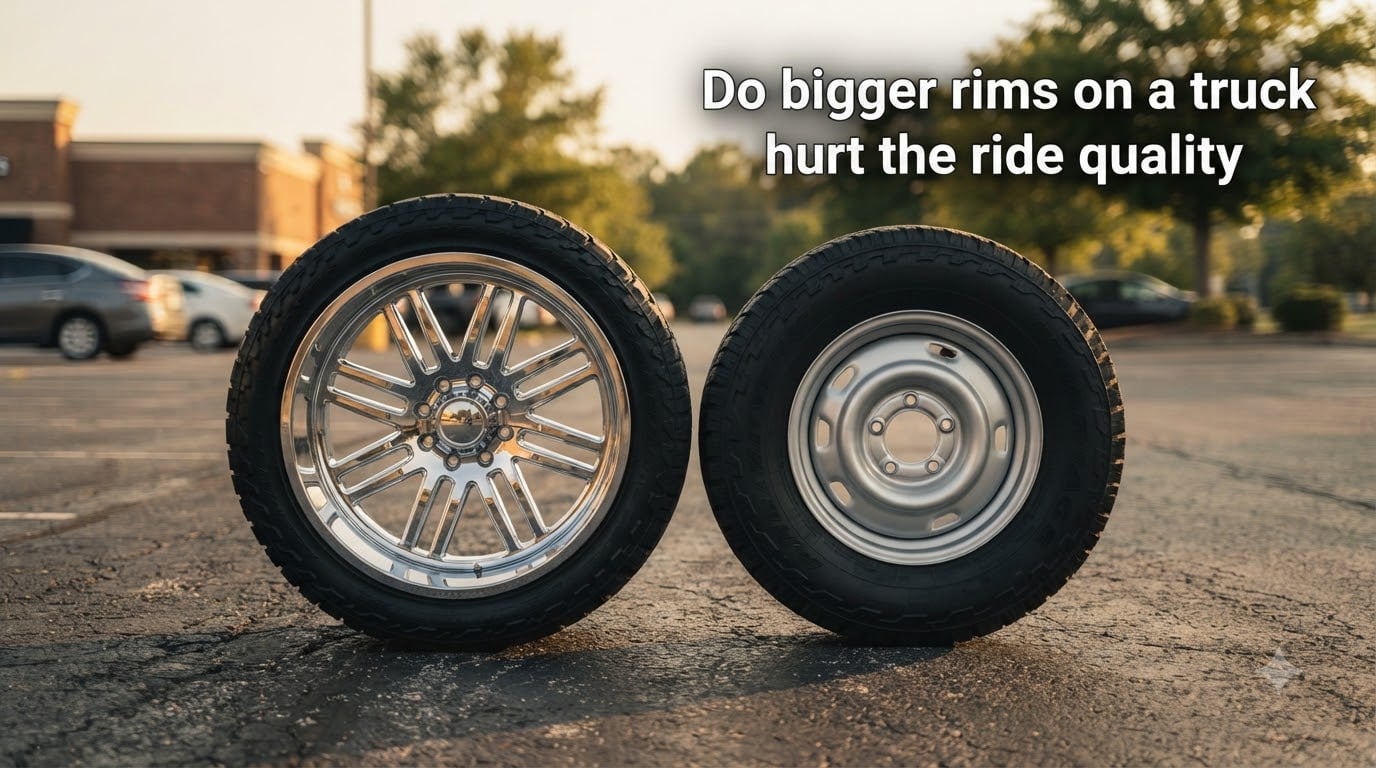
If you’ve been eyeing bigger rims for your truck, you’re probably wondering whether that upgrade will cost you in ride comfort. The short answer is yes — bigger rims on a truck typically do hurt ride quality, and the reason comes down to one word: sidewall. When you increase wheel diameter, the tire sidewall gets shorter, which means less rubber and air between you and every bump, pothole, and expansion joint on the road.
That said, the impact isn’t always dramatic, and there are smart ways to go bigger without destroying how your truck rides. In this guide, I’ll break down exactly why bigger rims affect ride quality, what truck-specific factors matter most, and how to size up your wheels without turning every drive into a punishment.
Table of Contents
Do Bigger Rims on a Truck Hurt the Ride Quality?
Yes, bigger rims usually hurt ride quality on a truck. The main culprit is a shorter tire sidewall. When you move from, say, a 17-inch to a 20-inch wheel, the overall tire diameter stays roughly the same to keep your speedometer accurate — but the sidewall height shrinks. That sidewall is your truck’s first line of cushion against the road, and less of it means more impact harshness, vibration, and cabin noise transmitted through the suspension.
The degree of the impact depends on how much bigger you go, the tire you pair with the wheel, and whether you make other adjustments like tire pressure or suspension upgrades. Going up one inch (plus-one sizing) is often tolerable. Jumping three or more inches will be noticeable to nearly everyone.
Why Bigger Rims Change the Way Your Truck Rides
To understand the ride quality tradeoff, you need to understand plus sizing. When truck owners move to bigger rims, the goal is usually to maintain the same overall tire diameter. A larger wheel means the tire wrapped around it must have a shorter sidewall to keep the math right.
That sidewall isn’t just rubber — it’s a pressurized air chamber that flexes and absorbs energy from the road. A 75-series sidewall (where the sidewall height is 75% of the tire width) has significantly more air volume and flex than a 45-series sidewall. On a truck that already rides stiffer than a car due to its suspension design and weight, losing that cushion amplifies every imperfection.
How Sidewall Height Affects Ride Comfort
The tire sidewall is the single biggest factor in ride comfort when you change wheel sizes. Think of it as a flexible air spring between the wheel and the road. The taller the sidewall, the more it can deform over bumps before the impact reaches the wheel, hub, and eventually the cabin.
A shorter sidewall does two things: it reduces the amount of deflection available to absorb impacts, and it stiffens the tire’s response to road irregularities. On smooth highways, you might barely notice. On potholed city streets, cracked rural roads, or any surface that isn’t perfect pavement, a lower-profile tire transmits those imperfections directly into your seat and steering wheel.
For trucks, this matters more than in cars because trucks carry loads. A loaded bed compresses the suspension further, making the tire sidewall an even more critical component of the total cushion system. Forum discussions across multiple truck communities consistently report that the sidewall, not the wheel diameter itself, is what determines whether the ride feels harsh or forgiving.
Unsprung Weight and Rotational Mass Explained
There’s a second factor that many truck owners overlook when swapping to bigger rims: unsprung weight. This is the weight of everything not supported by the springs — wheels, tires, brake rotors, hubs, and part of the suspension arms. Heavier wheels increase unsprung weight, and that has direct consequences for ride quality.
When a heavier wheel hits a bump, it takes more force to accelerate it upward and more force to stop it. The suspension has to work harder to control wheel movement, which translates to slower response to road surfaces and more vibration transmitted into the frame. Rotational mass — the energy needed to spin the wheel — also increases with heavier rims, affecting acceleration and braking feel.
This is where wheel construction matters. Cast aluminum wheels are heavier than forged aluminum wheels at the same diameter. Forum users on Ram forums and Reddit consistently recommend forged wheels if you’re going bigger, because they can save 3-5 pounds per corner compared to cast alternatives. That weight savings translates directly into better ride quality retention and improved suspension response.
Handling vs Comfort: The Bigger Rim Tradeoff
Not everything about bigger rims is negative. A lower-profile tire with a stiffer sidewall improves cornering grip and steering response. The tire flexes less during hard turns, giving you a more direct connection between the steering wheel and the road. For trucks that see spirited driving or highway on-ramp acceleration, this is a real benefit.
The tradeoff is straightforward: better dry-weather handling comes at the cost of everyday comfort. The stiffer sidewall that helps in corners also transmits more road imperfections in straight-line driving. Wider contact patches from bigger wheels can also increase road noise and make the truck more sensitive to road surface variations, a phenomenon called tramlining where the vehicle follows grooves in the pavement.
Most truck owners, based on forum consensus, find that handling improvements from bigger wheels are secondary to ride comfort after the first few weeks of ownership. The initial excitement of sharper cornering fades, but the daily discomfort from a rough ride never stops being noticeable.
What Truck Owners Need to Know: Towing, Payload, and Off-Road
Trucks are different from cars and SUVs when it comes to bigger rims. A truck’s suspension, load ratings, and intended use cases all play into whether the upgrade makes sense.
Towing is a major consideration. When you hook up a trailer, the rear suspension compresses and the tire sidewall becomes a larger part of the load-bearing system. A shorter sidewall on a bigger rim has less capacity to handle the additional weight and dynamic forces of towing. If you regularly pull heavy loads, keeping adequate sidewall height is important for both ride quality and tire safety.
Off-road use is another area where bigger rims create problems. Lower-profile tires are more vulnerable to rim damage from rocks, ruts, and obstacles. They also have less flex for airing down — a common off-road technique where you reduce tire pressure to increase the contact patch and improve traction on loose surfaces. If your truck sees trail time, maintaining sidewall height should be a priority.
Payload capacity can also be affected. Bigger wheels with lower load ratings per tire may reduce your truck’s official payload capacity. Always verify that your chosen wheel-and-tire combination meets or exceeds the manufacturer’s load rating specifications for your truck model.
How to Size Up Your Truck’s Wheels Without Ruining the Ride
You don’t have to give up on bigger rims entirely. The key is to make smart choices that minimize the ride quality penalty. Here are the strategies that experienced truck owners and tire professionals recommend:
Stick to plus-one sizing. Going from 17-inch to 18-inch or from 18-inch to 19-inch wheels is the sweet spot where most truck owners report acceptable ride quality with a noticeable visual improvement. Jumping two or more sizes (plus-two, plus-three) is where comfort drops off sharply.
Choose the lightest wheel you can afford. Forged aluminum wheels cost more than cast wheels but weigh significantly less. On a truck where unsprung weight already affects ride quality, saving 3-5 pounds per wheel makes a real difference in how the suspension handles bumps.
Don’t cheap out on tires. A premium all-season tire with a well-designed sidewall construction will ride noticeably better than a budget tire of the same size. Tire manufacturers engineer sidewall flex patterns, rubber compounds, and internal structures specifically to manage ride quality at lower aspect ratios.
Other Side Effects: Fuel Economy, Road Noise, and Speedometer Accuracy
Beyond ride quality, bigger rims affect your truck in other ways that are worth knowing about before you commit to the upgrade.
Fuel economy almost always drops. Bigger wheels are heavier, which increases rotational mass and the energy needed to get the truck moving and keep it rolling. Forum users across multiple truck communities report drops of 1-3 MPG after switching to larger, heavier wheels. If you drive a lot of highway miles, that adds up over a year.
Road noise typically increases. Lower-profile tires have less sidewall to dampen sound, and wider contact patches create more tire noise. On a truck that’s already noisier than a sedan due to its body-on-frame construction and larger cabin, this can make long drives more fatiguing.
Speedometer accuracy is affected if the overall tire diameter changes even slightly. A larger overall circumference makes your speedometer read low — you’ll be going faster than the gauge shows. A smaller diameter reads high. Professional tire shops can recalibrate the speedometer in most modern trucks, but it’s an extra step and cost that many owners forget about.
Tire Pressure and Suspension Pairing for Bigger Rims
Two adjustments can help recover some ride comfort after going to bigger wheels: tire pressure management and suspension upgrades.
Tire pressure has a dramatic effect on ride quality. Many trucks ship from the factory with higher-than-necessary tire pressures (sometimes 40-45 PSI) for fuel economy. Dropping pressure by 2-3 PSI within the door-jamb recommended range can noticeably soften the ride without significantly affecting handling or tire wear. Never go below the minimum pressure listed on the tire’s sidewall or the door placard.
For truck owners committed to 20-inch or larger wheels, pairing those rims with an upgraded suspension is the most effective way to preserve comfort. Air suspension systems, available on trucks like the Ram 1500, automatically adjust to road conditions and load, compensating for the stiffer tire. Adjustable coilovers offer similar benefits with more customization. Forum users with air suspension consistently report better ride quality with bigger wheels compared to those running standard coil springs.
Frequently Asked Questions
Do bigger rims affect ride quality?
Yes, bigger rims typically reduce ride quality because they require a shorter tire sidewall. The sidewall acts as a cushion between the wheel and the road, and a shorter sidewall has less air volume and rubber to absorb bumps, potholes, and road imperfections. The effect is proportional to how much larger the new rim is compared to the stock wheel.
What happens if I put bigger rims on my truck?
Your truck will likely have a firmer, harsher ride due to the shorter tire sidewall required for the larger wheel. You may also notice increased road noise, reduced fuel economy, slightly different steering feel, and more vulnerability to pothole damage. The speedometer may read inaccurately if the overall tire diameter changes. Handling on dry pavement typically improves due to the stiffer sidewall.
Do 18 or 20-inch wheels ride better?
Eighteen-inch wheels generally provide a better ride than 20-inch wheels on trucks. The two extra inches of wheel diameter at the 20-inch size means a shorter tire sidewall with less cushion. On most full-size trucks, 18-inch wheels offer a good balance of appearance and comfort, while 20-inch wheels start to noticeably impact ride quality on rough roads.
Can bigger rims ruin my truck’s transmission?
Bigger rims alone do not ruin a transmission, but they can increase strain on the drivetrain. Heavier wheels increase rotational mass, which the transmission and engine must work harder to accelerate. If the overall tire diameter changes, the effective gear ratio also changes, which can affect shift points and transmission behavior. Keeping the overall diameter close to stock minimizes this risk.
What is the best truck suspension for a smooth ride with bigger wheels?
Air suspension systems provide the smoothest ride with bigger wheels because they automatically adjust firmness based on road conditions and load. The Ram 1500’s air suspension is frequently cited by owners as the best pairing for 20-inch and larger wheels. Adjustable coilovers are a strong aftermarket alternative that lets you tune compression and rebound damping to compensate for the stiffer tires.
How much does fuel economy drop with bigger rims?
Most truck owners report a fuel economy drop of 1 to 3 miles per gallon after switching to larger, heavier wheels. The exact amount depends on the weight difference between the old and new wheels, driving habits, and tire choice. Forged wheels cause less of a fuel economy penalty than cast wheels because they weigh less at the same diameter.
Are bigger wheels better in snow and winter conditions?
No, bigger wheels are generally worse in snow and winter conditions. The shorter sidewall has less flex for biting into snow and ice, and the stiffer tire provides less grip on slippery surfaces. Winter tire specialists recommend using the smallest wheel diameter that fits over your brake calipers paired with a taller sidewall winter tire for the best cold-weather traction and ride comfort.
Final Thoughts
Do bigger rims on a truck hurt the ride quality? The honest answer is yes, they almost always do. The shorter tire sidewall that comes with a larger wheel is the primary reason — it reduces the cushion between your truck and the road. Heavier wheels add to the problem by increasing unsprung weight and rotational mass, which makes the suspension work harder and transmits more vibration into the cabin.
But that doesn’t mean you have to stick with stock wheels forever. By keeping your upgrade to plus-one sizing, choosing lightweight forged wheels, and pairing bigger rims with quality tires and proper tire pressure, you can enjoy the look you want without completely sacrificing comfort. For truck owners who tow, haul, or drive off-road, maintaining adequate sidewall height should be the top priority. If you do decide to go big, an air suspension or adjustable coilover system is the best investment you can make to keep your truck riding the way it should.