
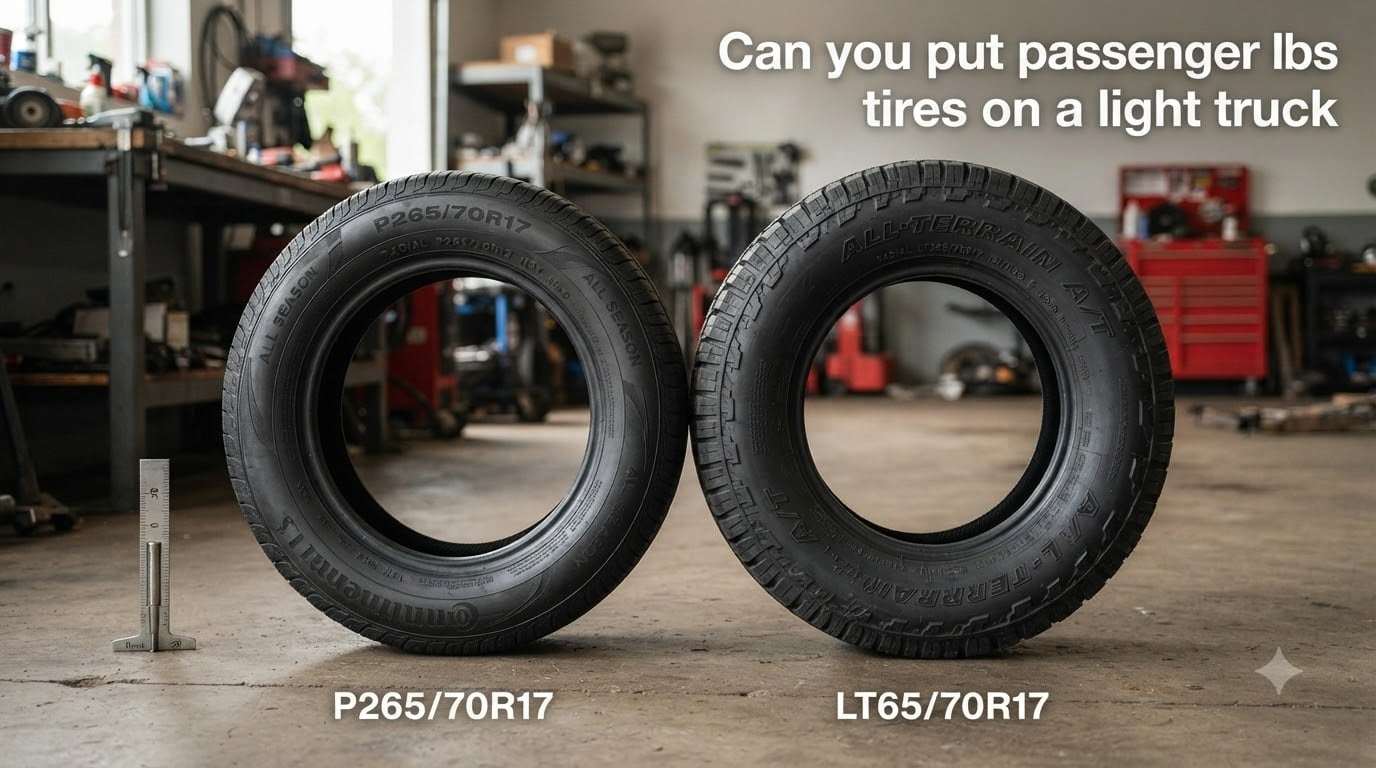
Yes, you can put passenger (P-metric) tires on a light truck, but only if your truck was originally equipped with P-metric tires, you stay within the load index listed on the door sticker, and you never tow or haul heavy loads. If your truck came from the factory with LT-metric tires, swapping to passenger tires is unsafe and not recommended by any major manufacturer. The right choice depends entirely on how you actually use the truck.
I have been through this exact decision three times with my own trucks (a daily-driver Tacoma and an F-150 used for towing a camper), and the answer is rarely what owners want to hear. In this guide, I will walk you through what P-metric and LT-metric really mean, the construction differences that matter, the scenarios where each type shines, and how to read your door sticker so you make the right call for your specific vehicle.
Table of Contents
Quick Answer: Can You Put Passenger Tires on a Light Truck?
You can put passenger tires on a light truck if the truck was originally equipped with P-metric tires and you stay within the load index and tire size printed on the Tire and Loading Information Label (the door sticker). If your truck rolled off the line with LT-metric tires, you should not downgrade to passenger tires – they cannot safely carry the load the truck was engineered to handle.
The two acronyms refer to two different tire classifications developed by the U.S. Tire and Rim Association. P-metric (the P prefix on your tire size) was designed for sedans, crossovers, minivans, and lighter light-duty trucks. LT-metric (the LT prefix) was engineered specifically for light trucks, vans, and SUVs that tow, haul, or go off-road. The construction underneath the tread is where the real difference lives.
What Are P-Metric and LT-Metric Tires?
P-metric tires and LT-metric tires are two separate tire classification systems that share the same wheel size but are built for different jobs. You can tell them apart at a glance by looking at the first letter stamped on the sidewall.
A P-metric tire starts with the letter P, like P265/70R17. P stands for passenger vehicle. These tires were originally designed for sedans, coupes, crossovers, and lighter light-duty applications. A P-metric tire uses a single load index number that assumes the tire is on a passenger car. When that same tire is fitted to a light truck, industry standards require a 1.10 service-factor reduction in the published load capacity – the tire cannot safely carry as much weight as the sidewall number alone implies.
An LT-metric tire starts with the letters LT, like LT265/70R17. LT stands for light truck. These tires carry two load indexes (one for single-axle use, one for dual-axle use) and are built with stiffer sidewalls, deeper tread, and higher ply counts. LT-metric tires are required when a truck’s Gross Vehicle Weight Rating (GVWR) exceeds the load capacity P-metric tires can safely carry at recommended inflation pressure.
Construction Differences: Ply, Sidewall, and Load Range
The biggest practical differences between P-metric and LT-metric tires are buried inside the tire carcass, where you cannot see them from the outside. Three factors drive the performance gap.
Ply Count and Load Range
A P-metric tire is typically built with 4 plies (sometimes called 4-ply rated) and falls under Load Range SL (Standard Load) or XL (Extra Load). An LT-metric tire is usually built with 6, 8, or 10 plies and falls under Load Range C, D, or E. More plies mean a stiffer, stronger tire that resists impact damage and supports more weight.
Sidewall Stiffness
LT tires have noticeably stiffer sidewalls than P tires. That extra rigidity helps the tire support heavy loads, resist punctures when aired down off-road, and stay planted during towing. The trade-off is a harsher ride and more road noise – a complaint I hear constantly on r/f150 and r/ToyotaTacoma threads.
Inflation Pressure Behavior
P-metric tires run on lower inflation pressures (usually 30 to 35 PSI for passenger applications) and have a single load curve. LT-metric tires are designed to operate at higher pressures (often 50 to 80 PSI for max load) and have a dual load curve – one for normal driving, one for the maximum load rating at maximum pressure. This is exactly why switching tire types without adjusting pressure is a common mistake owners make.
P-Metric vs LT-Metric at a Glance
| Feature | P-Metric (Passenger) | LT-Metric (Light Truck) |
|---|---|---|
| Sidewall prefix | P (e.g., P265/70R17) | LT (e.g., LT265/70R17) |
| Typical ply count | 4-ply (Load Range SL or XL) | 6, 8, or 10-ply (Load Range C, D, E) |
| Sidewall stiffness | Compliant, smoother ride | Stiff, harsher ride |
| Load index | Single number (service factor 1.10) | Dual numbers (single/dual axle) |
| Inflation pressure | Lower (30 to 35 PSI typical) | Higher (50 to 80 PSI for max load) |
| Tread depth | Shallow to medium | Deeper, more aggressive |
| Best use case | Daily commute, light loads, paved roads | Towing, hauling, off-road, work |
| Fuel economy | Better (lighter, lower rolling resistance) | Worse (heavier, stiffer) |
| Road noise | Quieter | Louder |
| Puncture resistance | Lower | Higher |
When It Is Safe to Use Passenger Tires on a Light Truck
Passenger tires are a safe choice on a light truck when every condition below is true. I have written these as a checklist so you can confirm each one in 30 seconds.
- Your truck came from the factory with P-metric tires (check the door sticker, not the brochure).
- You drive primarily on paved roads for commuting, errands, and highway trips.
- You rarely tow a trailer, and when you do, the trailer stays under 2,000 lbs loaded.
- You do not haul heavy loads in the bed (no contractors’ equipment, no ATV/dirt bike on a regular basis).
- You do not air down for off-road driving or take the truck on aggressive trails.
- The new P-metric tire matches the size and load index (or exceeds it) listed on the door sticker.
If all six boxes are checked, P-metric tires will give you a quieter ride, better fuel economy, and lower cost than LT tires. Most half-ton commuters – the truck used as a family vehicle that occasionally hauls a Home Depot load – fall into this category.
When You Should Avoid Passenger Tires
There are four situations where passenger tires on a light truck are genuinely unsafe, not just suboptimal. If any of these describes your situation, stay with LT-metric tires.
1. Your Truck Came With LT Tires From the Factory
This is the single biggest reason to keep LT tires. Manufacturers like Ford, Ram, and GM spec LT tires on trucks designed to tow or haul because the GVWR exceeds what P-metric tires can safely carry. Bridgestone, Goodyear, and Continental all explicitly warn that OE LT tires should never be replaced with passenger type tires because they do not have the load capacity the truck was engineered for.
2. You Tow Regularly
If you tow a camper, boat, car trailer, or anything over 2,000 lbs on a regular basis, the heat buildup in P-metric tires under sustained load can lead to catastrophic failure. LT-metric tires are built for sustained high-load operation; P-metric tires are not.
3. You Haul Heavy Loads in the Bed
Topsoil, gravel, paving stones, ATV/UTV loads, contractor equipment – all of these push a half-ton truck into its upper GVWR range. LT tires have the ply count and load index to handle it; P tires do not.
4. You Take the Truck Off-Road or Air Down
This is the most common blowout scenario I see on r/4×4 and r/Tacomaworld. P-metric sidewalls flex too much under aired-down, low-speed off-road conditions and are prone to punctures and pinch damage. LT tires with their stiffer sidewalls and higher ply counts are built for exactly this abuse.
How to Read Your Door Sticker and Match Load Index
The Tire and Loading Information Label – usually on the driver’s side door jamb or inside the door – is the single most important document for this decision. It lists the exact tire size, load index, and inflation pressure your manufacturer tested and approved for the truck as it left the factory. If your replacement tire does not match these specs, you are using the wrong tire for the vehicle.
Reading the Tire Size
On the door sticker, you will see something like P265/70R17 or LT265/70R17. The first letter (or letters) tells you the classification. P means passenger, LT means light truck. The numbers that follow are width in millimeters, sidewall aspect ratio, radial construction, and wheel diameter in inches. If the sticker says LT and you put P tires on, you have downgraded the truck’s load capacity.
Reading the Load Index
The load index is a two- or three-digit number that translates to a maximum weight capacity per tire. P-metric stickers will show one number (like 115 = 2,679 lbs per tire). LT-metric stickers will show two numbers (like 121/118 = 3,195 lbs single, 2,910 lbs dual). Match or exceed the door-sticker number – never go below it.
Adjusting Inflation Pressure
If you do switch between tire types, you must adjust your cold inflation pressure to match the new tire’s load curve. Running LT pressures in P tires makes the center wear fast and hurts ride quality. Running P pressures in LT tires overheats the sidewalls and risks blowout under load. This is one of the most-asked questions on r/MechanicAdvice, and the universal answer is: follow the tire maker’s inflation table for your specific tire size and load.
Real-World Scenarios: Daily Commuter vs Weekend Hauler
The easiest way to decide is to match your real-world use to the right tire type. Here are the four scenarios I see most often, with the recommendation that fits each one.
Daily Commuter Tacoma or Colorado
If your mid-size truck is your daily driver, sees mostly pavement, and never tows more than a small utility trailer, the factory P-metric tires are the right call. You will get better fuel economy, a quieter cabin, and a smoother ride. Step up to LT only if you start towing a camper or hauling regularly.
Half-Ton Weekend Hauler (F-150, Ram 1500, Silverado 1500)
If your half-ton truck occasionally pulls a camper, hauls a side-by-side, or carries a load of mulch on Saturday mornings, LT-metric tires are the right primary tire. You will trade a bit of ride comfort for the load capacity you actually need. Owners on r/f150 consistently report that going from P to LT costs about 1 to 2 MPG and adds noticeable noise – but those are the costs of doing real truck work.
Work Truck (Contractor, Landscaper, Ranch Use)
If the truck earns its living with heavy loads, tool trailers, livestock, or daily gravel-road driving, LT tires are not optional. P-metric tires will fail prematurely under sustained heavy loads, and the cost of a single roadside failure far exceeds the tire’s price difference. This is the scenario where OE LT tires were spec’d for a reason.
Off-Road or Overlanding Build
If you air down for trail driving or carry the truck into rocky, rutted terrain, LT-metric is mandatory. P-metric sidewalls cannot handle repeated aired-down cycles without cracking or pinching. Many overlanders also upgrade to higher load ranges (D or E) for added puncture resistance, even if the factory called for C.
Frequently Asked Questions
What’s the difference between light truck tires and regular tires?
Light truck (LT-metric) tires are built with more plies, stiffer sidewalls, and higher load ranges than regular (P-metric) tires. They are designed to handle the higher GVWR, towing, hauling, and off-road use that light trucks are built for. P-metric tires prioritize ride comfort, quieter operation, and fuel economy for lighter vehicles.
Does it matter if a tire is a passenger tire?
Yes. Using a passenger tire where the manufacturer spec calls for LT can leave you with insufficient load capacity, higher heat buildup under towing, and weaker sidewalls off-road. The classification on the sidewall is matched to the engineering of the vehicle, not just the wheel size.
Can I put non-LT tires on my truck?
You can put P-metric tires on a light truck if the truck originally came with P-metric tires and you match the door-sticker load index and size. You should not put P-metric tires on a truck that came from the factory with LT-metric tires – the load capacity will be below what the truck was engineered to carry.
Are LT tires a rougher ride?
Yes, LT tires generally ride rougher and produce more road noise than P-metric tires. The stiffer sidewalls and higher ply counts that make LT tires strong under load also transmit more road feel and vibration into the cabin. Owners on r/f150 and r/ToyotaTacoma consistently report this trade-off.
What is the 3 tire rule?
The 3-tire rule is a tire industry guideline that says you should never mix more than one tire type, size, or brand on the same axle. In practice, that means all four tires on a light truck should be the same classification (all P-metric or all LT-metric), the same size, and ideally the same brand and tread pattern for predictable handling.
Conclusion
So, can you put passenger tires on a light truck? Yes, when the truck was built for them, when you match the door-sticker size and load index, and when your real-world use stays within paved-road commuting and light hauling. If your truck came with LT tires, tows regularly, hauls heavy loads, or goes off-road, stay with LT-metric tires – they exist for exactly those jobs.
Before you buy, pull up your door sticker, confirm your original tire classification, and match the new tire’s load index and size. When in doubt, follow the manufacturer’s recommendation – it is the single most reliable guide for keeping your truck safe and your tires lasting.