
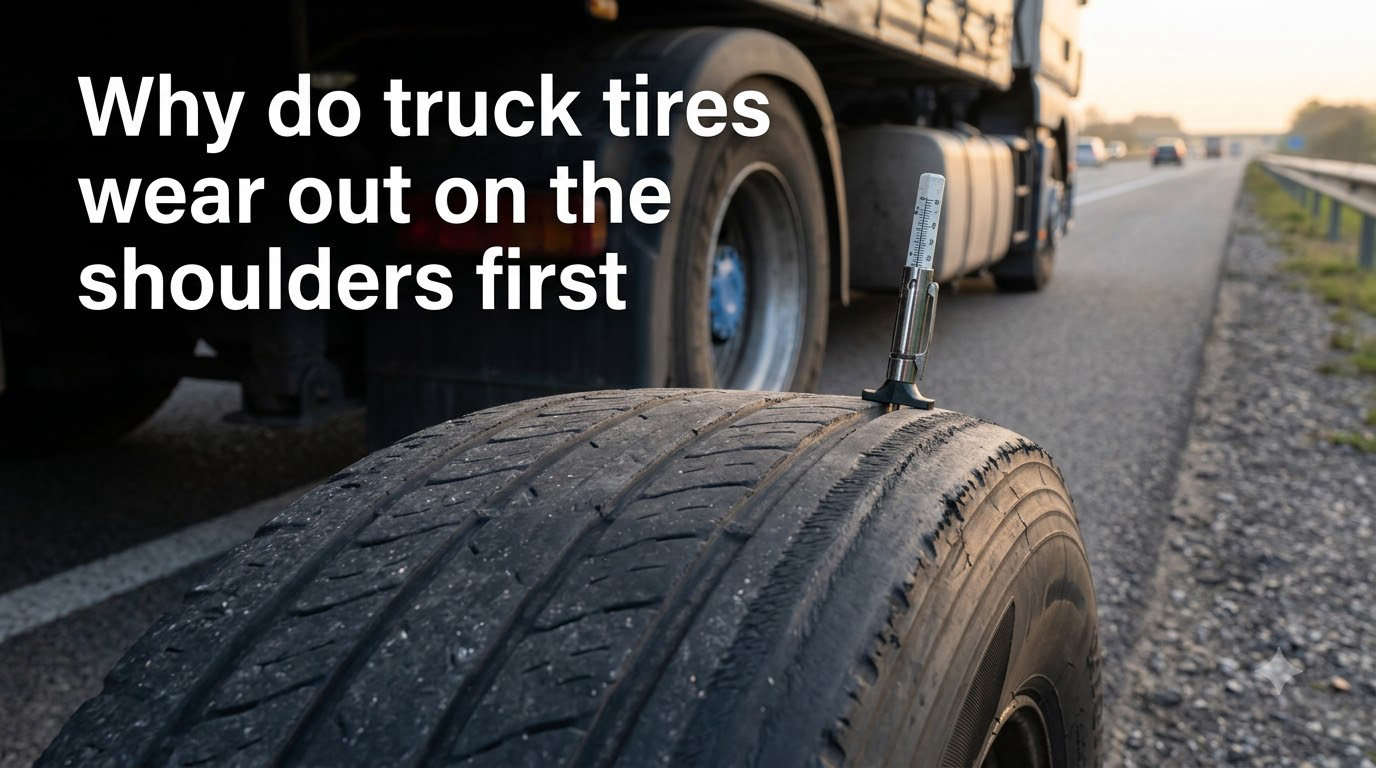
Truck tires wear on the shoulders first because the tread contact patch shifts away from center, concentrating load on the outer or inner ribs. The most common triggers are underinflation, excessive camber angle, and hard cornering forces. When any of these conditions push more weight onto the shoulder zone, those ribs scrub against the pavement harder and wear down before the center tread does.
If you have noticed the outer or inner edges of your truck tires eroding faster than the middle, you are not alone. Shoulder wear is the single most common irregular tread pattern reported by fleet operators, diesel technicians, and pickup truck owners alike. Understanding why it happens puts you in a better position to catch it early, fix the root cause, and protect the remaining tread life on an expensive set of tires.
Table of Contents
What Is a Tire Shoulder?
The shoulder is the outermost rib on each side of the tread, sitting where the flat tread face transitions into the sidewall. On a typical truck tire, three or four tread ribs span the width of the contact patch. The two ribs closest to the sidewall edges are the shoulder ribs.
The contact patch is the small rectangular area where rubber meets road at any given moment. On a properly inflated, correctly aligned tire, the load distributes evenly across all ribs. When something pushes that load off-center, the shoulder ribs end up bearing more weight, generating more friction, and wearing faster than the inner ribs.
Main Causes of Truck Tire Shoulder Wear
There are six primary reasons truck tires develop shoulder wear. Some are mechanical, some are maintenance-related, and a few come down to driving habits. Here is each one explained.
1. Underinflation and the Contact-Patch Shift
Underinflation is the single biggest contributor to shoulder wear on truck tires. When air pressure drops below the manufacturer’s specification, the tire’s sidewalls flex more than they should. That extra flex allows the contact patch to bulge outward, forcing the tread to cup and the outer shoulder ribs to carry a disproportionate share of the load.
The physics are straightforward: an underinflated tire flattens out. Its contact patch gets longer and wider, but the shoulders absorb most of that added contact area. More rubber on the shoulders means more friction, more heat, and accelerated wear on both edges while the center tread remains relatively untouched.
On commercial trucks running dual tires on the drive or trailer axles, a single underinflated tire in the pair creates an even worse problem. The properly inflated partner carries extra load, and the underinflated tire drags and scuffs at a different rate, which compounds the shoulder wear pattern.
2. Excessive Camber
Camber is the inward or outward tilt of the wheel when viewed from the front. Positive camber tilts the top of the wheel outward; negative camber tilts it inward. Either way, a camber angle outside the manufacturer’s specification concentrates load on one shoulder of the tire.
With positive camber, the outer shoulder bears the weight. With negative camber, the inner shoulder takes the hit. In both cases, the loaded shoulder scrubs against the road surface with more force than the rest of the tread, wearing it down faster and creating a distinct one-sided wear pattern.
For most trucks, the factory camber specification falls between 0.2 and 0.8 degrees of positive camber. Anything beyond one degree of deviation begins producing visible uneven wear within a few thousand miles. Worn ball joints, bent spindles, or damaged control arms are the usual culprits when camber drifts out of spec.
3. Excessive Toe and Axle Misalignment
Toe describes whether the front of the tires point slightly inward (toe-in) or outward (toe-out) when viewed from above. Even a fraction of a degree off specification forces the tires to fight each other as they roll, scrubbing the tread laterally with every revolution. That side load concentrates on the shoulder ribs.
Axle misalignment is a related but distinct problem. If the steer axle, drive axle, or trailer axle are not parallel to each other, one or more tires run at a slight angle to the direction of travel. Fleet technicians call this side scrubbing, and it produces rapid, asymmetric shoulder wear that worsens the longer the truck keeps rolling.
Diesel technicians on Reddit report that one-sided shoulder wear combined with a noticeable pulling sensation almost always points to alignment being out of specification. A full axle-parallelism check, not just a front-end alignment, is what catches this type of wear.
4. Heavy Cornering Loads and Side-Scrubbing
Every time a truck takes a turn, lateral forces shift load to the outside shoulder of each tire. On a lightly loaded pickup taking gentle highway curves, this effect is minimal. On a fully loaded commercial truck navigating tight urban turns, the outside shoulder can absorb a substantial percentage of the vehicle’s total weight for several seconds at a time.
Fleet Equipment Magazine has documented side scrubbing as a major contributor to commercial tire shoulder wear. When an axle runs slightly misaligned, the tire’s contact patch is angled relative to the direction of travel. The wide side of that angle experiences concentrated scrubbing, which erodes the shoulder rib while the center tread remains largely unaffected.
Drivers who regularly run tight routes with frequent turns, or who routinely carry heavy loads, will see shoulder wear develop sooner than long-haul highway operators. The combination of lateral force and sustained weight makes the shoulder the weakest point on the tread.
5. Worn Suspension Components
Shocks, struts, wheel bearings, and bushings all play a role in keeping the tire’s contact patch flat and centered. When any of these components wear out, the tire wobbles, bounces, or tilts slightly under load, which shifts stress onto the shoulder ribs.
Faulty shocks allow the tire to bounce, creating a scalloping or cupping pattern that often starts at the shoulders. Loose wheel bearings introduce lateral play that mimics camber wear. Worn bushings in the control arms or suspension links let the wheel move under braking or cornering, loading the shoulders unevenly.
A common forum scenario is shoulder wear that keeps coming back after repeated alignments. When that happens, the alignment shop is adjusting angles to compensate for worn components rather than addressing the root problem. Replacing the worn parts before aligning is the only lasting fix.
6. Mismatched Dual Tires or Incorrect Dual Inflation
On drive and trailer axles with dual tire setups, the two tires in each pair must be matched in size, inflation pressure, and tread depth. A mismatch means one tire carries more load or rolls at a different circumference, forcing both to scrub against the pavement.
The bigger tire in the pair carries more weight and develops shoulder wear from overload. The smaller tire spins slightly faster to keep pace and wears its shoulders from the constant differential. Technicians frequently find that a dual-tire inflation check reveals 10 to 15 psi differences between partners, which is more than enough to trigger premature shoulder wear within a few months.
One Shoulder vs Both Shoulders: How to Tell the Difference
Whether the wear shows up on one shoulder or both shoulders of the same tire points to different root causes. This is one of the most useful diagnostic distinctions a truck owner can make.
Wear on both shoulders with a clean center tread almost always means underinflation. The contact patch bulges outward in both directions when pressure is too low, loading both shoulder ribs equally while the center tread lifts slightly off the road.
Wear on one shoulder only points to a directional problem: camber out of specification, toe misalignment, axle misalignment, or a worn suspension component on that corner. The tire is tilted or angled in a way that loads one side more than the other.
There is an important exception: on trucks that run predominantly curved roads in one direction, or that make frequent turns on the same side, mild one-shoulder wear can be normal. But if the wear is dramatic or develops within a few thousand miles, it almost certainly has a mechanical cause that needs addressing.
How to Distinguish Shoulder Wear from Other Tire Wear Patterns
Shoulder wear is just one of several irregular tread patterns truck owners encounter. Knowing how to tell it apart from similar-looking patterns helps you and your technician zero in on the right fix faster.
Shoulder wear looks like the outer or inner ribs are noticeably lower than the center ribs. The wear is smooth and even across the affected shoulder, without scalloping or feathering. The primary causes are underinflation, camber, toe, and axle misalignment.
Feathering feels like saw-tooth edges when you run your hand across the tread blocks. Each block has a sharp edge on one side and a rounded edge on the other. Toe misalignment is the most common cause, and it affects the full tread width rather than just the shoulders.
Cupping or scalloping creates a series of smooth, rounded dips across the tread, often starting at the shoulder and spreading inward. Worn shocks, struts, or unbalanced wheels are the usual suspects. The pattern looks random compared to the uniform flatness of simple shoulder wear.
Heel and toe wear makes the tread blocks wear unevenly in the direction of rotation. One edge of each block wears lower than the other, creating a pattern you can feel by running your hand forward and backward along the tread. It is most common on drive axle tires and is related to the tire’s forward motion under load.
Diagonal wear produces a series of flat, worn spots arranged at an angle across the tread. It is caused by a combination of misalignment, insufficient tire rotation, and suspension issues. The pattern often appears on free-rolling axle positions.
How to Prevent and Fix Shoulder Wear on Truck Tires
Preventing shoulder wear comes down to a consistent maintenance routine. Most of the causes are avoidable or catchable early if you follow these steps.
Check inflation pressure weekly. Use a calibrated gauge, not the built-in gauge on a gas station air hose. For commercial trucks, inflate to the manufacturer’s specification for the load rating, and check all dual tires individually. A 10 psi difference between dual partners is enough to start shoulder wear.
Get a full alignment every 25,000 to 30,000 miles, or anytime you hit a major pothole, curb, or notice pulling. A front-end-only alignment misses drive and trailer axle problems, so request a full three-axle alignment on commercial trucks.
Inspect suspension components at every oil change. Look for leaking shocks, torn bushings, loose wheel bearings, and worn ball joints. Catching a worn shock before it destroys a set of steer tires saves hundreds or thousands of dollars depending on the tire size.
Rotate tires according to the manufacturer’s schedule. Front-to-rear rotation evens out the wear differences between steer and drive positions. On commercial trucks, rotating steer tires to the drive position and vice versa extends overall tread life significantly.
Match dual tires precisely. Both tires in a pair should be the same brand, size, and tread depth, and should be inflated to identical pressure. Mismatched duals are a hidden cause of shoulder wear that many truck owners overlook.
Replace worn components before aligning. If the alignment shop finds camber or toe out of spec, ask them to check the suspension first. Aligning over worn ball joints or bushings is a temporary fix at best and will not hold the angles steady.
Shoulder Wear Differences: Steer, Drive, and Trailer Tires
The position of the tire on the truck affects how shoulder wear develops and what it means.
Steer tires are the most sensitive to alignment and camber problems because they handle the truck’s direction changes. Shoulder wear on steer tires is the pattern fleet drivers report most frequently, and it is the most likely to cause a pulling sensation or vibration in the steering wheel.
Drive tires handle the engine’s torque and tend to develop shoulder wear from a combination of heavy loads and inflation issues. The dual-tire setup on most drive axles adds the mismatch factor. Drive-position shoulder wear often appears as both-shoulder wear from underinflation or one-shoulder wear from axle misalignment.
Trailer tires are free-rolling and do not steer or transmit torque, so they are less affected by camber and toe. Shoulder wear on trailer tires most often comes from overloading, underinflation, or worn trailer suspension components like bushings and air bags. Trailer tires also see the highest cornering loads during tight maneuvers, which can accelerate outer-shoulder wear on the turn side.
Fleet owners note that a small amount of shoulder step wear on slow-wearing radial tires can be normal and does not necessarily indicate a problem. The issue becomes a concern when the wear is rapid, asymmetric, or progresses to expose the belt package beneath the tread rubber.
Frequently Asked Questions
Why do my tires wear on the shoulders?
Tires wear on the shoulders when the contact patch shifts load to the outer or inner ribs. The most common causes are underinflation, excessive camber angle, toe misalignment, and heavy cornering forces that concentrate weight on the shoulder zone.
What are the three main causes of abnormal tire wear?
The three main causes are improper inflation pressure, out-of-spec wheel alignment (including camber, toe, and caster), and worn suspension components such as shocks, wheel bearings, and bushings. Each of these can produce distinct irregular tread patterns including shoulder wear, feathering, and cupping.
Can I drive with a bad camber?
Driving with bad camber is possible but not advisable. Excessive camber causes rapid one-shoulder tire wear, reduces traction, and can lead to premature tire failure. The longer you drive on it, the faster the affected shoulder wears down, and the more expensive the eventual tire replacement becomes.
Is 2.5 degrees of camber a lot?
For most trucks, 2.5 degrees of camber is significantly outside the normal range. Factory specifications typically fall between 0.2 and 0.8 degrees of positive camber. A reading of 2.5 degrees will produce visible uneven shoulder wear within a few thousand miles and should be corrected as soon as possible.
What causes premature wear on one shoulder of a tire?
One-shoulder wear usually comes from a directional mechanical issue: camber out of specification, toe misalignment, axle misalignment, or a worn suspension component on that corner of the vehicle. Unlike both-shoulder wear from underinflation, one-shoulder wear means the tire is tilted or angled in a way that loads one side more than the other.
How often should I check my truck tires for shoulder wear?
Inspect your tires visually every time you fuel up, and measure tread depth with a gauge at least once a month. Check inflation pressure weekly with a calibrated gauge. Catching shoulder wear early gives you time to correct the underlying cause before the tires are damaged beyond the point of saving.
Conclusion
Truck tires wear out on the shoulders first because that is where off-center load concentrates. Whether the culprit is low pressure, misaligned angles, worn suspension parts, or heavy cornering, the shoulder ribs end up bearing more weight and friction than the center tread. Weekly pressure checks, full-axle alignments every 25,000 to 30,000 miles, and staying alert to early signs of uneven wear are the best defenses against premature shoulder damage on your truck tires.