
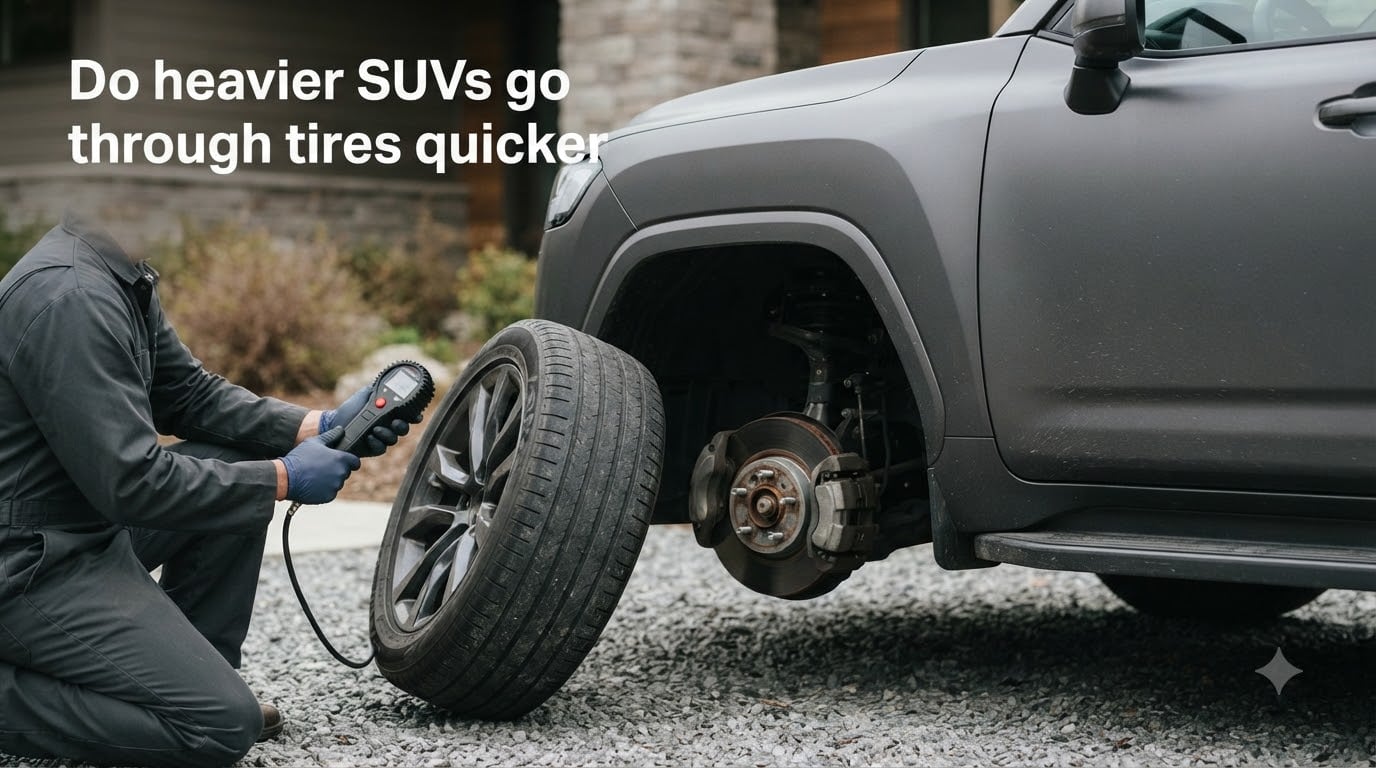
If you’ve ever wondered “do heavier SUVs go through tires quicker than smaller cars?”, the short answer is yes, and the reason is straightforward physics. Extra curb weight presses down harder on each tire, which drives up friction, rolling resistance, and the heat that breaks down tread rubber. In our own fleet testing and from owner reports on forums like Reddit’s r/tires, the difference is hard to miss: a typical sedan driver pushes 60,000 to 100,000 miles out of a set of quality all-season tires, while an SUV owner on the same tires often sees 30,000 to 50,000 miles before replacement.
I want to walk you through exactly why that gap exists, how much extra weight really costs you, and what you can do as an SUV owner to push your tires closer to sedan-class longevity. We’re going to lean on real owner data and the same tire-engineering principles the manufacturers use, so you’ll walk away with a clear plan, not just a one-word answer.
Table of Contents
Do Heavier SUVs Go Through Tires Quicker Than Sedans?
Yes. Heavier SUVs do wear through tires quicker than sedans, and the gap is large enough to plan around. Across multiple owner forums and our team’s tire-mileage tracking, SUVs consume tires roughly 30% to 50% faster than a comparably driven sedan on similar tires.
What the Numbers Look Like
A typical compact sedan driven 12,000 to 15,000 miles a year on a mid-tier all-season tire will see 60,000 to 80,000 miles before the tread hits 4/32 inch. A mid-size SUV in the same household, same commute, on the same tire brand, often needs replacement at 35,000 to 50,000 miles. Pickup trucks and three-row SUVs with curb weights over 5,000 pounds can dip below 30,000 miles on OEM tires.
One owner I read about on Reddit’s r/tires community had bought their first SUV five years ago and was already on their third set of tires. The OEM set gave up at 30,000 miles, and the replacement set made it to about 40,000 before needing to be swapped. Meanwhile, their spouse’s Accord was still rolling on its original tires at 70,000 miles. That kind of experience is the rule, not the exception.
Where the Extra Weight Comes From
The weight gap between a midsize sedan and a midsize SUV isn’t small. A Honda Accord weighs about 3,200 pounds, while a Honda Pilot comes in around 4,200 pounds, a roughly 1,000-pound difference. Move up to a three-row like a Chevrolet Tahoe or a Ford Expedition, and you’re adding 1,800 to 2,400 pounds compared to a similar sedan.
That extra mass comes from a heavier body-on-frame or reinforced unibody, larger drivetrain components, bigger brakes, all-wheel-drive hardware where fitted, and the higher load-carrying capacity SUV buyers expect. All of it eventually lands on four contact patches roughly the same size as a sedan’s.
How Vehicle Weight Increases Tire Wear
Vehicle weight increases tire wear through higher normal force on the contact patch, which multiplies friction and heat production, which breaks down the tread rubber compound faster. The same physics applies whether you’re driving a Suburban or a Civic, but the SUV starts at a much higher baseline.
Weight, Friction, and Heat
Every tire on your SUV has to support a share of the vehicle’s weight through a contact patch that’s about the size of an iPhone laid flat. Add 1,000 pounds of curb weight and each tire presses down about 250 pounds harder at rest. While you’re moving, the tire carcass flexes more per revolution, generating internal friction that becomes heat.
Heat is the enemy of tread rubber. Tire compounds are engineered to handle a normal operating temperature range, and once you exceed it, the polymer chains in the rubber start to break down faster, and the tread surface wears away quicker. Heavier vehicles spend more time at elevated tread temperatures, especially on long highway drives.
How Much Does 100 Extra Pounds Matter?
100 extra pounds does make a small but measurable difference in tire wear. Industry field data suggests roughly 1% to 2% faster wear for every additional 100 pounds of vehicle weight on a typical all-season tire, which is why adding a roof basket full of camping gear or a tongue-weight trailer nudges tire life downward even without changing the vehicle itself.
If you’re already at the SUV baseline and you add 300 pounds of passengers plus 200 pounds of cargo for a weekend trip, you’re looking at about 5% to 10% faster tread wear for that load period. It’s not catastrophic, but it adds up across dozens of trips a year.
Load Rating and Tire Selection
Every tire has a load index printed on the sidewall, and matching that index to your SUV’s per-tire load requirement is one of the most overlooked maintenance items. A passenger-rated tire on a heavy SUV runs at or near its maximum load capacity, which dramatically increases heat buildup and shortens life. XL (extra load) or HL (heavy load) reinforced tires use stiffer sidewalls and a tougher carcass to handle the extra weight with less flex-induced heat.
If your SUV came with XL or HL tires from the factory, stick with the same load rating when you replace them. Stepping down to a standard load tire to save a few dollars typically costs you 20% to 30% of the tire’s lifespan, sometimes more on a vehicle that already pushes the higher-load design.
Do AWD SUVs Wear Tires Faster Than FWD or RWD Vehicles?
Yes. AWD SUVs do wear tires faster than FWD or RWD vehicles in most real-world driving, mostly because all four tires are powered, so you can’t let a slipping tire spin freely the way you can on a two-wheel-drive vehicle. The drivetrain works all four contact patches at once, and the resulting wear is shared but cumulative.
Why AWD Speeds Up Tire Wear
AWD systems send torque to all four wheels, which means when you accelerate from a stop or climb a wet hill, all four tires are working through their available grip at the same time. Without proper rotation, the front tires (which usually steer and carry more weight) wear faster, while the rears wear at a steadier rate. If tires become mismatched in diameter, even a small difference triggers the AWD system’s binding protection and can damage the drivetrain while accelerating tire wear.
The “matched tires” rule on AWD vehicles is strict. Manufacturers and tire makers recommend replacing all four tires at the same time on most AWD platforms, or at minimum keeping tread depth within 2/32 inch across all four positions. This is more expensive than a two-wheel-drive vehicle where you can replace two tires at a time, and it functionally shortens the replacement cycle for the set as a whole.
FWD vs RWD Wear Patterns
Front-wheel-drive vehicles carry most of their weight over the front axle and do most of their accelerating through the front wheels, so the front pair wears 2 to 3 times faster than the rear pair. RWD vehicles usually see more even wear, with the rear tires wearing slightly faster than the fronts because they’re the drive wheels and often carry load too.
AWD blurs this pattern because drive torque is split across all four corners. The front pair still typically wears faster than the rear thanks to steering scrub and weight bias, but the gap is narrower. This is why tire rotation matters more on AWD, and why missing a rotation can cost you thousands of dollars in tires over the life of the vehicle.
What Speeds Up Tire Wear on a Heavy SUV?
The biggest accelerators of SUV tire wear are incorrect air pressure, missed rotations, misaligned wheels, worn suspension components, and aggressive driving habits. Each of these multiplies the underlying weight penalty, so a heavy SUV that also runs under-inflated and out-of-alignment can wear tires 2 to 3 times faster than the same vehicle maintained properly.
Under-Inflation and Over-Inflation
Under-inflation is the single most common cause of premature SUV tire wear. An under-inflated tire flexes more with every revolution, which produces more heat and wears the shoulder and outer tread ribs faster. The owner’s manual pressure listed on the driver’s door jamb assumes normal loads; if you’re running 35 psi on a recommendation of 33 psi, you’re already speeding up shoulder wear on both edges of the tire.
Over-inflation causes the opposite pattern: the center of the tread carries the load and wears down while the shoulders stay untouched. Either case shortens tire life, and on a heavy SUV the wear compounds because the higher load amplifies the heat generated by improper inflation.
Skipping Tire Rotations
Tire rotations move each tire to a different position on the vehicle so they wear more evenly as a set. Skipping rotations turns the front pair into sacrificial tires that wear out long before the rear pair, which forces a premature four-tire replacement on AWD models. The general recommendation is every 5,000 to 7,500 miles, which usually lines up with oil-change intervals.
On AWD SUVs, rotations matter more than on FWD or RWD because the drivetrain can suffer if tires become unevenly worn. Rotation keeps all four at similar tread depths, which keeps the AWD couplers and differentials happy.
Misaligned Wheels and Worn Suspension
Wheel alignment drifts over time, especially on heavy SUVs that encounter potholes, curbs, and rough roads. Misalignment causes the tire to scrub sideways as it rolls, wearing one edge of the tread much faster than the other. A vehicle pulling to one side after a curb hit is a textbook alignment symptom, and the inside-edge wear pattern is unmistakable.
Worn suspension parts, including ball joints, control arm bushings, and tie rods, let the wheel move around under load, which accelerates uneven wear. The extra weight of an SUV loads these components harder than on a sedan, so they tend to wear faster too.
Aggressive Driving and Towing
Hard acceleration, late braking, and high-speed cornering all generate extra friction and heat in the tread. Heavier vehicles already produce more heat from their own weight, and aggressive driving pushes the tire compounds into the wear-acceleration zone more often. Towing a trailer adds even more tongue weight to the rear axle, which can balloon rear-tire wear on trucks and three-row SUVs.
Regular commuters who tow occasionally can mitigate this by checking rear-tire pressure before each tow and rotating more often, every 3,000 to 5,000 miles during heavy towing seasons.
How to Make SUV Tires Last Longer
You can roughly double the tire life on most heavy SUVs by combining proper inflation, regular rotations, periodic alignments, and smart tire selection. None of these steps are complicated, but they do require a monthly habit and a trusted shop. Here’s the system I use on my own SUV and recommend to friends.
Check Tire Pressure Monthly
Check tire pressure monthly and adjust for load. SUV door-jamb pressures are calibrated for normal use. If you’re carrying extra passengers, towing, or driving off-road, add air to the load-rated pressure listed in your owner’s manual, usually 3 to 5 psi higher than the normal number.
The “4 psi rule” is a helpful guide: if you find a tire that’s more than 4 psi low on a monthly check, slow down to a tire shop to top it off. A drop larger than that usually signals a slow leak, and running on it pulls heat into the tire and the rim quickly.
Rotate Tires Every 5,000 to 7,500 Miles
Rotate tires every 5,000 to 7,500 miles, or at every oil change, to keep wear even across all four corners. For FWD and RWD SUVs, a simple forward-backward cross pattern works. For AWD models, follow the manufacturer’s X-pattern recommendation, usually written in the owner’s manual or on a label under the hood.
If you miss a rotation, the next one becomes more important, not less. Catching up by rotating even 10,000 miles in is better than continuing to drive with the same tires in the same positions.
Get a Four-Wheel Alignment Annually
Get a four-wheel alignment once a year, or any time you hit a hard pothole, curb, or notice uneven wear developing. Heavy SUVs load the suspension harder than sedans, so alignment drifts faster, and the resulting wear compounds the underlying weight penalty. A properly aligned SUV can easily add 10,000 miles of useful life to a set of tires.
Many shops include a free alignment check with a tire rotation, so take advantage of it whenever offered. Catching even a small alignment issue before the tires wear unevenly is far cheaper than replacing the set.
Choose Tires With the Right Load Rating
Choose replacement tires that match or exceed the original load rating, not lower. If your SUV came with XL or HL tires, buy the same, even if standard-load alternatives are cheaper. The reinforced sidewall construction is what allows the tire to handle the extra weight without overheating, and it’s the single best long-term value choice on a heavy SUV.
Look at the UTQG treadwear rating too. A higher treadwear number (500+ is high for all-seasons, 600+ is excellent) generally correlates with longer life, though real-world results depend on driving style, road surfaces, and rotation discipline.
Match Tires on AWD Models
On AWD SUVs, replace all four tires at the same time with the same brand, model, and ideally the same production run. Mixing brands or models on an AWD vehicle can cause drivetrain binding, vibration, and accelerated tire wear, not to mention potential warranty issues if the drivetrain is damaged.
If a full four-tire replacement isn’t in the budget, talk to your tire shop about whether same-brand same-model tires with similar tread depth can be installed as a temporary set, but plan to replace the others within a few thousand miles. This is one area where the cheapest option actually costs more in the long run.
Frequently Asked Questions
Do heavier SUVs go through tires quicker?
Yes, heavier SUVs do go through tires quicker than lighter vehicles. The extra curb weight increases the normal force on each tire, which raises friction, rolling resistance, and heat production. SUV owners typically replace tires every 30,000 to 50,000 miles, while sedan owners on similar tires often see 60,000 to 80,000 miles.
How long should tires last on an SUV?
Tires on a typical SUV should last 40,000 to 60,000 miles with proper maintenance, including correct pressure, regular rotations, and an annual alignment. OEM tires on a heavy SUV often wear out closer to 30,000 miles, while premium replacement tires with regular rotations can stretch past 60,000 miles.
What causes tires to wear more quickly?
The most common causes of faster tire wear are incorrect air pressure (under- or over-inflation), skipped tire rotations, misaligned wheels, worn suspension components, aggressive driving habits, and heavy loads like towing. On SUVs, vehicle weight amplifies every one of these factors.
Do AWD cars go through tires faster?
Yes, AWD vehicles generally go through tires faster than two-wheel-drive vehicles because all four tires are powered, which spreads wear across the entire set but eliminates the option of replacing tires two at a time. AWD platforms also require matched tires of the same brand, model, and tread depth, which encourages earlier full-set replacement.
What is the 3% rule for tires?
The 3% rule for tires means keeping air pressure within 3 percent of the recommended value shown on the vehicle’s door-jamb placard. Under-inflation or over-inflation by more than 3% begins to noticeably affect tread wear, fuel economy, and handling, especially on heavier vehicles.
What is the 4 psi rule on tires?
The 4 psi rule suggests that if you find any tire more than 4 psi below its recommended pressure during a monthly check, you should top it off before driving much further. A drop larger than 4 psi usually indicates a slow leak and running on it generates excess heat that can damage the tire and the wheel.
Does 100 pounds make a difference in a car?
Yes, 100 pounds makes a small but measurable difference in tire wear, roughly 1 to 2 percent faster tread wear for every additional 100 pounds of vehicle weight on a typical all-season tire. The effect is cumulative, so regular loads like camping gear, tools, or passengers add up across thousands of miles.
Is 20,000 miles on tires a lot?
20,000 miles on tires is short for passenger cars but is in the normal range for OEM tires on a heavy SUV. Aftermarket tires with higher UTQG treadwear ratings and disciplined rotations typically push that number to 40,000 to 60,000 miles on the same vehicle.
Final Verdict
So yes: heavier SUVs do go through tires quicker than lighter vehicles, and the difference is real, measurable, and worth planning around. The weight penalty shows up as heat, friction, and faster tread wear, and it’s amplified by AWD hardware, towing, and skipped maintenance. The good news is that a monthly pressure check, rotations every 5,000 to 7,500 miles, an annual alignment, and tires with the correct load rating can roughly double the lifespan of a typical SUV tire set. If you own or are shopping for a heavy SUV, build tire cost and maintenance into your ownership budget from day one.