
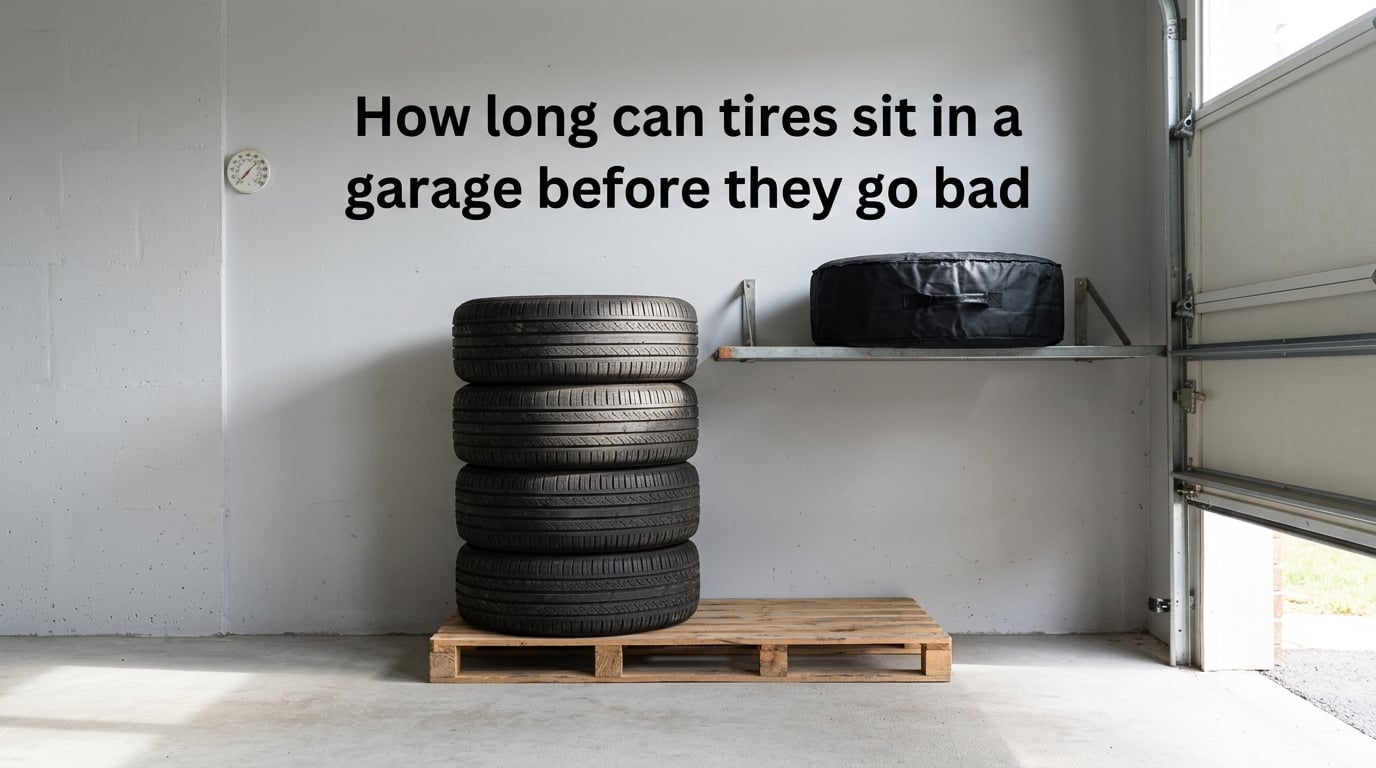
If you just bought a set of tires on sale, parked a classic for the winter, or inherited a car that has been sitting for years, you have probably asked the same question we get every week: how long can tires sit in a garage before they go bad? The short answer is 6 to 10 years in storage, with the NHTSA recommending replacement at 10 years regardless of how the tire looks. The longer answer, the one that keeps you safe on the road, depends on temperature, humidity, ozone, and the three clocks that start the moment a tire stops rolling.
I have been around tires long enough to watch a perfectly treaded 8-year-old tire fail on a freeway on-ramp because the belts separated inside. Tread depth measures how far you have driven, not how old the rubber is. In this guide I will walk you through the exact timeline, the inspection steps, and the storage habits that protect tires sitting in a garage, whether they are on the car or stacked in the corner.
Table of Contents
How Long Can Tires Sit in a Garage Before They Go Bad
The safe storage window for garage-stored tires is 6 to 10 years. The NHTSA and the U.S. Tire Manufacturers Association both cite this range, and most tire shops will refuse to mount a tire older than 10 years regardless of its appearance. Many manufacturers, including Mercedes-Benz, Volkswagen, and Nissan, recommend replacement at 6 years as a more conservative rule.
A garage is one of the better places to store tires because it blocks UV light, the single biggest accelerator of rubber aging. But a garage also traps heat in summer, can hold ozone from electric motors and fluorescent lights, and exposes tires to temperature swings through an uninsulated wall. The 6-to-10-year range assumes a climate that does not punish the rubber. A tire stored in a hot, leaky Southwest garage can show visible dry rot in 2 years. The same tire in a climate-controlled basement can pass inspection at 8 years. Garage conditions matter as much as calendar years.
What “Going Bad” Actually Means for a Stored Tire
“Going bad” is not one condition. It is three independent clocks that start the moment a tire stops rolling, and they can fail separately or together.
The first clock is pressure loss. A stationary tire loses 1 to 3 PSI per month through natural permeation, faster in heat. Underinflation is the leading cause of sidewall flex failure, and a tire sitting flat for months can develop a crease where the rubber folded against the rim.
The second clock is physical deformation. The weight of the vehicle presses the tire into a single contact patch. After about 30 days at the same spot, the sidewall develops a temporary flat spot. After several months, the flat spot becomes permanent as the rubber polymer chains realign.
The third clock is chemical aging. Oxygen, ozone, heat, and UV light attack the rubber polymers and slowly deplete the antioxidants and antiozonants the manufacturer blended into the compound. This is dry rot, and it is the reason a tire with deep tread can still be unsafe at 10 years. Belt separation, the failure mode that causes sudden blowouts at highway speed, is a chemical-aging failure that cannot be seen from outside the tire.
Tread depth tells you mileage wear. The DOT date code tells you calendar age. You need both to judge a tire, and calendar age wins the safety argument every time.
Timeline: How Tires Degrade by Duration
Here is what actually happens week by week and year by year to tires sitting in a garage.
First Two Weeks
Pressure drops noticeably. The tire may look fine on the outside, but it has lost 1 to 2 PSI already. No permanent damage yet, but this is the cheapest moment to top off the pressure and prevent the next stage.
One Month In
Flat spotting starts. The contact patch under the wheel develops a visible flat area when you roll the tire by hand. If you drive the car now, you will feel a thump-thump-thump rhythm for the first few miles until the tire warms and reshapes. The flat spot is usually still recoverable.
Three to Six Months
Ozone cracking begins showing on the sidewall, especially if the garage holds an electric motor, fluorescent fixture, or furnace. Hairline cracks appear first on the sun-facing sidewall, even through a closed garage door if it has windows. The TPMS light often comes on because the pressure has dropped 5 to 15 PSI.
One to Two Years
Visible sidewall cracks spread. The rubber compound hardens as the antioxidants deplete. A fingernail dragged across the sidewall will leave a clear line where it used to bounce back. The tire is still legally usable for another 4 to 8 years, but it has moved firmly into the “inspect every 6 months” category.
Five to Six Years
This is the manufacturer replacement window. Mercedes-Benz, VW, and Nissan recommend replacement at 6 years regardless of tread depth. The U.S. Tire Manufacturers Association backs this as a conservative rule. Even a garage queen tire should be replaced at this point unless you are a vintage collector with annual inspections.
Ten Years and Older
The hard limit. The NHTSA recommends replacement at 10 years from the date of manufacture, regardless of tread depth, storage conditions, or visual appearance. Most tire shops will refuse to mount a tire older than 10 years because of liability. Belt separation risk climbs steeply in this window.
Twenty Years and Older
No. Even a tire that looks pristine on a barn-find car has had two full chemical-aging cycles. Belt separation is a real possibility the first time it sees highway speed. Replace the tires, full stop.
Tires Stored on a Vehicle vs Off a Vehicle
This is the question most articles skip, and it is exactly the question people ask when they say “tires sitting in my garage.” The answer depends on whether the tires are mounted on the car or stored separately.
Tires mounted on a parked car face all three degradation clocks at once. They lose pressure under the vehicle’s weight, flat-spot under the same contact patch for months, and absorb heat from the garage floor and the brake rotors behind them. The big advantage is convenience and the fact that the tires stay sealed against the rim.
Tires stored off the car avoid flat spotting entirely. Stacked upright on a clean surface, sealed in airtight bags, and kept out of direct sunlight, an unmounted tire can outlast a mounted tire by 2 to 3 years in the same garage. The downside is that unmounted tires need more handling and a place to store them.
Either way, the 6-to-10-year calendar limit applies. A tire does not know whether it is on a hub or in a stack. The chemistry is the same.
Heated, Unheated, and Detached Garage Conditions
Not all garages age tires the same way. Here is how the four common garage types compare.
A climate-controlled garage, heated in winter and air-conditioned in summer, holds tires at a steady 50 to 75 degrees Fahrenheit with low humidity. This is the best-case environment and stretches the safe window toward the upper end of the 6-to-10-year range.
An unheated but insulated attached garage stays close to outdoor temperature but blocks direct sun and rain. Daily swings of 10 to 20 degrees are normal. Tires here follow the standard 6-to-10-year timeline.
An unheated, uninsulated attached garage is the most common setup. Summer attic-style heat can push the interior above 100 degrees Fahrenheit. This heat accelerates every clock. Expect visible sidewall cracks by year 5 and replacement planning at year 6.
A detached, uninsulated garage or carport is the harshest. Full temperature swings, possible moisture on the floor, and direct sun through open doors. Tires here can show dry rot in 2 years and should be replaced by year 5 even if they look okay.
Ozone is a hidden hazard in all four. Electric motors, fluorescent light ballasts, and furnace blowers generate ozone that attacks rubber faster than UV does. A garage that runs any of these regularly will age tires faster than one that does not.
Garage Floor Surfaces: Concrete, Asphalt, and Wood
No, a concrete floor will not ruin your tires. This is one of the most common garage myths, and it does not hold up. Concrete is chemically inert against rubber compounds. What concrete does do is wick moisture from the ground in humid climates, which raises the humidity around the tire and slightly accelerates hydrolysis in the rubber.
Asphalt is a different story. Asphalt absorbs and radiates heat. A tire sitting on an asphalt garage floor in summer can see surface temperatures well above 120 degrees. Over months, this radiant heat bakes the bottom of the tire and is one cause of uneven sidewall cracking on the ground-facing side.
Wood pallets or rubber matting under the tire break the contact patch with the floor and let air circulate. They also lift the tire off any standing water or condensation. This is the cheapest garage upgrade you can make for stored tires.
How to Read the DOT Date Code on Your Tires
Every tire sold in the U.S. since 2000 carries a DOT date code on one sidewall. The last four digits are what you need.
Look on the sidewall for “DOT” followed by a string of letters and numbers. Move to the end of that string. The last four digits are the date code. The first two digits are the week of the year, from 01 to 52. The last two digits are the year. So a tire marked 3419 was made in week 34 of 2019, the last full week of August 2019.
Tires made before 2000 use a three-digit code. The first two digits are the week, and the third digit is the year within a decade. A code of 348 means week 34 of 1988 or 1998. If your tire has only three digits, it is at least 25 years old and should not be on a car.
Some tires also show a separate date stamp on the inner sidewall that is only visible after dismounting. Either stamp is valid for the age check.
Sidewall Crack Severity Scale: Cosmetic vs Structural
Not every crack means replace the tire. Here is the scale I use when I inspect a stored tire.
Stage 1, cosmetic crazing, is a network of fine surface lines that look like the tire has been dry for too long. They do not catch a fingernail dragged across them. These are age marks, not failure marks. Inspect again in 6 months.
Stage 2, light cracking, is single cracks you can feel with a fingernail but not catch under the nail. The rubber still has flex memory. These tires are usable but on the clock. Inspect every 3 months and replace at the 10-year mark no matter what.
Stage 3, structural cracking, is when a fingernail catches in the crack and you can feel depth. Cracks that run radially across the sidewall are worse than circumferential cracks around the bead. Replace the tire now, regardless of age.
Stage 4, exposed casing, is when cracks reach the steel belts or polyester ply. The tire may still hold air, but it is structurally compromised. Replace immediately and do not drive on it.
Inspection Checklist Before Driving Tires That Sat
Run through this list before you put a stored car back on the road or mount a set of tires that have been waiting on a shelf.
- Check cold pressure on every tire and inflate to the door-jamb placard PSI.
- Visually inspect both sidewalls for cracks, bulges, and embedded debris.
- Measure tread depth at the center, both shoulders, and both inner edges with a tread depth gauge.
- Look for flat spots by rolling the tire slowly and watching the profile.
- Inspect the DOT date code and replace anything 10 years or older.
- Check the spare, including full-size spares, which often outlast the road tires.
- Reset the TPMS by driving above 25 mph for 10 minutes; replace any sensor battery that does not hold a charge.
- Test drive at low speed in a parking lot before any highway use.
If any single check fails, take the tire to a professional before driving on it.
Storage Best Practices for Garage-Stored Tires
These habits slow all three clocks and extend the safe window toward the upper end of the 6-to-10-year range.
Seal unmounted tires in airtight plastic bags or dedicated tire totes. This blocks ozone, the most aggressive indoor rubber attacker. The bags cost almost nothing and add 2 to 3 years of usable life in most garages.
Store unmounted tires upright, never hung from the center hole. Hanging stretches the bead. Stack mounted tire-and-wheel assemblies no more than four high and rotate the stack monthly so the bottom tires do not deform under load.
Keep tires away from electric motors, fluorescent lights, welding equipment, and furnace blowers. These all produce ozone that ages rubber faster than sunlight.
Avoid direct sunlight through windows or open doors. UV is the most visible aging factor and the easiest to block with a curtain or shade.
Maintain steady temperature if possible. A garage that stays between 40 and 80 degrees year-round is far kinder to tires than one that swings from 30 to 110 degrees with the seasons.
If the tires are mounted on the car, inflate to the placard pressure, move the car a few inches forward every month to shift the flat spot, and consider jack stands for storage longer than 6 months. Jack stands take the weight off the tires entirely.
Frequently Asked Questions
How long are tires good for if kept in the garage?
Tires stored in a garage typically last 6 to 10 years. The NHTSA recommends replacement at 10 years regardless of tread depth, while the U.S. Tire Manufacturers Association suggests a more conservative 6-year rule. Climate-controlled garages extend the window, and hot or ozone-exposed garages shorten it.
Is it okay to store tires in an unheated garage?
Yes, an unheated but dry and shaded garage is one of the better places to store tires. The key is to keep them out of direct sunlight, away from ozone sources like electric motors and fluorescent lights, and sealed in airtight bags. Uninsulated garages that reach over 100 degrees in summer will shorten tire life noticeably.
Can 20 year old tires still be good?
No. A 20-year-old tire has gone through two full chemical-aging cycles and is well past the 10-year NHTSA replacement limit, even if the tread looks deep and the sidewalls look clean. Belt separation can happen without warning. Replace tires that are 20 years old regardless of appearance.
Will tires dry rot in storage?
Yes, tires will eventually dry rot in storage because oxygen, ozone, and heat attack the rubber polymers even when the tire is not being driven. A garage blocks UV, which is the biggest accelerator, but does not block ozone from electric motors or heat from an uninsulated roof. Visible dry rot can appear in 2 years in a hot garage or take 8 to 10 years in a cool, climate-controlled one.
Are 10 year old tires safe if stored in the garage?
A 10-year-old tire is at the NHTSA replacement limit and most tire shops will refuse to mount it regardless of how it looks. If the tread is still deep and the sidewalls are crack-free, the tire has performed well, but belt separation risk climbs steeply past year 10. Replace it now to stay on the safe side of the consensus.
How long can a car sit before tires get flat spots?
Flat spots start forming at about 30 days under the same contact patch. They are usually temporary at first and round out after a few miles of driving. After 6 months or more, flat spots become permanent as the rubber polymers realign. Moving the car a few inches forward every month or storing it on jack stands prevents permanent flat spotting.
When to Replace Garage-Stored Tires
Tires sitting in a garage can stay safe for 6 to 10 years, and a well-stored set can stretch toward the upper end of that range. The decision comes down to two numbers: the DOT date code on the sidewall and the cracks you can see with your own eyes. If the date code is past 10 years, replace the tire no matter how it looks. If you see cracks that catch a fingernail, replace the tire no matter how new it is. Everything in between is judgment, and judgment gets safer when you check the date code, inspect the sidewalls, and trust the 6-year conservative rule from the U.S. Tire Manufacturers Association over the 10-year NHTSA hard limit.
If your garage-stored tires are past their safe window, our team at american-tire.com carries a full range of replacement tires from every major manufacturer, and we can ship them straight to your door. Browse our tire catalog and we will help you find the right fit for the car you are putting back on the road.