
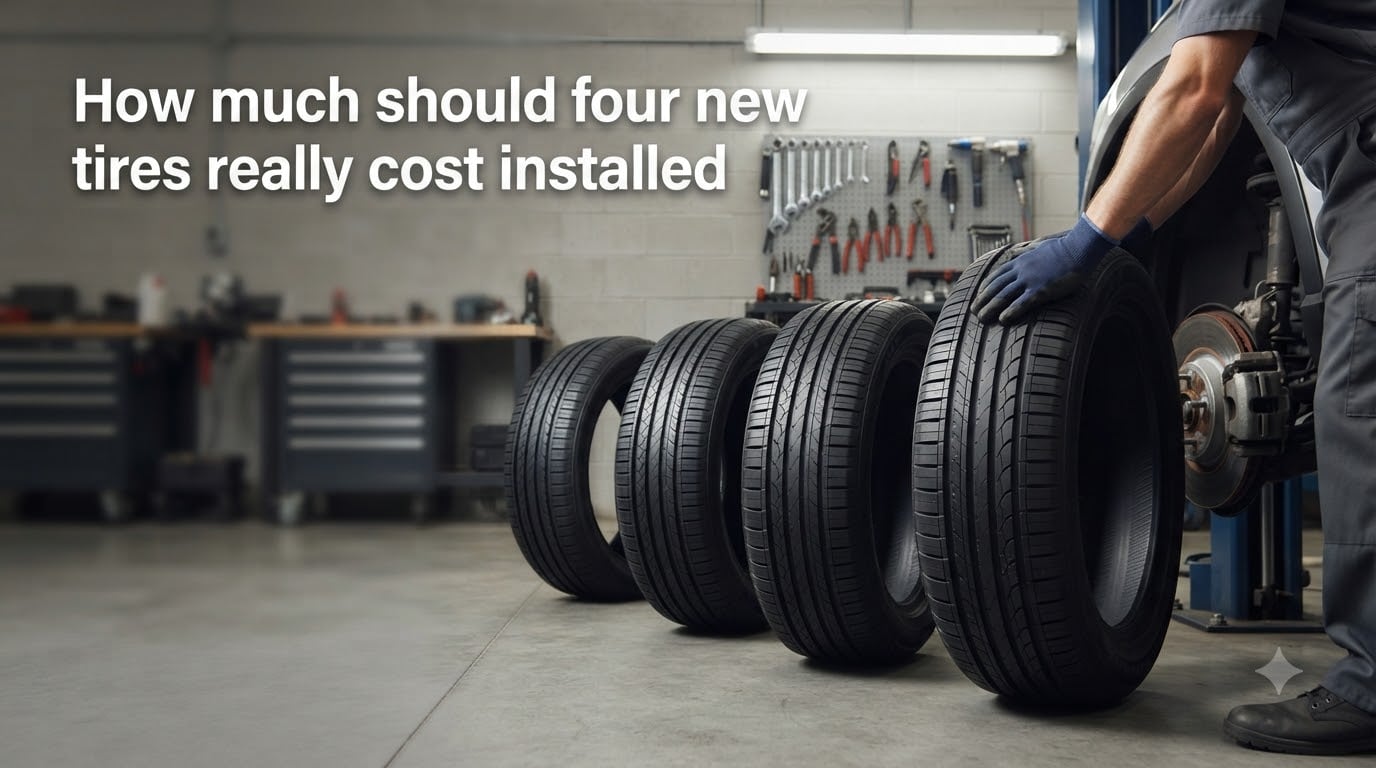
If you’re staring at worn tread and wondering how much four new tires really cost installed, here’s the straight answer: most drivers pay between $400 and $1,500 for a full set of four tires installed, with the typical sedan owner landing somewhere around $600 to $900. The wide range comes down to what you drive, what kind of tires you buy, and where you have them mounted.
I’ve spent weeks pulling together real-world pricing from major retailers, tire makers, and service shops to build this guide. My goal: give you a genuine cost benchmark so you can walk into a tire shop knowing what a fair price looks like and where the upsells hide. Whether you drive a compact sedan, a family SUV, or a half-ton truck, the numbers below reflect what informed buyers are paying in 2026.
Table of Contents
How Much Should 4 New Tires Cost Installed?
A set of four new tires installed typically costs between $400 and $1,500, with most passenger vehicles landing in the $600 to $900 range once you include mounting, balancing, and valve stems. Here’s how that breaks down by common scenario:
- Sedan with budget all-season tires: $400 to $600 installed
- Sedan with mid-tier all-season tires: $600 to $900 installed
- SUV or crossover with all-season tires: $700 to $1,100 installed
- Light truck with all-terrain tires: $900 to $1,500 installed
- Performance car with summer or ultra-high-performance tires: $1,000 to $2,000+ installed
- EV with low-rolling-resistance tires: $800 to $1,400 installed
That installed price covers the tires themselves, mounting on your wheels, computerized wheel balancing, new rubber valve stems, and old-tire disposal at most shops. Where the surprises happen is in what isn’t included: TPMS sensor replacement, road hazard warranties, alignments, and shop supply fees can quietly add another $50 to $300 to your final bill.
The big drivers of price are tire type (a set of premium performance tires can cost three times what a budget set does), wheel size (larger diameter tires cost more), and vehicle class (truck and SUV tires carry heavier load ratings that bump up the price). Where you buy also matters; installation packages at Costco, Discount Tire, Walmart, and online retailers like Tire Rack differ in what’s bundled and how transparent the final pricing is.
Quick cost reference
For a single tire, expect to pay $50 to $300 for the rubber itself, plus $15 to $50 per tire for mounting, balancing, and basic install services. Multiply by four and the math gets you to the totals above. Specialty tires (run-flat, ultra-high-performance, heavy-duty truck) push the per-tire number to $400 or more, which is why some drivers see quotes well above $2,000 for a full set.
Cost Breakdown by Tire Type
The single biggest factor in your final bill is what kind of tire you buy. All-season, performance, winter, and all-terrain tires aren’t just different in grip and tread; they occupy entirely different price tiers. Here’s what each category typically runs per tire and for a full set of four:
All-season tires
All-season tires are the workhorse for most passenger vehicles, and they cover the widest price spread. Budget all-season tires from brands like Cooper, Kumho, or General Tire start around $50 to $90 each, putting a full set at roughly $200 to $360 before installation. Mid-tier options from Continental, Toyo, or Yokohama run $90 to $160 per tire ($360 to $640 for the set). Premium all-season tires from Michelin, Bridgestone, or Goodyear sit between $160 and $250 each, or $640 to $1,000 for four.
For an average commuter sedan, expect to land on a mid-tier all-season tire installed for about $700 to $1,000. That’s the sweet spot for tread life (50,000 to 70,000 miles on most premium all-season tires) and year-round usability in moderate climates.
Performance and ultra-high-performance tires
Performance tires trade tread life for grip and handling. Summer performance tires from Continental ExtremeContact or Michelin Pilot Sport start around $150 to $200 per tire, with ultra-high-performance versions reaching $300 to $450 each. For a sports sedan or sporty coupe, a quality summer performance set runs $700 to $1,200 just for the tires, and the bill climbs from there once you add installation.
Max-performance summer tires (the kind designed for cars like the BMW M3 or Chevrolet Corvette) push into $400 to $700 per tire territory. A complete set on a high-performance car can easily cross $2,500 installed when you factor in larger wheel diameters, softer compounds, and the shorter lifespan that comes with sticky rubber.
Winter tires
Winter tires are specialty products with deeper tread blocks and rubber compounds that stay flexible in freezing temperatures. Studless winter tires from Michelin X-Ice, Bridgestone Blizzak, or Continental VikingContact run $130 to $250 each, with a full set landing between $520 and $1,000 before installation. Studded winter tires add another $20 to $50 per tire for the studs themselves.
Most drivers who run dedicated winter setups buy a second set of wheels to make seasonal swaps easier. If you factor in a basic steel wheel package ($50 to $80 per wheel from online retailers), a complete winter tire and wheel package runs $800 to $1,400 for most sedans and small SUVs.
All-terrain and mud-terrain tires
All-terrain tires are popular on trucks and SUVs for their blend of on-road manners and off-road capability. Popular options from BFGoodrich, Toyo, and Falken run $180 to $300 each, putting a full set for a half-ton truck at $720 to $1,200. More aggressive mud-terrain tires designed for serious off-road use push into $250 to $400 per tire, and a complete set can exceed $1,600.
All-terrain tires also wear faster than highway tires (typically 40,000 to 50,000 miles), so the total cost of ownership is higher than the sticker suggests. Factor that in if you’re comparing all-terrain tires against a higher-mileage highway option.
Run-flat tires
Run-flat tires let you drive a short distance after a puncture, which is why many new BMW, Mercedes-Benz, and Mini models come with them from the factory. The trade-off is cost: run-flat tires typically run $200 to $400 each, and replacement sets often hit $1,000 to $1,800 before installation. Replacing run-flats with standard tires is sometimes possible (and cheaper), but check with the manufacturer because not all vehicles support that switch.
Fuel-efficient and low-rolling-resistance tires
Low-rolling-resistance tires, designed to squeeze more miles out of each tank, have become popular with hybrids and EVs. Major options from Michelin (Energy Saver), Continental (EcoContact), and Goodyear (Assurance Fuel Max) run $120 to $220 per tire, putting a full EV-sized set around $700 to $1,200 installed. The fuel savings are real but modest; most drivers see a 1 to 3 percent improvement in fuel economy.
Cost Breakdown by Vehicle Type
Your vehicle plays a major role in what you’ll pay because tire size, load rating, and drivetrain all influence pricing. A 17-inch all-season tire for a Honda Civic is half the cost of a 20-inch performance tire for a Ford Explorer. Here are realistic examples by category to anchor your expectations:
Compact and midsize sedans
For something like a Honda Civic, Toyota Camry, or Mazda 3 with 16 to 17 inch wheels, you’re typically looking at all-season tires in the $80 to $160 per tire range. A full mid-tier set installed usually runs $500 to $800 once you add mounting, balancing, valve stems, and disposal. Budget tires can bring the total closer to $400; premium tires push it toward $900 or $1,000.
SUVs and crossovers
Crossovers and small SUVs (Honda CR-V, Toyota RAV4, Ford Escape) wear 17 to 19 inch tires, and load ratings tend to be higher than sedan equivalents. A mid-tier all-season set installed typically runs $700 to $1,100. Larger three-row SUVs (Chevy Tahoe, Ford Expedition) with 20 to 22 inch wheels can easily push past $1,200 for the full set installed, especially if you want premium touring tires.
Light trucks
Half-ton pickups like the Ford F-150, Chevy Silverado, and Ram 1500 use heavy-duty tire sizes that cost more per tire. A set of highway-terrain tires installed runs $900 to $1,400 depending on brand and size. All-terrain and off-road tires push the total to $1,200 to $1,800. Heavy-duty three-quarter and one-ton trucks can run higher still because of the load range E or F tires they require.
Sports cars and performance vehicles
Sports cars typically wear staggered setups (wider tires in back than front) and run-flat or ultra-high-performance compounds. A set of summer performance tires for a rear-wheel-drive sports car runs $1,000 to $2,000 before installation. Once you add mounting, balancing, and disposal, the total frequently exceeds $1,300 to $2,500 installed.
Electric vehicles
EVs need tires rated for the extra weight of their battery packs and designed to maximize range. Many EVs (Tesla Model 3, Model Y, Hyundai Ioniq 5, Ford Mustang Mach-E) use 19 to 21 inch low-rolling-resistance tires in the $180 to $320 per tire range. A set installed on a typical EV runs $900 to $1,400, with some larger-rim EV models reaching $1,800 or more.
Installation Fees and What’s Included
Installation is where a lot of confusion happens, because different shops bundle different services. Here’s what a standard tire installation actually includes and what you should expect to pay for each component:
- Mounting: Removing old tires and putting new ones on your wheels. $5 to $15 per tire.
- Wheel balancing: Spinning each wheel on a balancer and adding small weights to eliminate vibration. $10 to $20 per tire.
- New valve stems: Replacing the rubber stems that seal air in the tire. $2 to $10 per tire.
- Tire disposal: Hauling away and recycling your old tires. $2 to $10 per tire.
- Road force balancing (optional upgrade): A more precise balancer that simulates driving weight. $10 to $25 per tire.
Most shops bundle all of those into a flat per-tire installation fee of $15 to $50. Bigger per-tire installations at dealerships ($40 to $80 per tire) usually include road force balancing and more frequent rotation services. Independent shops and warehouse clubs often quote the lower end of the range and unbundle optional add-ons.
What installation doesn’t include
Standard installation does not include a wheel alignment, TPMS sensor replacement, brake inspection, or suspension work. Those are separate services that many shops will recommend when you’re already in for new tires because it’s a convenient time to do them. Whether you need them depends on your vehicle, driving habits, and how the old tires wore.
Tire rotation is typically a free lifetime service at most tire retailers (Discount Tire, Costco, America’s Tire). It involves moving tires between positions (front to back, side to side) to extend overall tread life. If a retailer offers free rotations for the life of the tires, that’s a meaningful perk on top of the install price.
Hidden Fees and Add-On Charges to Watch For
One of the most common pain points in tire buying is the gap between the quoted price and the final bill. Drivers in our research routinely reported surprises of $50 to $200 in unexpected fees. Knowing the line items ahead of time is the best defense. Here’s what’s often added and when those charges are actually warranted:
TPMS sensor replacement
Tire Pressure Monitoring System (TPMS) sensors live inside the wheel and report pressure to your dashboard. They have non-replaceable batteries that last about 5 to 10 years. When you mount new tires, the shop often recommends replacing the sensors, which runs $40 to $80 per sensor. For a set of four, that adds $160 to $320 to your bill.
If your vehicle is over 7 years old or the sensors are original, replacement is a fair recommendation. If the car is newer and the sensors are recent, you can usually skip this. Ask your shop how old the existing sensors are and whether they’re transmitting correctly before agreeing.
Shop supplies and environmental fees
Some shops add small line items labeled “shop supplies” or “environmental fees,” usually $5 to $20 total. These cover things like cleaning solvents, tire shine, and disposal of waste materials. They aren’t huge in dollar terms, but they signal a shop that’s nickel-and-diming. A reputable shop rolls those costs into their standard pricing.
Road hazard warranty
A road hazard warranty covers tire damage from potholes, nails, glass, and other road debris. Costs range from $10 to $25 per tire ($40 to $100 for the set) and covers repair or replacement within a set time or mileage window. Whether it’s worth it depends on your roads and driving. If you commute on rough urban streets, road hazard is often worth the price. If you mostly drive smooth highways, it’s a tougher sell.
Wheel alignment recommendation
An alignment adjusts the angles of your wheels so they meet the road correctly. It’s not part of tire installation, but shops often recommend it when you get new tires. Cost is typically $80 to $150. If your old tires wore evenly, you can probably skip it. If they showed uneven wear (cupping, feathering, or one-sided wear), an alignment is a smart move.
New tire pressure sensors and nitrogen fill
Some shops push nitrogen tire fills as a premium service ($5 to $10 per tire). The benefit is minor: nitrogen leaks more slowly than regular air, so your tire pressure stays more stable over time. The trade-off is that topping off at any gas station requires finding a nitrogen source, which isn’t always convenient. Free air is fine for most drivers.
Where to Buy Tires: Retailer Comparison
Where you buy affects not only the per-tire price but also what’s bundled into installation. Here are the major channels and what each typically offers:
Costco Tire Center
Costco is widely considered one of the best values for tire installation. Their per-tire prices are competitive, and installation includes mounting, balancing, new valve stems, disposal, and lifetime rotation and balancing. Members also get road hazard protection included for the life of the tire. The catch: you need a Costco membership, and wait times for installation appointments can be long.
A typical Costco installation for a set of mid-tier all-season tires on a sedan lands around $700 to $900 out the door. For non-members, the membership fee erases some of the savings.
Discount Tire (and America’s Tire)
Discount Tire runs one of the largest tire installation networks in the country. Their per-tire prices are competitive, and they include mounting, balancing, valve stems, and disposal in their installation package. Road hazard protection is available but not always included. Like Costco, they offer free lifetime rotation and balancing on installed tires.
Discount Tire typically matches competitor pricing, which makes it easy to combine a manufacturer’s rebate with their installation package. A mid-tier all-season set installed typically runs $700 to $1,000 once you account for fees.
Walmart Auto Care Centers
Walmart offers competitive tire pricing and installation in most of its Auto Care Centers. Their per-tire installation fee is often lower than dealership pricing ($15 to $30 per tire), and they include mounting, balancing, valve stems, and disposal. Road hazard warranty is optional. Walmart’s biggest advantage is convenience: most locations have appointments available within a few days.
The trade-off is selection; Walmart stocks fewer premium brands and size options than specialty retailers. For common sizes on mainstream vehicles, Walmart is usually a solid choice at a competitive price.
Local independent tire shops
Independent shops vary widely in price and service quality. The best ones match big-box pricing while offering more flexible scheduling and personal advice. The worst ones push unnecessary add-ons and charge hidden fees. Ask neighbors, check reviews, and get itemized quotes before committing.
A quality independent shop can install a set of mid-tier tires for $600 to $900 on a sedan, often with more flexibility on tire brand and selection than the big chains.
Dealerships
Dealerships typically charge 20 to 50 percent more for tire installation than independent shops, sometimes $40 to $80 per tire in labor alone. The advantages: technicians trained on your specific vehicle, OEM tire options matched to factory specs, and warranty-friendly service on leased or certified pre-owned vehicles.
For drivers under warranty or those with vehicles that require specific tire certifications (some performance cars, EVs with range requirements), the dealership can be the right call. For everyone else, the premium rarely justifies the result.
Online retailers (Tire Rack, Discount Tire Direct, Amazon)
Online retailers often beat in-store pricing on the tires themselves, sometimes by 20 to 40 percent. The catch: you need to arrange installation separately. Most online retailers ship to a local installer they partner with, and installation fees are added at the point of service.
Tire Rack, Discount Tire Direct, and SimpleTire all offer shipping to a network of installers. Total cost including installation is often comparable to or slightly lower than big-box retailers, especially on premium tire brands.
Online vs In-Store Tire Purchasing
Buying tires online is almost always cheaper on the per-tire sticker price, but the experience is different from buying in-store. Here are the trade-offs to weigh:
Advantages of online tire buying
The biggest advantage is price: online retailers have lower overhead than physical stores and pass that savings on. Selection is also broader. Tire Rack carries dozens of brands and hundreds of models including sizes and specs that most local shops don’t stock. Customer reviews tend to be more detailed and uniform than in-store recommendations.
Drawbacks of online tire buying
The downsides are logistics and post-purchase support. If a tire arrives damaged, you deal with shipping claims rather than a face-to-face return. Warranty claims go through the manufacturer (which is true of all tire purchases) and may require documentation shipping. Installation scheduling requires more legwork since you’re coordinating between the online retailer and a separate installer.
For drivers who value hands-on service and easy returns, in-store purchasing is still the better fit. For drivers who know exactly what they want and want to save $20 to $50 per tire, online purchasing is hard to beat.
How to Save Money on New Tires
New tires aren’t optional, but there are legitimate ways to keep costs down without sacrificing safety or quality. Here’s what actually works:
Shop manufacturer rebates
Major tire makers (Michelin, Goodyear, Bridgestone, Continental, Cooper) run rebate promotions several times a year, typically $40 to $100 off a set of four. Rebates usually align with spring and fall seasonal changeovers. Check manufacturer websites directly; the rebate terms sometimes disqualify online orders or specific retailers, so read the fine print.
Buy during seasonal sales
The best tire prices typically appear in early April (spring changeover) and early October (winter changeover). Retailers clear inventory to make room for the next season’s selection. Black Friday tire deals are also common and often combine with manufacturer rebates.
Use price matching
Most big-box tire retailers (Costco, Discount Tire, Walmart, Sam’s Club) will match a competitor’s price if you show them a quote. Get itemized written quotes from at least two retailers before purchasing, and bring the lower quote to your preferred installer to negotiate.
Consider mid-tier brands
Mid-tier tire brands (Continental, Toyo, Yokohama, General Tire, Cooper) deliver roughly 90 percent of the performance of premium brands at 60 to 75 percent of the price. For daily commuting and family vehicles, the difference is rarely noticeable. Save premium brands for performance cars, EVs, or drivers who rack up serious mileage.
Skip unnecessary add-ons
Road hazard warranty, nitrogen fills, TPMS sensor replacement on relatively new vehicles, and shop supplies fees can add $200 to $400 to a tire bill. Push back politely but firmly when these are presented as required. Most are optional, and the add-on pressure is the most common source of buyer’s remorse in tire shopping.
Get an alignment only if needed
Wheel alignment is a smart service when it’s needed, but the need is real only when your old tires showed uneven wear, your vehicle was in an accident, or you’ve hit a major pothole. If your old tires wore evenly across the tread, you can usually skip the alignment.
Consider used or retreaded tires for short-term use
Used tires are widely available and cost 30 to 60 percent less than new ones. The trade-off is unpredictable remaining tread life and no meaningful warranty. They’re an option for tight budgets or short-term use, but new tires are the safer long-term choice. Retreaded tires are common on commercial trucks but rare and less reliable on passenger vehicles.
When to Replace All Four Tires
Most vehicles should replace tires as a full set of four to maintain consistent traction, handling, and braking. There are a few exceptions, but understanding when you need all four helps you avoid both premature replacement and unsafe mismatched setups.
Tread depth tells the story
Tread depth is the most reliable indicator that it’s time. New tires start at about 10/32 inch tread. The legal minimum in most states is 2/32 inch. Most tire makers recommend replacement at 4/32 inch or earlier, especially in wet climates, because stopping distances and hydroplaning resistance drop sharply below that threshold.
The penny test is a quick check: insert a penny into the tread with Lincoln’s head facing down. If you can see the top of Lincoln’s head, your tread is below 2/32 inch and replacement is overdue. For a more accurate reading, a dedicated tread depth gauge costs a few dollars and gives clear measurements.
Age matters even if tread looks fine
Tire rubber breaks down with age, even on vehicles that aren’t driven much. Most manufacturers recommend replacing tires every 6 to 10 years regardless of tread depth. The DOT date code on the sidewall (last four digits show week and year of manufacture) tells you how old the tire actually is.
Spare tires age on the same clock. Check the date code on your spare as well; tires older than 10 years shouldn’t be relied on for emergency use.
Visible damage is a deal-breaker
Sidewall bulges, deep cuts, exposed steel belts, or punctures larger than a quarter inch mean the tire needs to be replaced regardless of tread. Driving on a damaged tire is a safety risk, and the failure can cause a loss of vehicle control.
AWD and 4WD vehicles typically need all four
All-wheel-drive and four-wheel-drive vehicles are sensitive to differences in tire diameter between axles. Mismatched tires can strain the transfer case, differentials, or center clutch, leading to repairs costing $1,500 to $4,000. If you drive an AWD or 4WD vehicle, replacing tires as a full set of four is strongly recommended.
For two-wheel-drive vehicles, replacing two tires at a time is acceptable as long as the new tires match the existing pair in brand, model, size, and tread depth. Mount the new tires on the rear axle for better stability, especially in wet conditions.
Frequently Asked Questions
How much does it cost to mount and balance 4 tires?
Mounting and balancing for four tires typically costs $60 to $200 total, or $15 to $50 per tire at most shops. This is included in the installation package at retailers like Costco, Discount Tire, and Walmart. Road force balancing, a more precise version that simulates driving weight, adds another $10 to $25 per tire.
Are tires cheaper at Costco or Discount Tire?
Per-tire pricing at Costco and Discount Tire is usually within $5 to $15 of each other on the same brand and model. Both include mounting, balancing, valve stems, disposal, and lifetime rotation. Costco adds road hazard protection at no extra cost for members, while Discount Tire charges separately for it. For non-members, Discount Tire typically wins on total cost.
Is it cheaper to buy tires online and have them installed locally?
Buying tires online can save $20 to $50 per tire on the rubber itself, but shipping and local installation fees often erase part of the savings. After installation, the total is usually similar to or slightly lower than buying in-store. The online route pays off most on premium brands or less common sizes where local pricing is higher.
How much do tires cost for a truck?
A set of four tires for a light-duty truck (Ford F-150, Chevy Silverado, Ram 1500) typically costs $700 to $1,400 for the tires alone, or $900 to $1,600 installed with mounting, balancing, and disposal. All-terrain and off-road tires push the total toward $1,200 to $1,800 installed. Heavy-duty three-quarter-ton and one-ton trucks run higher because of load range E or F tire requirements.
Do dealerships charge more for tire installation?
Dealerships typically charge 30 to 60 percent more for tire installation than independent shops or tire retailers. Per-tire installation at dealerships often runs $40 to $80, putting a full set of four at $160 to $320 just for labor. The premium covers OEM-trained technicians and warranty-friendly service, but most drivers can get equivalent installation at independent shops for $80 to $200 total.
How long do new tires last?
Most all-season passenger tires last 40,000 to 70,000 miles, with premium brands typically reaching the higher end. Performance tires last 20,000 to 40,000 miles due to softer compounds. Winter tires last 30,000 to 50,000 miles if used only in winter months. Tire lifespan depends heavily on driving habits, road conditions, tire rotation frequency, and proper inflation.
What is included in tire installation?
Standard tire installation includes removing old tires, mounting new tires on your wheels, computerized wheel balancing, new valve stems, proper inflation, and old-tire disposal. It does not include wheel alignment, TPMS sensor replacement, brake service, or suspension work. Some retailers bundle road hazard warranty or lifetime rotation into the installation package.
Is it OK to replace only 2 tires?
On two-wheel-drive vehicles, replacing two tires at a time is usually fine if the new tires match the existing pair in brand, model, size, and tread depth. Mount the new tires on the rear axle for better stability and wet-weather handling. On all-wheel-drive and four-wheel-drive vehicles, replacing all four tires at once is strongly recommended to avoid strain on drivetrain components, which can cause repairs costing $1,500 to $4,000.
Final Thoughts on Tire Replacement Costs
Knowing how much four new tires should cost installed puts you in a strong negotiating position and helps you spot when a quote is padded. For most passenger vehicles, a fair installed price on a quality mid-tier all-season tire lands between $700 and $1,000 out the door. Below $500 total usually means very budget-tier tires or a shop cutting corners on installation. Above $1,500 typically means premium tires, large wheel diameters, or a vehicle with specialty requirements.
Before you commit, get itemized quotes from at least two retailers, ask what’s included in the installation package, and push back on add-ons you don’t need. A few minutes of comparison shopping is the single most effective way to lower your final bill without giving up safety or quality. Use this guide as your benchmark, and you’ll walk into your next tire purchase with realistic expectations and a clear picture of what a fair deal looks like in 2026.